

About this worksheet
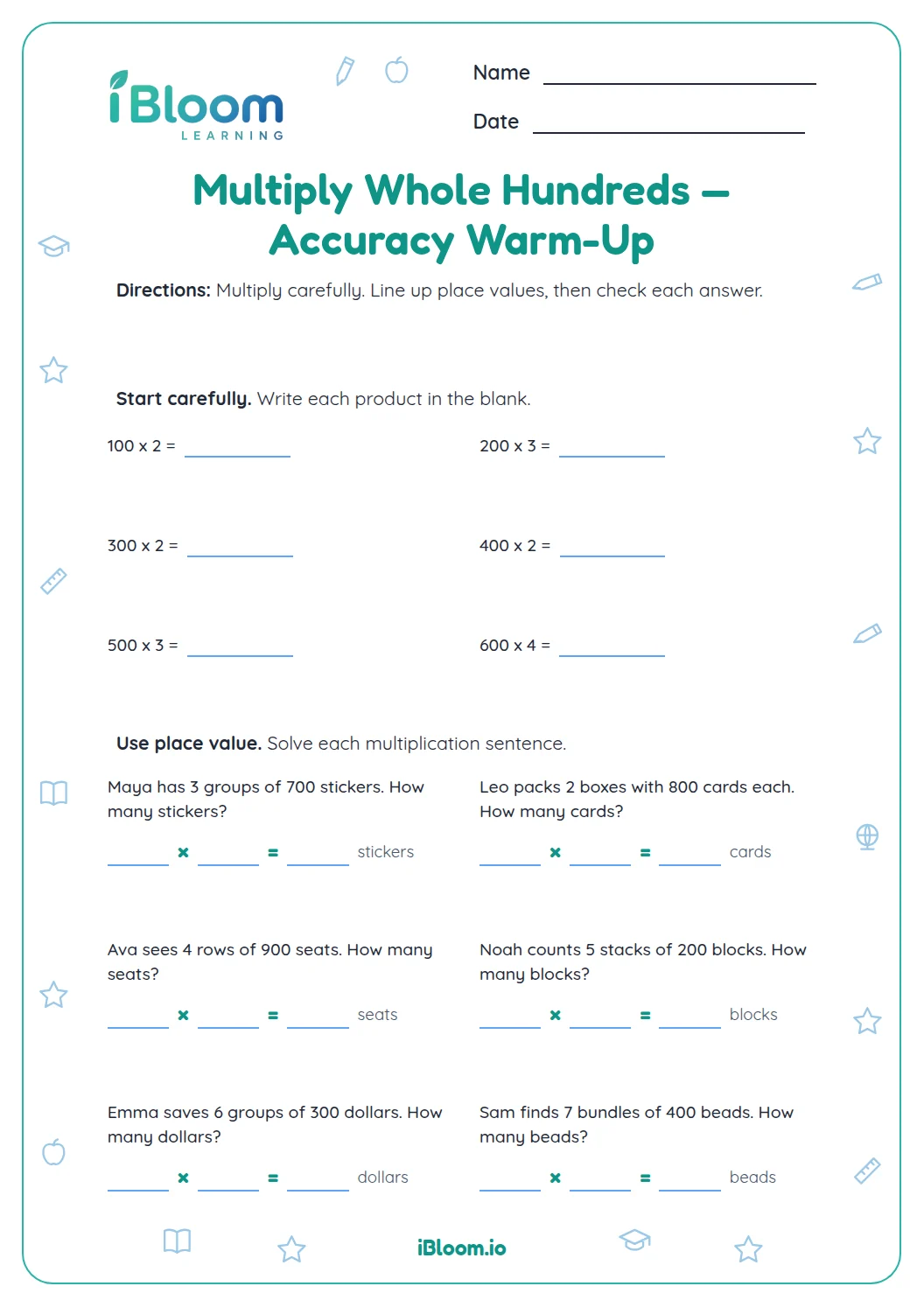
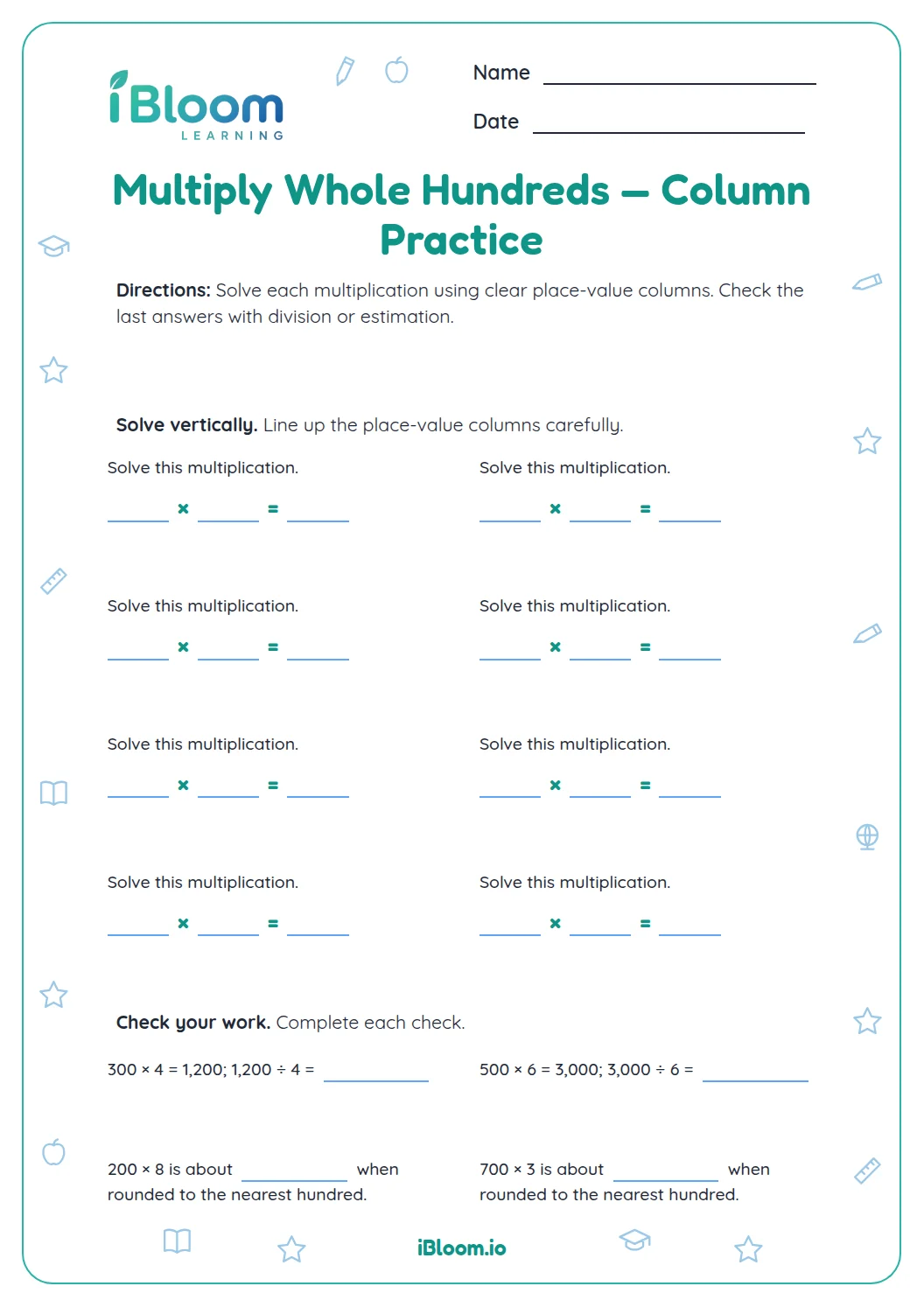
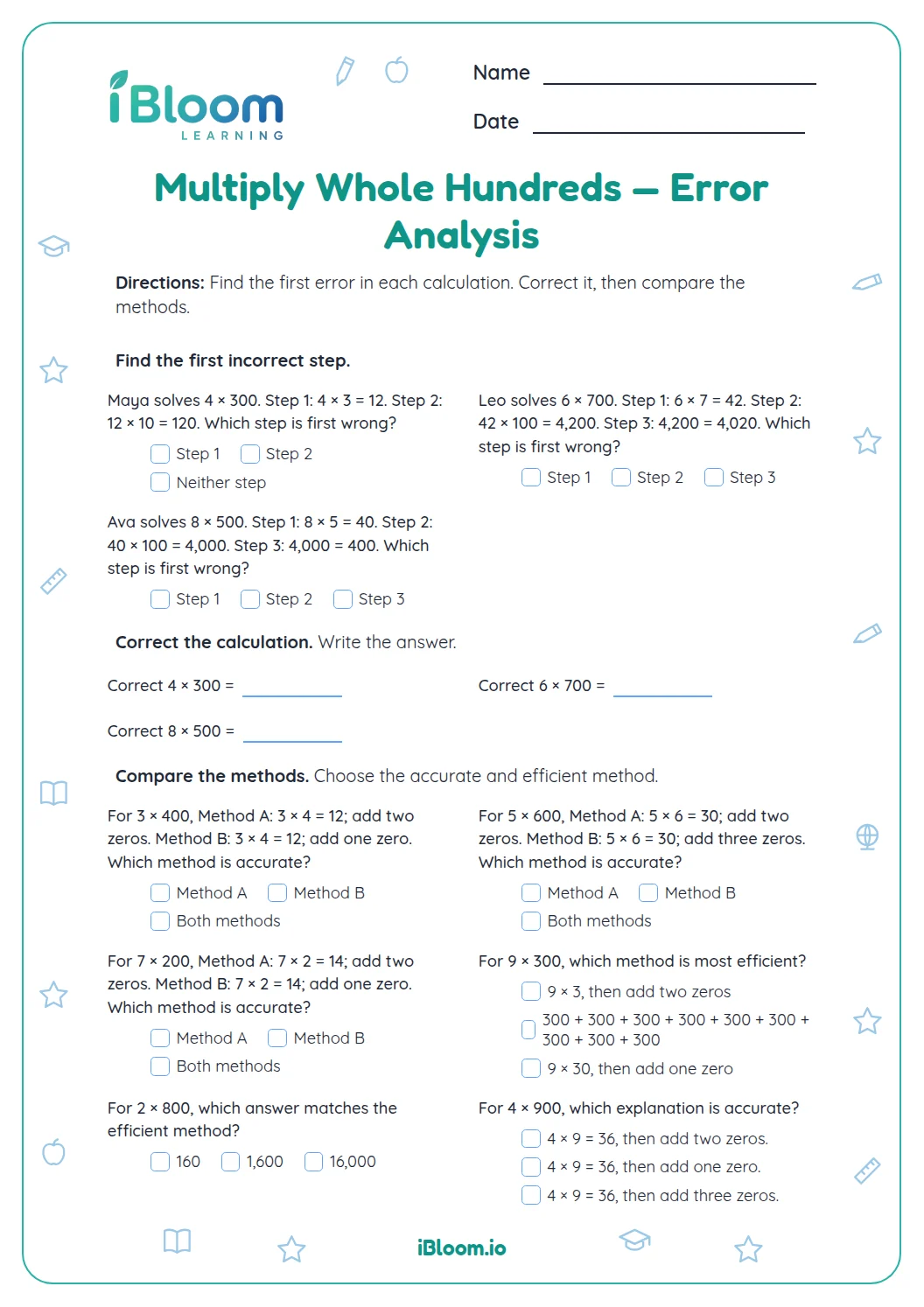
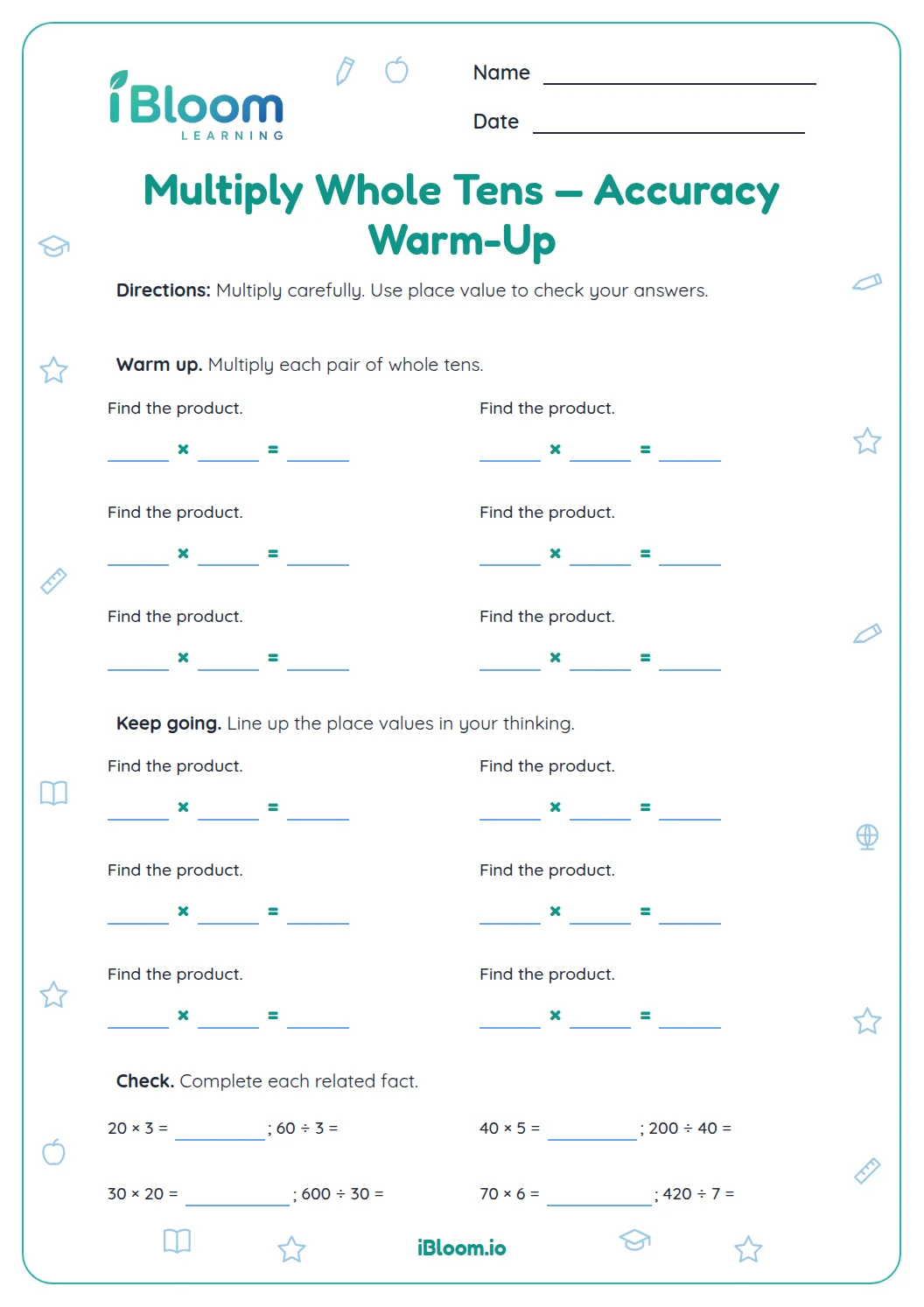
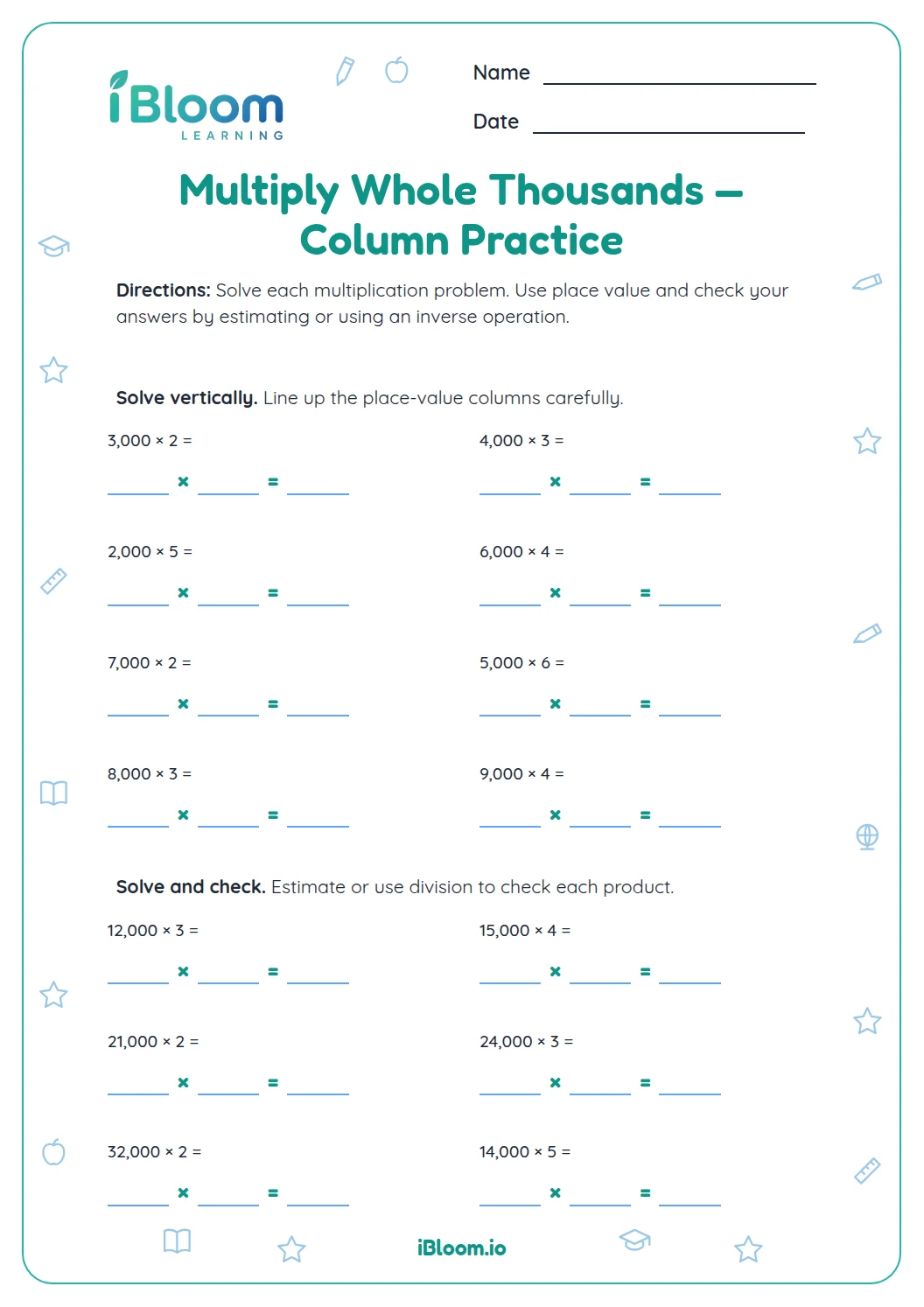
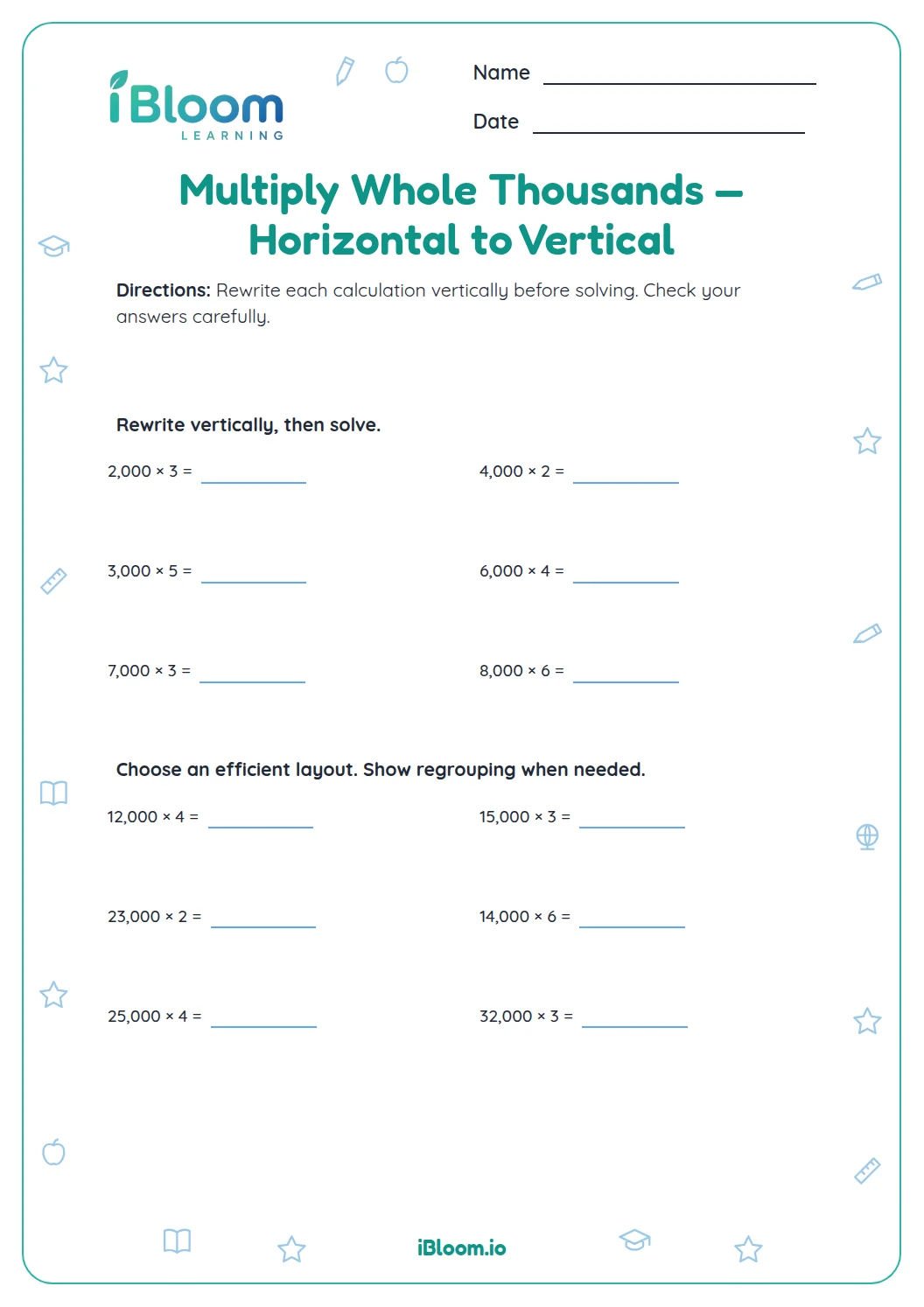
This printable multiplication drill focuses on multiplying whole hundreds by one-digit numbers. It starts with direct products, then asks children to find missing factors, solve two equal-group word problems, and explain how the zeros relate to multiplication by hundreds. The 16 questions progress from computation to reasoning while keeping every factor and product a whole number. It aligns with Common Core 4.NBT.B.5, which includes multiplying a multi-digit whole number by a one-digit number using place-value strategies.
Aligned to 4.NBT.B.5
What does a whole-hundred factor mean?
In 300 × 4, the 300 is 3 hundreds. Four groups of 3 hundreds make 12 hundreds, or 1,200. Multiplying the nonzero digits first helps keep track of the place value.
- 1300 × 4
- 23 hundreds × 4 = 12 hundreds
- 312 hundreds = 1,200
How do you find a missing factor?
Use the known product to reverse the multiplication. For question 7, 2,800 is 28 hundreds. Divide 28 by 4 to find 7, so the missing factor is 7. Check: 7 × 400 = 2,800.
How can you check whether a product makes sense?
Estimate with the nonzero digits and then restore place value. Since 4 × 8 = 32, 4 × 800 should be 32 hundreds, or 3,200. An answer of 320 would be ten times too small.
How to use this worksheet
- 1Multiply the nonzero digits first.
- 2Name the unit in the factor: 3 hundreds, 7 hundreds, and so on.
- 3Convert the result from hundreds back into a whole number.
- 4For missing factors, divide the product by the known factor.
- 5Write an equation for each word problem before solving.
- 6Check the number of zeros against the hundreds in the factor.
Common mistakes and quick fixes
The mistake
Dropping a zero and writing 300 × 4 = 12.
The fix
Say “12 hundreds” and write 1,200.
The mistake
Adding zeros without multiplying the nonzero digits.
The fix
Compute 3 × 4 first, then interpret 12 as hundreds.
The mistake
Reversing the factors in a missing-factor equation incorrectly.
The fix
Substitute the answer back into the original equation to check.
Common Core alignment
This worksheet gives children focused practice with the standard below.
Multiply a whole hundred by a one-digit factor using place value.
On this sheet: Children multiply whole hundreds by one-digit whole numbers and explain products with place value.
Show the official wordingHide the official wording
Multiply a whole number of up to four digits by a one-digit whole number, and multiply two two-digit numbers, using strategies based on place value and the properties of operations. Illustrate and explain the calculation by using equations, rectangular arrays, and/or area models.
What to practice next
Make more practice
Further reading
Questions parents and teachers ask
Why does 300 × 4 equal 1,200?
The factor 300 means 3 hundreds. Four groups of 3 hundreds make 12 hundreds, and 12 hundreds is 1,200. The child can multiply 3 by 4 first, name the result as hundreds, and then write the matching whole number.
How can I check a missing factor?
Substitute the missing factor into the original equation and multiply to see whether the product matches. For example, 7 × 400 gives 2,800, so 7 works in the missing-factor question. This reverse check helps distinguish the number of groups from the size of each group.
Are there word problems on this sheet?
Yes. Two questions use equal groups of cards and beads. Each has working space for writing the multiplication and product. Encourage the child to identify the number of groups and the number in each group before choosing which factors to multiply.
Does the worksheet include an answer key?
Yes. The separate key gives products, missing factors, word-problem calculations, and sample reasoning responses. For explanation questions, accept wording that correctly describes multiplying the nonzero digits and interpreting the result in hundreds. Ask the child to name the hundreds in the result and match them to the original factor.
What does the answer key show for the explanations?
The key gives sample explanations for the two written-response questions. For 9 × 500, a correct explanation connects 9 × 5 = 45 to 45 hundreds, or 4,500. For 4 × 800, it identifies 3,200 as 32 hundreds and confirms the product is reasonable.