
About this worksheet
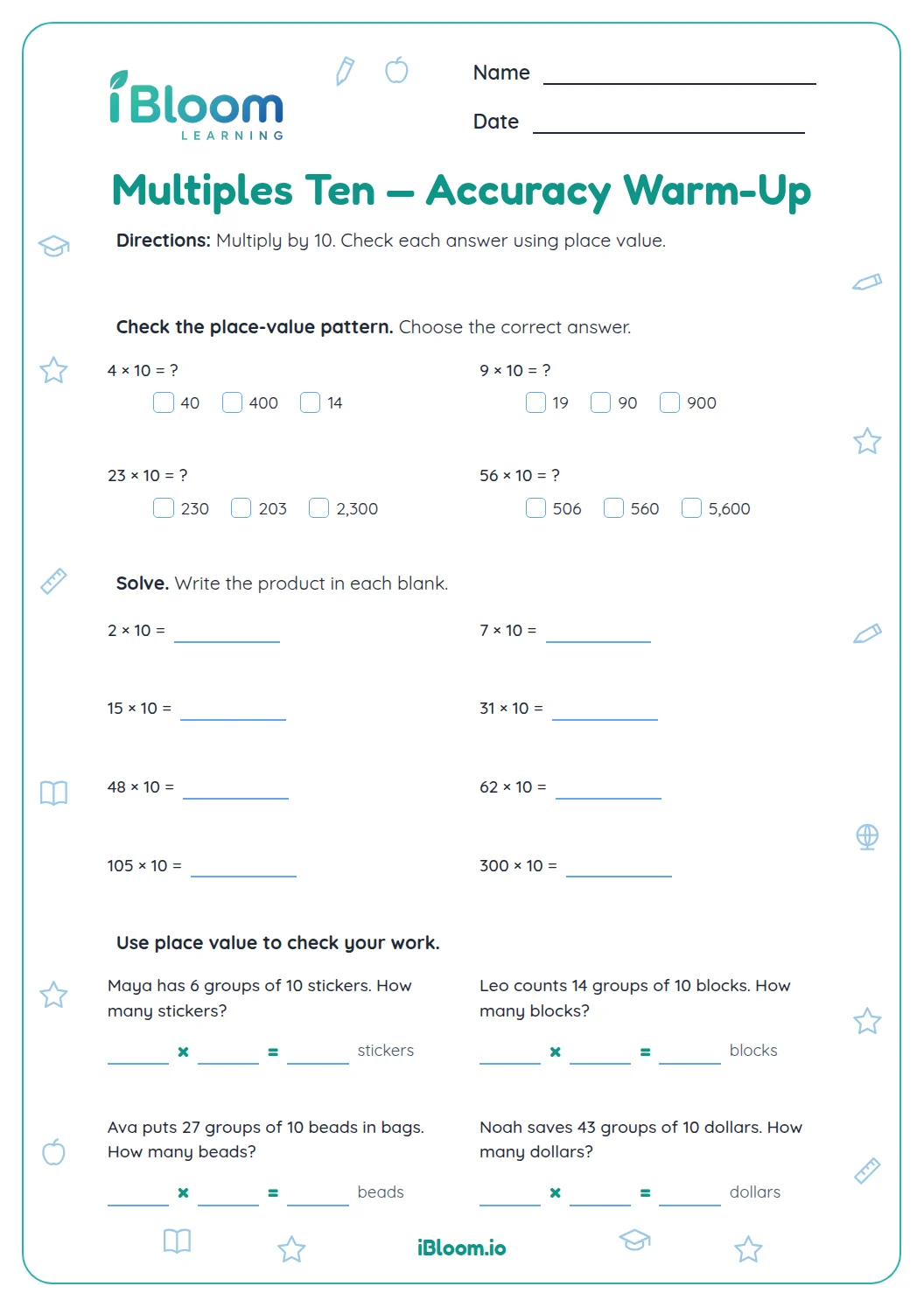
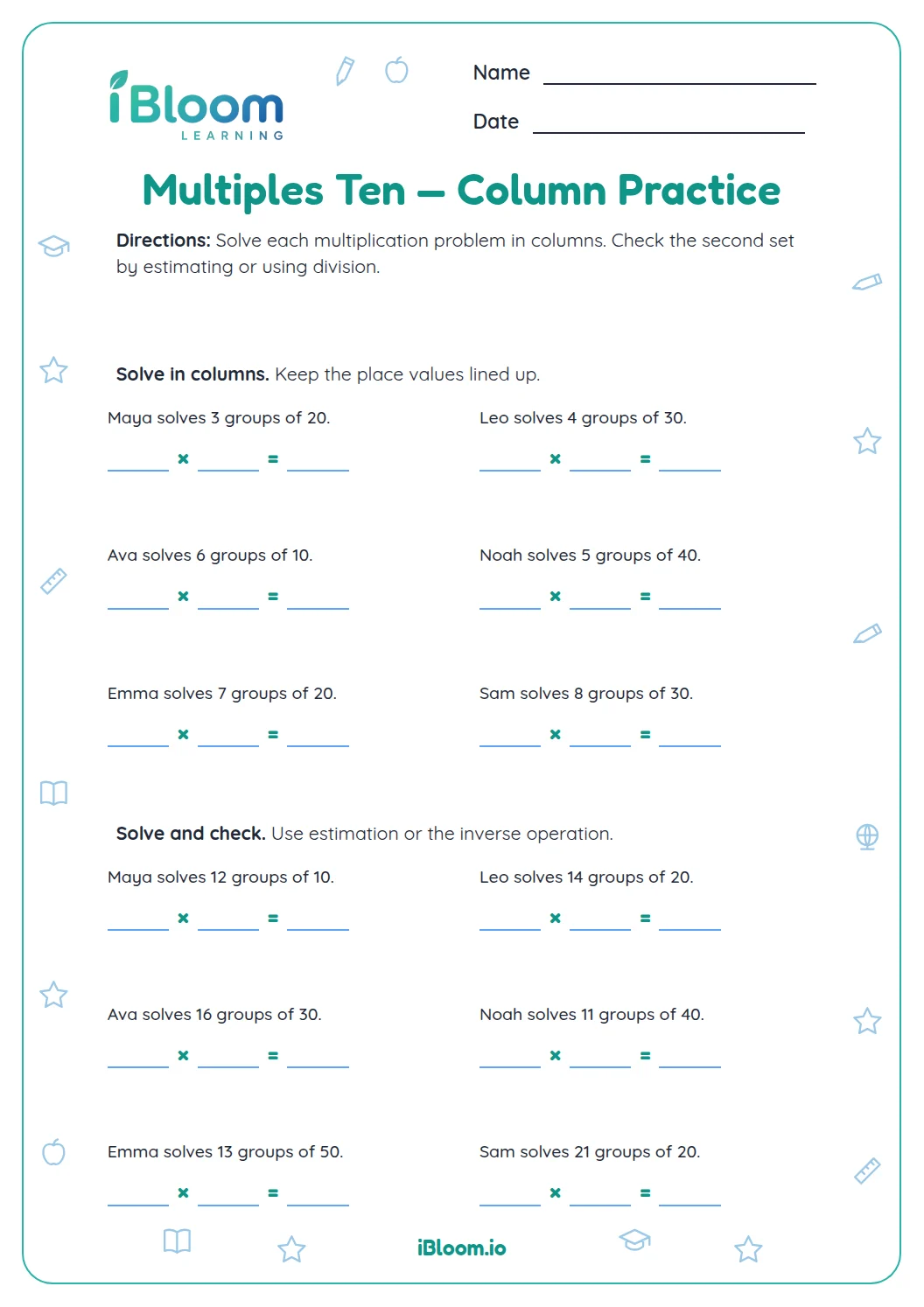
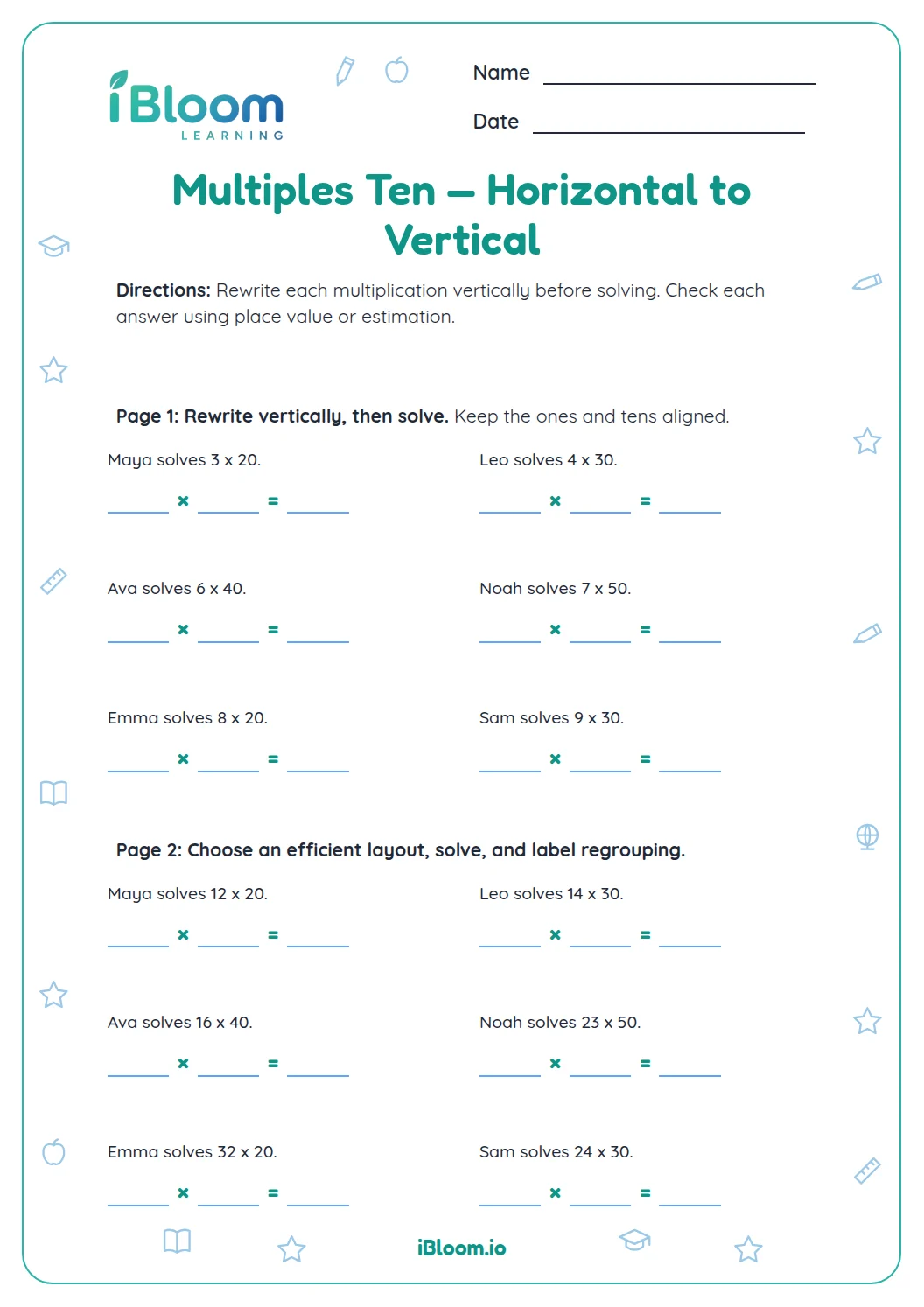
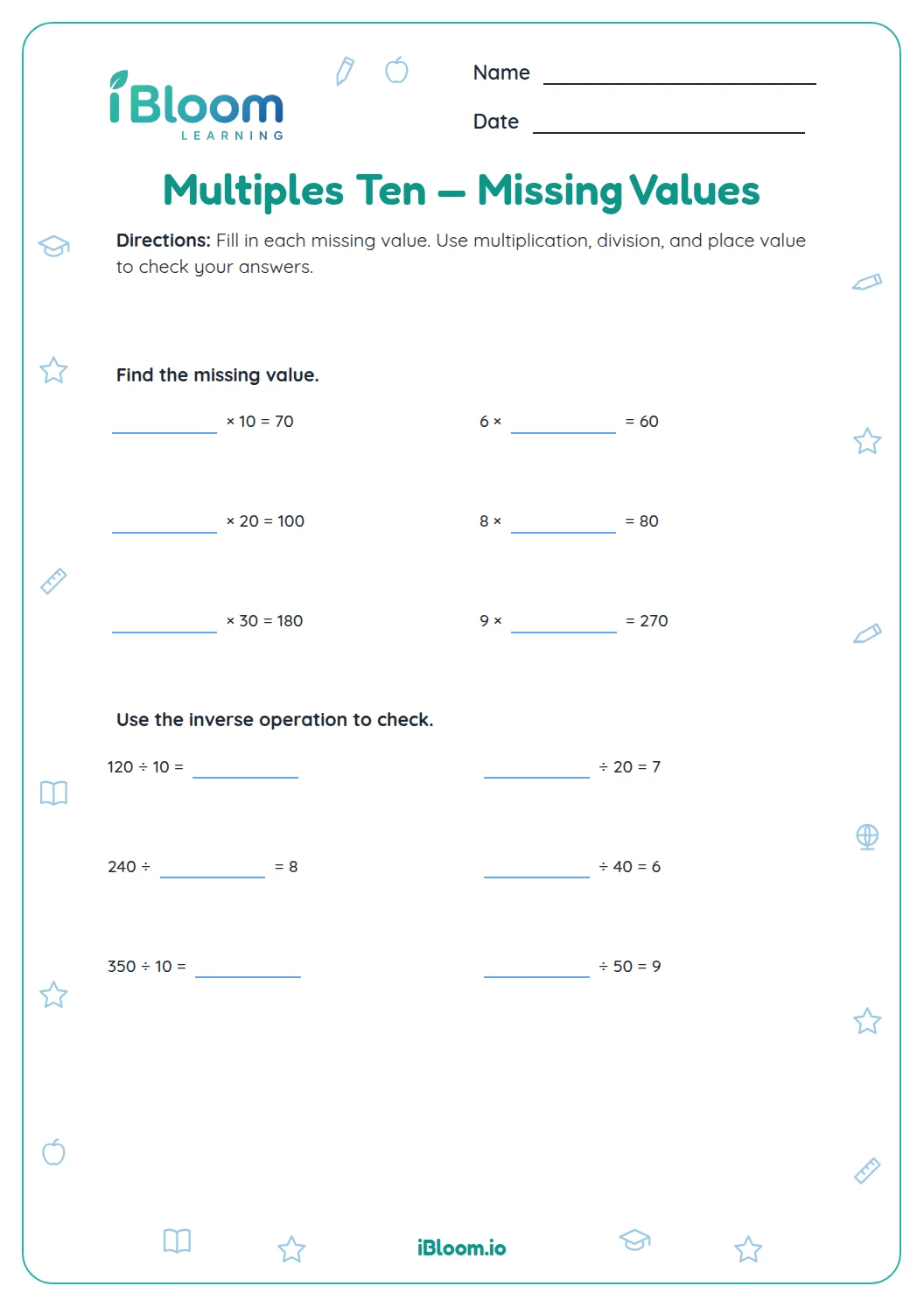
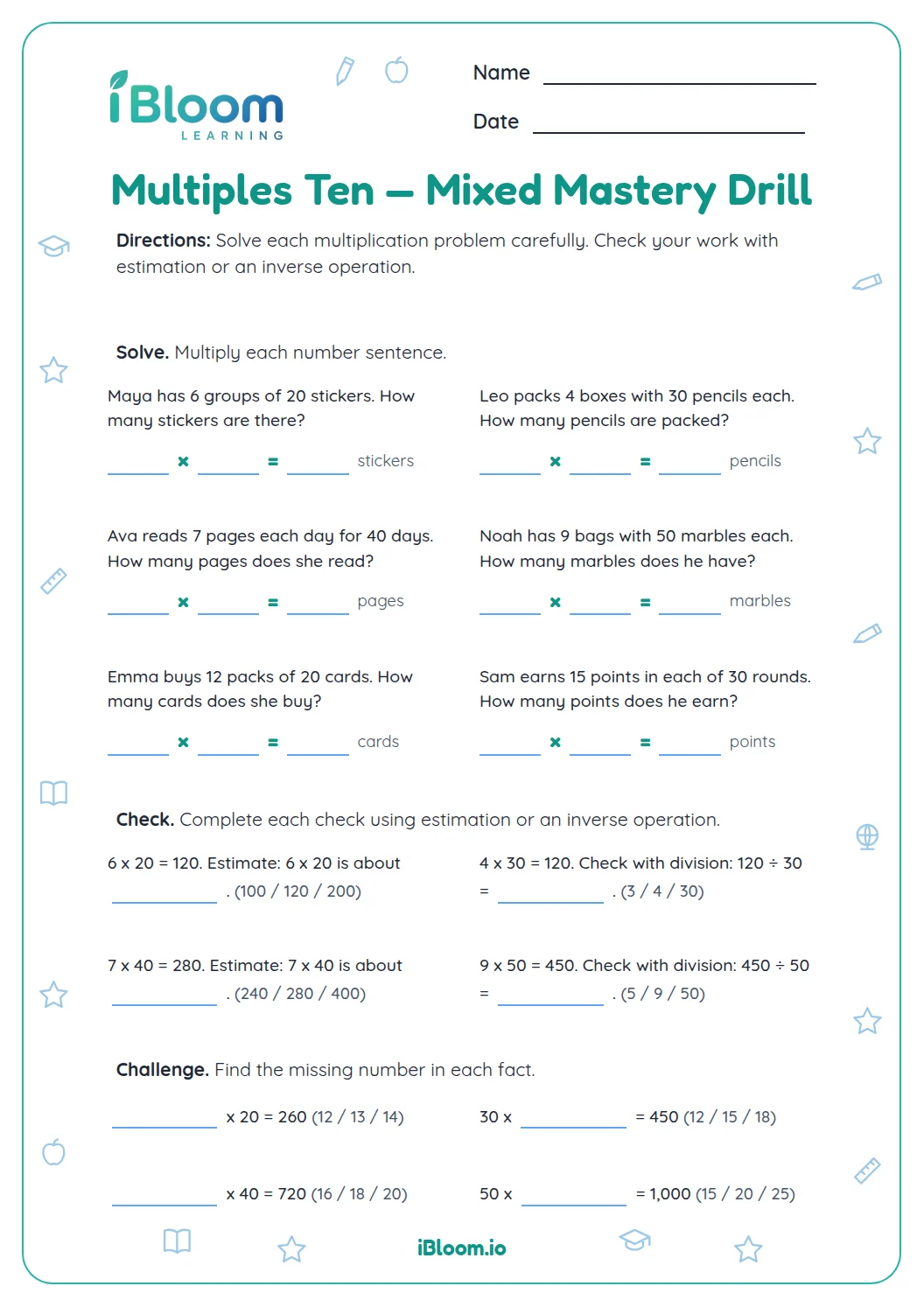
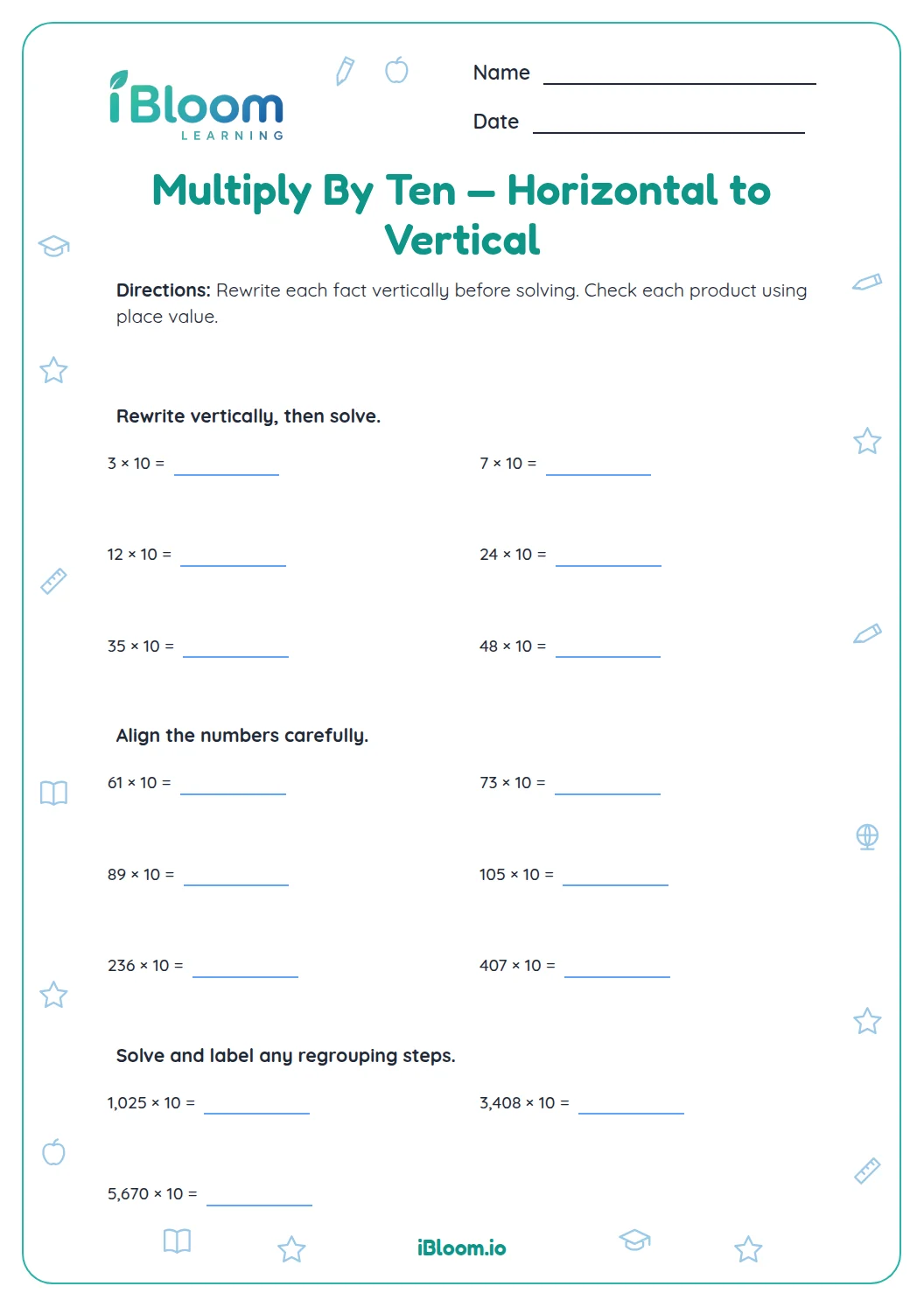
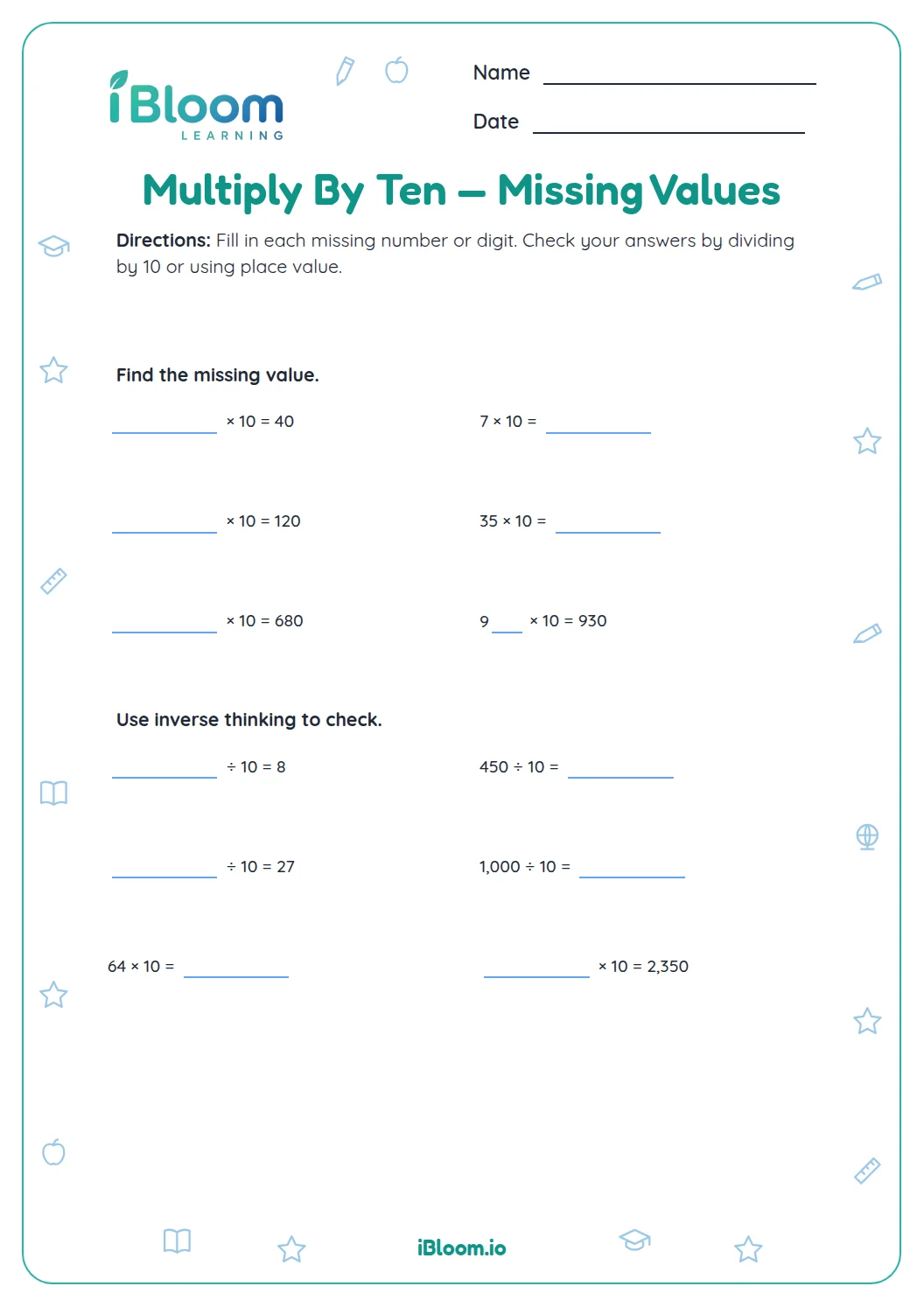
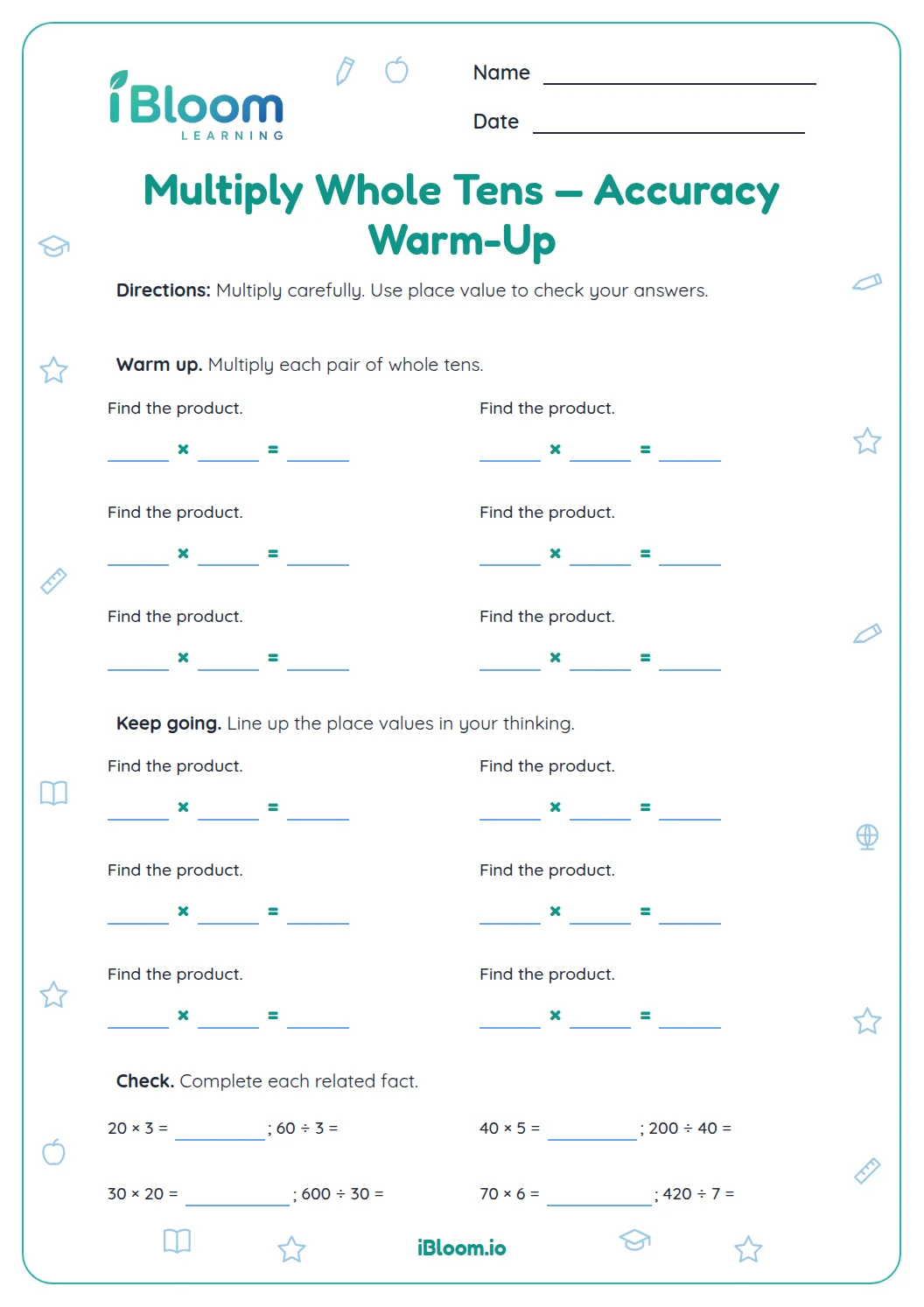
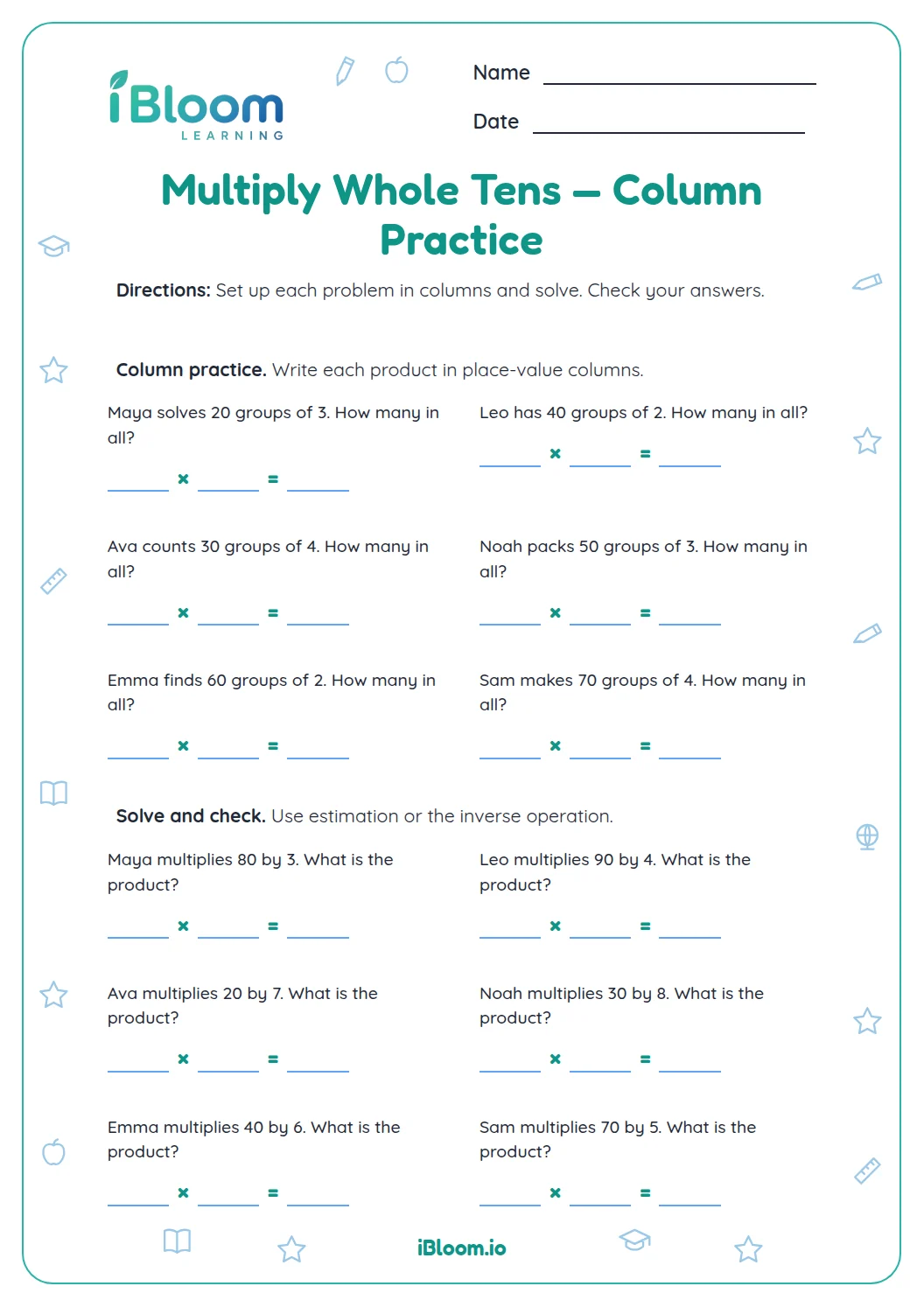
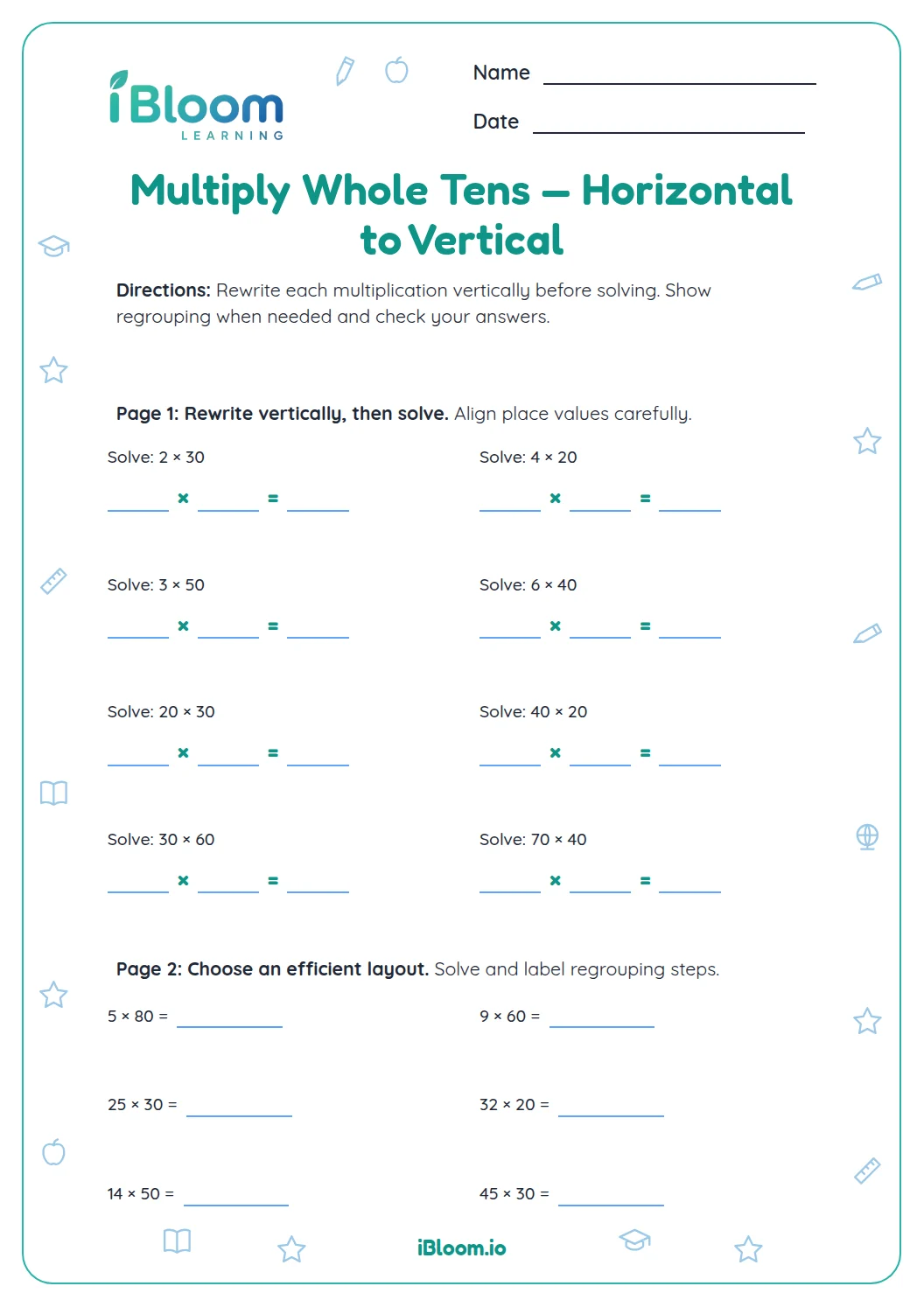
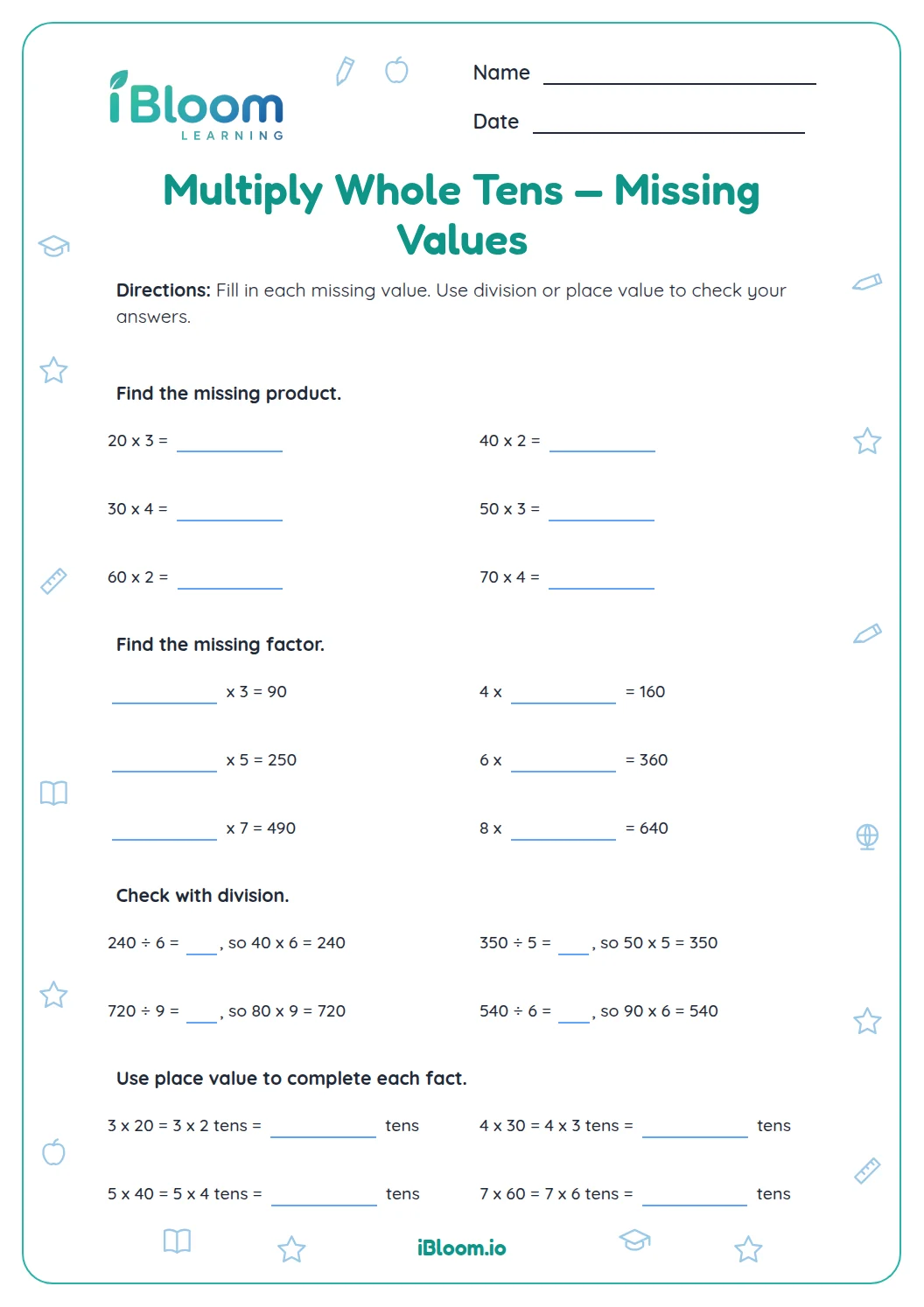
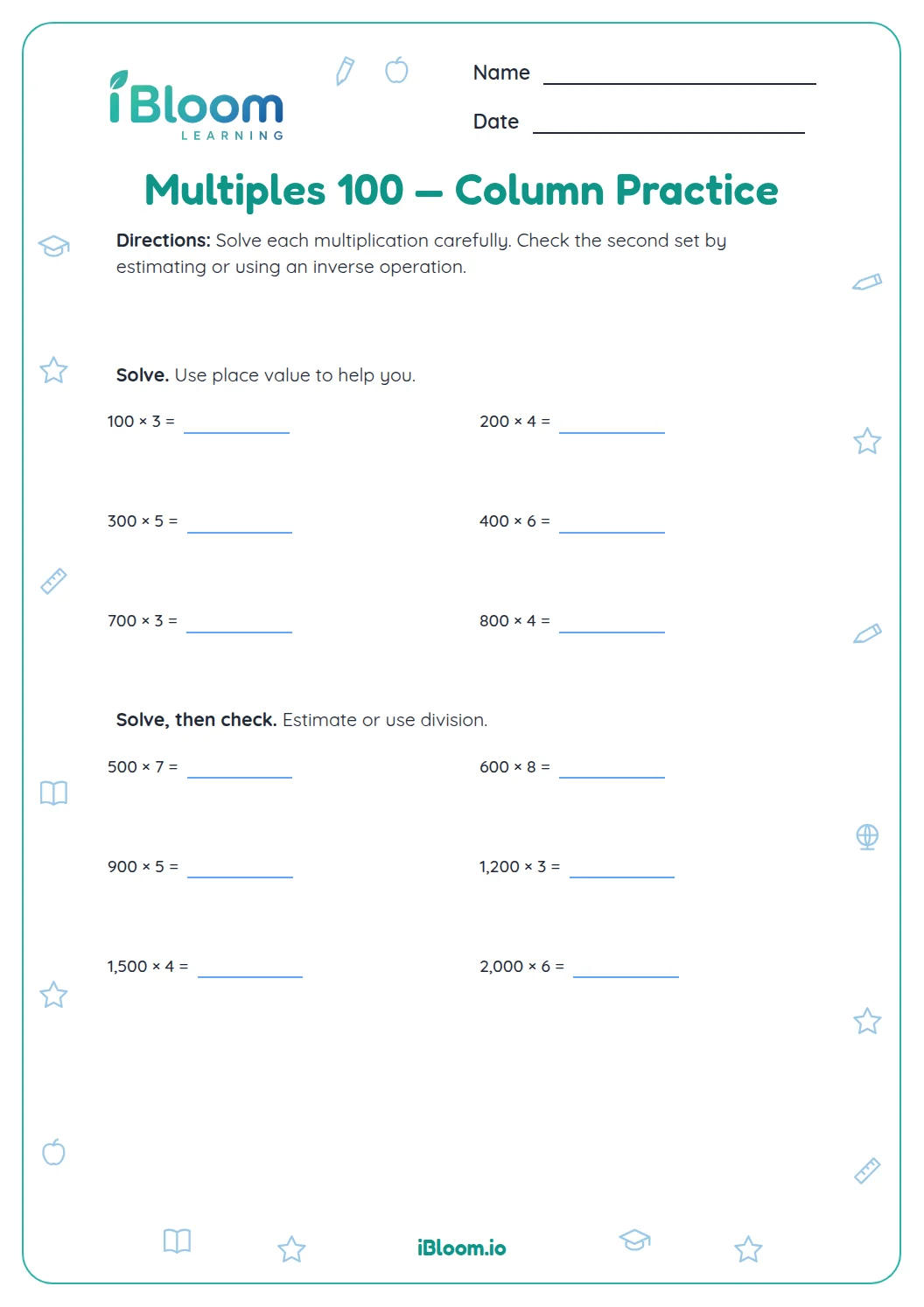
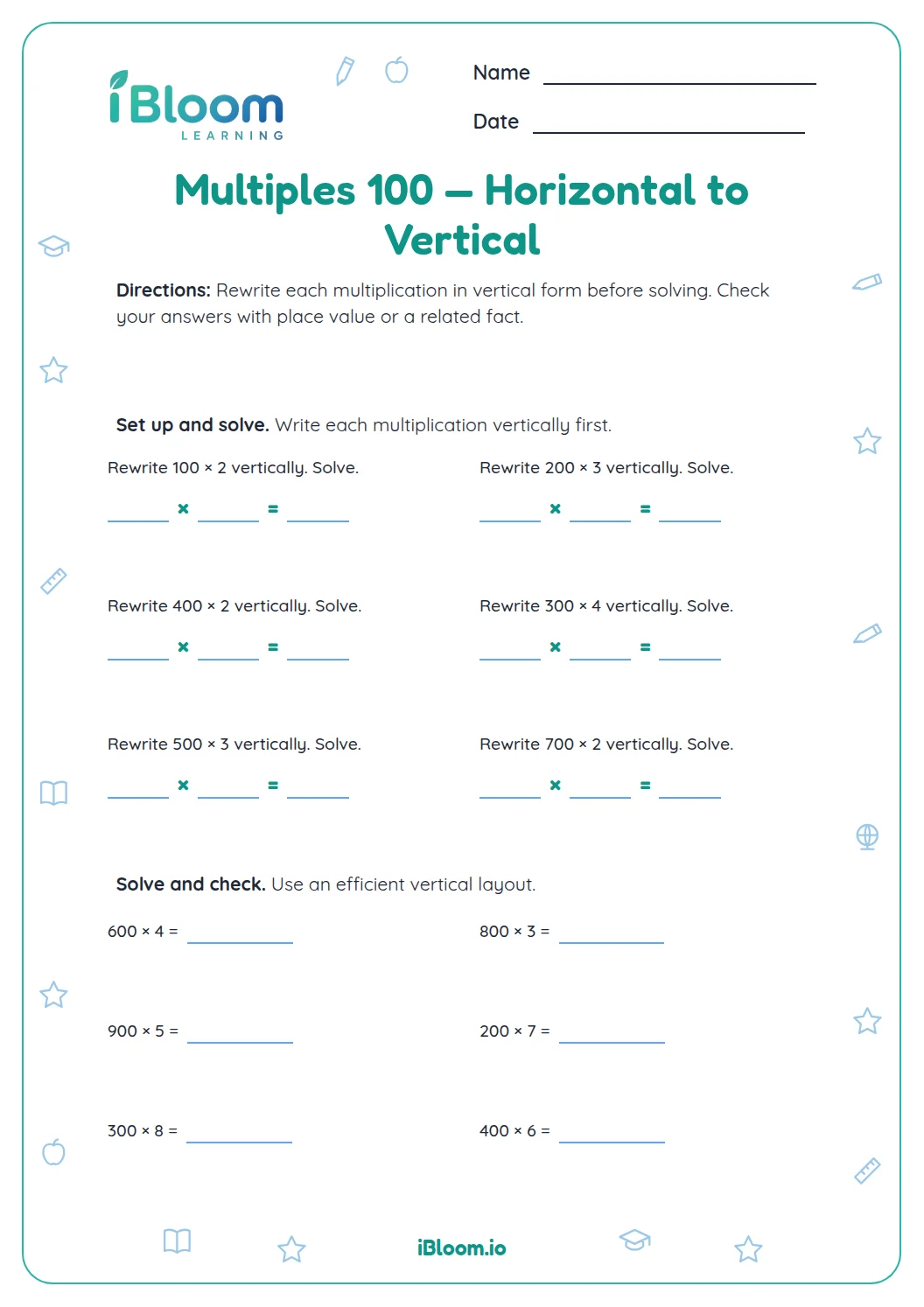
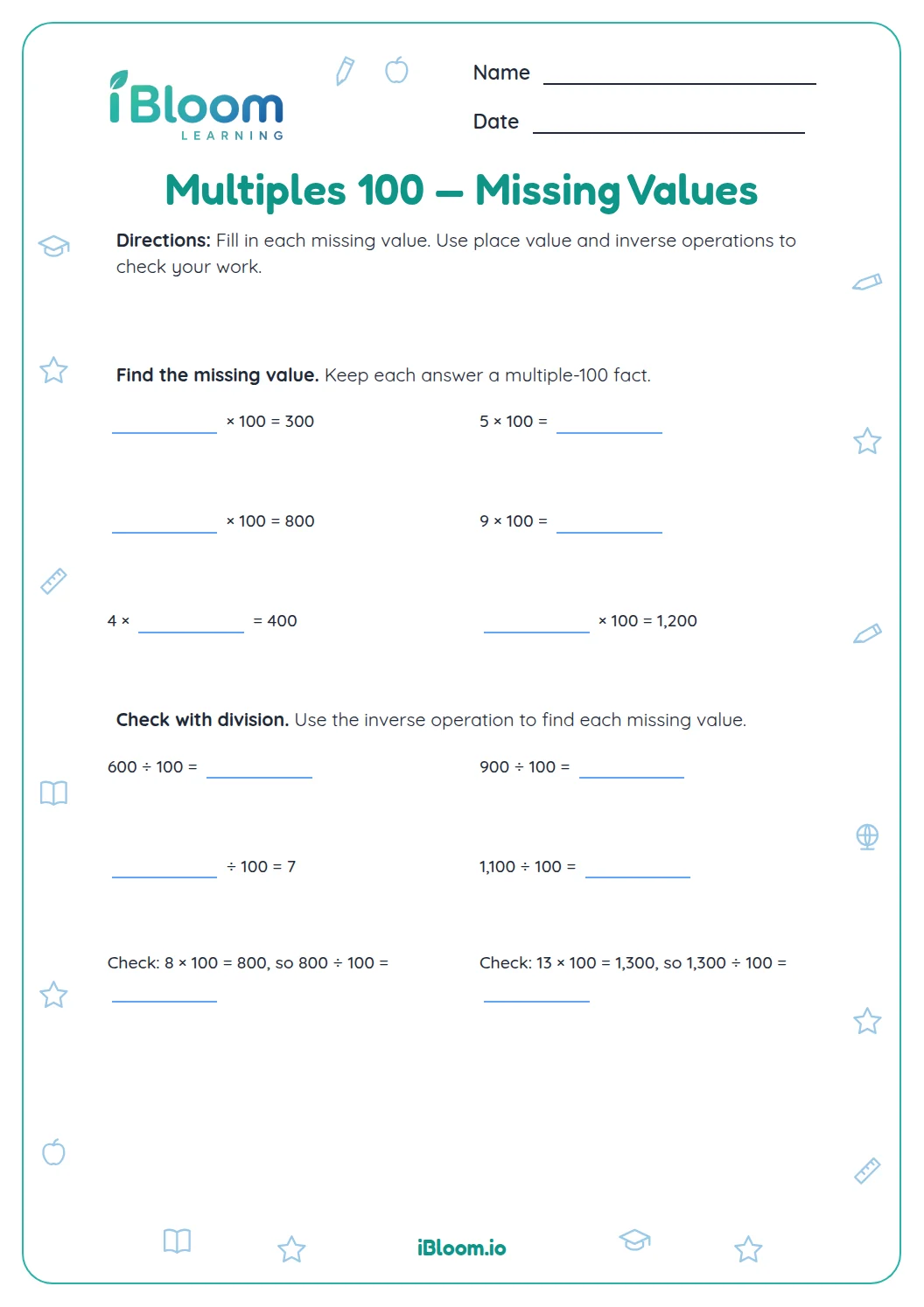
This Grade 3–5 multiplication drill focuses on one-digit factors times multiples of ten from 20 to 80. Children check four product claims, calculate five products, find two missing factors, compare products, and solve two short situations. The separate key includes the corrected claims and answers.
Aligned to 3.NBT.A.3
Why does multiplying by tens change place value?
A multiple of ten contains tens, not ones. For 7 × 30, think 7 groups of 3 tens: 21 tens, or 210. The zero in 30 marks the tens place.
- 17 × 30
- 27 × 3 tens = 21 tens
- 321 tens = 210
How can you check a multiplication claim?
Estimate or rewrite the tens factor before accepting a product. For instance, 8 × 40 is 8 × 4 tens, so it must be 32 tens, or 320. A product of 32 would have lost the place value.
How do you find a missing factor?
Undo multiplication with division. In 4 × ___ = 360, calculate 360 ÷ 4 = 90. Then check: 4 × 90 = 360.
What does this worksheet practice?
The 14 questions move from checking claims to calculating products, then applying the same place-value reasoning to missing factors and short situations.
How to use this worksheet
- 1Rewrite the multiple of ten as a number of tens.
- 2Multiply the one-digit factors first.
- 3Use the tens to name the product.
- 4Estimate the size before accepting a claim.
- 5Multiply a missing factor back to check it.
Common mistakes and quick fixes
The mistake
Writing only the basic fact product, such as 24 for 6 × 40.
The fix
Remember that 4 in 40 means four tens: 6 × 4 tens is 24 tens, or 240.
The mistake
Adding two zeros when the tens factor has one zero.
The fix
Multiply by the number of tens, then write the product in tens: 5 × 80 = 40 tens = 400.
The mistake
Choosing the larger factor instead of the larger product.
The fix
Calculate both products before comparing: 6 × 80 = 480 and 7 × 60 = 420.
Common Core alignment
This worksheet gives focused practice with the skill described below.
Multiply one-digit numbers by multiples of ten using place-value strategies.
On this sheet: The products, missing factors and stories use one-digit factors and multiples of ten in the stated range.
Show the official wordingHide the official wording
Multiply one-digit whole numbers by multiples of 10 in the range 10–90 (e.g., 9 × 80, 5 × 60) using strategies based on place value and properties of operations.
What to practice next
Make more practice
Further reading
Questions parents and teachers ask
Why is 6 × 50 equal to 300?
The 5 in 50 means five tens. Six groups of five tens make 30 tens, and 30 tens equal 300. The same idea appears in the worksheet’s product questions: multiply the nonzero digits, then use place value to name the full product.
How can a child check whether a multiplication claim is reasonable?
Rewrite the tens factor in groups of ten and estimate the product before deciding. For example, 8 × 40 is 8 groups of 4 tens, or 32 tens. That equals 320, so a claim of 340 needs correcting.
How do you find a missing factor in 4 × ___ = 360?
Divide the product by the known factor: 360 ÷ 4 = 90. Then multiply 4 × 90 to check that the product returns to 360. This inverse operation checks both the missing factor and its place value. The answer is 90, a multiple of ten.
Does this printable include an answer key?
Yes. The separate key lists all 14 answers: four product checks, five products, two missing factors, one comparison, and two word problems. It gives the corrected product for each inaccurate claim so the place-value reasoning is easy to verify.
What grade levels are listed for this practice?
The source page lists Grades 3, 4, and 5. The sheet practices one-digit multiplication by multiples of ten, using factors such as 20, 30, 40, 60, 70, and 80. Children can use the worked checks to review how tens affect a product.