



About this worksheet
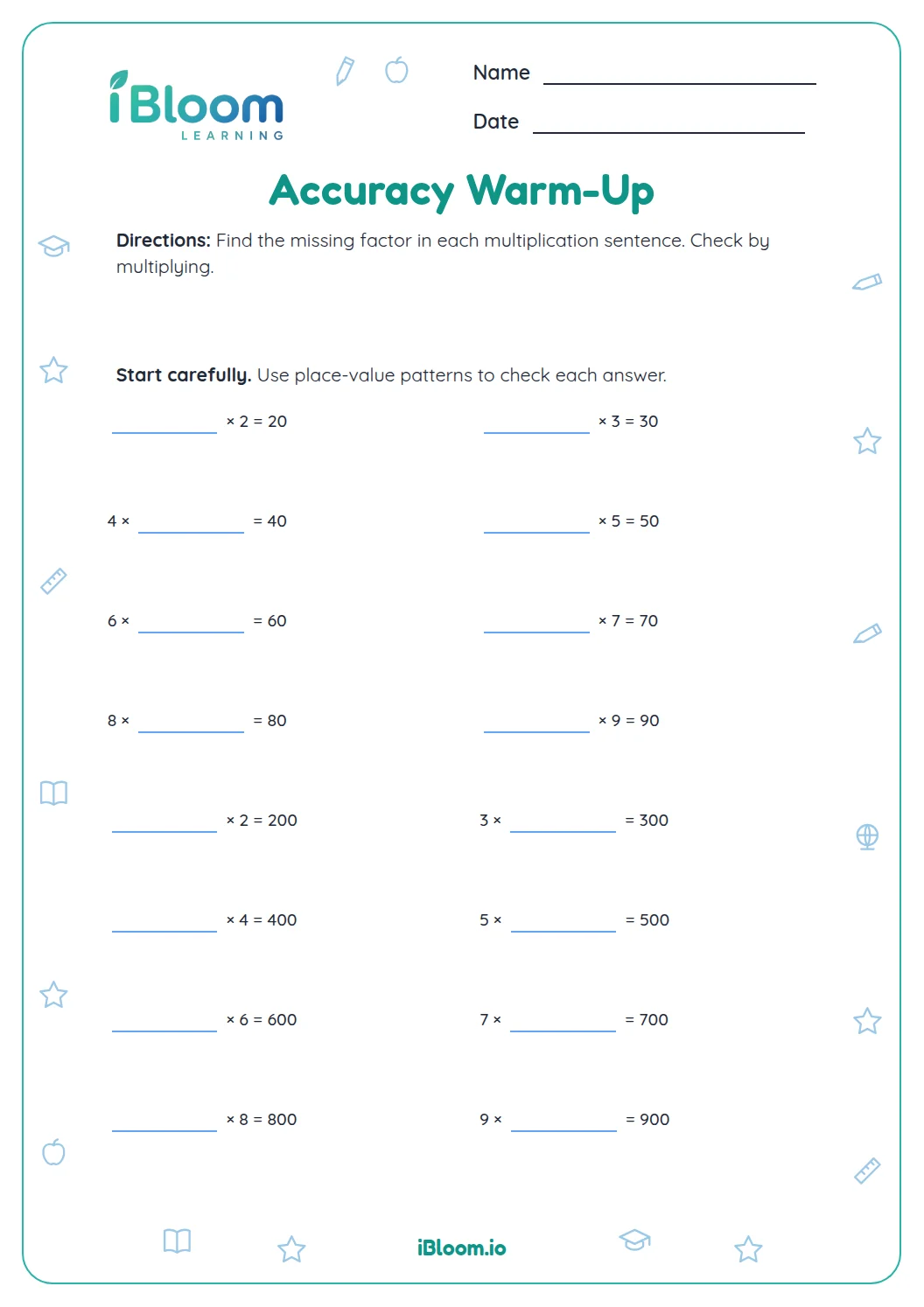
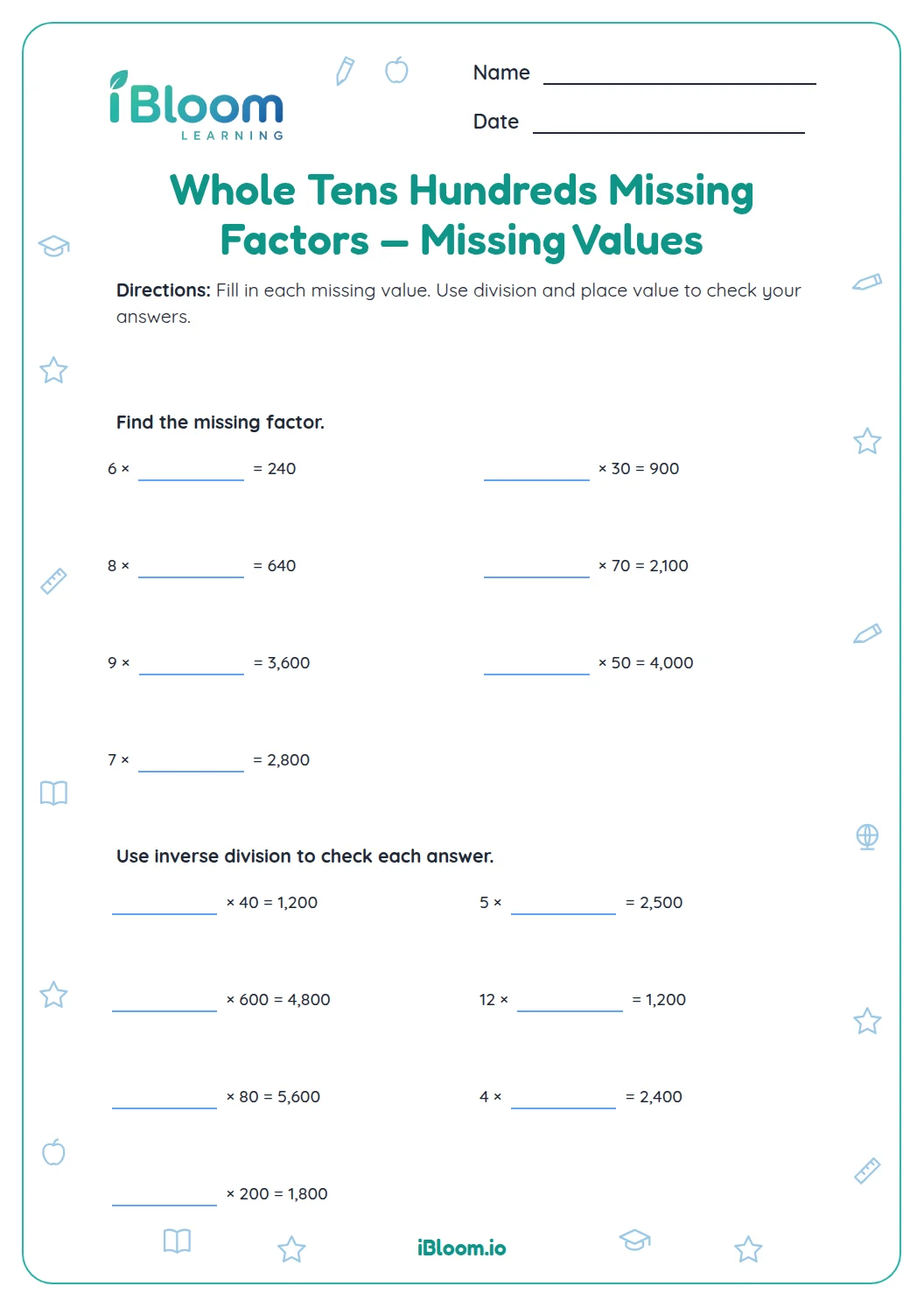
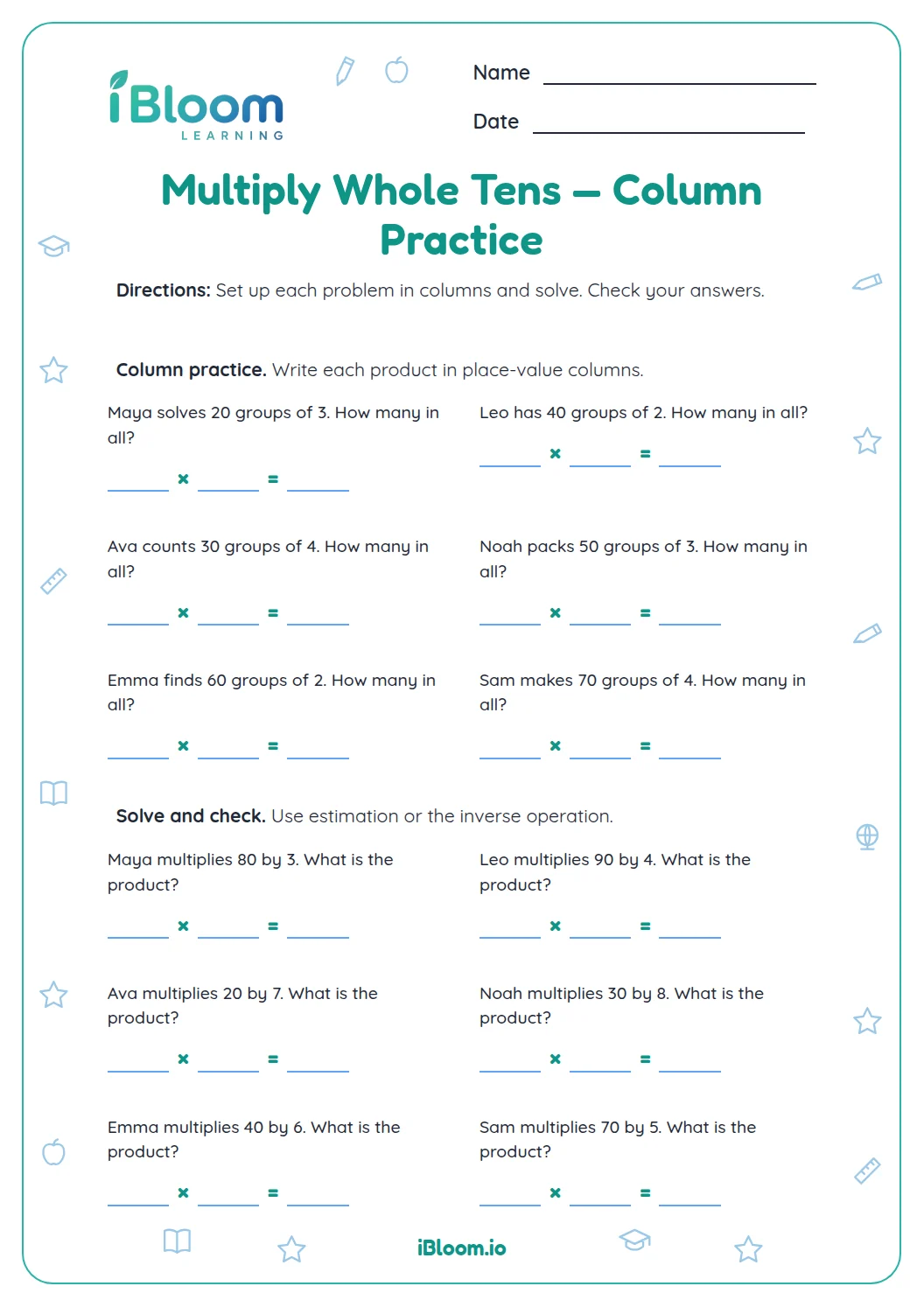
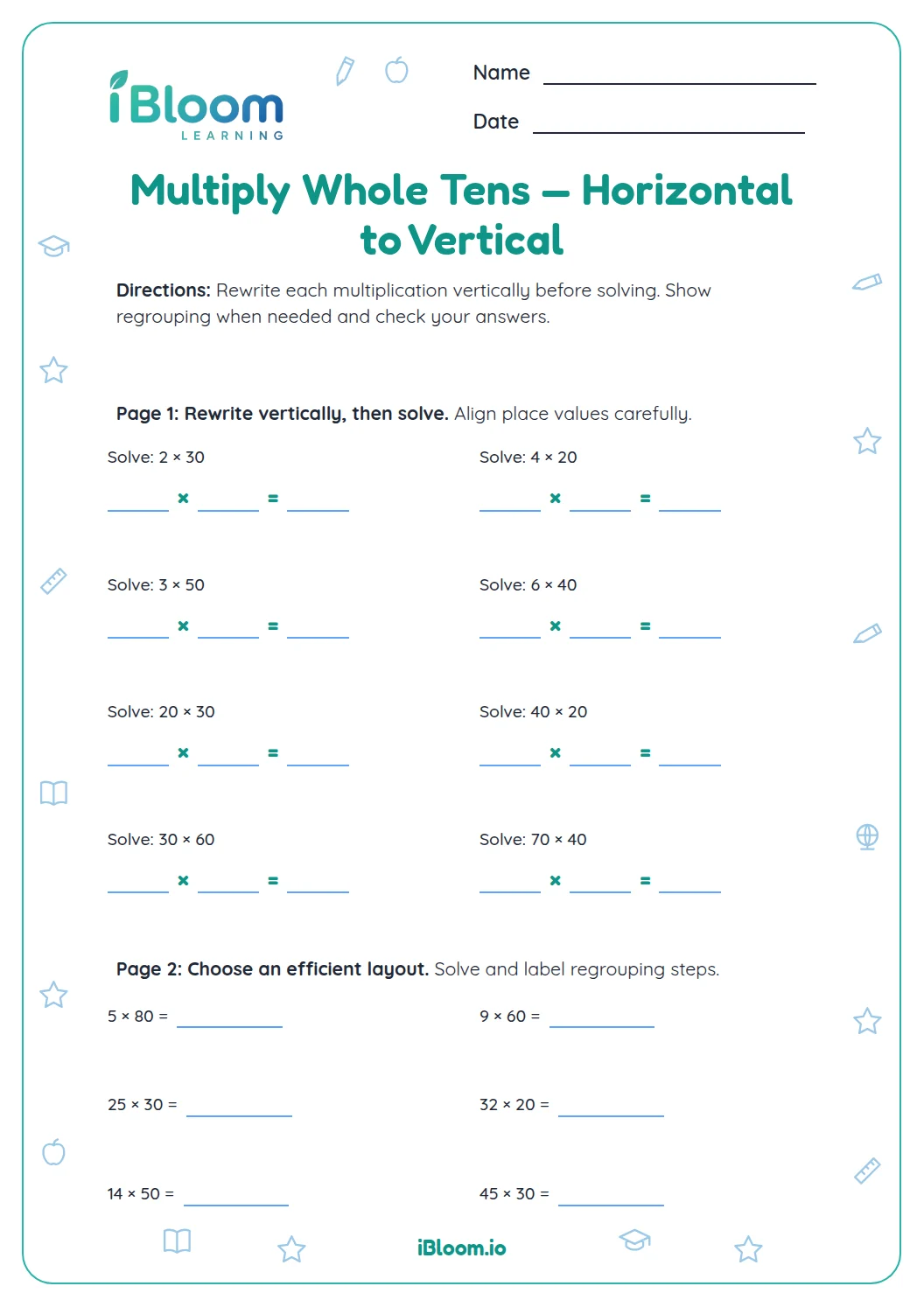
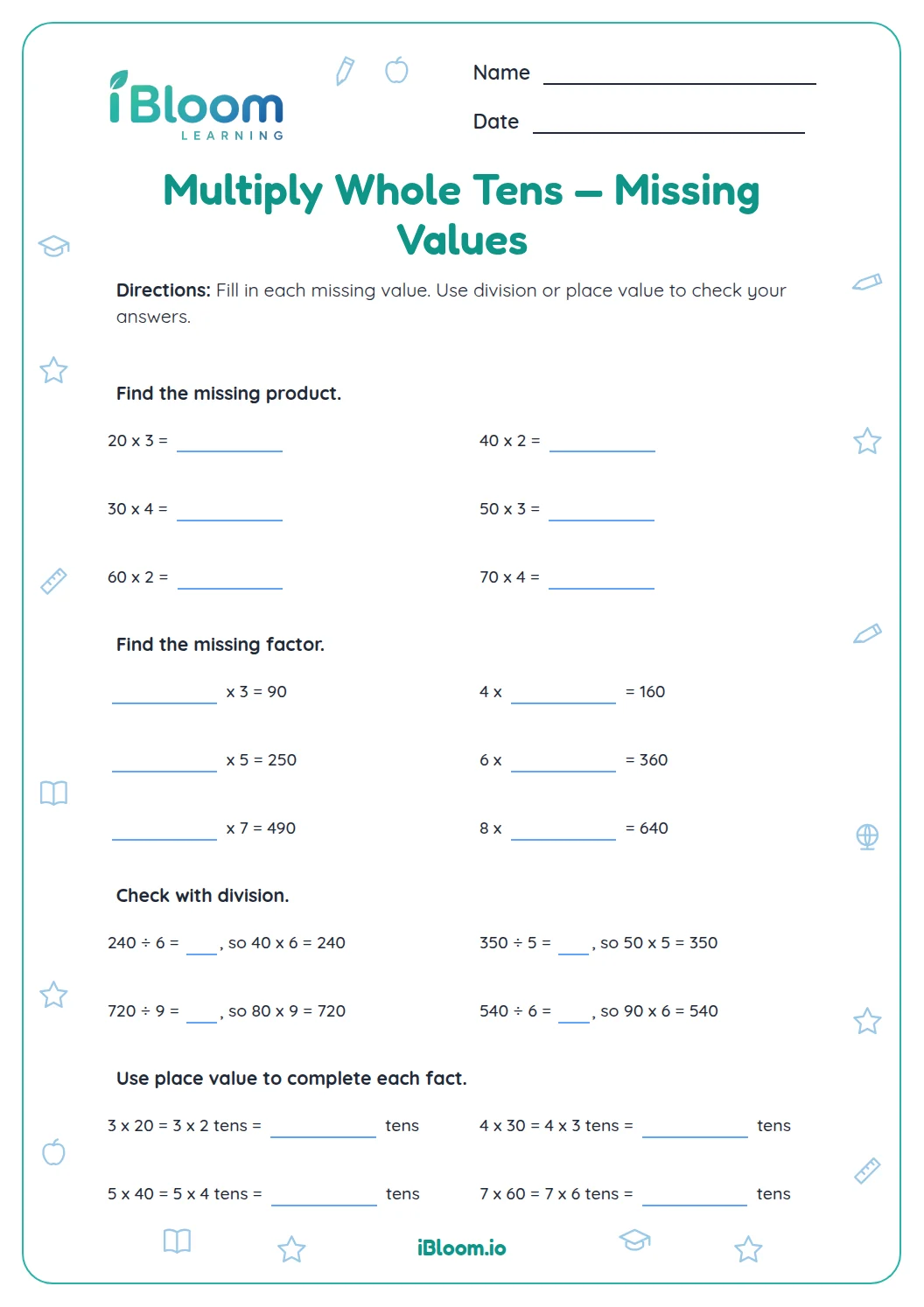
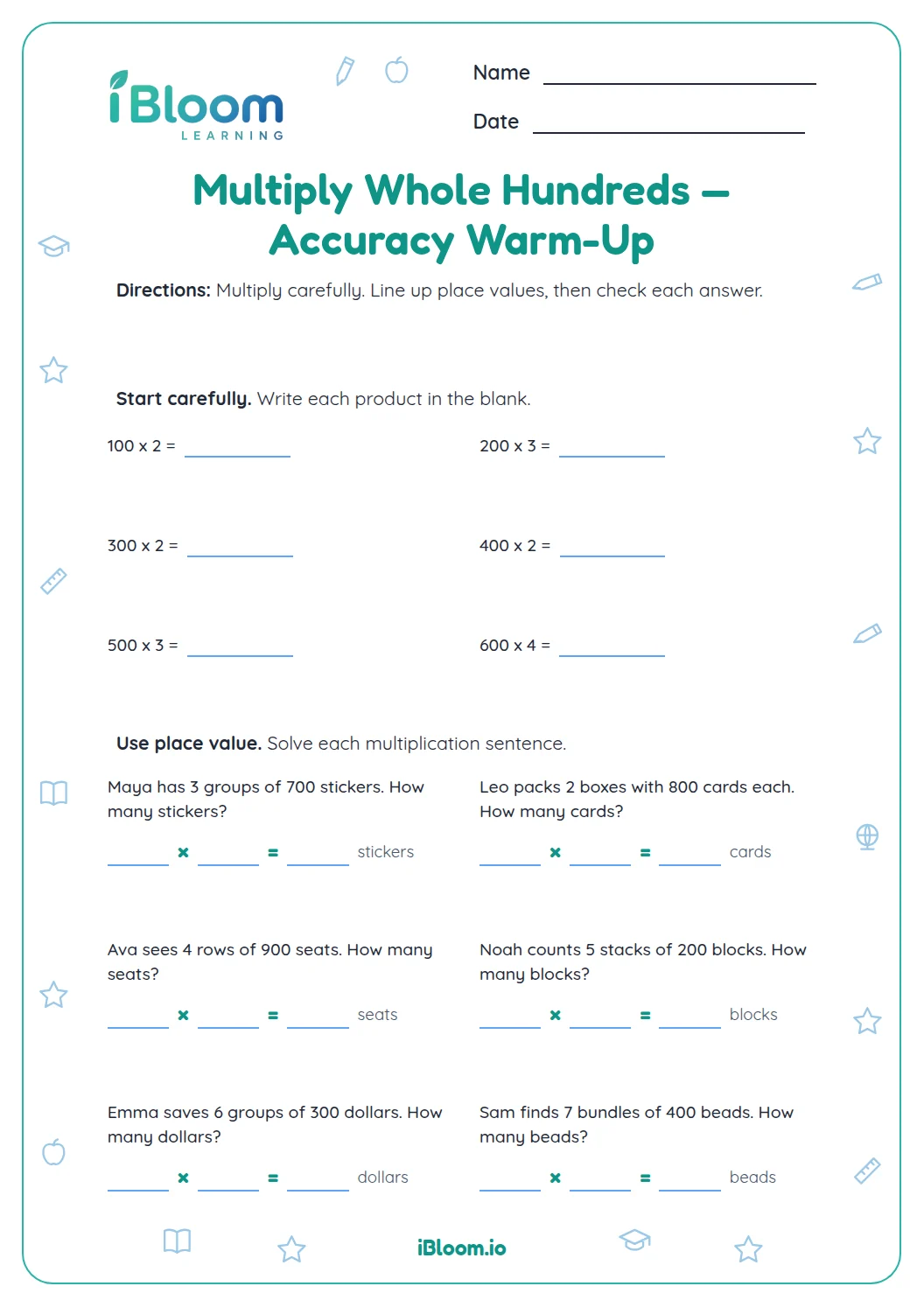
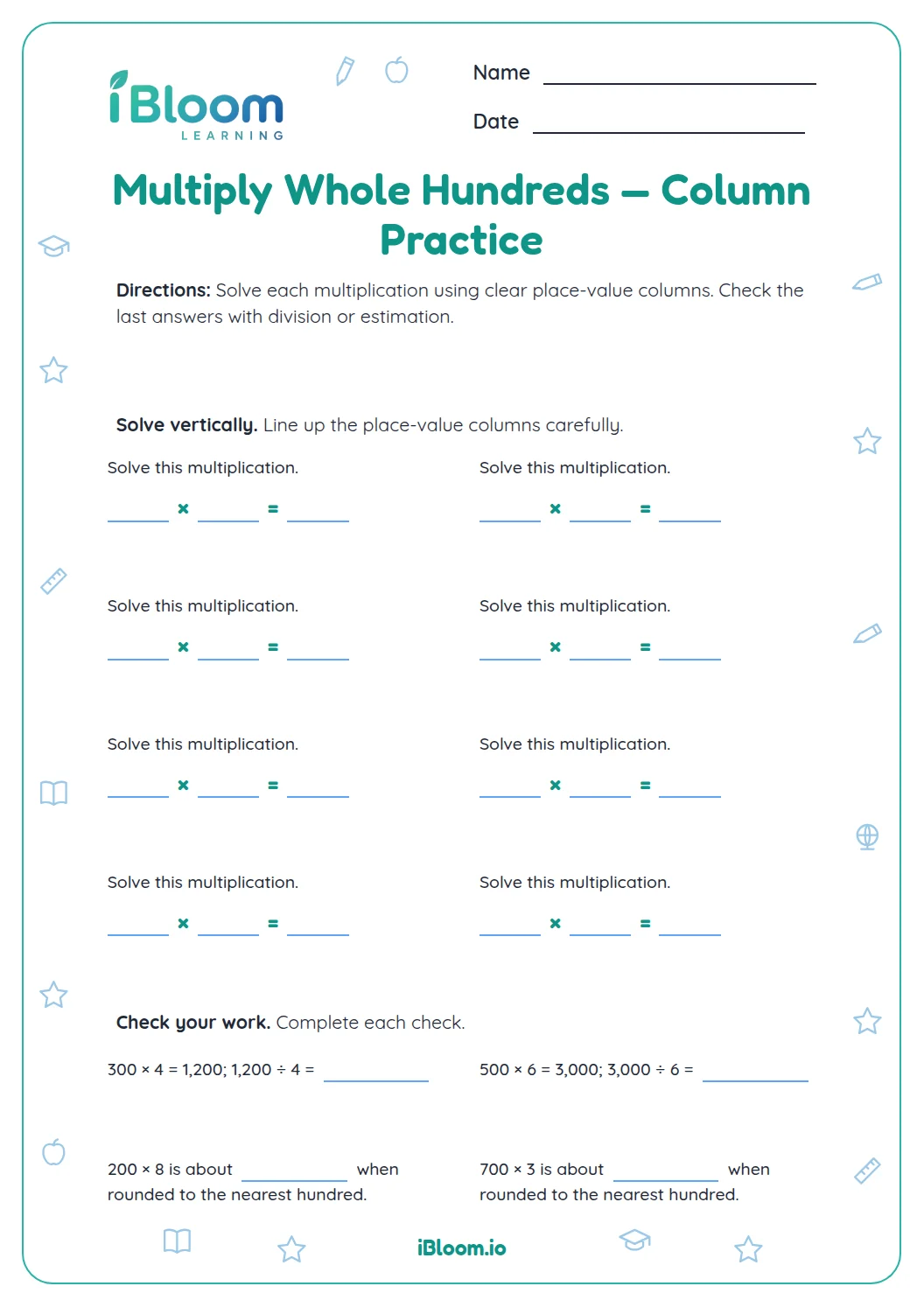
This Grade 4 mixed drill practices multiplying whole tens and hundreds and reversing the multiplication equation to find a missing factor. Across 16 items in two parts, students solve products and missing-factor equations using basic facts and place value. The separate key lists each product or factor. This practice connects to CCSS 4.NBT.B.5, multiplying whole numbers by one-digit factors.
Aligned to 4.NBT.B.5
How do you multiply whole tens and hundreds?
Use the nonzero digits as a basic multiplication fact, then restore the place value. For example, 6 × 40 is 6 × 4 tens, or 24 tens, which is 240.
How can you find a missing factor?
Use division or a related fact to reverse the multiplication. In ___ × 70 = 560, ask how many groups of 70 make 560; eight groups do.
How can you check the equation?
Substitute the factor or product into the blank and multiply again. Check the number of zeros against the tens or hundreds in the factors.
How to use this worksheet
- 1Identify whether the blank asks for a product or a factor.
- 2Solve the basic fact using the nonzero digits.
- 3Use the tens or hundreds to place the product correctly.
- 4For a missing factor, divide the product by the known factor.
- 5Substitute your answer and check the full equation.
Keep place value clear
The mistake
Mistake: writing 24 for 6 × 40.
The fix
Recognize that 24 groups of ten equal 240.
The mistake
Mistake: adding zeros without multiplying the basic digits.
The fix
Solve the basic fact first.
The mistake
Mistake: treating the blank as the product every time.
The fix
Check which factor or product is missing.
Multiply a whole number of up to four digits by a one-digit whole number, and multiply two two-digit numbers.
On this sheet: The questions provide direct practice with this skill.
Show the official wordingHide the official wording
Multiply a whole number of up to four digits by a one-digit whole number, and multiply two two-digit numbers.
What to practice next
Make more practice
Further reading
Questions parents and teachers ask
How do you multiply by a whole hundred?
Multiply the nonzero digits first, then account for the two place-value places in the hundred. For example, 8 × 300 is 8 × 3 hundreds, or 2,400. Checking the size of the result helps catch a missing zero.
How can I find a missing factor?
Divide the product by the known factor or use a related multiplication fact. For ___ × 70 = 560, 560 ÷ 70 is 8, so the missing factor is 8. Substitute the result back into the equation to verify it.
Are there both product and missing-factor questions?
Yes. The 16 equations include blanks for products and blanks for factors. Read the position of each blank before solving. Part A emphasizes products and missing factors with whole tens and hundreds; Part B mixes the forms for additional practice.
What grade is this worksheet for?
The sheet is labeled Grade 4. It practices whole-number multiplication with tens and hundreds and uses basic multiplication facts to find products and missing factors. Students should be comfortable multiplying the basic digits and attending to place value.
How can students check an answer?
Fill in the blank and multiply the factors. The product should match the number in the equation, with the tens or hundreds correctly reflected in place value. For a missing factor, the product divided by the known factor should give the same answer.