





About this worksheet
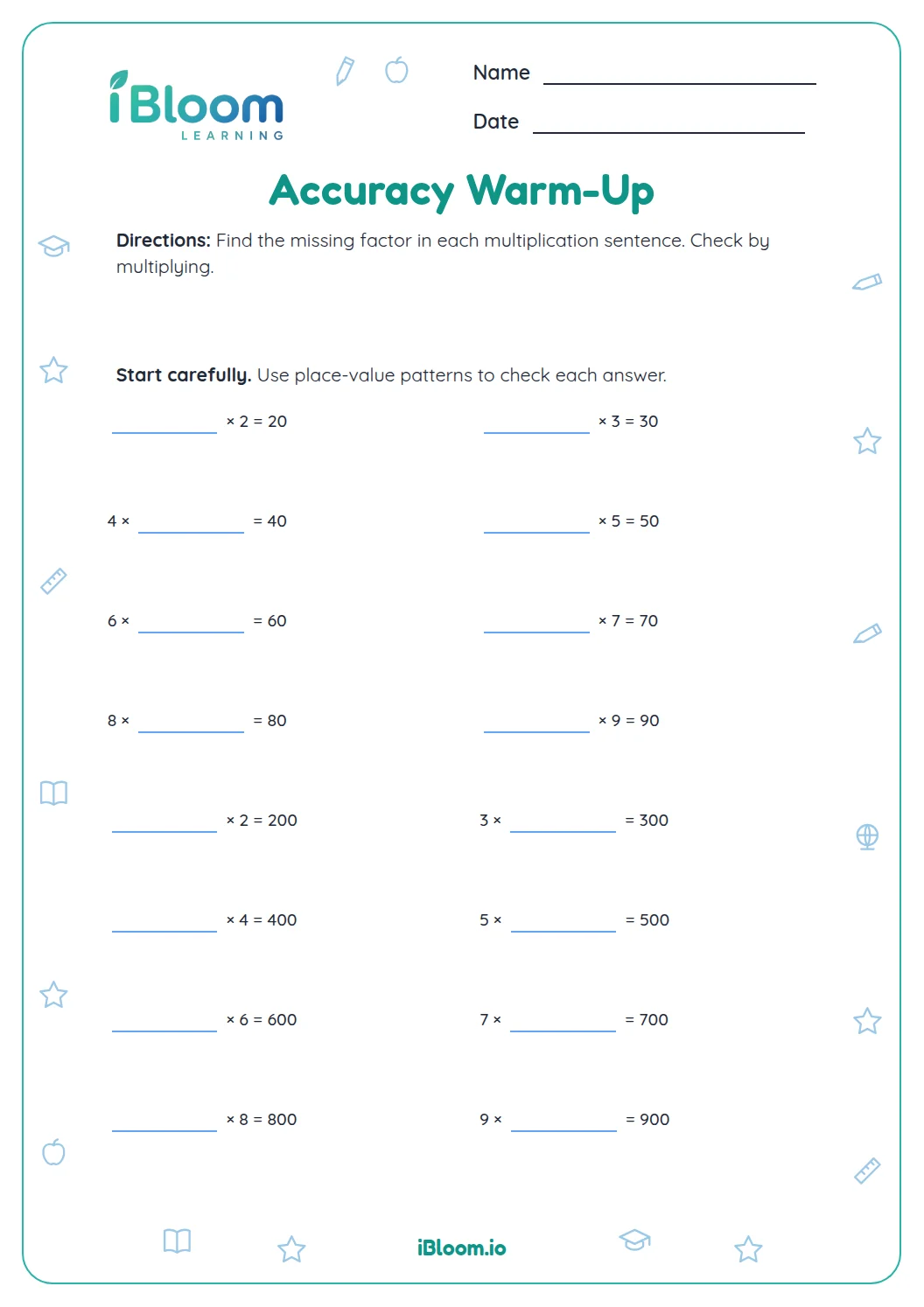
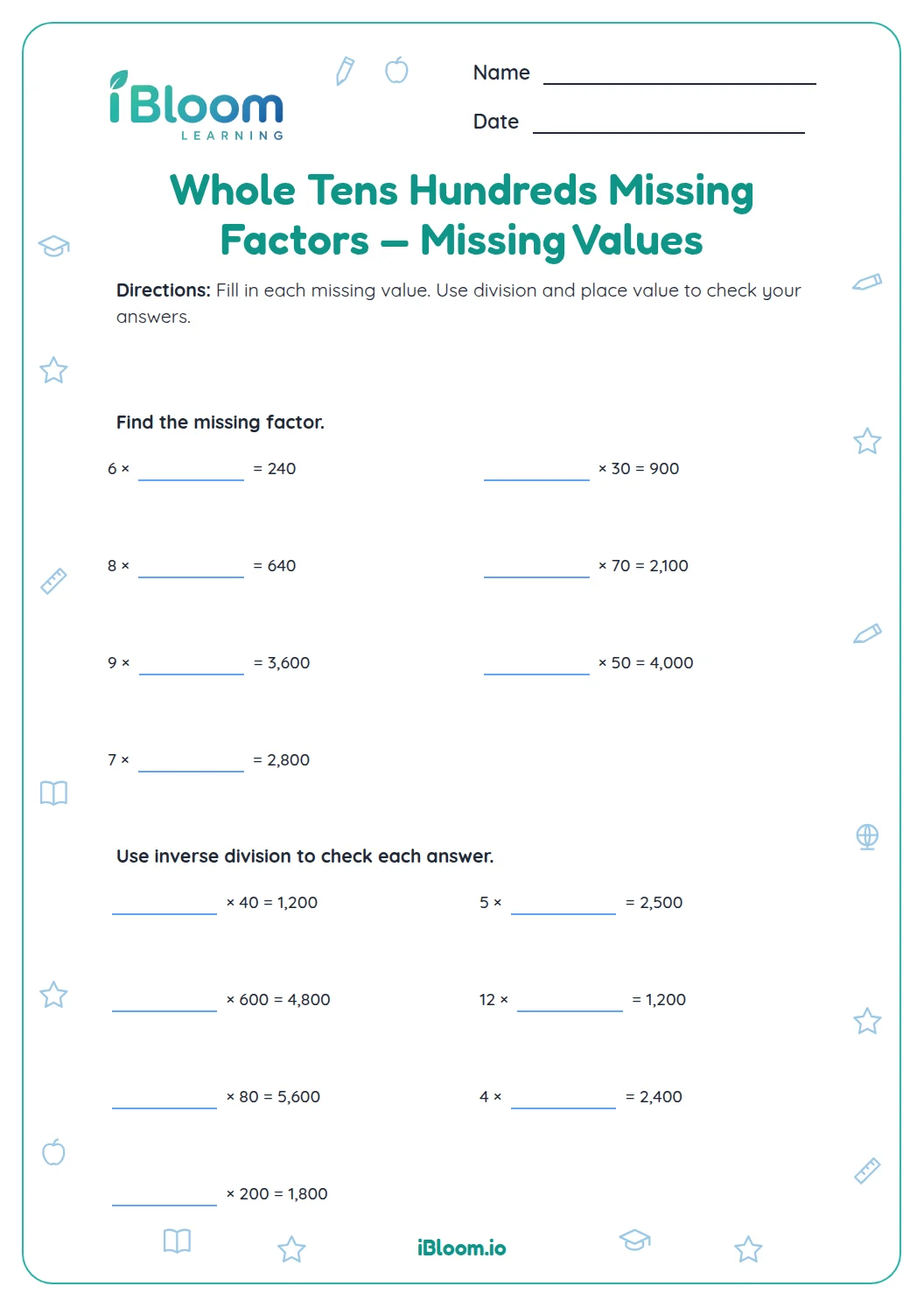
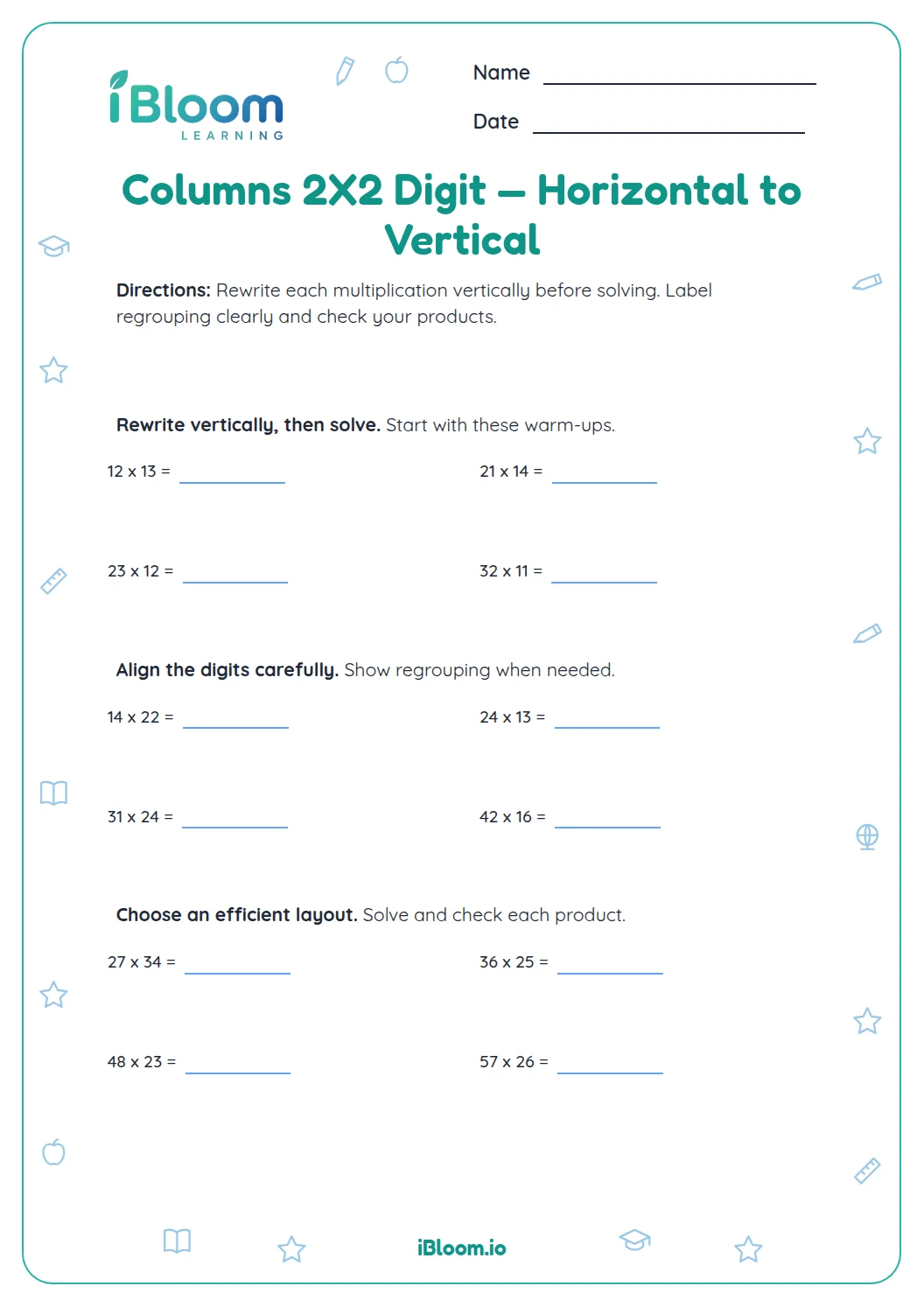
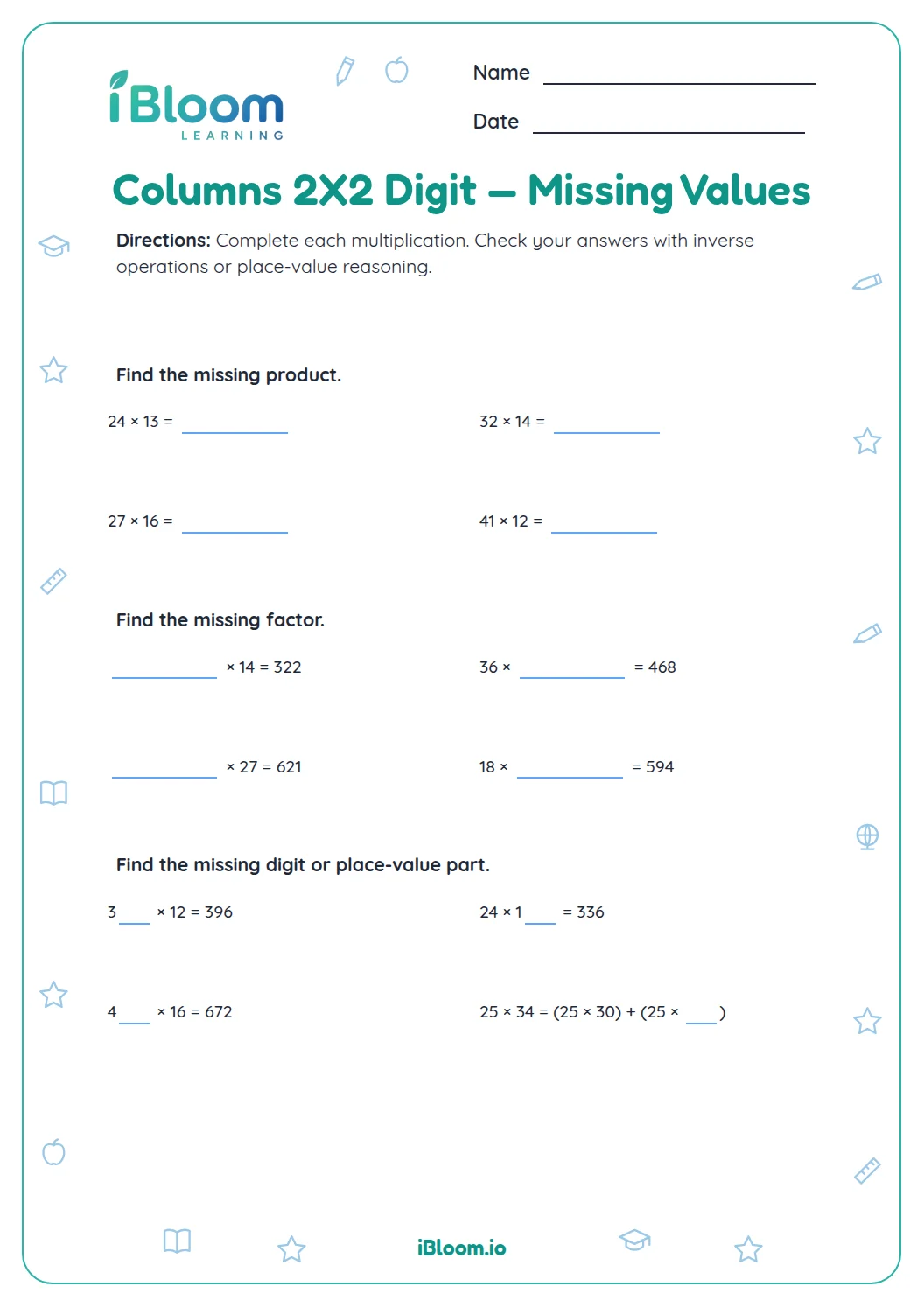
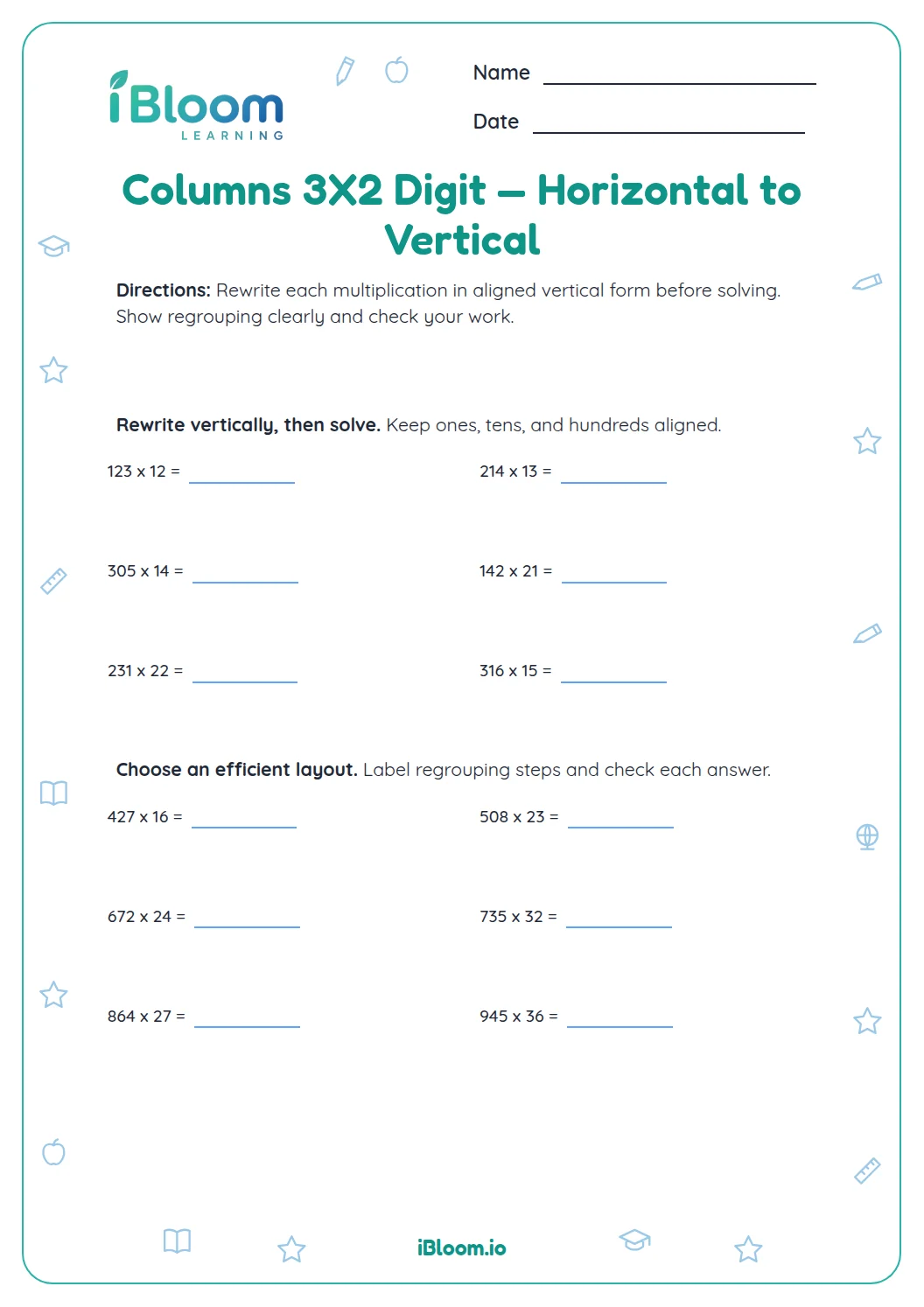
This Grade 4 printable practices missing factors in multiplication equations with tens and hundreds. Learners find unknown factors, evaluate common place-value slips, and apply multiplication to grouping situations. It contains 16 questions in three parts, with a separate answer key.
Aligned to 4.OA.A.3
How do you find a missing factor?
Divide the product by the factor you know. Then multiply to check that the equation balances.
For 6 × ___ = 240, calculate 240 ÷ 6 = 40, then check 6 × 40 = 240.
- 16 × ___ = 240
- 2240 ÷ 6 = 40
- 3Answer: 40
How can you spot a place-value slip?
Compare products when a factor changes by a factor of ten. In question 9, 7 × 500 is 3,500; the extra zero in 350 is a place-value slip.
How does multiplication model a grouping story?
Identify the number of groups and the amount in each group. Multiply for a total, or divide the total equally when the question asks for the size of each group.
How to use this worksheet
- 1Read the directions before starting each part.
- 2Complete the first item together and explain the reasoning aloud.
- 3Let the learner try the remaining questions independently.
- 4Pause to check signs, labels, and units where they appear.
- 5Use the answer key to find one item to review.
Multiplication slips to check
The mistake
Dividing the product by the wrong factor.
The fix
Use the factor shown in the equation and multiply your result back to check.
The mistake
Treating 30 and 300 as the same factor.
The fix
Compare the number of zeros; multiplying by 300 gives ten times the product of multiplying by 30.
The mistake
Adding equal groups instead of multiplying.
The fix
Write groups × items in each group, then calculate.
Common Core alignment
This worksheet practices the skills described in the standard below.
Solve whole-number problems using multiplication and equations.
On this sheet: Solve whole-number problems using multiplication and equations.
Show the official wordingHide the official wording
Solve multistep word problems posed with whole numbers and having whole-number answers using the four operations, including problems in which remainders must be interpreted. Represent these problems using equations with a letter standing for the unknown quantity. Assess the reasonableness of answers using mental computation and estimation strategies including rounding.
What to practice next
Make more practice
Further reading
Questions parents and teachers ask
How many questions are included?
There are 16 questions in three parts: six missing-factor equations, four items about multiplication errors, and six word problems. The answer key is separate. Learners can check each product by multiplying the factors or dividing the product by a known factor.
How does the worksheet handle multiplication errors?
Four questions ask learners to check multiplication claims and place value. For example, 7 × 500 equals 3,500, while 7 × 50 equals 350. The story problems then apply the same multiplication and division reasoning to groups, boxes, and batches.
What should learners do when a factor is missing?
Divide the product by the factor that is already given. For 6 × ___ = 240, 240 ÷ 6 gives 40. Multiplying 6 by 40 confirms the missing factor. Learners can apply this check to each equation before moving on.
Is the answer key included?
Yes. A separate answer key lists the expected response for every question, including units for the word problems. Have learners explain an incorrect response and try the calculation again. This makes it easier to see whether an error came from division or place value.
How long should this practice take?
The page lists about 20 minutes as a planning estimate. Learners may take more or less time depending on whether they show work and discuss the error-analysis questions. The three parts can also be completed in separate sittings.