




About this worksheet
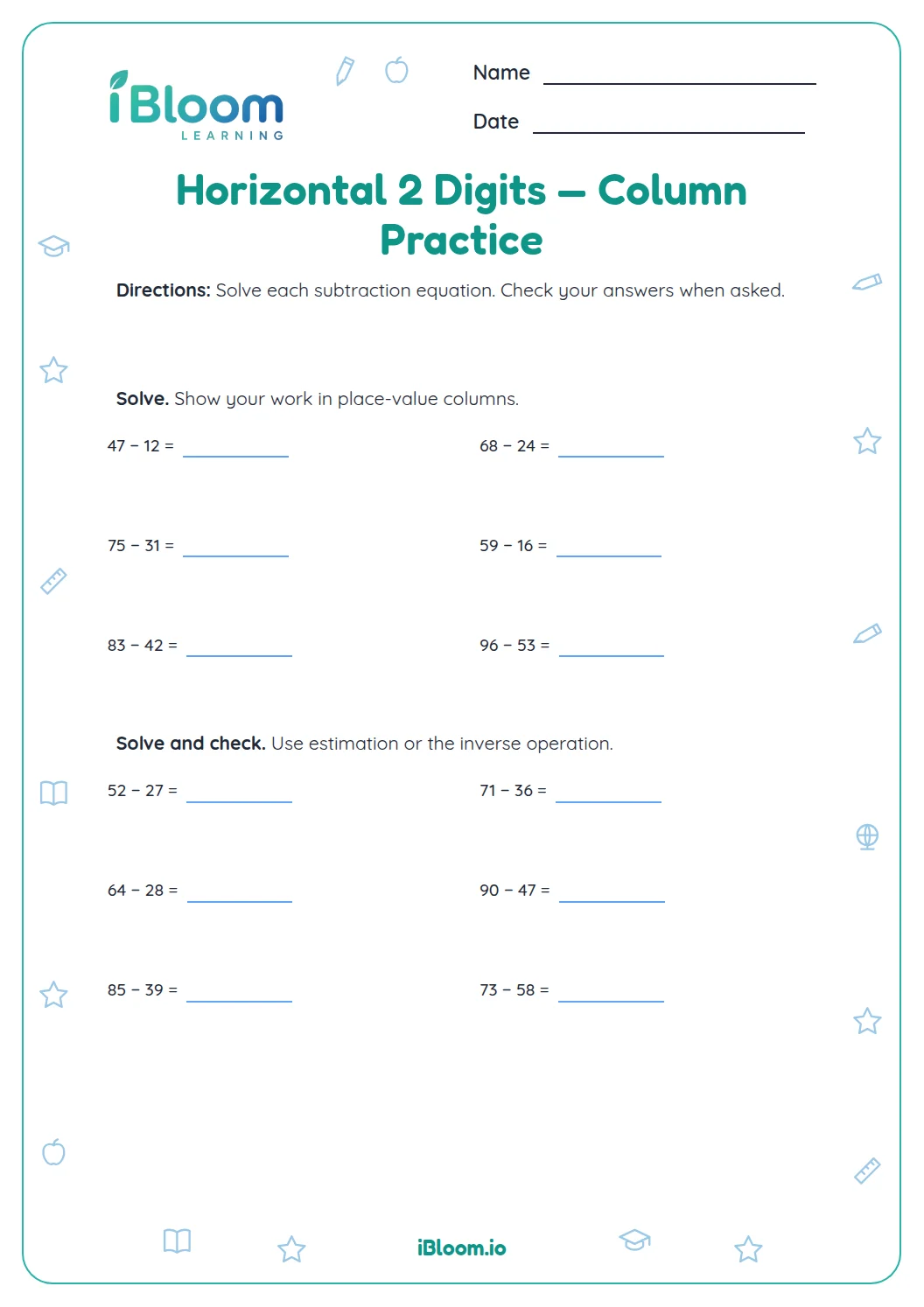
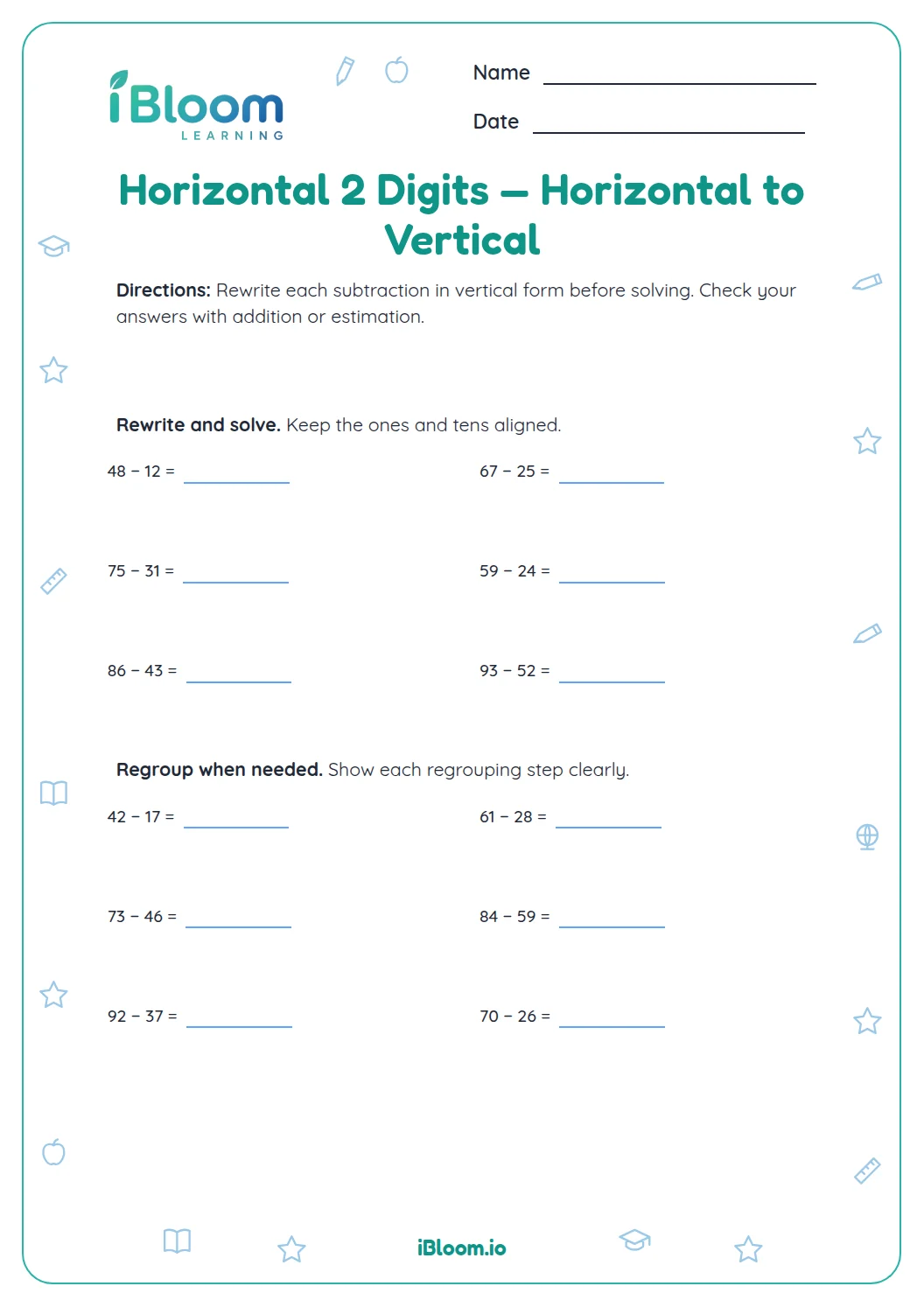
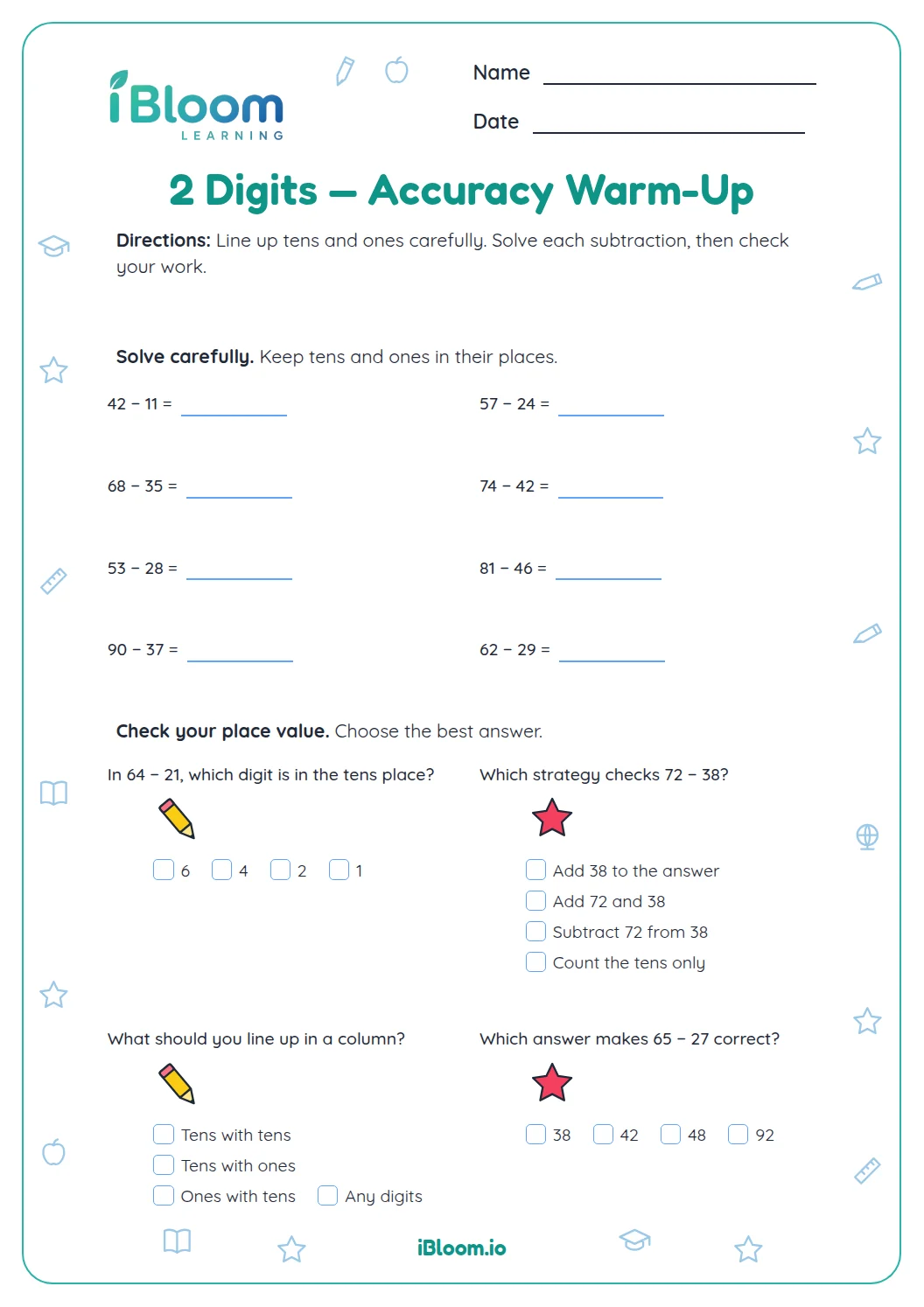
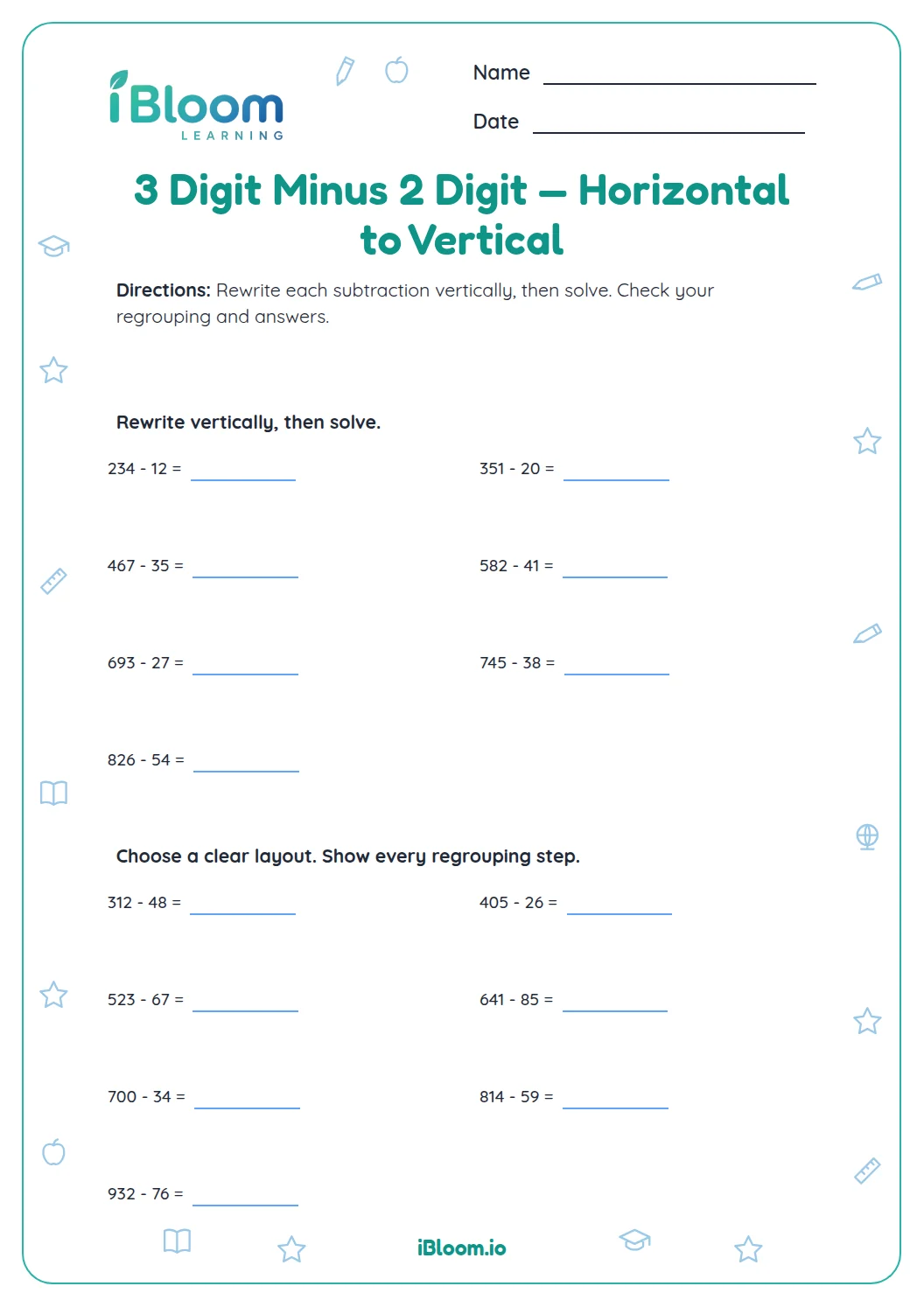
This Grade 2 and Grade 3 warm-up focuses on accurate horizontal subtraction with two-digit numbers. Children begin with problems that do not require regrouping, then solve examples that require trading one ten for ten ones. Sixteen equations fit into two parts, and the answer key makes checking quick. The skill practices CCSS 2.NBT.B.5.
Aligned to 2.NBT.B.5
How do you subtract when each place is large enough?
Subtract ones from ones and tens from tens. In 68 − 24, eight ones take away four ones leaves four ones, and six tens take away two tens leaves four tens.
- 168 − 24
- 28 − 4 = 4 ones
- 36 tens − 2 tens = 4 tens
- 4Difference: 44
When do you regroup a ten?
If there are fewer ones on top than ones being subtracted, trade one ten for ten ones. In 52 − 27, trade a ten so 52 becomes 4 tens and 12 ones; then subtract each place.
How can addition check a subtraction answer?
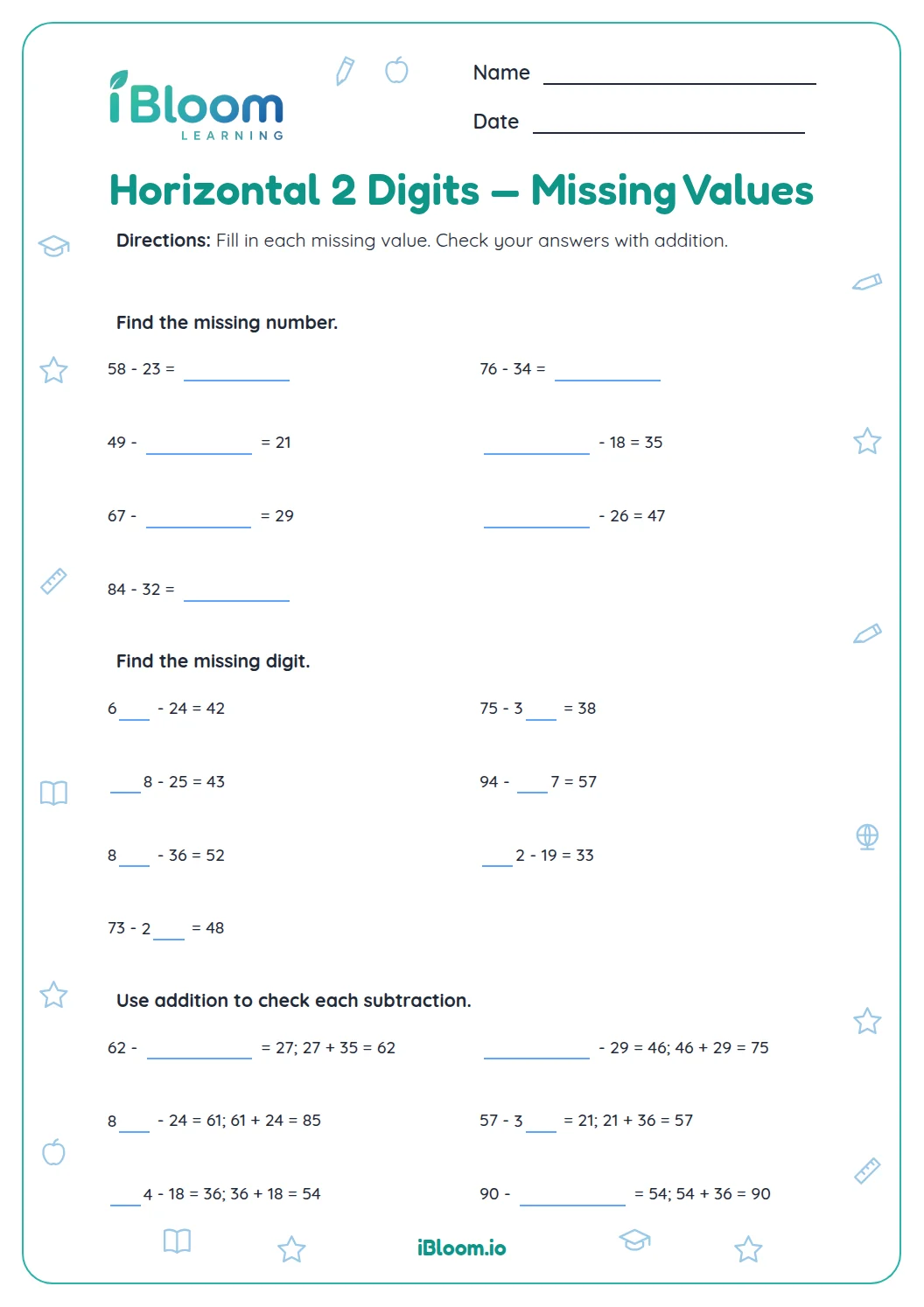
Add the difference to the number taken away. For 52 − 27 = 25, check 25 + 27 = 52. If the sum differs from the starting number, revisit the place where you regrouped.
How to use this worksheet
- 1Read the subtraction sentence from left to right.
- 2Subtract the ones; trade one ten if the top digit is smaller.
- 3Subtract the tens after regrouping.
- 4Estimate whether the difference is a sensible size.
- 5Add the difference and subtrahend to check.
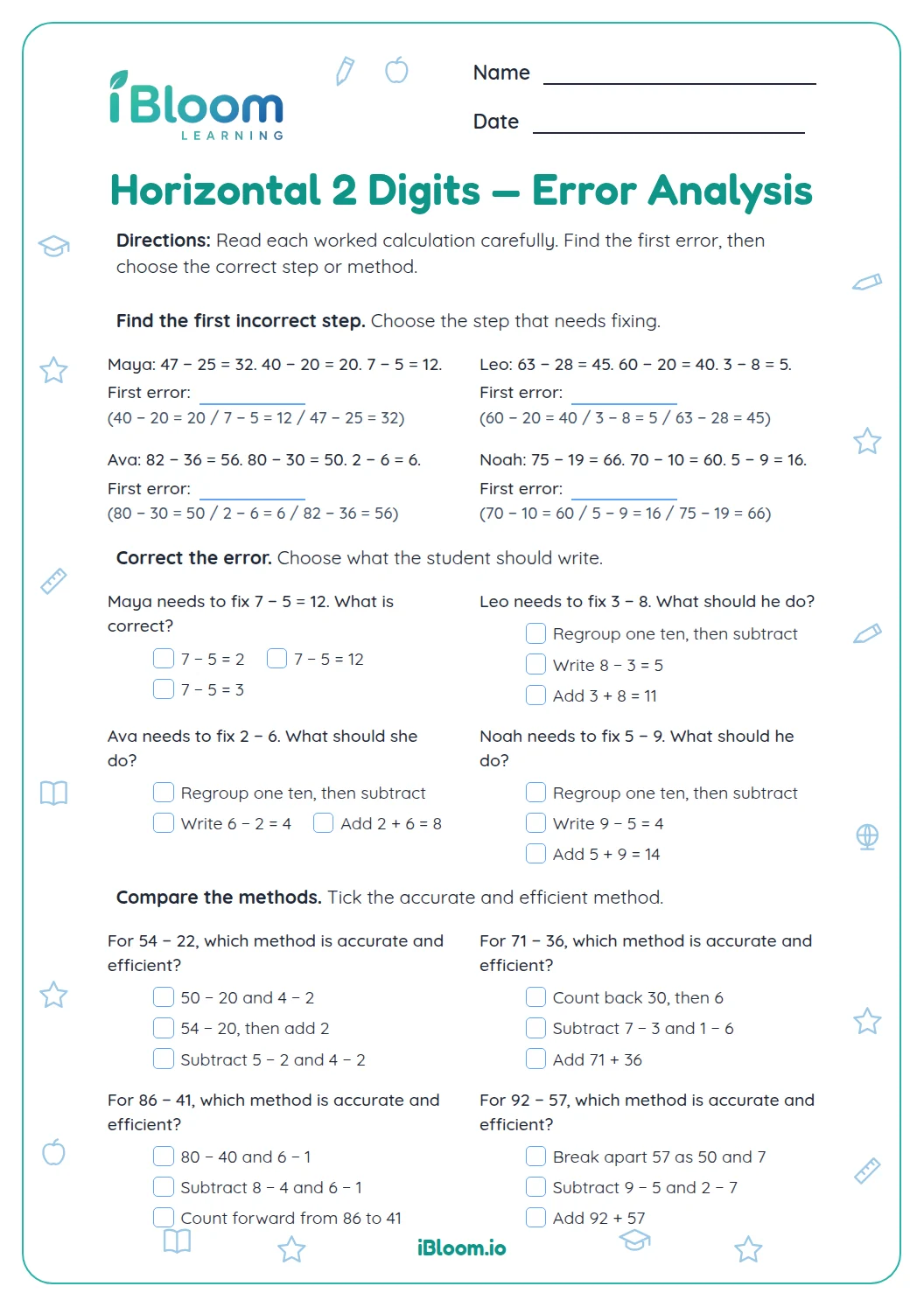
Common mistakes and quick fixes
The mistake
Subtracting the smaller ones digit from the larger without regrouping.
The fix
Trade one ten for ten ones before subtracting.
The mistake
Forgetting that regrouping reduces the tens by one.
The fix
Mark the new tens digit before finishing.
The mistake
Adding instead of subtracting after regrouping.
The fix
Use the subtraction sign and check by adding the difference back.
Common Core alignment
This sheet gives focused practice with the standard below.
Subtract two-digit numbers using place-value strategies.
On this sheet: Children practice two-digit subtraction and check using addition.
Show the official wordingHide the official wording
Fluently add and subtract within 100 using strategies based on place value, properties of operations, and/or the relationship between addition and subtraction.
What to practice next
Make more practice
Further reading
Questions parents and teachers ask
Does this worksheet include regrouping?
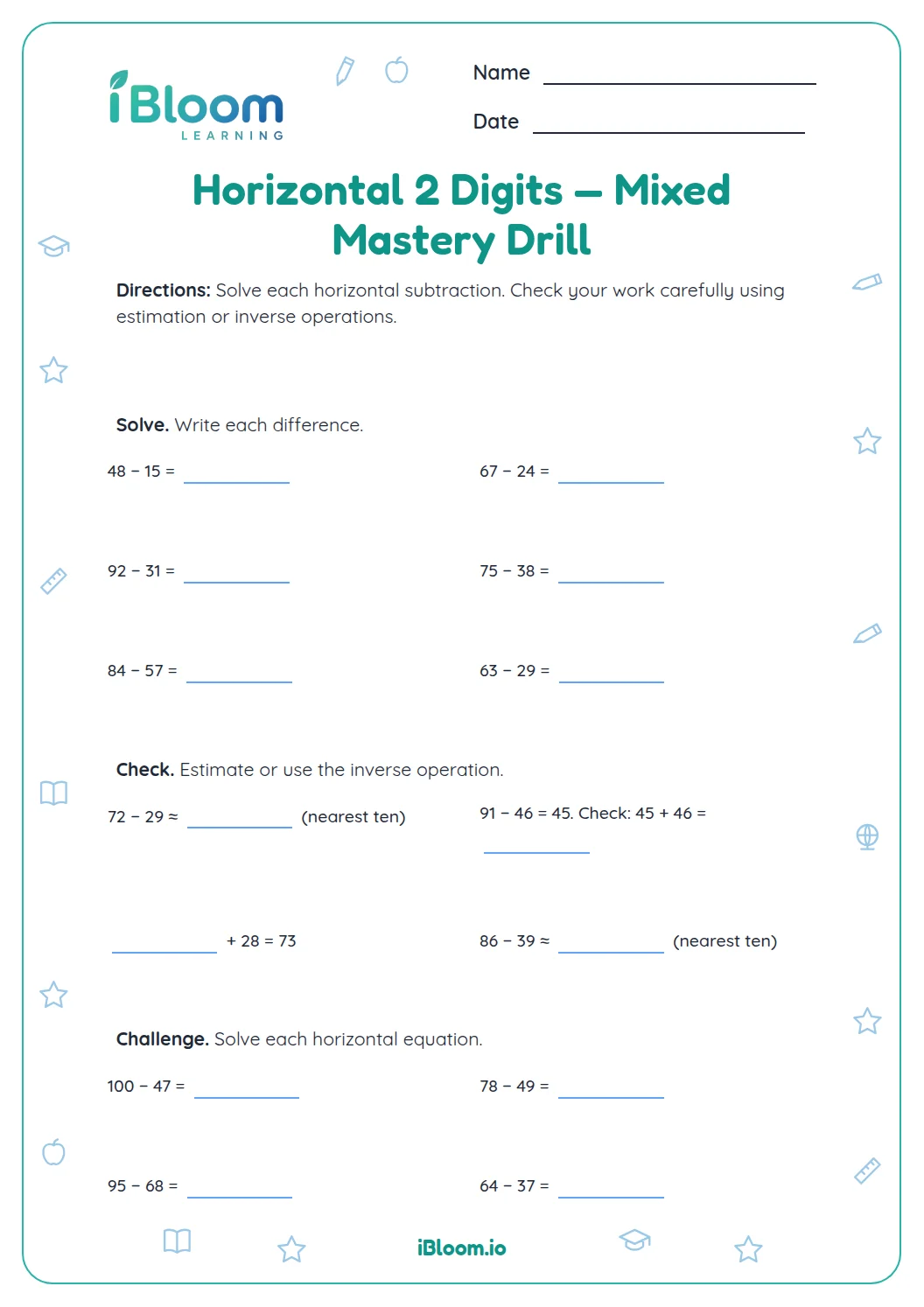
Yes. The 20 horizontal subtraction problems begin with examples that do not need regrouping and continue with problems that require trading one ten for ten ones. Children can check a difference by adding it to the number being subtracted. The key provides the checked differences.
How can my child check a difference?
Add the difference to the number being subtracted. The sum should equal the starting number; for example, 62 − 27 = 35 checks because 35 + 27 = 62. This gives children a way to find a regrouping error. The key lists the matching difference.
What does horizontal subtraction mean?
The starting number, subtraction sign, and number being subtracted appear on one line, such as 74 − 38. Children still keep tens and ones in their correct places, especially when they trade a ten before subtracting the ones. This format keeps each equation on one line.
How many problems are included?
There are 20 problems in two parts: eight without regrouping and twelve with regrouping. The separate answer key lists a difference for each horizontal equation. Each item has an answer in the key for checking. Children can check after solving each one.
What is a useful warm-up routine?
Ask the child to name the tens and ones, estimate the size of the difference, and solve each equation. For a regrouping problem, check that the tens decrease by one as the ones increase by ten. Finish by adding the difference back.