






About this worksheet
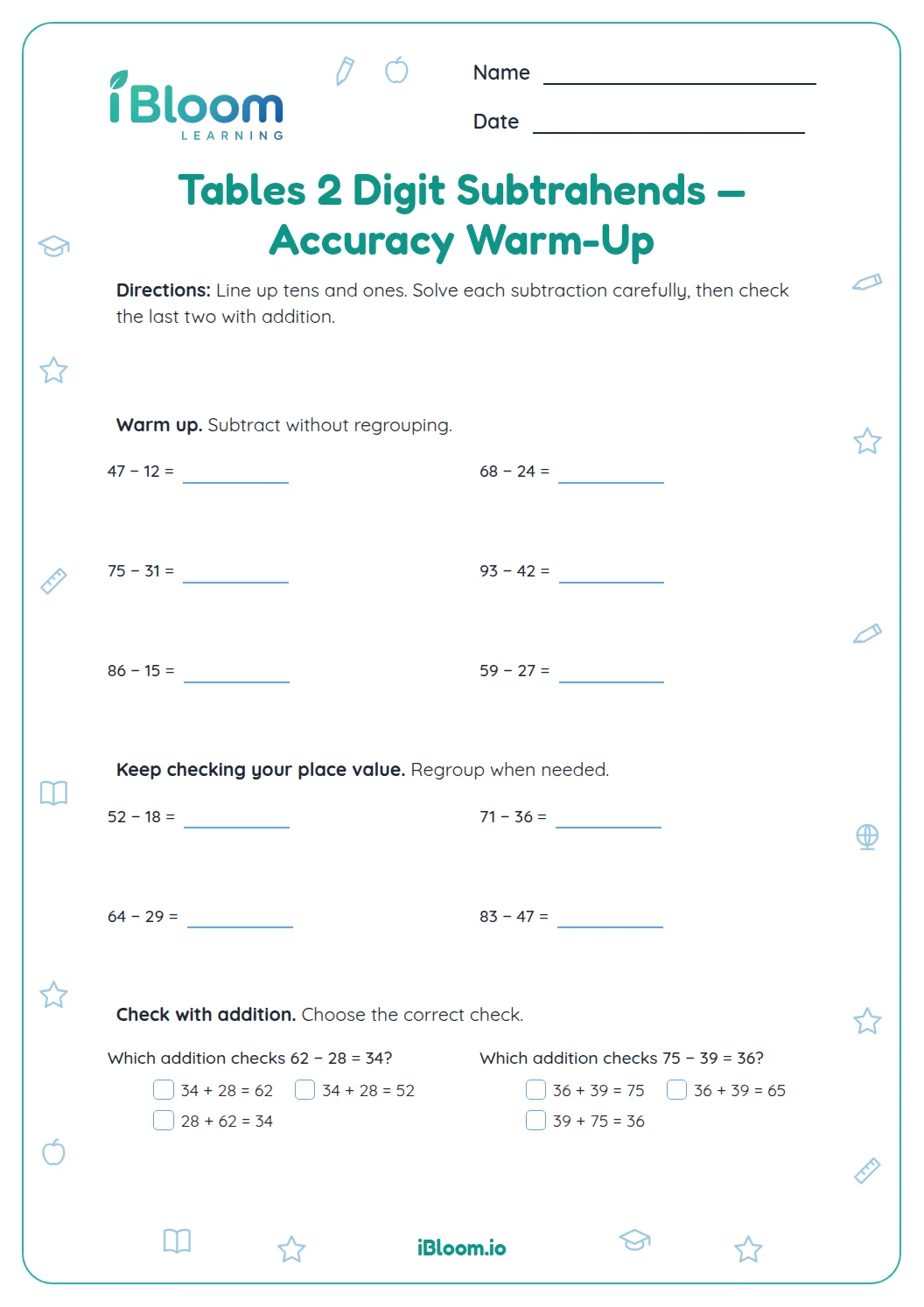
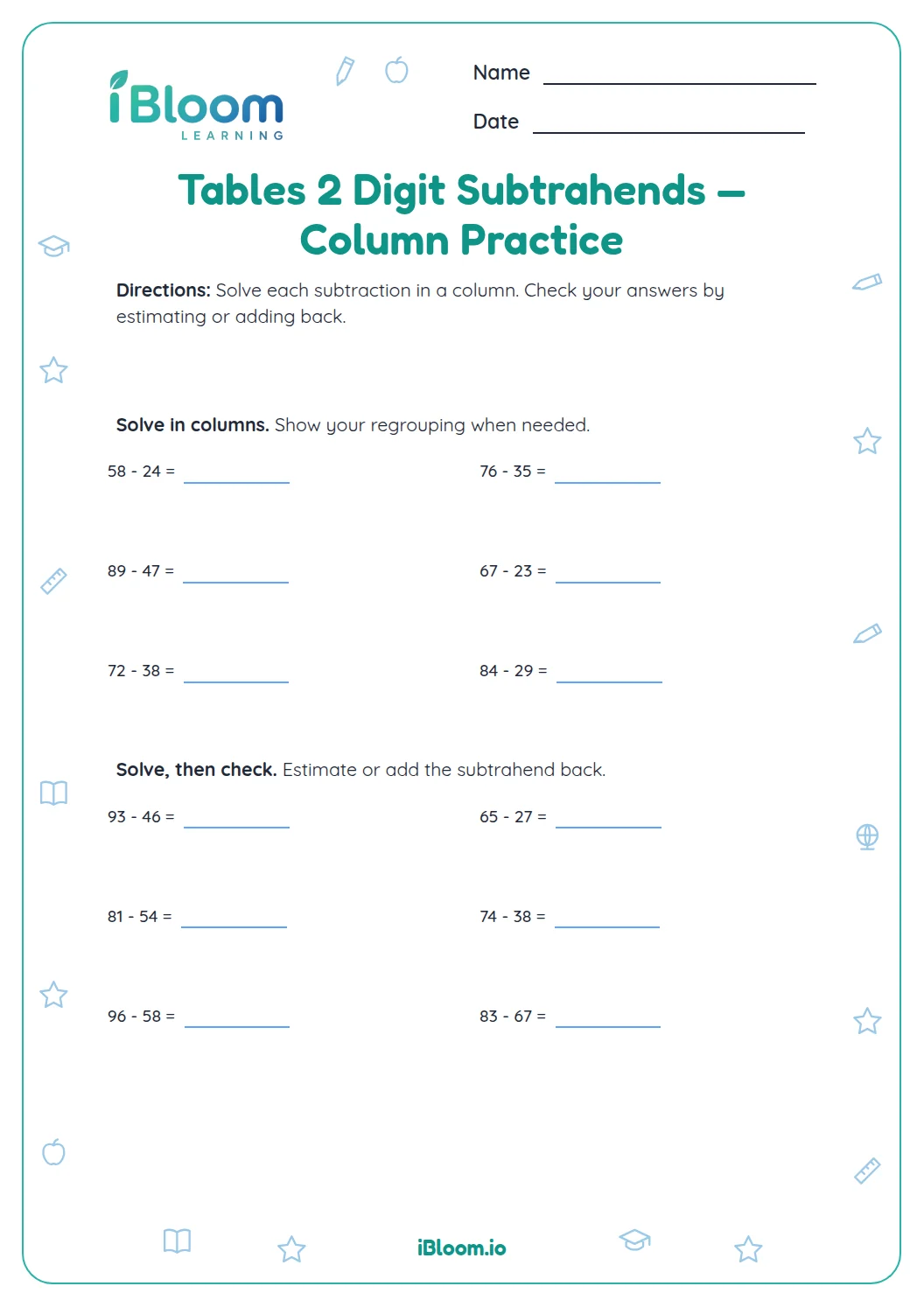
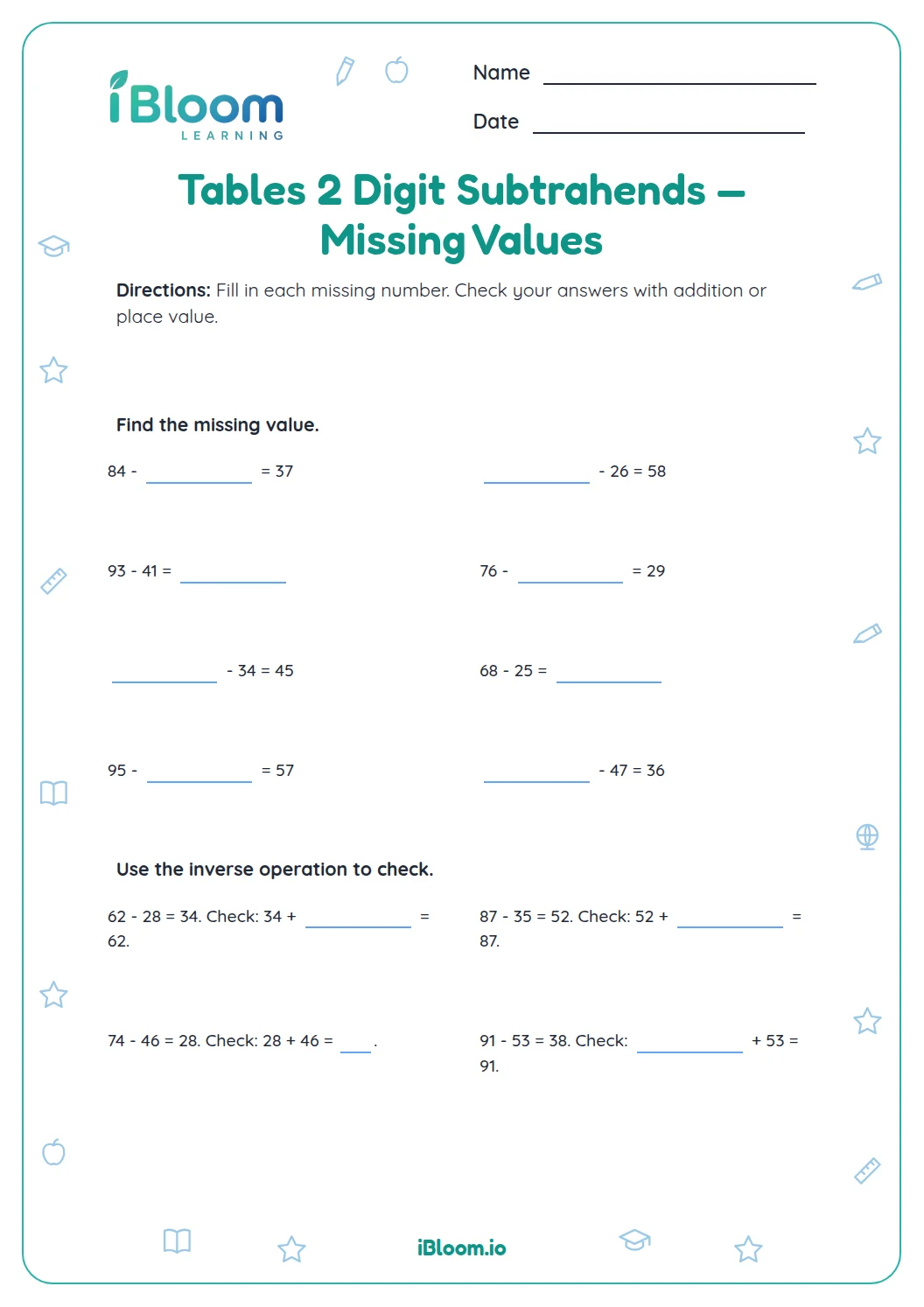
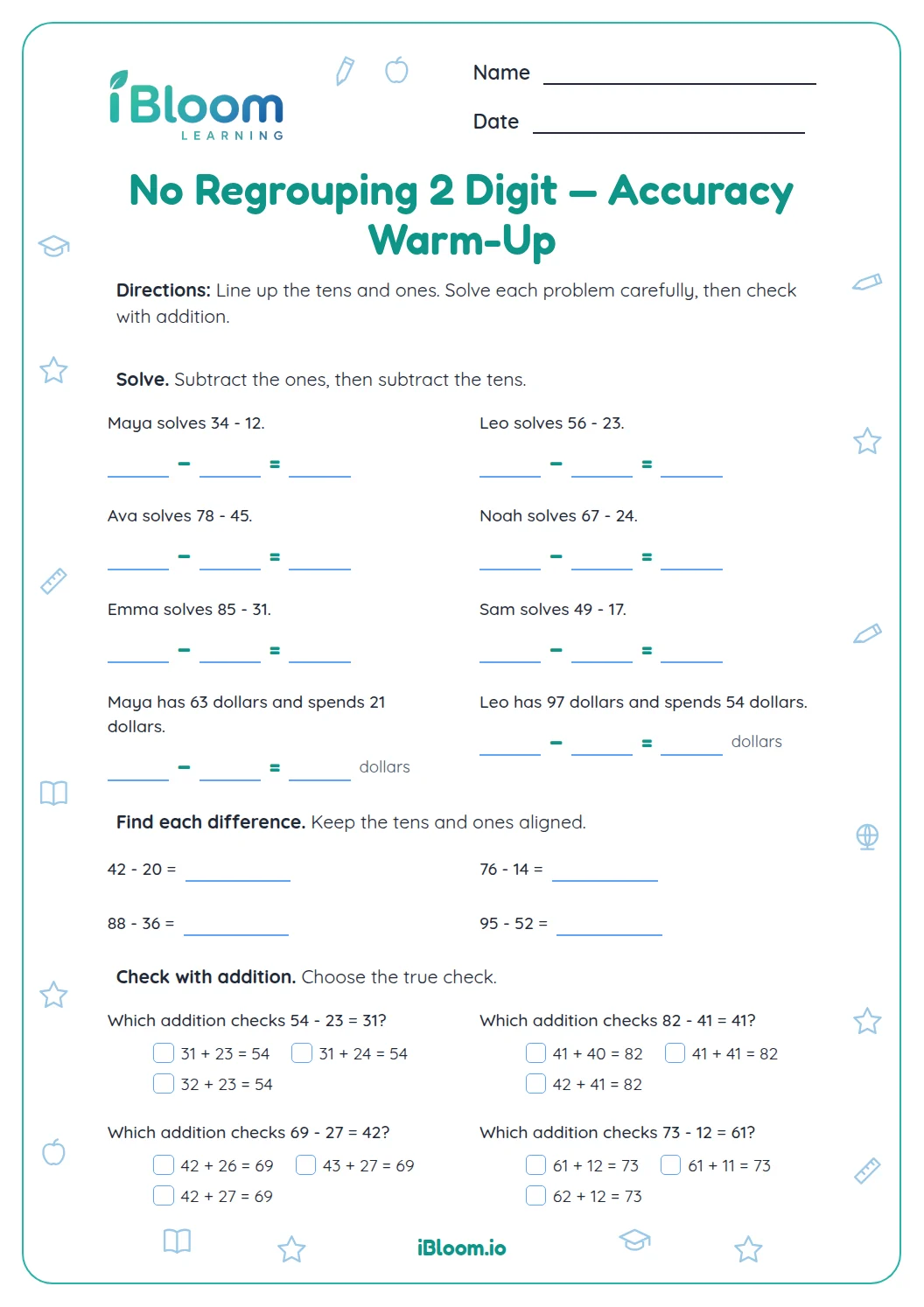
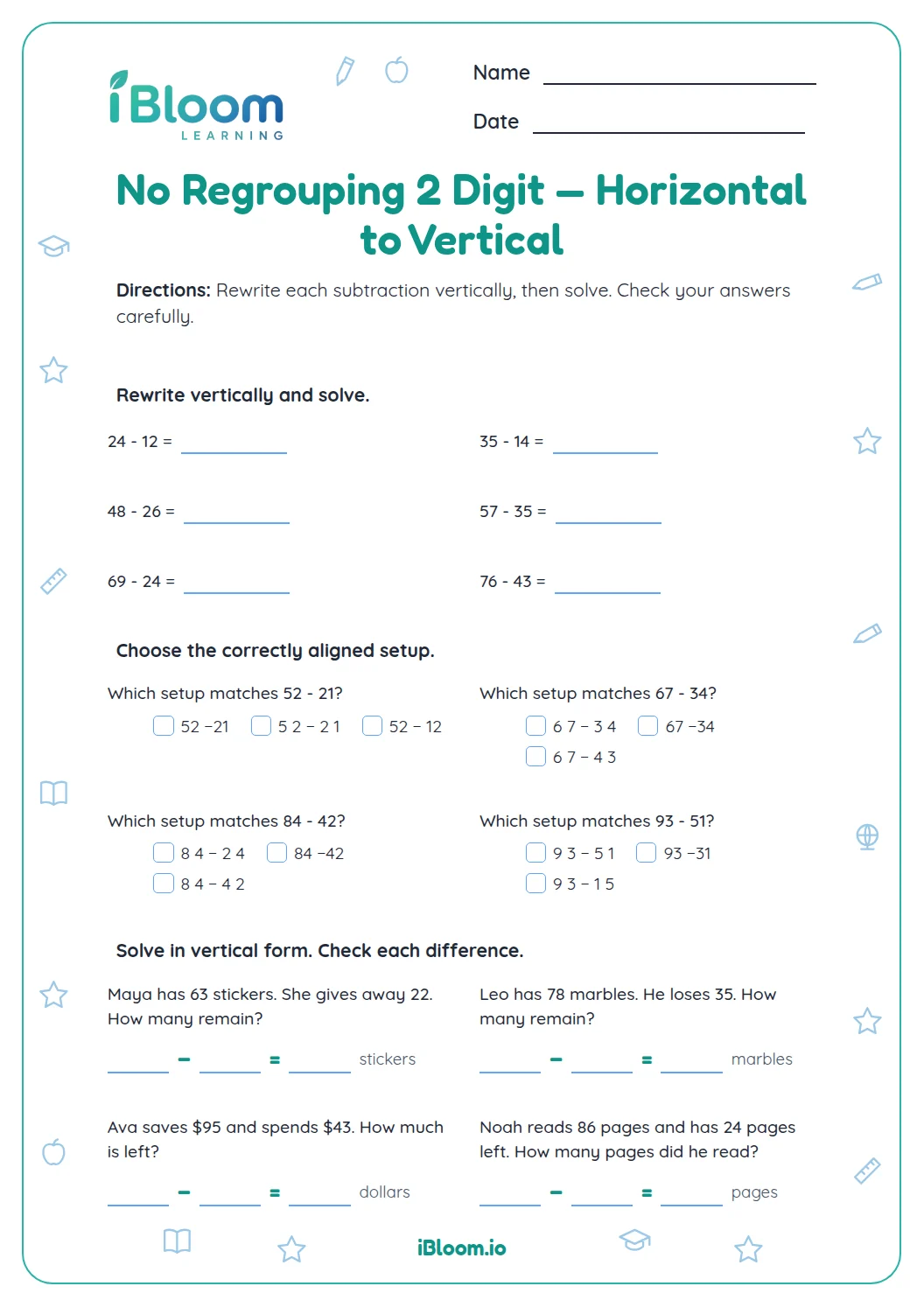
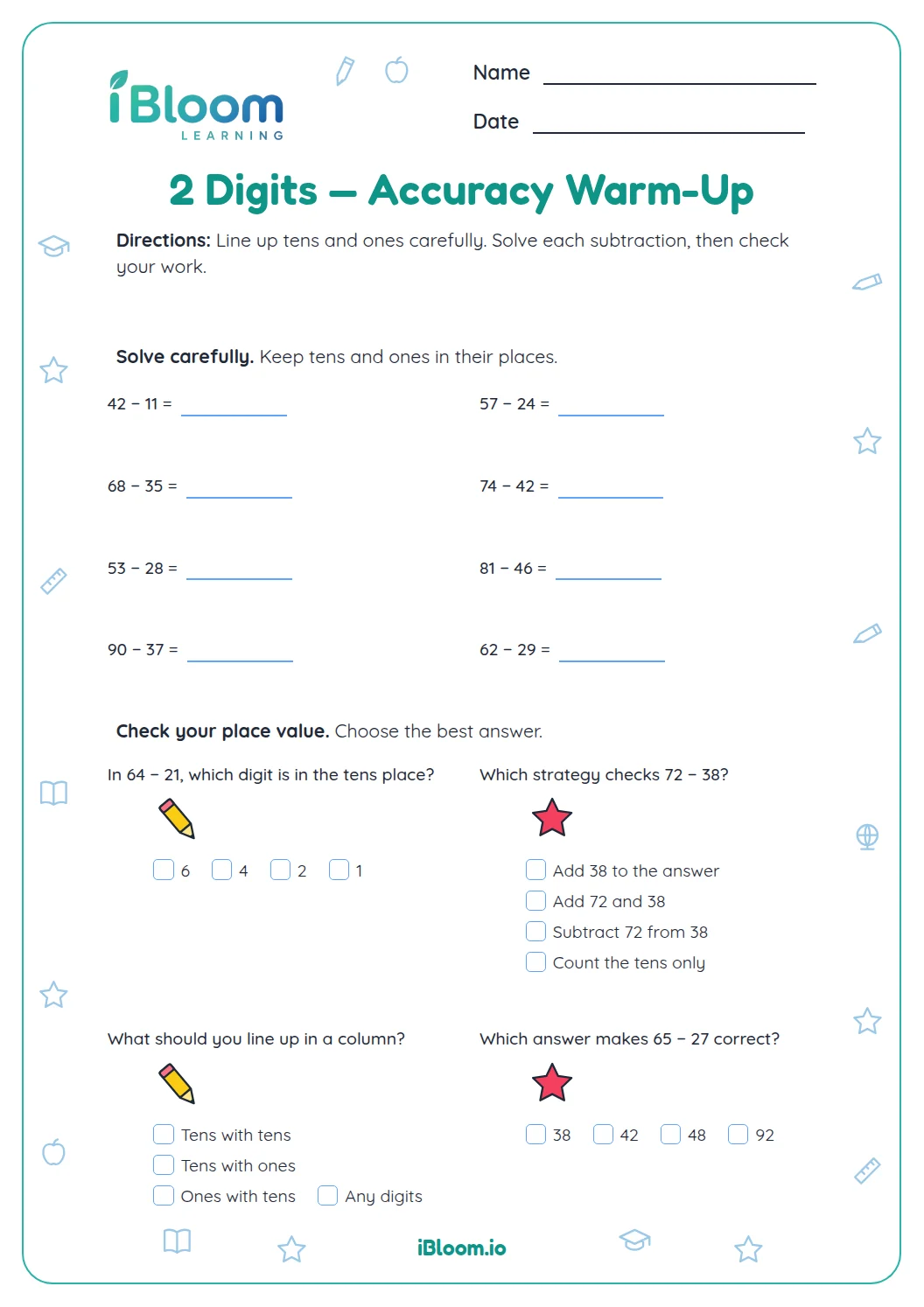
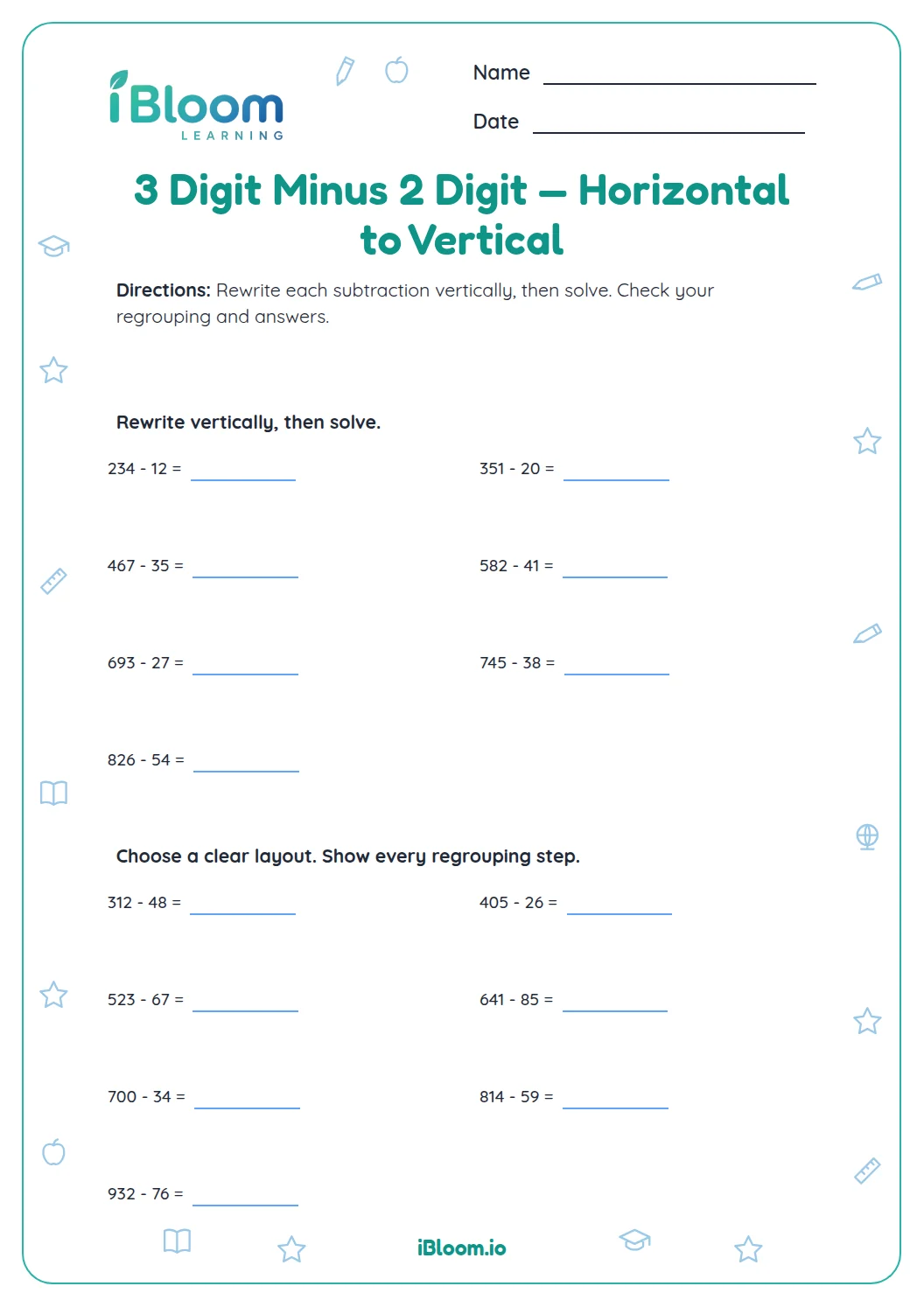
This Grade 2 worksheet has 15 questions on two-digit subtraction within 100, including problems with two-digit subtrahends. Students find the first incorrect step in five worked calculations, correct four subtraction problems, and compare six subtraction methods. The sequence follows the saved sheet’s error-analysis approach and uses place-value reasoning with regrouping. The work aligns with Common Core 2.NBT.B.5, and a separate answer key is included.
Aligned to 2.NBT.B.5
How do you find the first error in a subtraction solution?
Check the steps in order, beginning with regrouping and the ones column. In 64 − 28, the ones cannot be subtracted without regrouping. After trading one ten, 14 − 8 = 6. The first claim that says 4 − 8 = 4 is the first incorrect step.
- 164 − 28
- 2Regroup 6 tens as 5 tens and 14 ones.
- 314 − 8 = 6.
- 4The first incorrect step is A: 4 − 8 = 4.
How can you correct a two-digit subtraction calculation?
Trade one ten for ten ones if the top ones digit is too small. Then subtract the ones and tens. For example, 64 − 28 = 36. Add 36 + 28 to check that the sum returns to 64.
Which subtraction method is efficient?
Use place value and regroup only when needed. For 58 − 24, subtract 50 − 20 and 8 − 4 to get 34. For 63 − 27, regroup because 3 ones is less than 7 ones.
How to use this worksheet
- 1Read the claim or subtraction equation carefully.
- 2Subtract the ones, regrouping one ten when needed.
- 3Subtract the tens after regrouping.
- 4Add the difference to the subtrahend to check.
Mistakes to check
The mistake
Subtracting the smaller ones digit from the larger one without regrouping.
The fix
Trade one ten for ten ones first, then subtract the ones.
The mistake
Forgetting to reduce the tens after regrouping.
The fix
After trading a ten, subtract one fewer ten in the tens column.
The mistake
Checking by adding the difference to the starting number.
The fix
Add the difference to the subtrahend; the sum should return to the starting number.
Curriculum alignment
Subtract within 100 using place-value strategies and related operations.
On this sheet: Students solve two-digit subtraction within 100, regroup when needed, and check with addition.
Show the official wordingHide the official wording
Fluently add and subtract within 100 using strategies based on place value, properties of operations, and/or the relationship between addition and subtraction.
What to practice next
Make more practice
Further reading
Questions parents and teachers ask
How do you find the first incorrect subtraction step?
Check each written step from the beginning. Make sure regrouping trades one ten for ten ones, then check the ones subtraction before the tens subtraction. For 64 − 28, 4 − 8 = 4 is incorrect because regrouping is needed first.
When is regrouping needed?
Regroup when the top digit in the ones place is smaller than the bottom digit. In 64 − 28, trade one ten for ten ones so you can subtract 8 from 14. Then subtract the tens and check the difference by adding 28 back.
How can addition check a subtraction answer?
Add the difference to the number being subtracted. For example, 64 − 28 = 36 checks because 36 + 28 = 64. This lets students verify the result with an operation relationship after they complete the subtraction steps Use the exact subtraction steps shown in the prompt.
What is the difference between a correct and efficient method?
A correct method gives the right difference. An efficient method also uses clear steps without extra work, such as subtracting tens and ones separately when no regrouping is needed. The last six questions ask students to choose a suitable method for each calculation.
How many questions are on the worksheet?
There are 15 questions across the worksheet pages plus an answer key. Students inspect five worked solutions, correct four subtraction calculations, and compare six methods. The problems use two-digit numbers within 100 and include regrouping practice Use the exact subtraction steps shown in the prompt.