
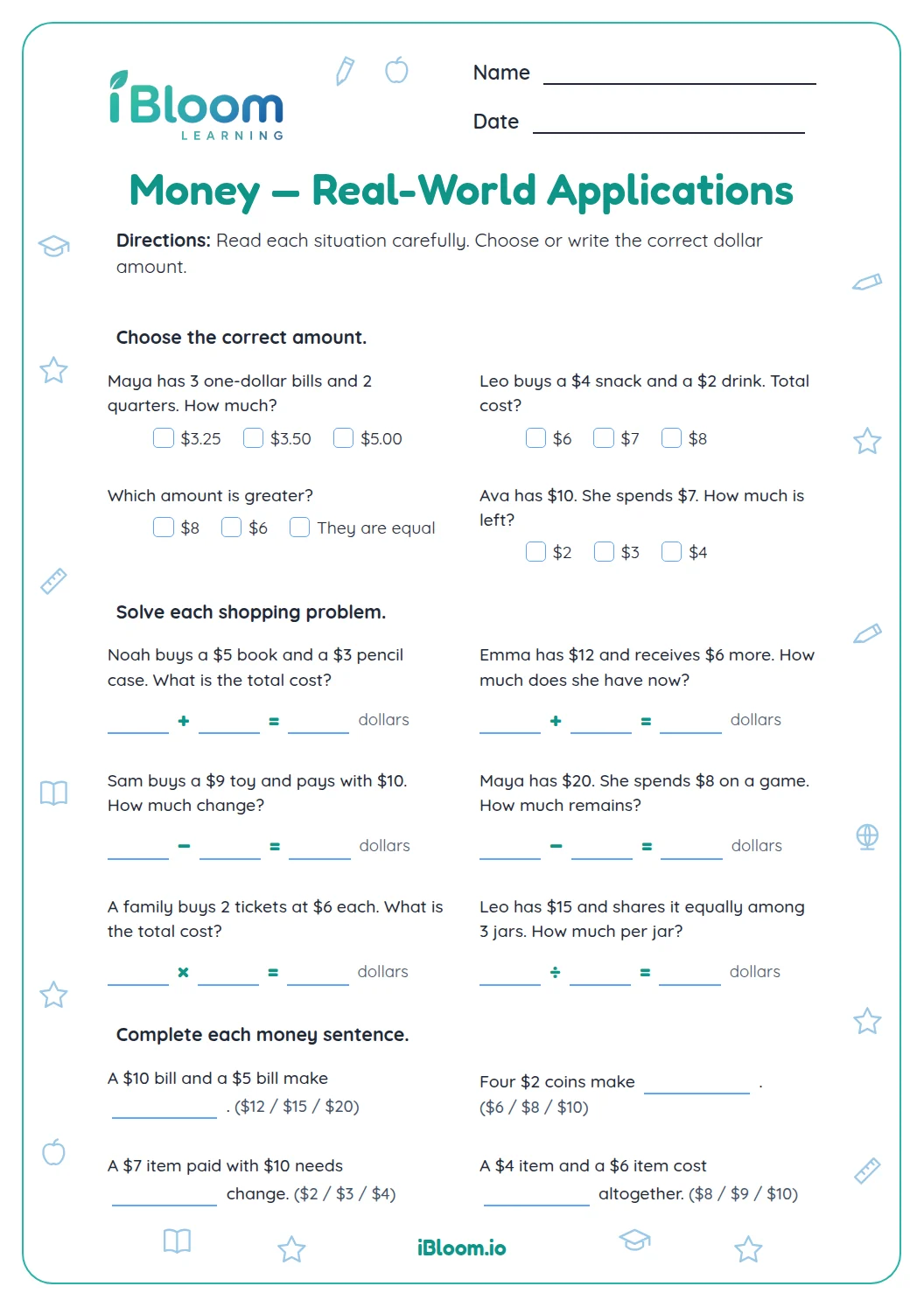
About this worksheet
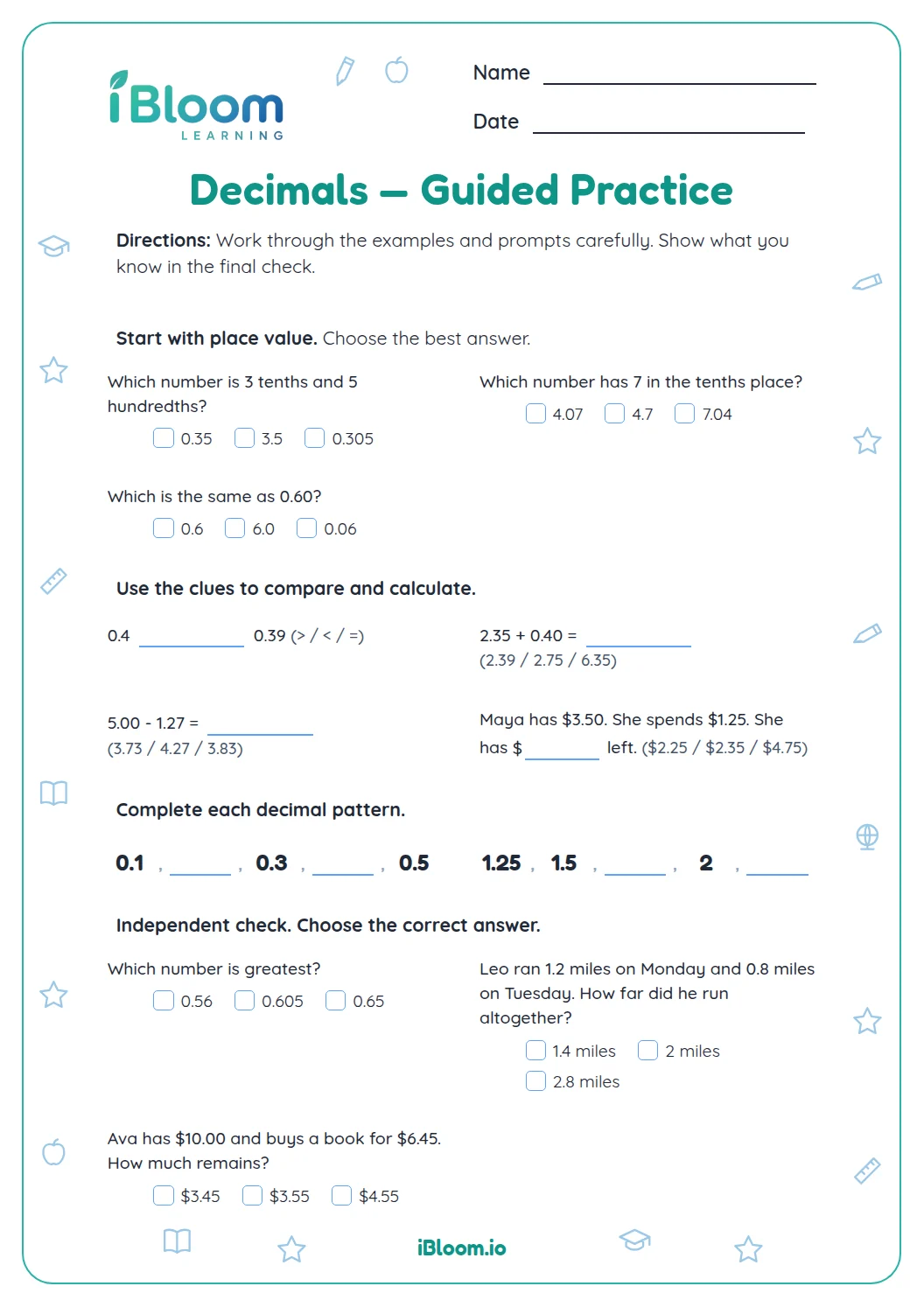
This printable Grade 5 worksheet puts decimals into familiar situations involving money, distance, weight, volume, and supplies. Students solve mixed addition and subtraction problems, entering decimal answers and units in blanks. The numbers reach hundredths, so students need to line up place values and treat a missing hundredths digit as zero when needed. The sheet practices Common Core 5.NBT.B.7 through addition and subtraction of decimals to hundredths in real contexts. A separate answer key shows each result.
Aligned to 5.NBT.B.7
What kinds of situations are on the sheet?
All 14 questions ask students to solve familiar decimal situations and fill in the missing amount. The problems use purchases, distances, recipe amounts, water, ribbon, and weight.
For money, keep the decimal hundredths even when the amount ends in zero.
How should a student line up decimal amounts?
Align decimal points so tenths are added to tenths and hundredths to hundredths. A zero can hold an empty place: 2.4 can be written as 2.40. Estimate whether the result should be greater or less than the starting amount before checking the calculation.
- 1Question 1 combines $2.75 and $1.20.
- 22.75 + 1.20 = 3.95, so the total is $3.95.
Why should the answer keep its unit?
The number alone may not tell what was measured. “3.35” could be meters of ribbon or liters of water, so copy the unit from the question. For money, include the dollar sign. Then check whether the answer makes sense: a remaining amount should be smaller than the start.
How to work through the decimal problems
- 1Underline the amounts and the unit in each situation.
- 2Decide whether the story joins amounts or takes an amount away.
- 3Line up decimal points before calculating.
- 4Add a zero to an empty decimal place when it helps.
- 5Check the result against an estimate and the story.
- 6Write the unit or dollar sign in the final answer.
Common decimal slips and quick fixes
The mistake
Adding 2.4 and 5.75 as if 24 and 575 had matching places.
The fix
Write 2.4 as 2.40 and align both decimal points.
The mistake
Treating 0.8 as smaller than 0.35 because it has fewer digits.
The fix
Compare tenths with tenths: 0.8 is 0.80.
The mistake
Leaving off meters, liters, or dollars after calculating.
The fix
Copy the unit from the situation into the final answer.
Common Core alignment
The problems use decimal addition and subtraction with amounts expressed to hundredths in everyday measurement and money contexts.
Add and subtract decimals to hundredths in real situations.
On this sheet: Students solve real-world addition and subtraction problems with decimal amounts to hundredths.
Show the official wordingHide the official wording
Add, subtract, multiply, and divide decimals to hundredths, using concrete models or drawings and strategies based on place value, properties of operations, and/or the relationship between addition and subtraction; relate the strategy to a written method and explain the reasoning used.
What to practice next
Make more practice
Further reading
Questions parents and teachers ask
What decimal skills does this worksheet practice?
The 14 questions practice adding and subtracting decimal amounts in familiar situations. Students work with hundredths in money and measurement contexts, write equations for word problems, and label their results with units. The answer key lists the correct totals and differences.
How do you add decimals with different numbers of digits?
Line up the decimal points, then add a zero to the shorter decimal if it helps. For example, 2.4 can be written as 2.40. This makes the tenths and hundredths places easier to compare and helps keep each digit in its correct column.
When should a student subtract in a word problem?
Subtract when a story describes an amount being used, spent, removed, or the change between two measurements. The remaining amount should be less than the starting amount. If the story combines two separate amounts, addition is usually the operation to use.
Why do the answers include units?
A unit tells what the decimal measures. The answer 3.35 is incomplete if the question asks how many meters of ribbon remain. Include meters, liters, kilograms, kilometers, cups, degrees, or a dollar sign as the situation requires. The unit makes the result clear.
How can a student check a decimal answer?
Estimate the result before or after calculating. A total should be greater than either amount being added, while an amount left after spending or using some should be less than the starting amount. Recheck the decimal alignment if the result does not fit the story.