

About this worksheet
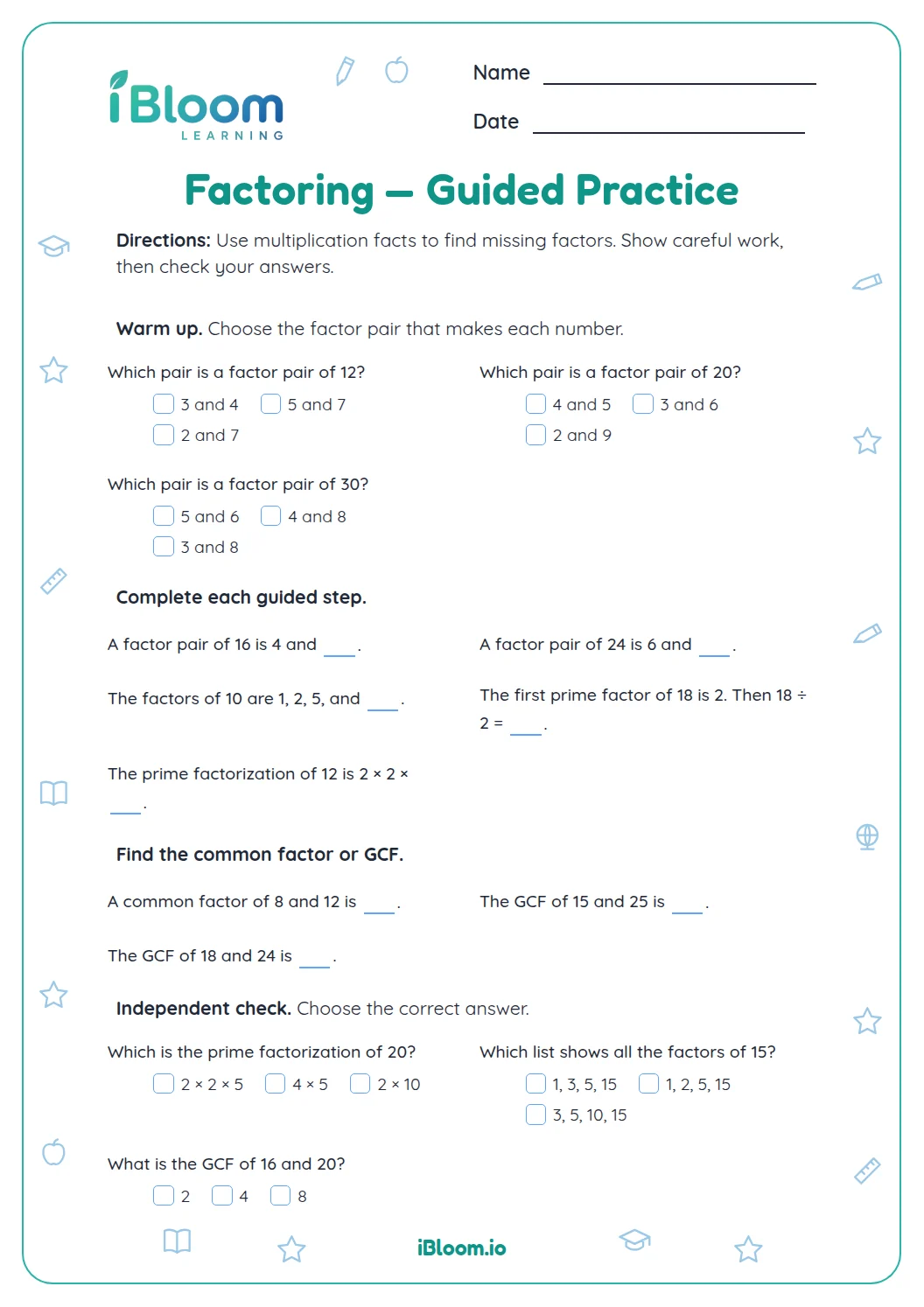
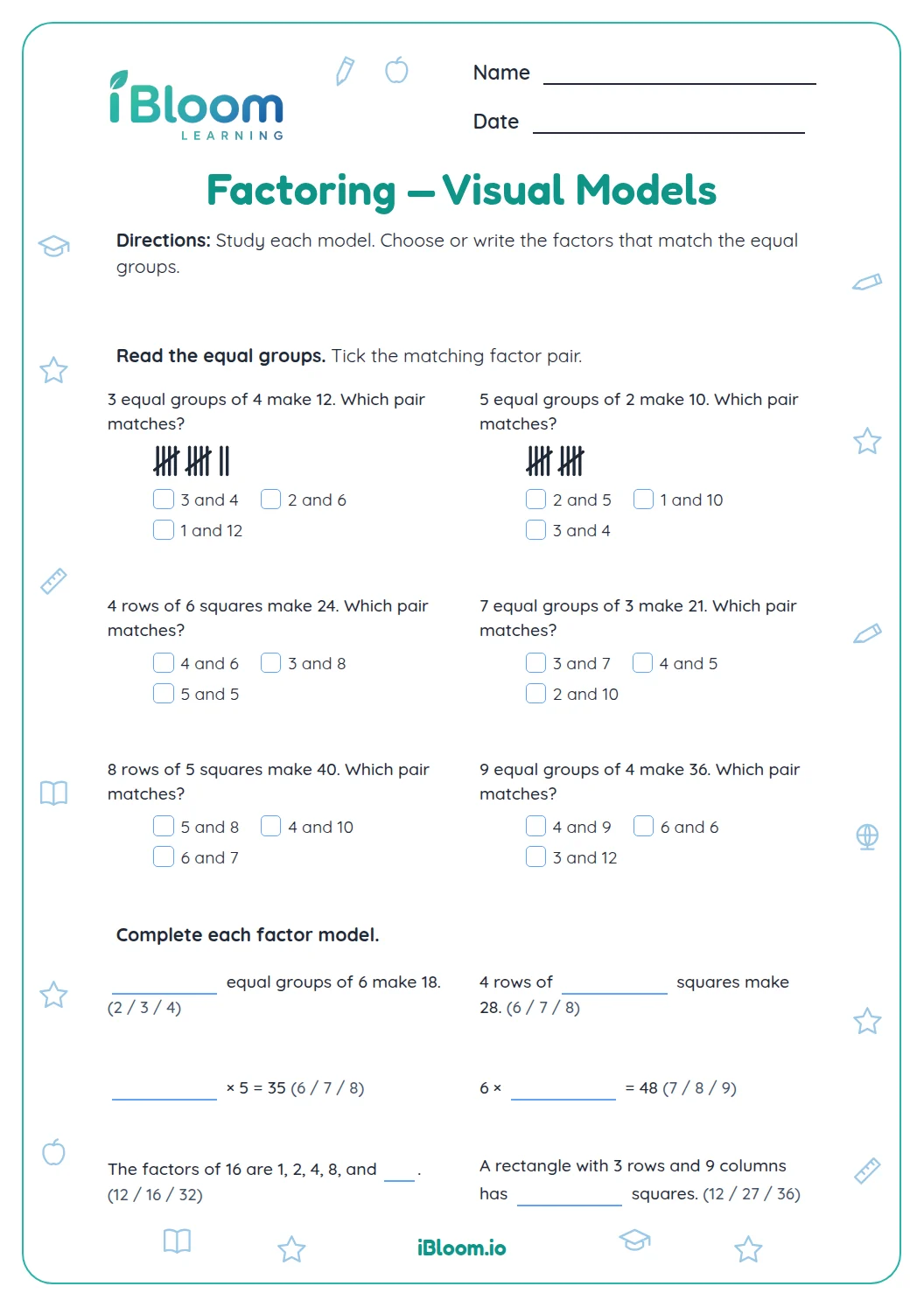
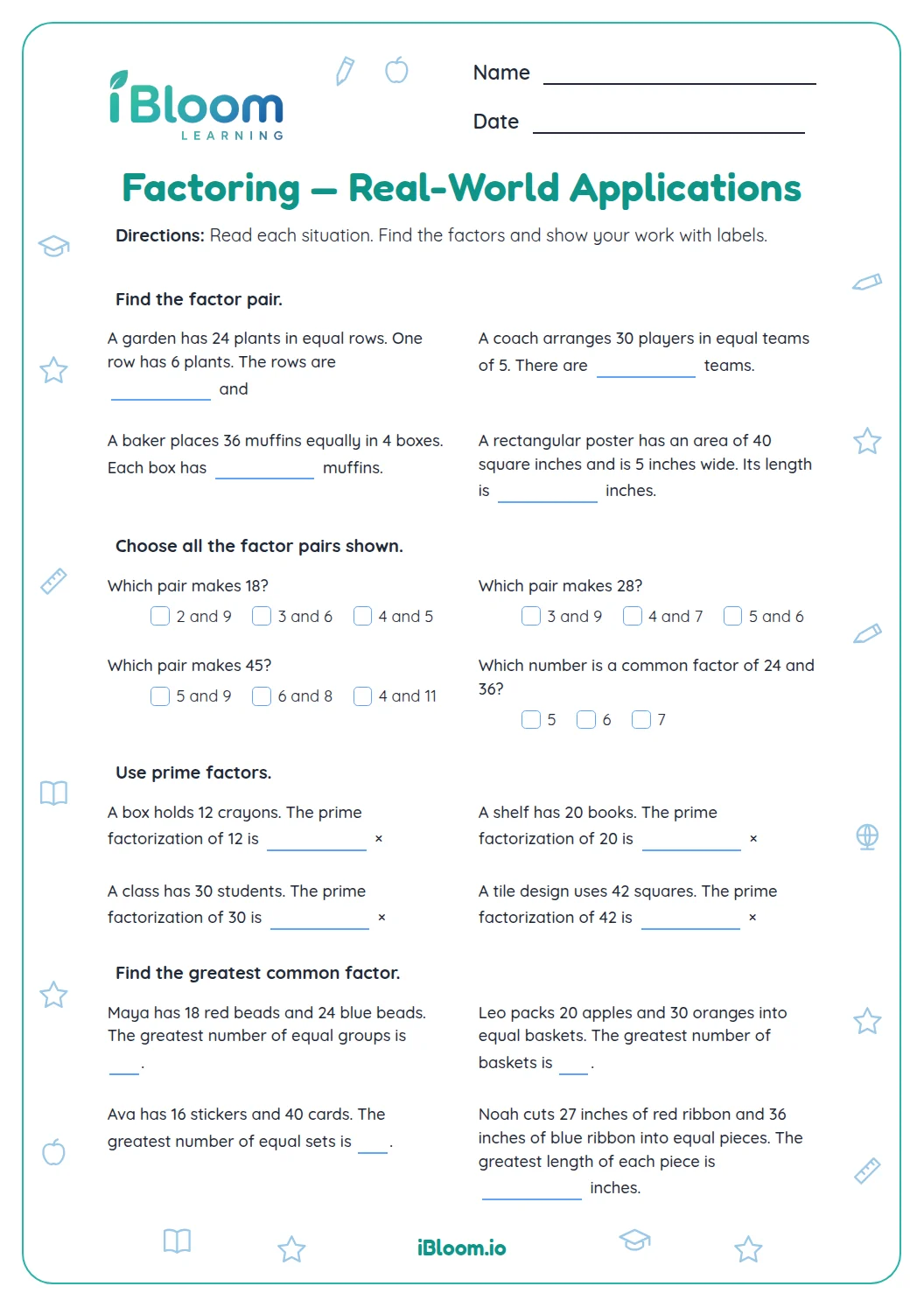
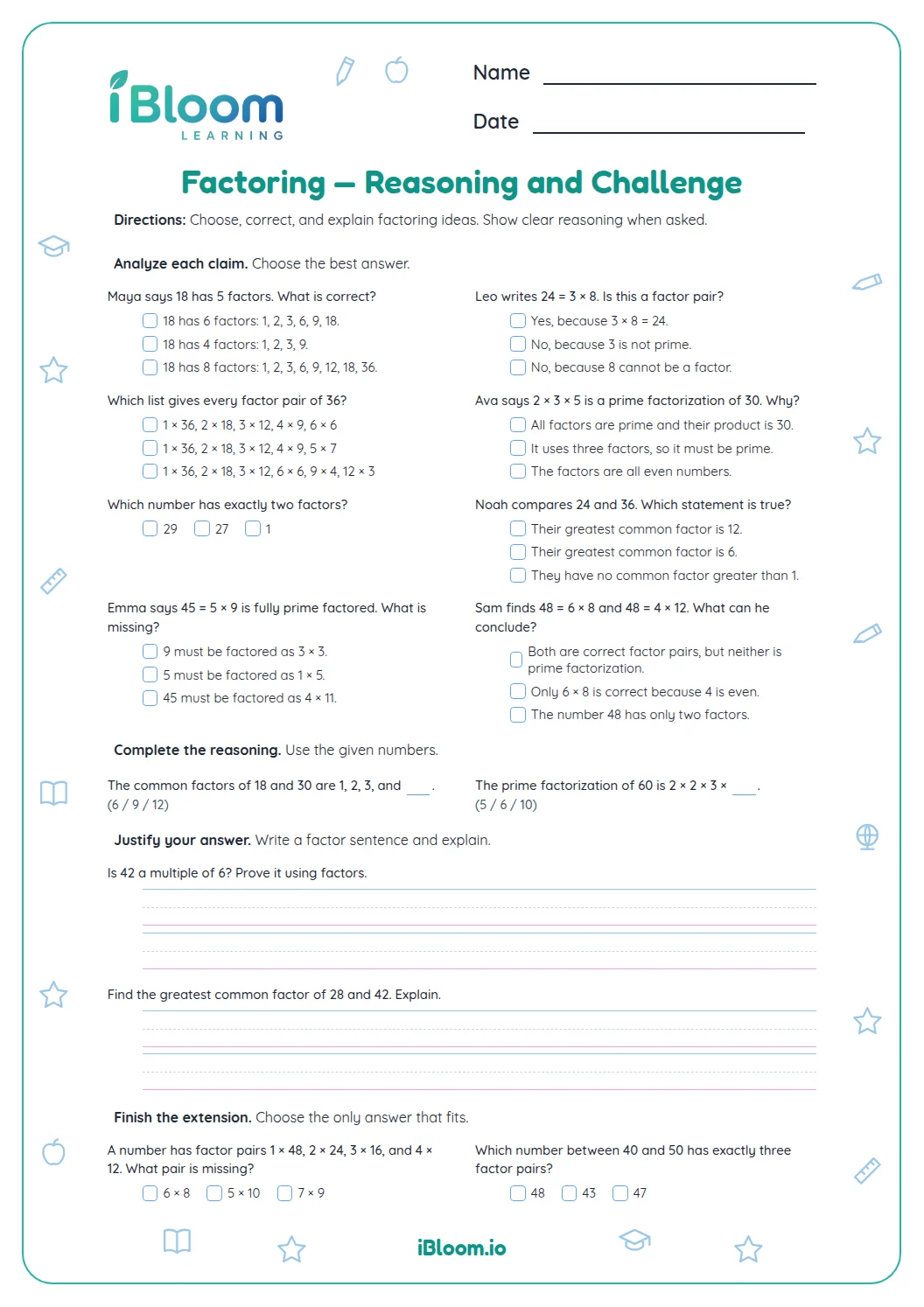
This factoring worksheet gives upper elementary students 14 chances to connect multiplication with factors. They name and list factor pairs, complete a product, read arrays, classify prime and composite numbers, and use factors in equal-group situations. The worksheet pages move from finding pairs to applying factor reasoning, with a separate answer key. The number range stays within 100 and aligns with CCSS 4.OA.B.4.
Aligned to 4.OA.B.4
How do you find factor pairs?
Try dividing the whole number by 1, then 2, then the next whole numbers. When the quotient is also a whole number, the divisor and quotient make a pair. Stop when the pairs repeat in reverse.
- 128 = 1 × 28
- 228 = 2 × 14
- 328 = 4 × 7
- 4No new pair follows because 7 × 4 repeats.
What does an array have to do with factors?
Rows and columns name a factor pair. The 4 by 9 array in q7 has 36 counters, so 4 and 9 are factors of 36. Turning it gives another arrangement, 6 rows of 6. Question 8 states five rows of seven stars; their product is 35.
- 14 rows of 9 counters
- 26 rows of 6 counters
- 3Both arrangements make 36.
How can factors show whether a number is prime?
A prime number has exactly two positive factors: 1 and itself. A composite number has more than two. Since 51 equals 3 × 17, it has more than two factors and is composite.
- 145 = 5 × 9
- 2Both factors are greater than 1.
- 3So 45 is composite.
How to use this worksheet
- 1Test small divisors in order and record each whole-number quotient.
- 2Check each pair by multiplying its two factors.
- 3For array questions, count rows and columns and verify the product.
- 4A number is prime only if 1 and itself are its only positive factors.
- 5Use the answer key to check that no factor pairs were skipped.
Common mistakes and quick fixes
The mistake
Listing the same pair twice in reverse order.
The fix
Stop when the next divisor would repeat a pair already listed.
The mistake
Calling every odd number prime.
The fix
Test odd divisors too; 21 = 3 × 7 and is composite.
The mistake
Confusing a factor with a multiple.
The fix
A factor divides the number evenly; the number is a multiple of that factor.
Common Core alignment
This worksheet practices the following Common Core math skills.
Find factor pairs and tell whether whole numbers are prime or composite.
On this sheet: Questions list factor pairs and classify numbers through 100.
Show the official wordingHide the official wording
Find all factor pairs for a whole number in the range 1-100. Recognize that a whole number is a multiple of each of its factors. Determine whether a given whole number in the range 1-100 is a multiple of a given one-digit number. Determine whether a given whole number in the range 1-100 is prime or composite.
What to practice next
Make more practice
Further reading
Questions parents and teachers ask
What is a factor pair?
A factor pair is two whole numbers whose product is the number being studied. For 24, 4 and 6 form a pair because 4 × 6 = 24. The worksheet asks children to name pairs, list all pairs for selected numbers, and use them in equal-group situations.
How do I know when I have listed every factor pair?
Test possible divisors in order, starting with 1. Once the divisor is larger than the matching quotient, the pairs repeat in reverse. For 28, the pairs are 1 and 28, 2 and 14, and 4 and 7, so the list is complete.
What is the difference between prime and composite?
A prime whole number greater than 1 has exactly two positive factors: 1 and itself. A composite number has more than two. The worksheet asks students to classify 29 and 51 and to use a factor pair to explain why 21 is composite.
Can arrays help with factoring?
Yes. An array organizes objects into equal rows and columns, and the row and column counts multiply to the total. The 4-row, 9-column array has 36 counters, so 4 and 9 are a factor pair of 36; the second arrangement is 6 by 6.
What kind of factoring does this worksheet practice?
The sheet focuses on factor pairs, equal groups, and prime or composite classification. For example, children use 5 and 9 to show 45 is composite and find a factor pair for a packet problem. These ideas build fluency with products and whole-number factors.