
About this worksheet
This mixed-level worksheet progresses from multiplication facts to multiplying by two- and three-digit numbers and solving equal-groups stories. The range supports learners across the listed grades; choose the sections that match current instruction.
Aligned to 4.NBT.B.5
How does this sheet build multiplication skill?
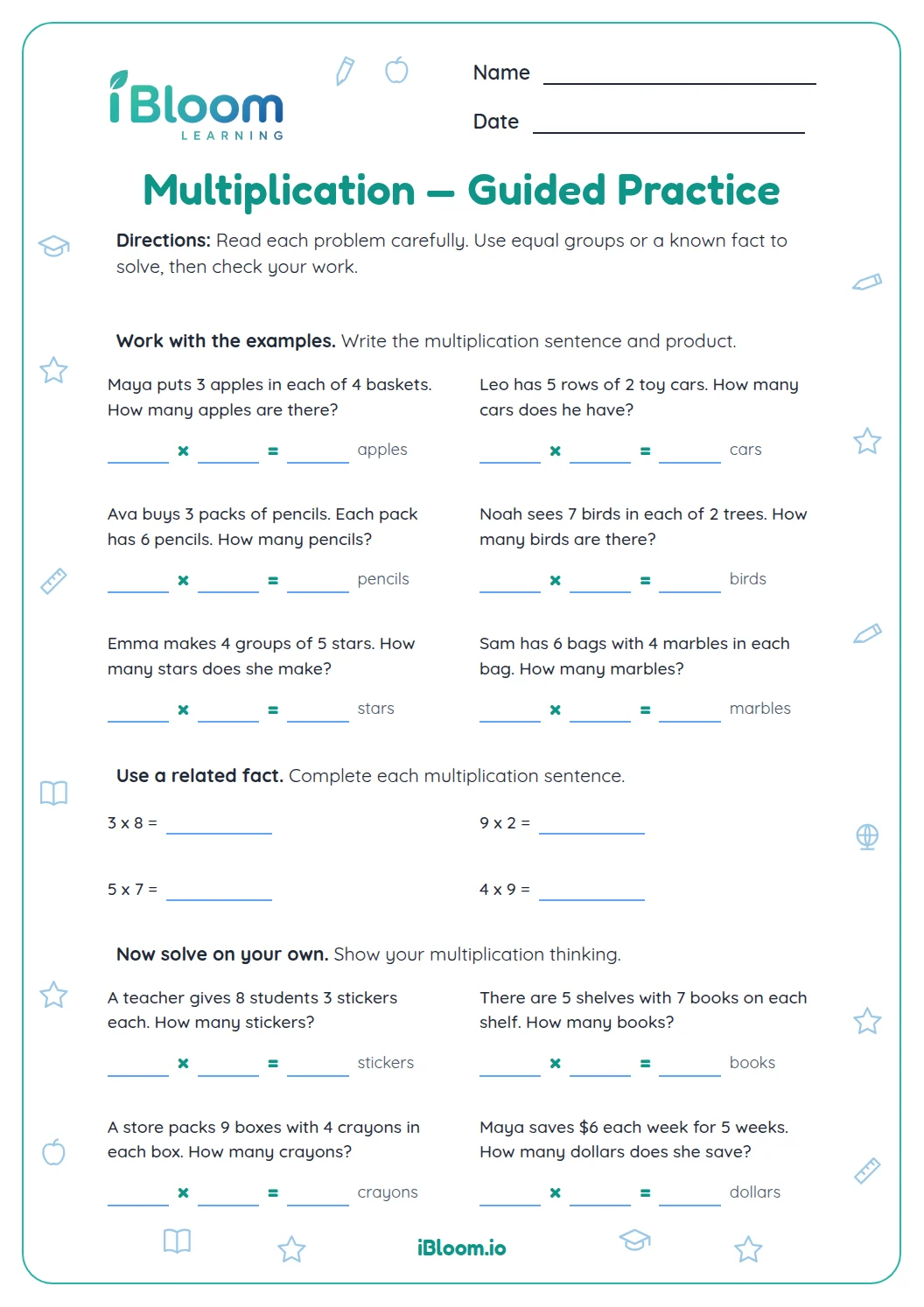
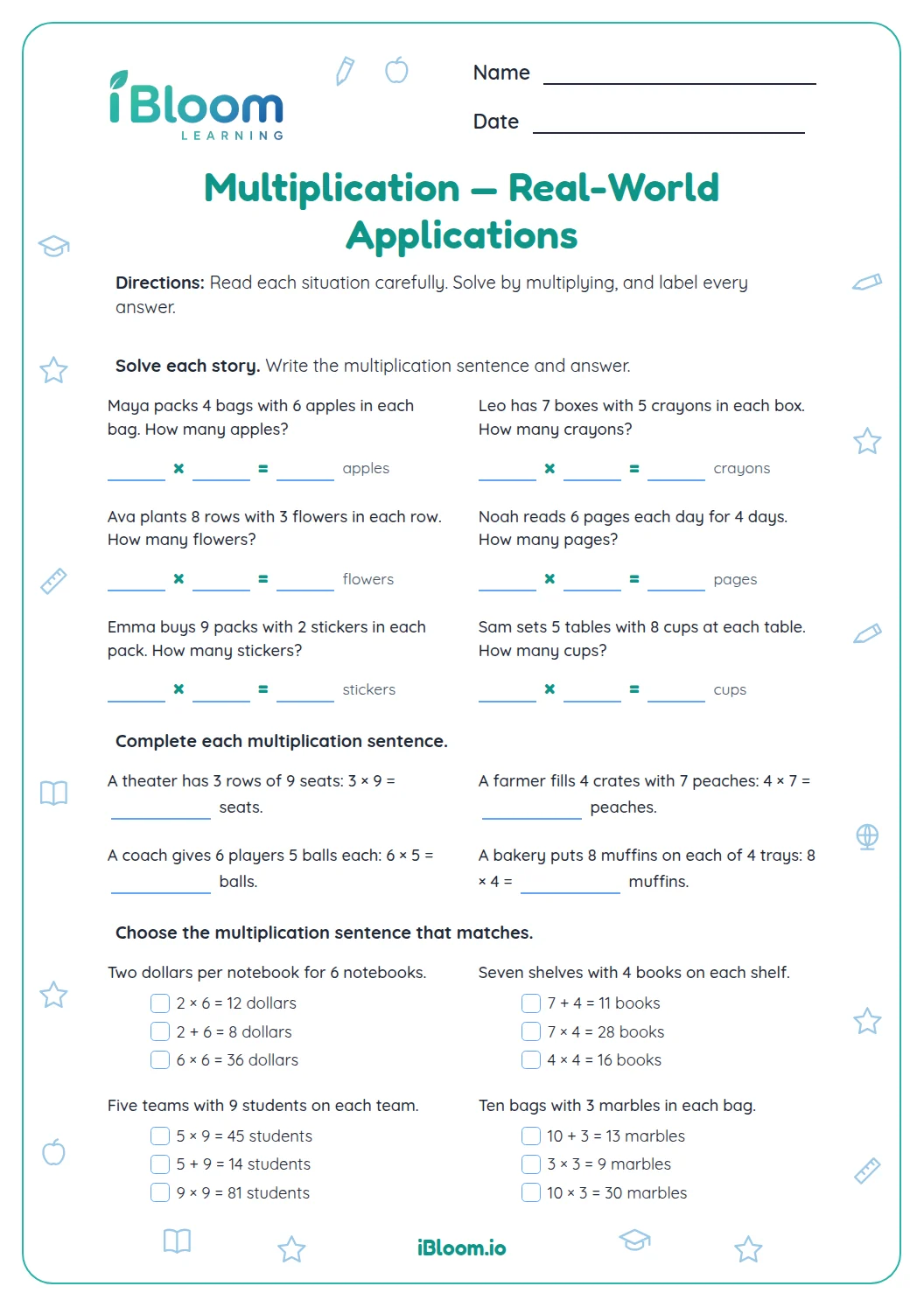
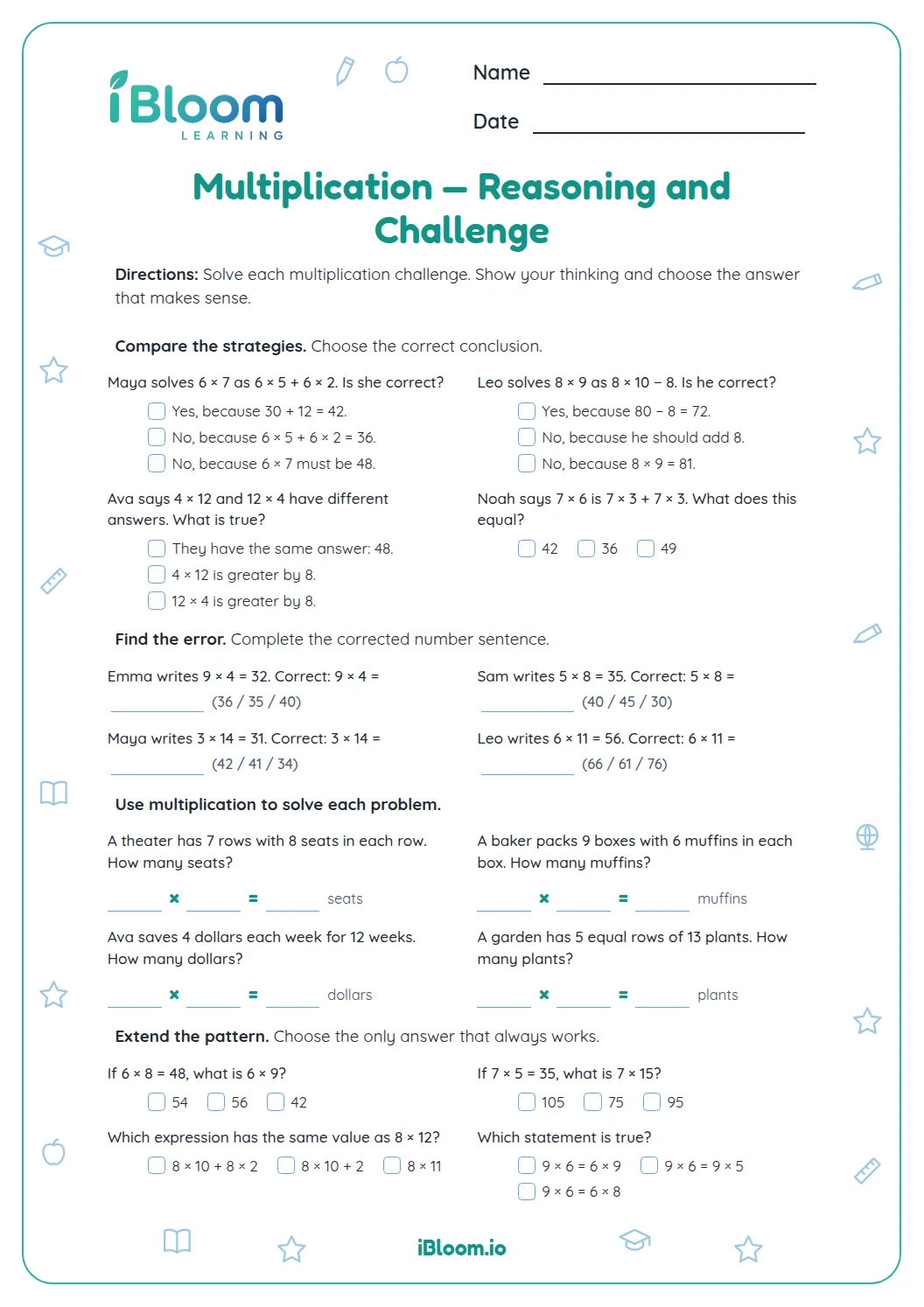
Part A reviews core facts. Part B uses place value with larger factors. Part C applies multiplication to equal groups and asks learners to explain a strategy.
The sequence moves from fluent facts to products such as 6 × 34 and 3 × 125. Learners can show partial products to keep the place values clear.
What will learners practice?
The source page lists Grades 2 through 5. This set starts with facts and extends to multi-digit products for learners studying upper-elementary multiplication.
- Part A: A
- Part B: B
- Part C: C
How to use this worksheet
- 1Warm up with Part A and use a known fact to check an unfamiliar product.
- 2For Part B, split the larger factor into place-value parts.
- 3In Part C, write an equation before calculating and include units.
Common mistakes and quick fixes
The mistake
Forgetting that 3 × 125 means three groups of 125.
The fix
Estimate first: the answer should be near 300–400.
The mistake
Multiplying the tens digit as though it were ones.
The fix
Write 34 as 30 + 4 and keep the tens value in its partial product.
Common Core alignment
This worksheet practices the following Common Core skill.
Multiply whole numbers using place-value strategies.
On this sheet: Facts, distributive reasoning, and multiplication by larger factors provide progression through upper-elementary multiplication.
Show the official wordingHide the official wording
Multiply a whole number of up to four digits by a one-digit whole number, and multiply two two-digit numbers, using strategies based on place value and the properties of operations. Illustrate and explain the calculation by using equations, rectangular arrays, and/or area models.
What to practice next
Make more practice
Further reading
Questions parents and teachers ask
How do I multiply 6 by 34?
Break 34 into 30 and 4. Multiply each part: 6 × 30 = 180 and 6 × 4 = 24. Then add the partial products, 180 + 24 = 204. This uses place value and the distributive property to make a larger multiplication fact easier to solve.
How does place value help with multiplication?
Place value lets you split a factor into tens, hundreds, and ones. Multiply the other factor by each part, keeping each place value in the result, then combine the partial products. Estimating first also helps you notice an answer that is much too large or too small.
Which grades can use this sheet?
This page is labeled for Grades 3–5 and moves from multiplication facts to larger factors and multi-digit products. Teachers and families can choose the questions that fit current instruction. The later questions use multi-digit multiplication, while the opening facts provide a warm-up.
Is there an answer key?
Yes. A separate answer key gives the products and labeled word-problem answers. It also includes a sample strategy for the final explanation. Students may use another correct method, such as an array, partial products, or breaking apart a factor, as long as the calculation and result are accurate.
How can I check a multiplication product?
Use an estimate or the inverse operation. For 6 × 34, estimate about 6 × 30 = 180, then check the exact product, 204, by dividing 204 by 6 to get 34. The answer key lists products and units for the word problems.