
About this worksheet
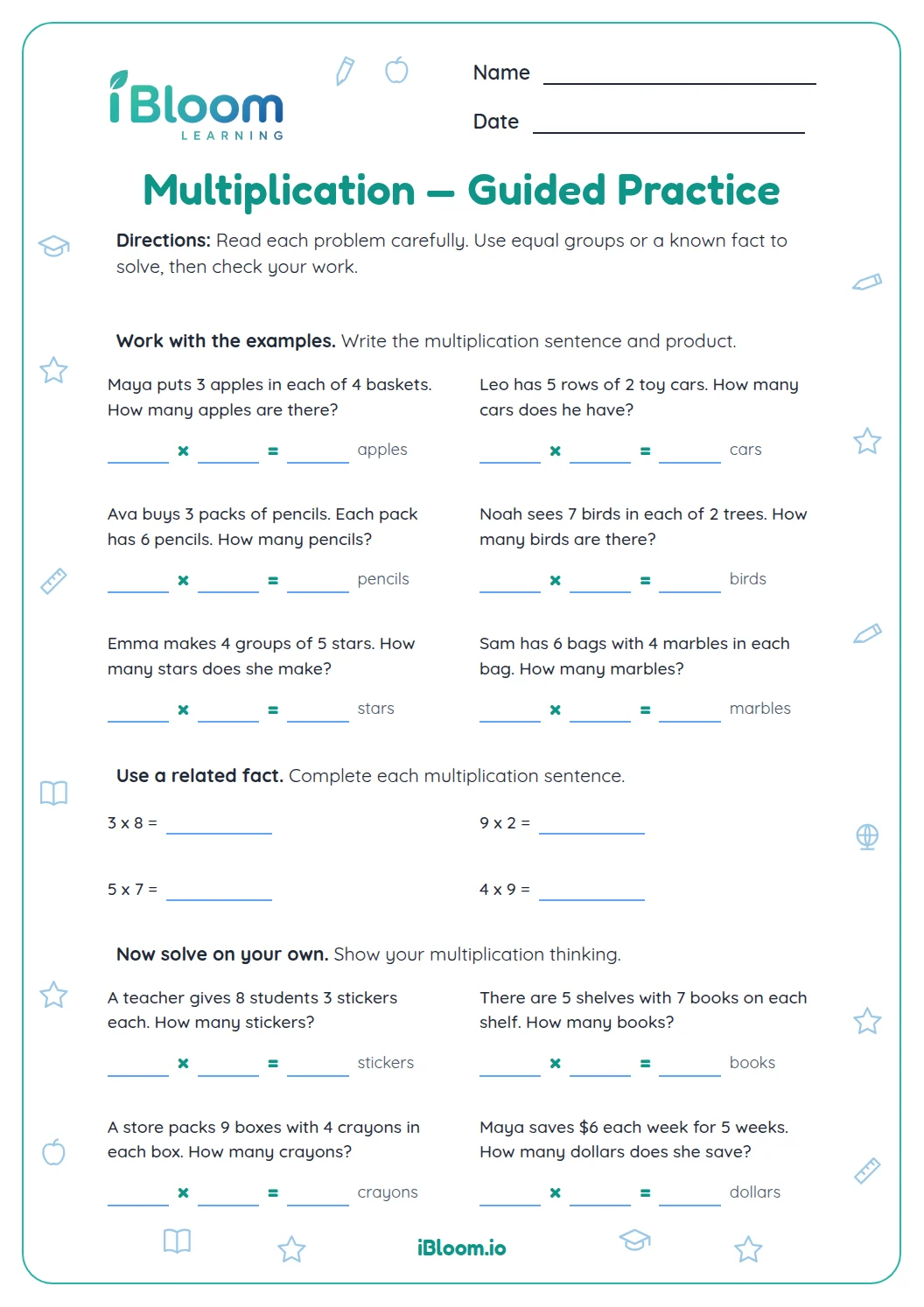
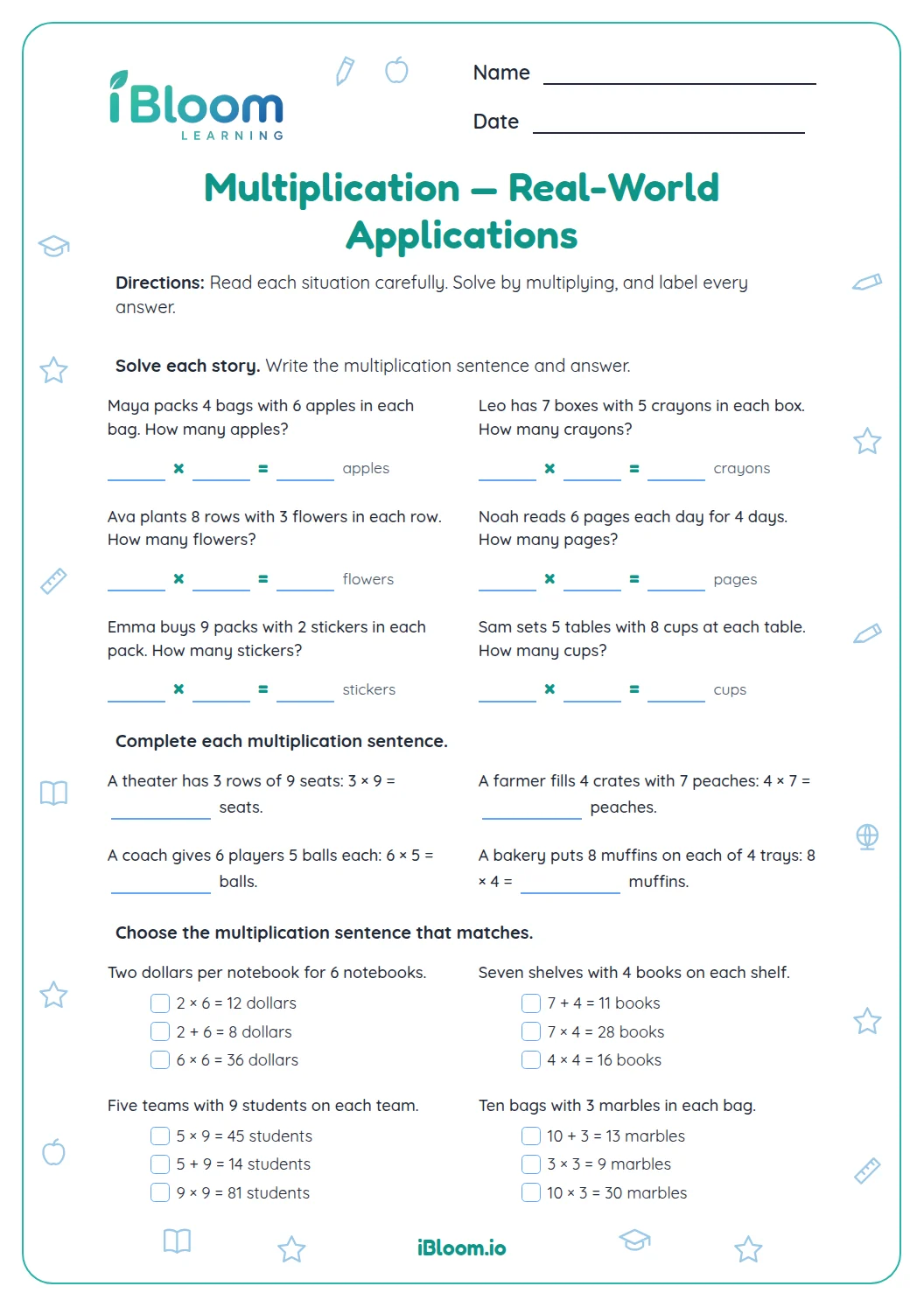
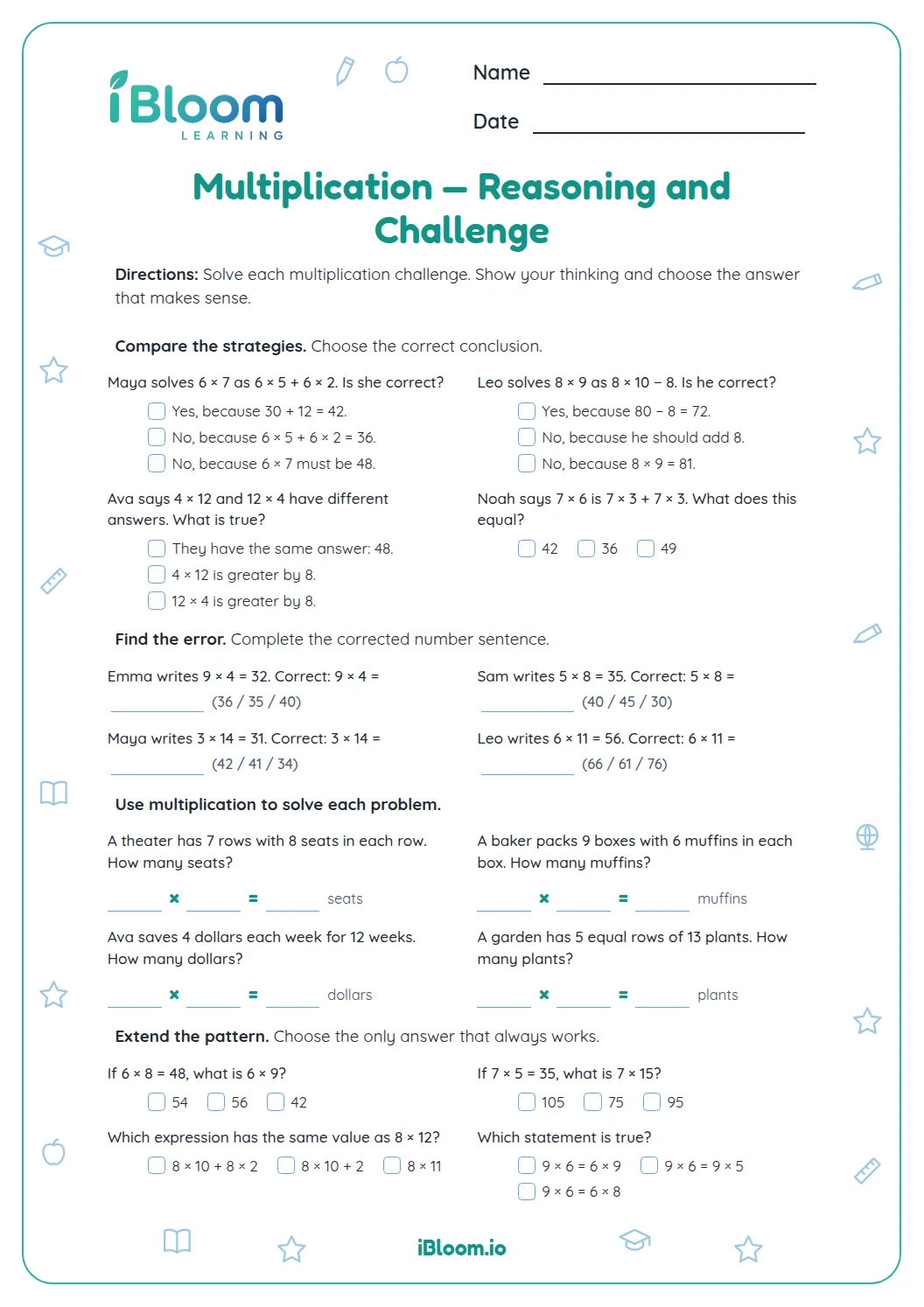
This Grade 3 printable uses arrays to connect equal groups with multiplication. Learners read six pictured arrays, complete four missing products, and solve four short stories with array models. The practice builds the interpretation described in Common Core 3.OA.A.1, and the answer key gives a quick way to check each product.
Aligned to 3.OA.A.1
How do arrays show multiplication?
An array has equal rows and equal columns. Count the rows as groups, then count the items in each row; multiplication records the total without counting every dot one by one.
Question 2 has 3 rows of 4. The matching sentence is 3 × 4 = 12, so there are 12 dots.
- 13 rows of 4 dots
- 23 × 4 = 12
- 3There are 12 dots in all.
What does this page ask learners to do?
The page has six pictured arrays, four number sentences with a missing product, and four equal-row stories. The stories include array drawings; the number sentences are independent fact practice.
How to use this worksheet
- 1Point to one row and count its dots.
- 2Count the rows to find how many equal groups there are.
- 3Write rows × dots in each row.
- 4Find the product and check by skip counting.
- 5For a story, make sure its group count and group size match the array.
Common mistakes and quick fixes
The mistake
Switching rows and dots per row
The fix
The factors can switch places without changing the product. When explaining an array, name the rows and items in each row clearly.
The mistake
Counting only one row
The fix
A row gives the group size, so multiply it by the number of rows.
The mistake
Adding the factors
The fix
Multiplication asks for all the items in equal groups; count or multiply the groups, not add the two factor labels.
Common Core alignment
This worksheet gives learners practice with the standard below.
Interpret rows or groups as equal sets and find their total with multiplication.
On this sheet: Interpret rows or groups as equal sets and find their total with multiplication.
Show the official wordingHide the official wording
Interpret products of whole numbers, e.g., interpret 5 × 7 as the total number of objects in 5 groups of 7 objects each. For example, describe a context in which a total number of objects can be expressed as 5 × 7.
What to practice next
Make more practice
Further reading
Questions parents and teachers ask
What does an array show?
An array places objects in equal rows and columns. Count the rows and the objects in each row to identify the factors, then find the product. The first six questions ask learners to read the total from a pictured array.
How can a child solve 3 rows of 4?
There are 4 objects in each row and 3 rows, so 3 × 4 = 12. The factors describe the array, and the product is the total number of objects. Question 2 uses this exact arrangement. This total is the product.
Are word problems included?
Yes. The last four questions describe equal rows of crayons, seeds, books or shells. Each story has a matching array, so learners can connect the group count and group size to the total. The drawing shows both factors as equal rows.
Does the sheet include an answer key?
Yes. A separate key gives the products for all 14 questions. Use it to check the six array totals, four missing products and four equal-row story answers. The answer key follows the same item order. That helps locate each response.
What if the factors seem reversed?
Multiplication gives the same product when factors switch places. For an array explanation, however, connect one factor to the number of rows and the other to the objects in each row. This keeps the model description clear. The product stays the same when factors switch places.