

About this worksheet
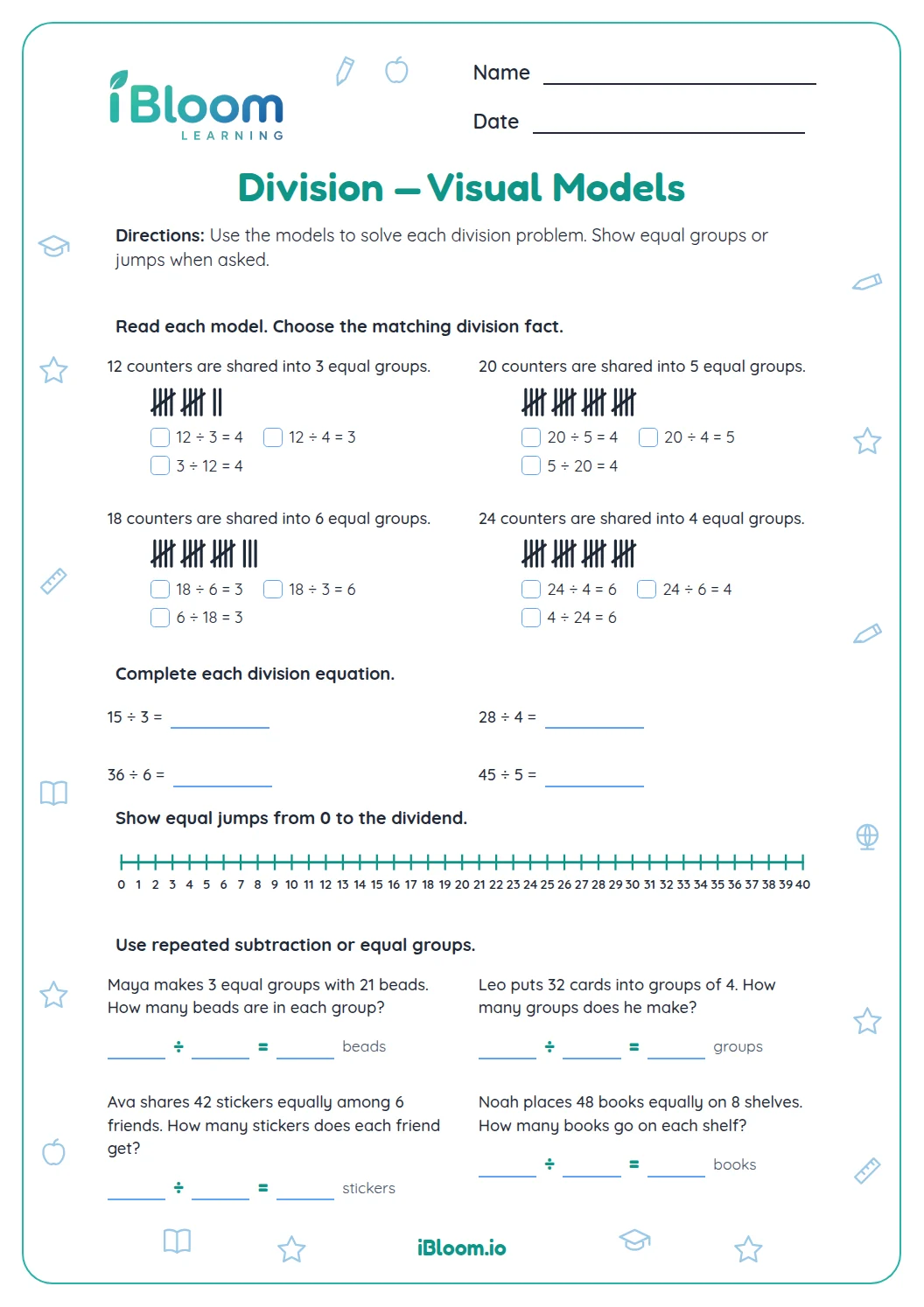
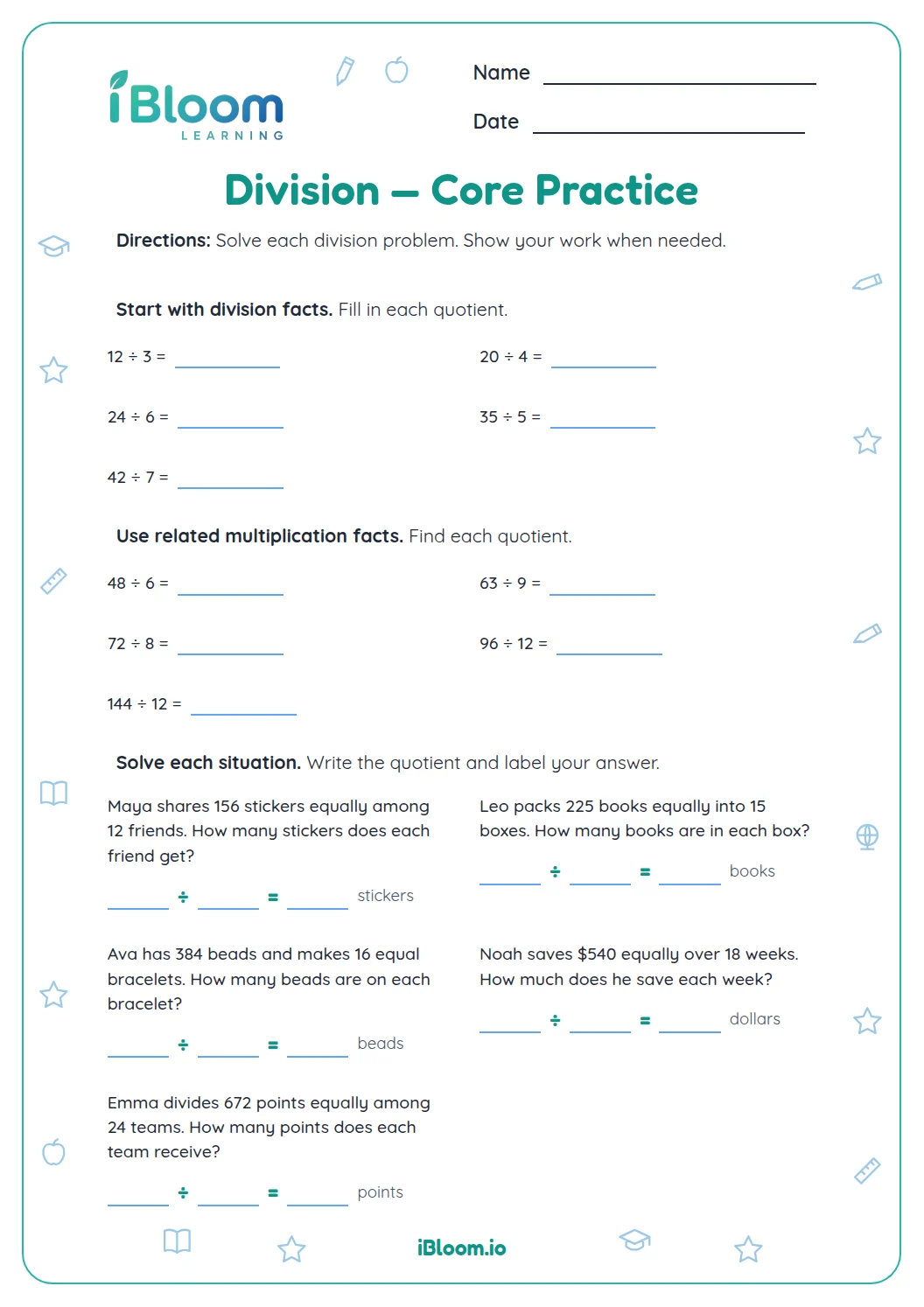
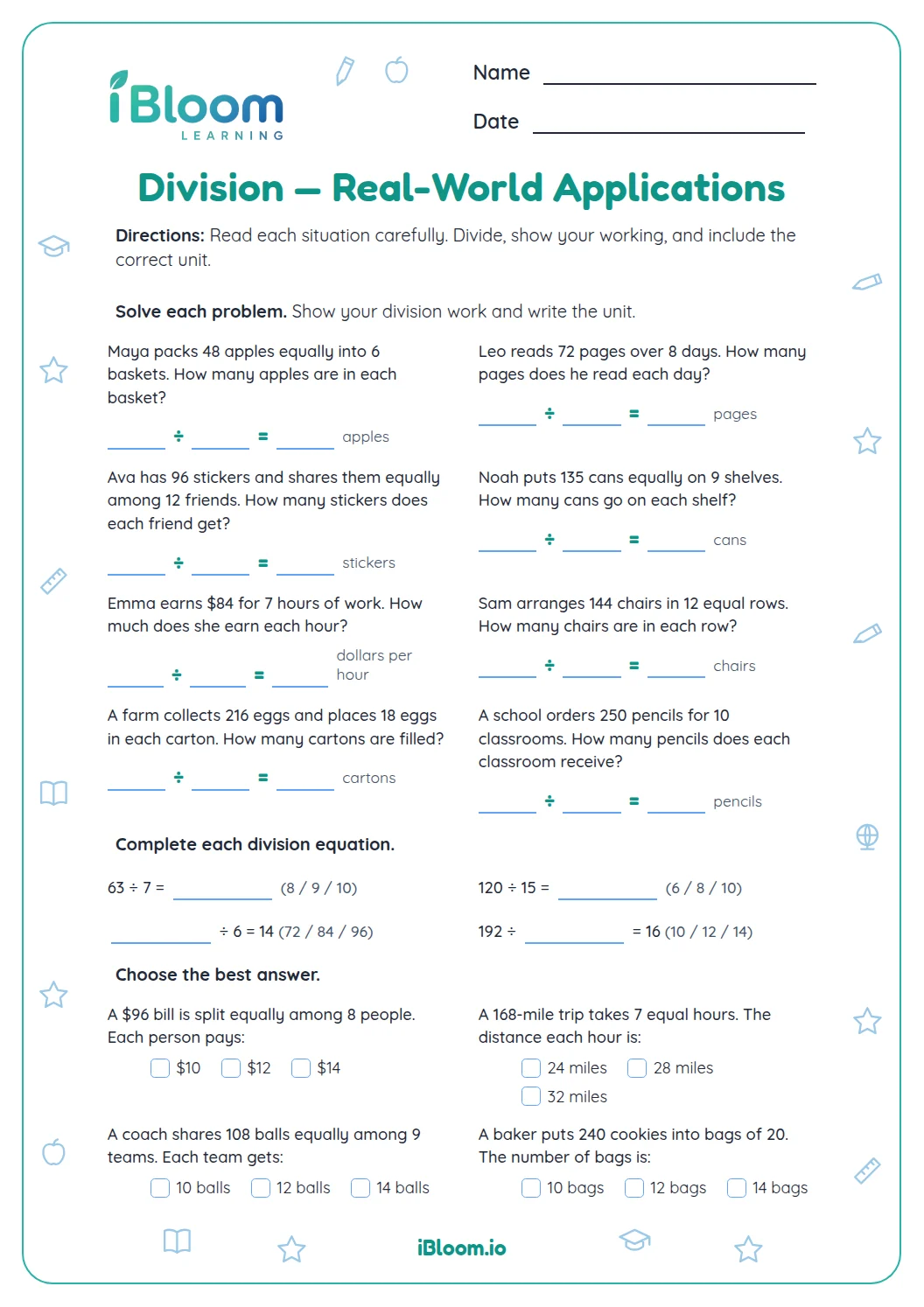
This free Grade 3 worksheet builds division practice through three connected models. Children solve whole-number facts, read division tables to find the number in each equal row, and write equations for sharing stories. All quotients are whole numbers and the dividends stay within 100. A separate answer key gives each quotient. The worksheet practices Common Core 3.OA.A.2 by interpreting division as equal sharing or grouping.
Aligned to 3.OA.A.2
How are multiplication facts related to division?
A multiplication fact can help find a quotient. For 24 ÷ 6, ask which number times 6 equals 24.
- 124 ÷ 6 = ?
- 26 × 4 = 24
- 3So 24 ÷ 6 = 4
How does a division table show a quotient?
Each table gives the total dots and the number of equal rows. Divide the total by the row count to find the dots in each row.
How can a division equation model sharing?
Identify the total and the number of equal groups. Divide to find how many objects go in each group, then check by multiplying.
How to use this worksheet
- 1Read the total and the number of groups.
- 2Recall a multiplication fact with the same factors.
- 3For a division table, divide the total by the number of equal rows.
- 4Write a division equation for each story.
- 5Multiply the quotient by the divisor to check.
Common mistakes and quick fixes
The mistake
Dividing the group count by the total
The fix
Keep the total first and divide it by the number of groups.
The mistake
Using the total as the number in one row
The fix
Divide the total dots by the number of rows to find dots in one row.
The mistake
Giving the number of groups instead of the group size
The fix
Reread the question and identify what each group contains.
Curriculum alignment
Interpret division as sharing or grouping into equal groups.
On this sheet: The equal-group models and stories interpret division quotients.
Show the official wordingHide the official wording
Interpret whole-number quotients of whole numbers, e.g., interpret 56 ÷ 8 as the number of objects in each share when 56 objects are partitioned equally into 8 shares, or as a number of shares when 56 objects are partitioned into equal shares of 8 objects each.
What to practice next
Make more practice
Further reading
Questions parents and teachers ask
What does a quotient tell us?
A quotient tells how many objects are in each equal group or how many equal groups can be made. The story wording identifies what to find. For 28 apples shared among 4 bags, the quotient 7 is the number of apples in each bag.
How can multiplication help with division?
Use a related fact family. Since 6 × 4 = 24, then 24 ÷ 6 = 4 and 24 ÷ 4 = 6. Multiplying the quotient by the divisor checks that the answer returns to the dividend. This is useful for the number sentences and the story problems.
How should children read the division tables?
Each table shows the total number of dots and how many equal rows they form. Divide the total by the row count to find the dots in one row. For example, 12 dots in 3 rows means 12 ÷ 3 = 4 dots per row. The answer key gives the quotient.
Are remainders included?
No. Each total divides evenly into the groups shown or described, so every answer is a whole number. The examples focus on what division means when all groups have the same number of objects. Children can check an answer by multiplying the group size by the number of groups.
How many practice questions are included?
There are 14 questions: five division facts, four division-table models, and five sharing stories. Each model asks for the number of dots in one row, while the stories ask how many objects each group receives. The answer key lists all quotients.