
About this worksheet
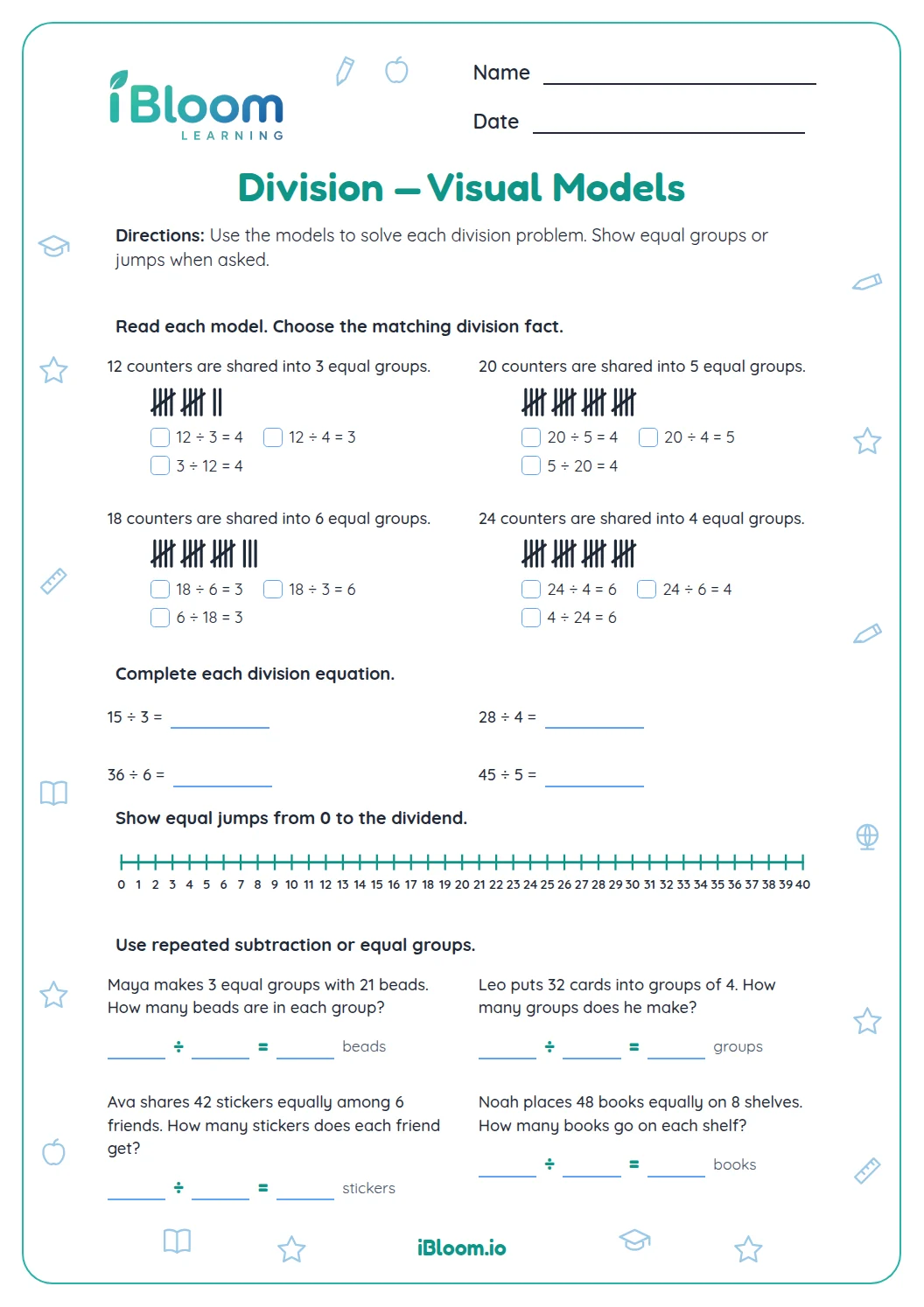
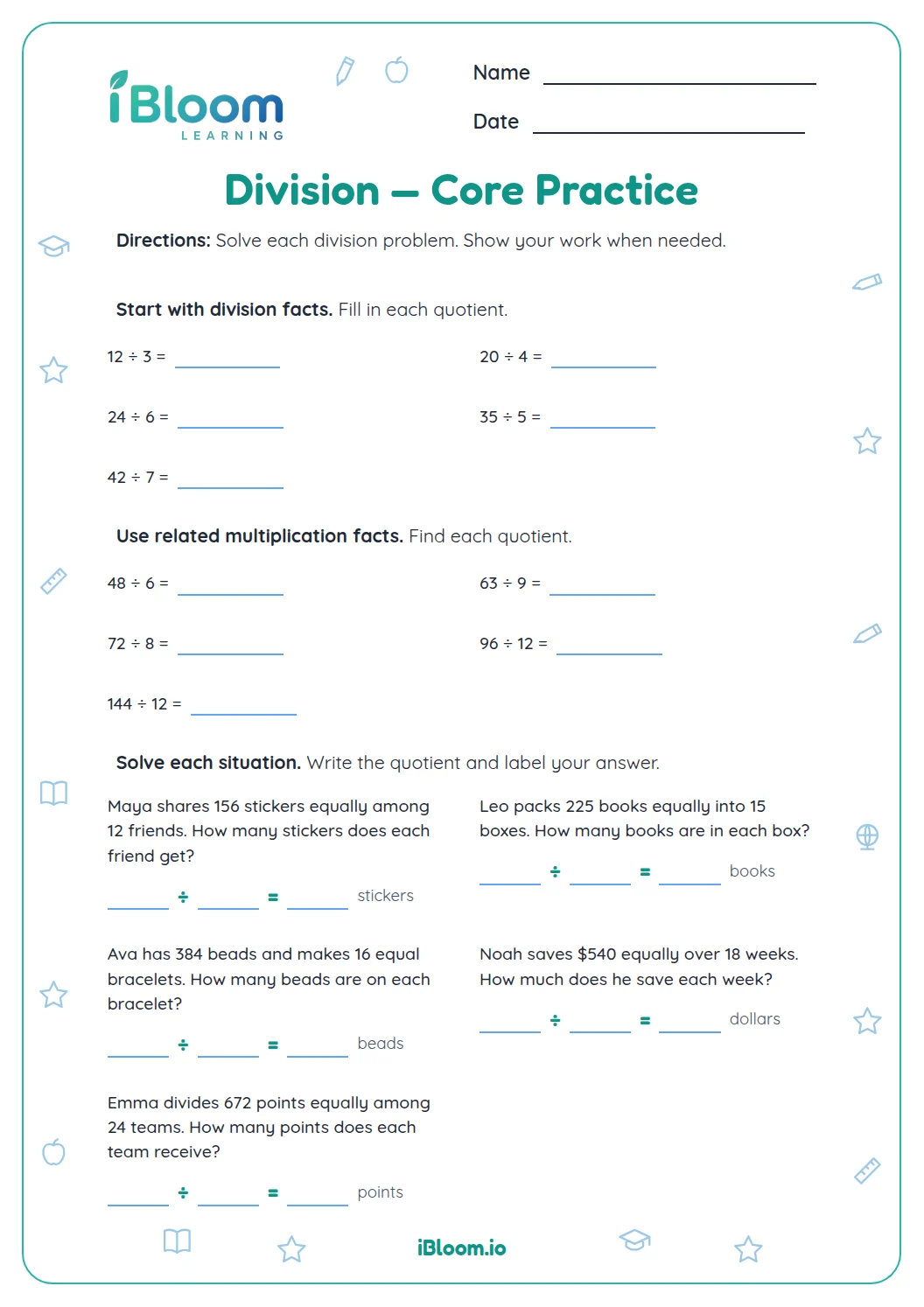
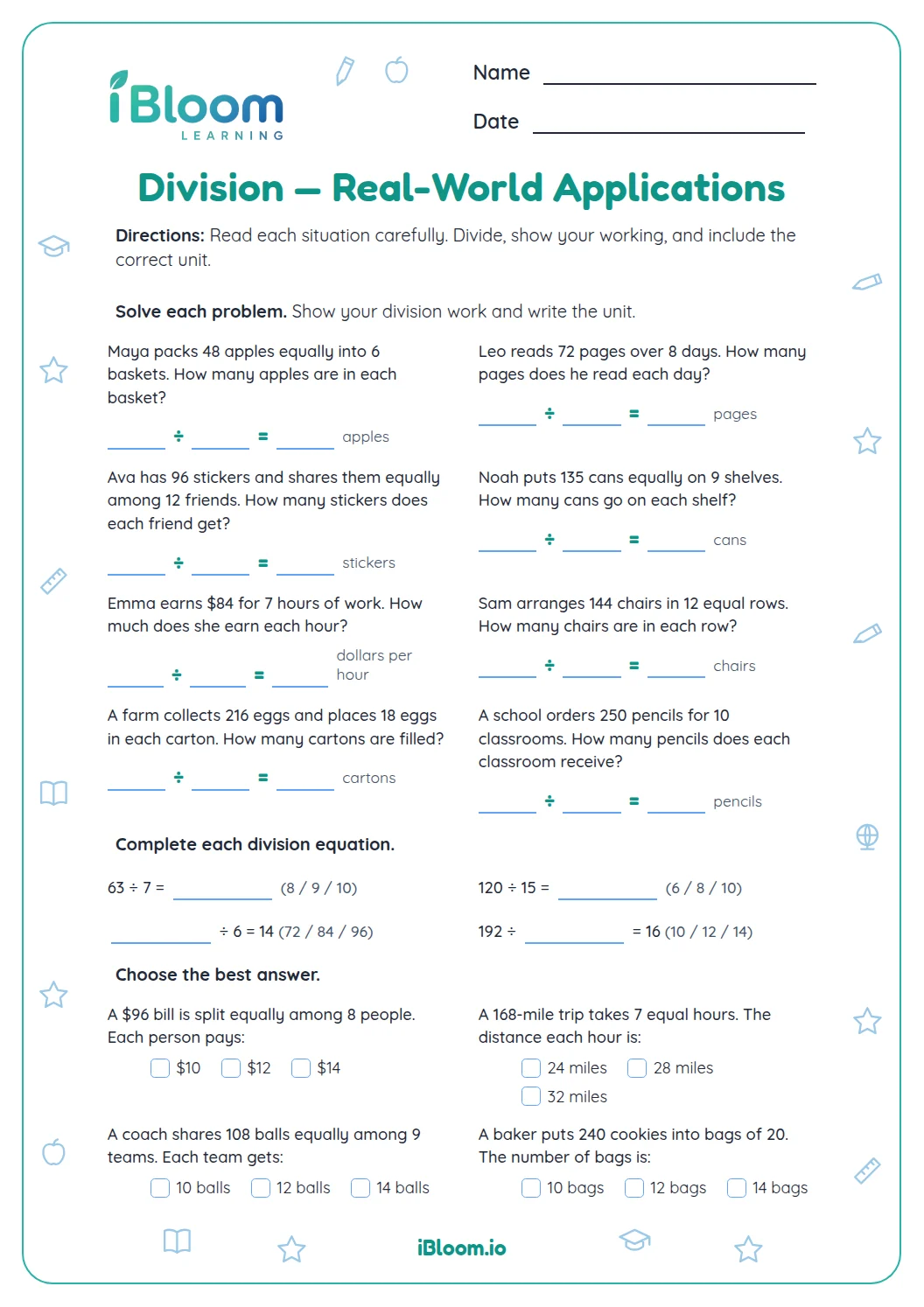
This Grade 3 division worksheet has 14 questions in three parts. Students solve facts, use multiplication to check division, and apply equal sharing to short stories before correcting a quotient error. The practice aligns with Common Core 3.OA.C.7, which calls for fluency with multiplication and division within 100. A separate answer key is included.
Aligned to 3.OA.C.7
How are multiplication and division connected?
Division asks how many equal groups fit or how many items belong in each group. Multiplication can check either question: quotient × divisor should equal the dividend.
For example, 72 ÷ 9 = 8 because 8 × 9 = 72. The check brings the answer back to the starting total.
How should students reason through a division problem?
First identify the total and the number of groups or items in each group. Then use a known multiplication fact or a related fact to find the missing number. For a word problem, attach the correct unit to the answer.
- 148 markers are shared among 6 tables.
- 2Think: 6 × ? = 48.
- 3Since 6 × 8 = 48, each table gets 8 markers.
What is on this division worksheet?
Part A reviews quotients within 100. Part B uses multiplication checks and equal-sharing stories. Part C asks students to check and correct a quotient using multiplication.
For example, 68 ÷ 4 is 17 because 17 × 4 = 68.
How to use this worksheet
- 1Read whether the question gives the total, group count, or group size.
- 2Use a multiplication fact to find the missing factor.
- 3For story problems, write the unit with your answer.
- 4Check by multiplying quotient × divisor.
- 5In the last problem, compare the product with the original total.
Mistakes to watch for
The mistake
Multiplying the two numbers in a division expression.
The fix
Ask what factor times the divisor gives the dividend.
The mistake
Reversing the group count and group size.
The fix
Draw or describe equal groups before calculating.
The mistake
Stopping at a quotient that is close.
The fix
Multiply the quotient by the divisor and compare with the exact total.
Curriculum alignment
This printable connects focused practice with a Common Core learning goal.
Fluently divide within 100 using multiplication facts.
On this sheet:
Show the official wordingHide the official wording
Fluently multiply and divide within 100, using strategies such as the relationship between multiplication and division (e.g., knowing that 8 × 5 = 40, one knows 40 ÷ 5 = 8) or properties of operations. By the end of Grade 3, know from memory all products of two one-digit numbers.
What to practice next
Make more practice
Further reading
Questions parents and teachers ask
How can multiplication check a division answer?
Multiply the quotient by the divisor. For 72 ÷ 9 = 8, the check is 8 × 9 = 72. The product should match the original total. Questions 6 and 7 connect a missing factor and a division fact, and question 14 uses the same check to correct a quotient.
What kinds of division practice are on this sheet?
The 14 questions include division facts, a missing factor, multiplication checks, equal sharing, grouping, and one quotient error to correct. Students move from number sentences to short stories, then use multiplication to decide whether a proposed quotient matches the dividend.
Does the printable include an answer key?
Yes. A separate two-page key gives the answer to each of the 14 questions. It includes units for the story problems, such as markers per table and boxes, so students can check both the quotient and what the number represents.
How can a student approach a difficult division fact?
Rewrite the division as a missing-factor question. For example, 56 ÷ 8 asks which number multiplied by 8 equals 56. Use a multiplication fact to find the quotient, then multiply back to confirm that the product is 56.
What does the final question ask students to notice?
Sam suggests 16 for 68 ÷ 4 because 4 × 16 is 64. Students compare that product with 68 and find the quotient that makes the multiplication equation true: 17, since 4 × 17 = 68. This check shows why a close product is not enough; the product must equal the dividend.