
About this worksheet
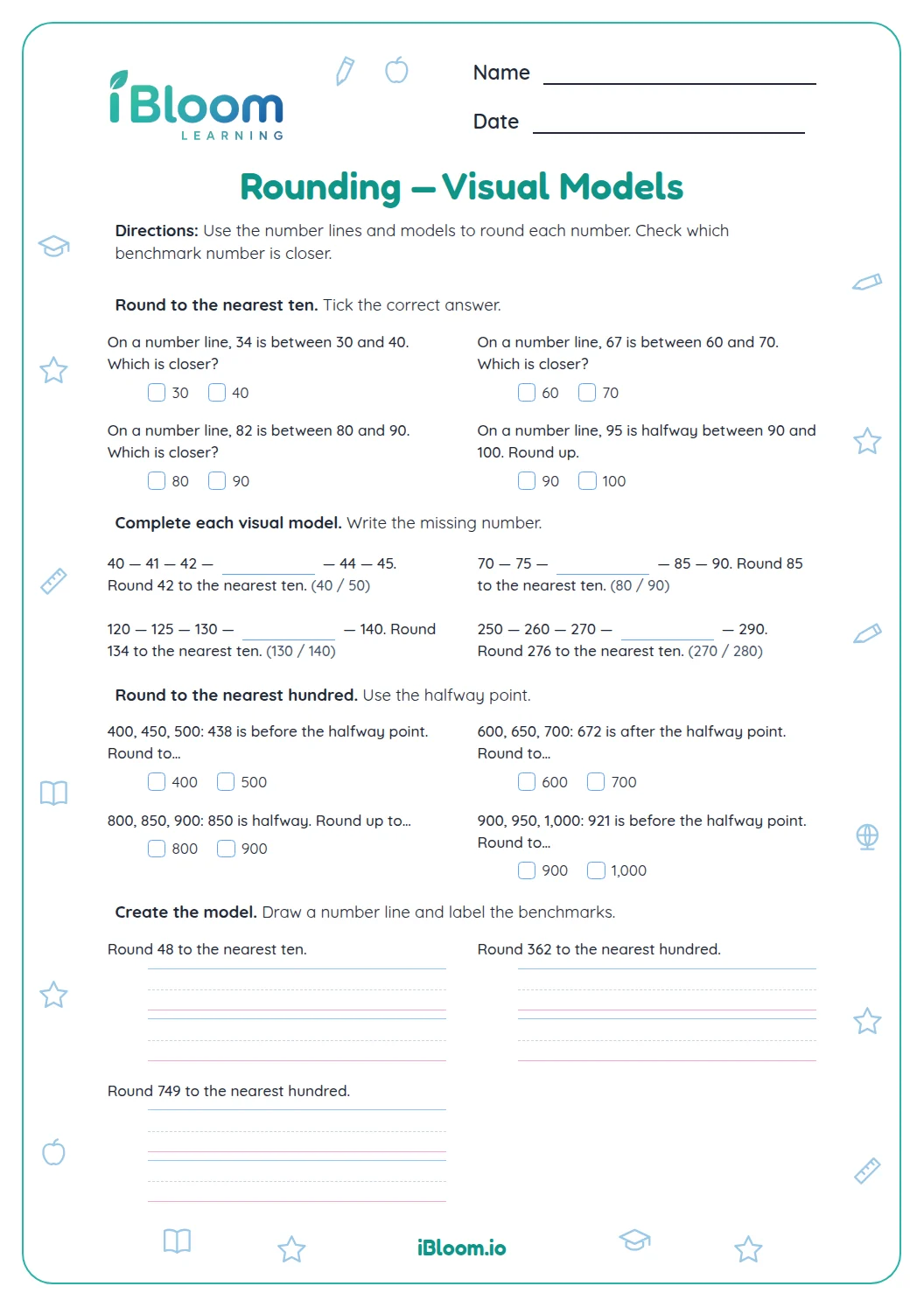
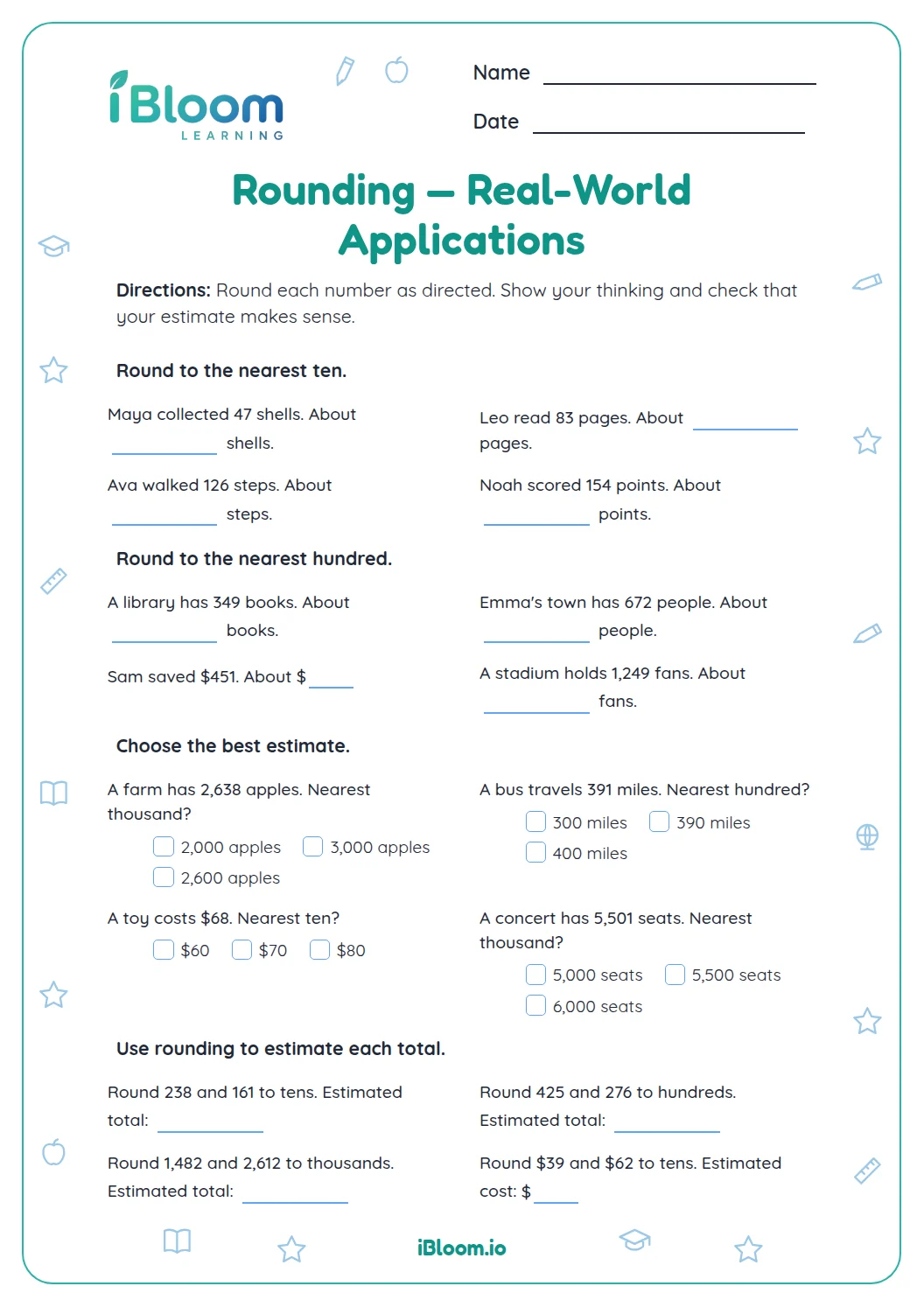
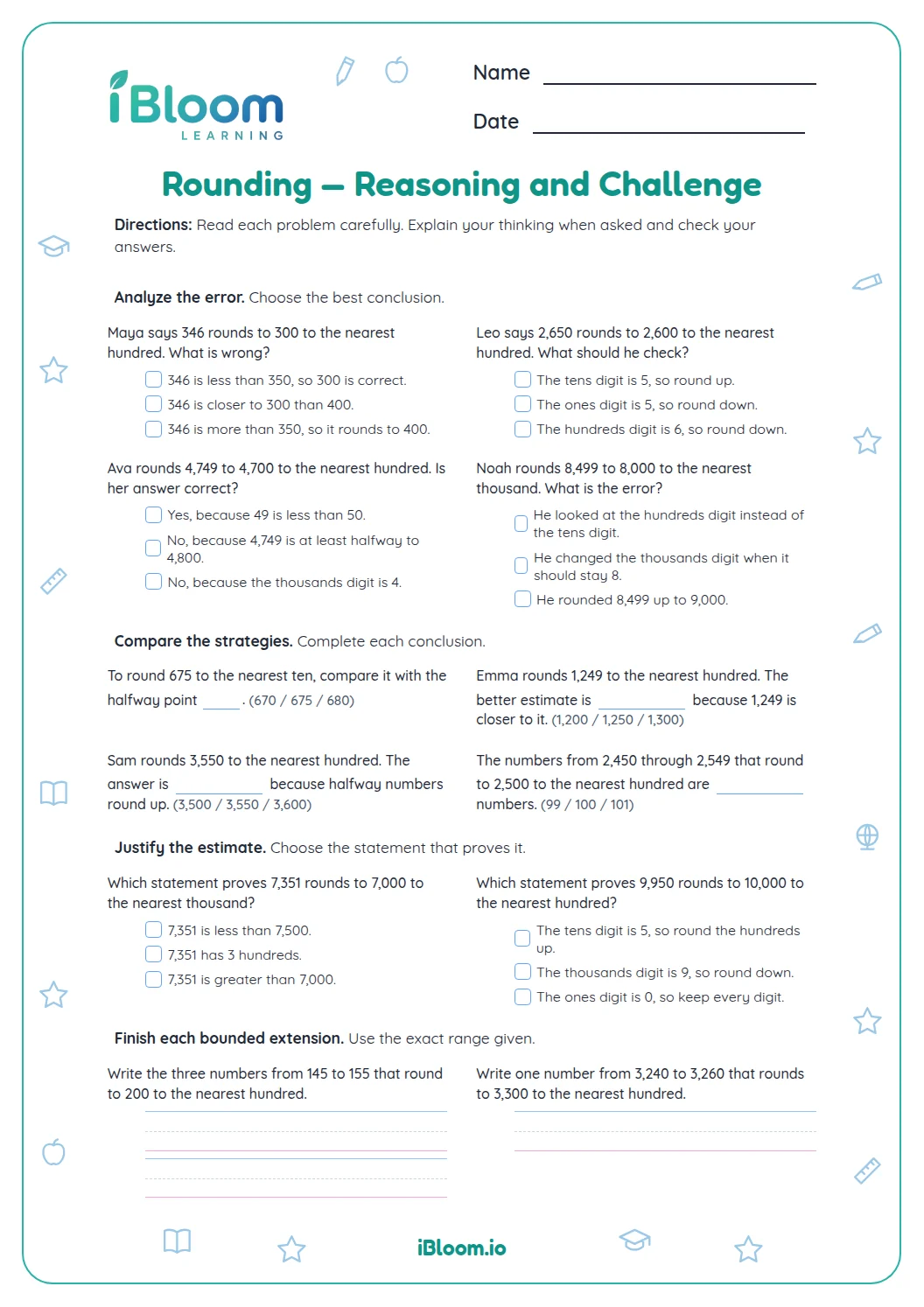
This free printable rounding worksheet is designed for Grade 3 learners practicing whole numbers to the nearest ten and hundred. It starts with direct problems and moves to rounded values in short contexts. The sheet has 15 questions in three parts plus a separate answer key. The work aligns with CCSS 3.NBT.A.1: using place value to round whole numbers to the nearest 10 or 100.
Aligned to 3.NBT.A.1
Which digit helps you round to a ten?
When rounding to the nearest ten, look at the ones digit. If it is 0 through 4, the tens digit stays. If it is 5 through 9, increase the tens digit by one. Then write zero in the ones place.
For question 2, 85 has a 5 in the ones place, so choose 90. The halfway rule sends the number up to the next ten.
- 185
- 2Ones digit: 5
- 3Choose the rounded number: 90
What changes when you round to a hundred?
Look at the tens digit to decide. For 1,349, the tens digit is 4, so keep the hundreds digit and replace the tens and ones with zeroes: 1,300.
When is a rounded number useful?
An estimate gives a nearby amount that is easier to use mentally. For example, 386 rounds to 400 to the nearest hundred, so the cart has about 400 books. The final part asks learners to choose reasonable estimates and check a rounding claim.
How to use this worksheet
- 1Underline the place named in the question.
- 2Look at the digit immediately to its right.
- 3Keep the named digit for 0–4; raise it for 5–9.
- 4Change all smaller places to zeroes.
- 5Read the rounded number and check it is the nearby ten or hundred.
Common mistakes and quick fixes
The mistake
Looking at the wrong digit.
The fix
For nearest hundred, check tens; for nearest ten, check ones.
The mistake
Keeping the original smaller digits.
The fix
Replace every place right of the target with zero.
The mistake
Rounding 85 down because it is close to 80.
The fix
A 5 is the halfway case and rounds up to 90.
Common Core alignment
This worksheet gives focused practice with the standard below.
Round whole numbers to the nearest ten or hundred.
On this sheet: Questions round whole numbers to tens and hundreds, including a simple estimate.
Show the official wordingHide the official wording
Use place value understanding to round whole numbers to the nearest 10 or 100.
What to practice next
Make more practice
Further reading
Questions parents and teachers ask
How do I round a whole number to the nearest ten?
Find the tens digit and look at the ones digit. If the ones digit is 5, 6, 7, 8, or 9, increase the tens digit by one; if it is 0 through 4, keep the tens digit. Replace the ones digit with zero.
How do I round to the nearest hundred?
Find the hundreds digit and inspect the tens digit. A tens digit of 5 or more means the hundreds digit goes up by one; 4 or less means it stays. Then replace the tens and ones digits with zeroes to finish.
Why does 85 round to 90?
85 is halfway between 80 and 90. In the whole-number rounding rule, a 5 in the ones place rounds up, so 85 rounds to 90. Question 2 gives another chance to apply the halfway rule and see why the number moves toward 90.
How can rounding help with an estimate?
Rounding gives a nearby number that is easier to use mentally. In the library cart question, 386 rounds to 400 to the nearest hundred, so the cart has about 400 books. The exact count remains 386; the estimate is a convenient nearby amount.
How many questions are on this worksheet?
There are 15 questions in three parts: five nearest-ten problems, five nearest-hundred problems, and five short applications. A separate answer key shows the rounded values and the correction for the final item, including the halfway decision. The choices keep each question quick to read.
Is there an answer key?
Yes. A separate key page lists every answer. For the question about a student’s rounding, the answer includes both whether the student is correct and the rounded result, so children can check the reasoning as well as the number.