
About this worksheet
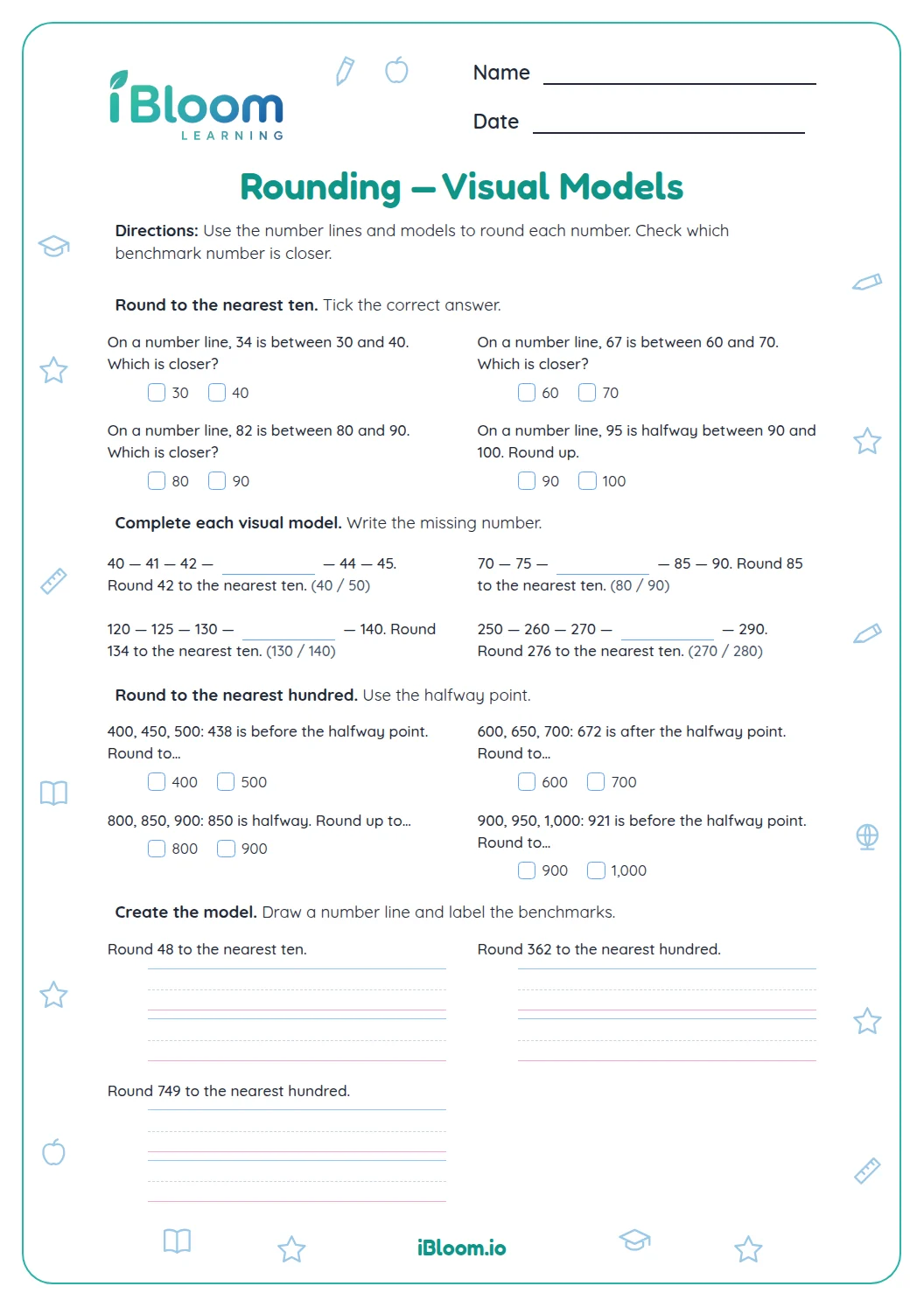
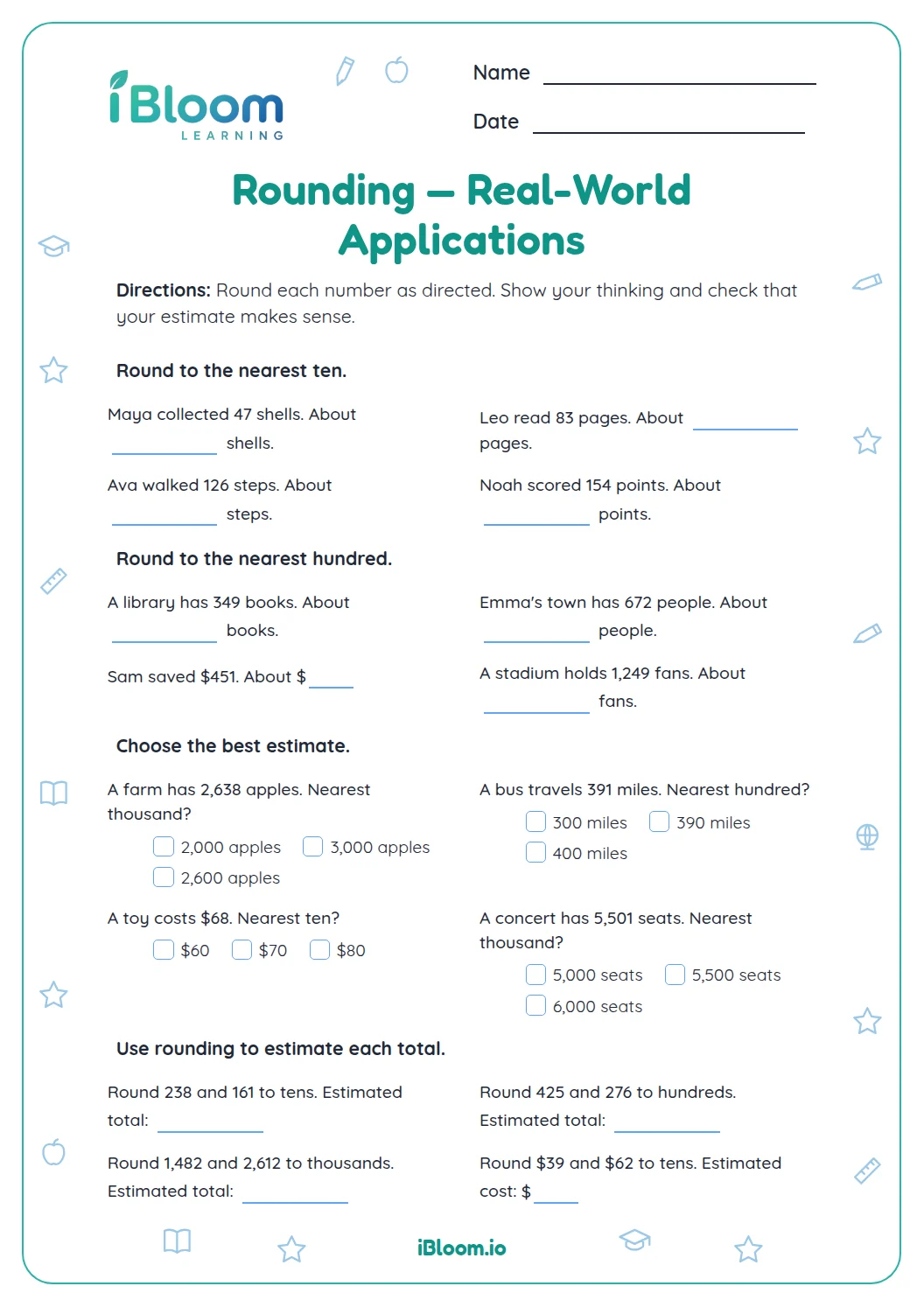
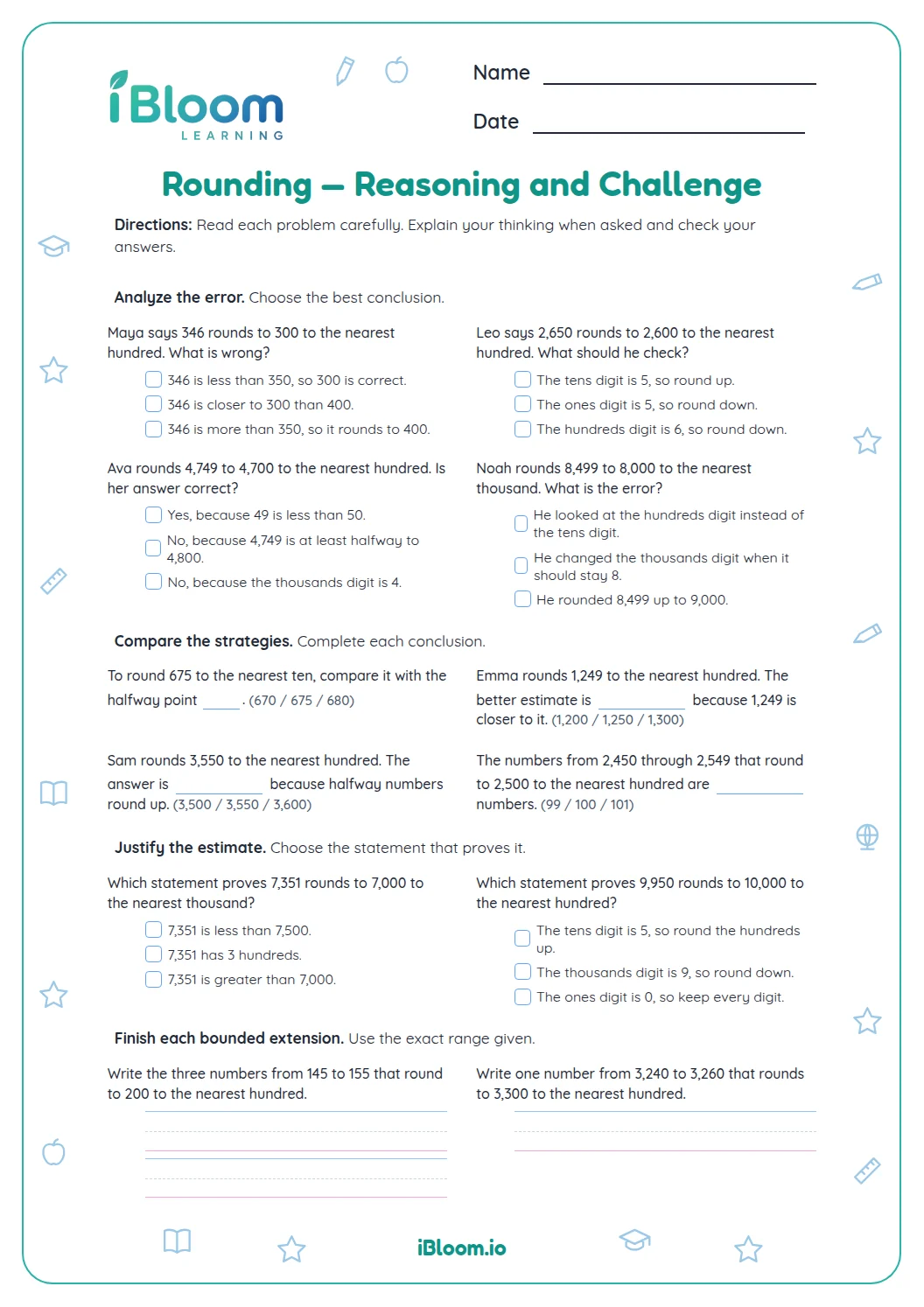
This free printable worksheet gives children in Grades 2–5 20 rounding questions. Part A rounds six numbers to tens, Part B rounds six to hundreds, and Part C rounds four numbers to thousands. Part D applies rounding to beads, steps, savings and pages read, with the target place stated in every question. Children choose the nearer multiple, round halfway values up and leave exact multiples unchanged. The sheet practices Common Core 3.NBT.A.1 and 4.NBT.A.3. Start with one part and add the next place when the child is comfortable. A separate answer key gives all 20 answers.
Aligned to 3.NBT.A.1 and 4.NBT.A.3
What does nearest mean when rounding?
Nearest means the multiple with the smaller distance from the starting number. When rounding to tens, the possible answers are multiples of ten; when rounding to hundreds, they are multiples of one hundred. The original number lies between two of these values or equals one of them.
For 85, the neighboring tens are 80 and 90. Both are 5 away. On this sheet, a halfway value rounds to the greater multiple, so 85 becomes 90.
How do you round 450 to the nearest hundred?
Question 10 is exactly halfway between two hundreds. The tens digit is 5, which marks the halfway point. Choose 500 and write both trailing zeros.
- 1450 lies between 400 and 500.
- 2450 − 400 = 50 and 500 − 450 = 50.
- 3The distances are equal, so round to the greater hundred.
- 4450 rounds to 500.
How does the practice get harder?
Part A includes 47, 62, 85, 134, 195 and 280. These mix rounding up, rounding down, crossing into a new hundred and leaving an exact ten unchanged. Part B uses the same decisions at the hundreds place.
Part C moves to thousands with 2,340, 6,780, 4,500 and 9,499. Compare 4,500 with 9,499: the first is halfway and rounds up, while the second is just short of halfway and rounds down.
Part D brings the same decisions into everyday situations. For 398 beads rounded to the nearest hundred, compare 300 and 400 and choose 400. Always use the place named in the question, even when a different rounded value also seems close.
A rounding routine for this sheet
- 1Read the place named in the part heading before starting.
- 2Underline that place in the first number: the tens digit in 47 is 4.
- 3Name the neighboring multiples and compare the distances.
- 4Write the rounded number, keeping the needed zeros.
- 5Use the key to check each part; revisit any halfway value by naming both neighbors.
Rounding slips to check
The mistake
Writing 47 as 40 because the tens digit is 4.
The fix
Compare the distances to 40 and 50; the ones digit 7 places 47 closer to 50.
The mistake
Rounding 450 to 400 at the halfway point.
The fix
Use the sheet’s halfway convention: choose the greater multiple, 500.
The mistake
Writing 280 as 300 when the question asks for the nearest ten.
The fix
An exact multiple of ten already meets the instruction. Keep 280.
Common Core alignment
Round whole numbers to the nearest ten and hundred.
On this sheet: Parts A and B use place value to round 12 whole numbers.
Show the official wordingHide the official wording
Use place value understanding to round whole numbers to the nearest 10 or 100.
Round multi-digit whole numbers to the nearest thousand.
On this sheet: Part C rounds four numbers to thousands, including a halfway value.
Show the official wordingHide the official wording
Use place value understanding to round multi-digit whole numbers to any place.
What to practice next
Make more practice
Further reading
Questions parents and teachers ask
Which rounding places are on this worksheet?
The sheet covers tens, hundreds and thousands, followed by everyday estimates. Children complete six questions for tens, six for hundreds, four for thousands and four multiple-choice word problems. Each part or question names the target place, so the rounding direction never depends on guessing what an estimate means.
How should I use this with a younger child?
Begin with Part A and work through the first example together. Ask the child to name 40 and 50 as the neighboring tens for 47, then decide which is closer. Continue to the hundreds and thousands sections when that distance idea makes sense.
What happens to a number exactly halfway between two choices?
Choose the greater multiple when the distances are equal. On this sheet, 85 becomes 90, 450 becomes 500 and 4,500 becomes 5,000. Naming both neighbors makes the halfway point visible and connects the familiar rule about 5 to the size of the number.
Why does 280 stay 280 in Part A?
It is already a multiple of ten, so its distance from that multiple is zero. The nearest-ten instruction asks for the closest multiple of ten, and 280 itself qualifies. Have the child check the part heading before changing the number to a nearby hundred.
What does the answer key include?
The separate key gives all 16 fill-in answers and marks the four correct estimates. Check after each part or after the whole sheet. If an answer differs, ask the child to identify the target place and the neighboring multiples before trying the question again.