Free printable practice
Converting Fluid Volume Units Decimals Practice Activities
Class 5 maths worksheets for converting fluid volume units using decimals, especially between litres and millilitres.
Free printable worksheet PDFs
Preview every available page, then download the free worksheet PDF for home, homeschool, tutoring, or classroom practice.
Preview the exact activity before downloading it.
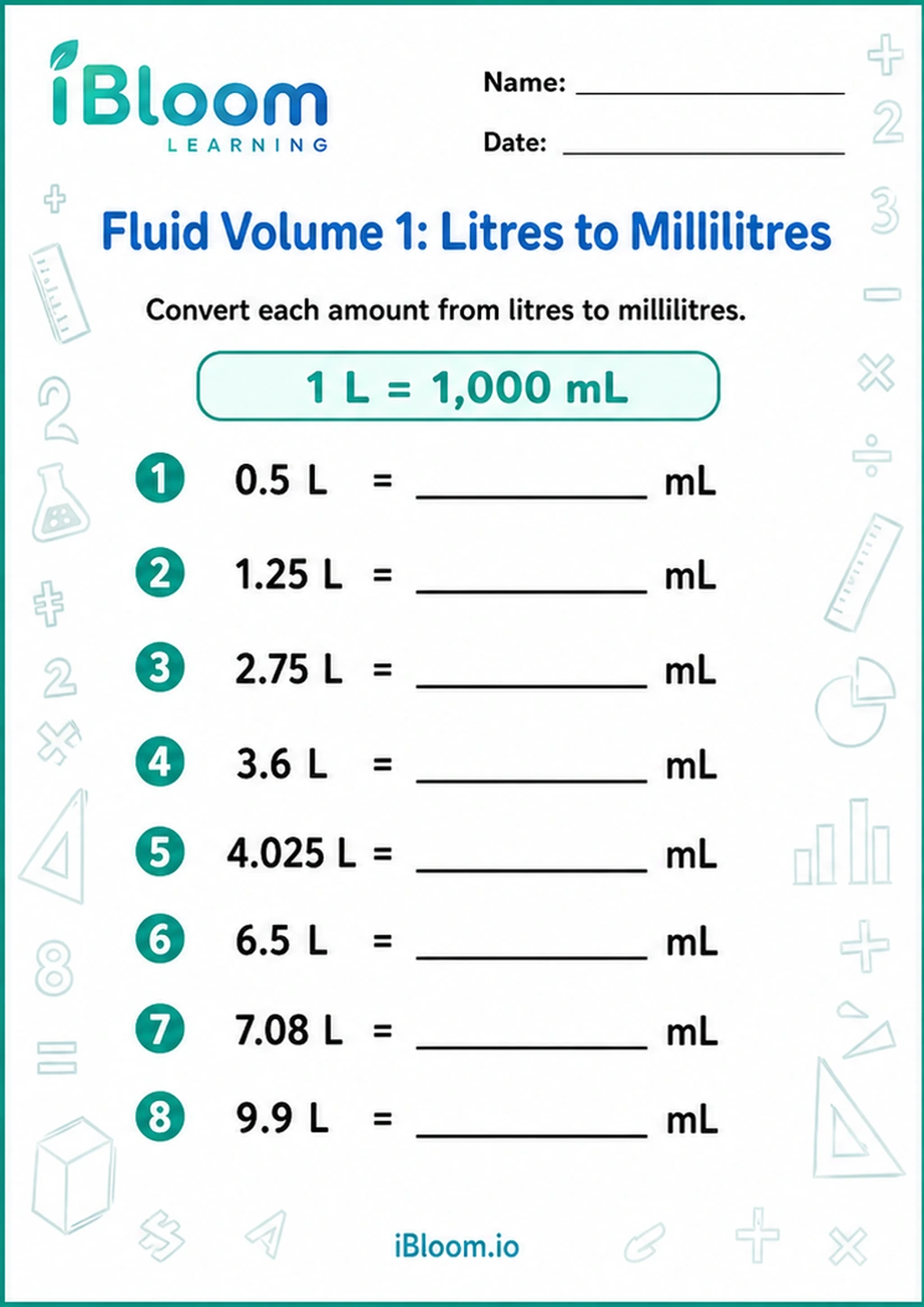 Fluid Volume 1: Litres to MillilitresClass 5 printable practice for Decimal Fluid Volume Conversions.Class 5Free PDF preview
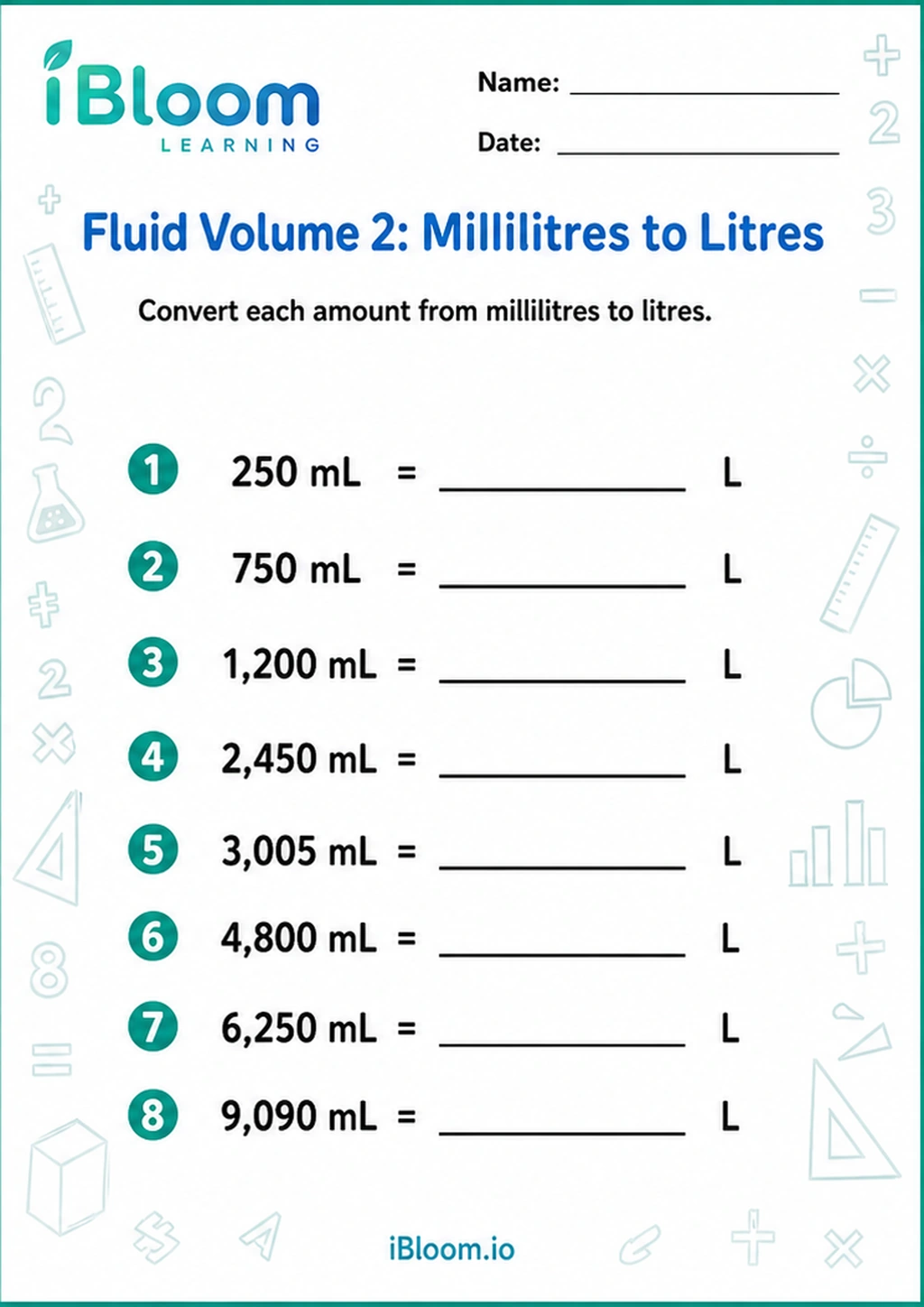 Fluid Volume 2: Millilitres to LitresClass 5 printable practice for Decimal Fluid Volume Conversions.Class 5Free PDF preview
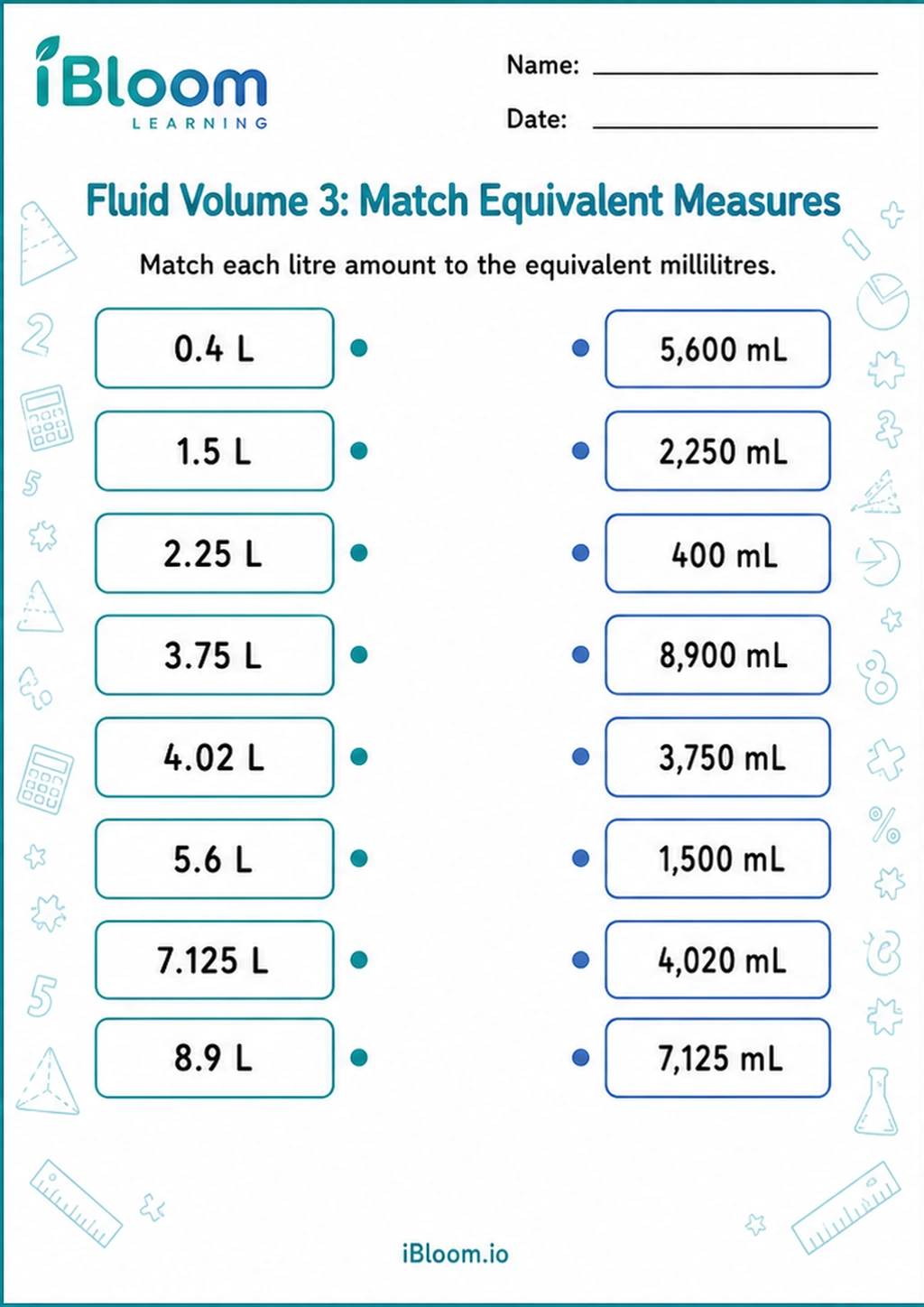 Fluid Volume 3: Match Equivalent MeasuresClass 5 printable practice for Decimal Fluid Volume Conversions.Class 5Free PDF preview
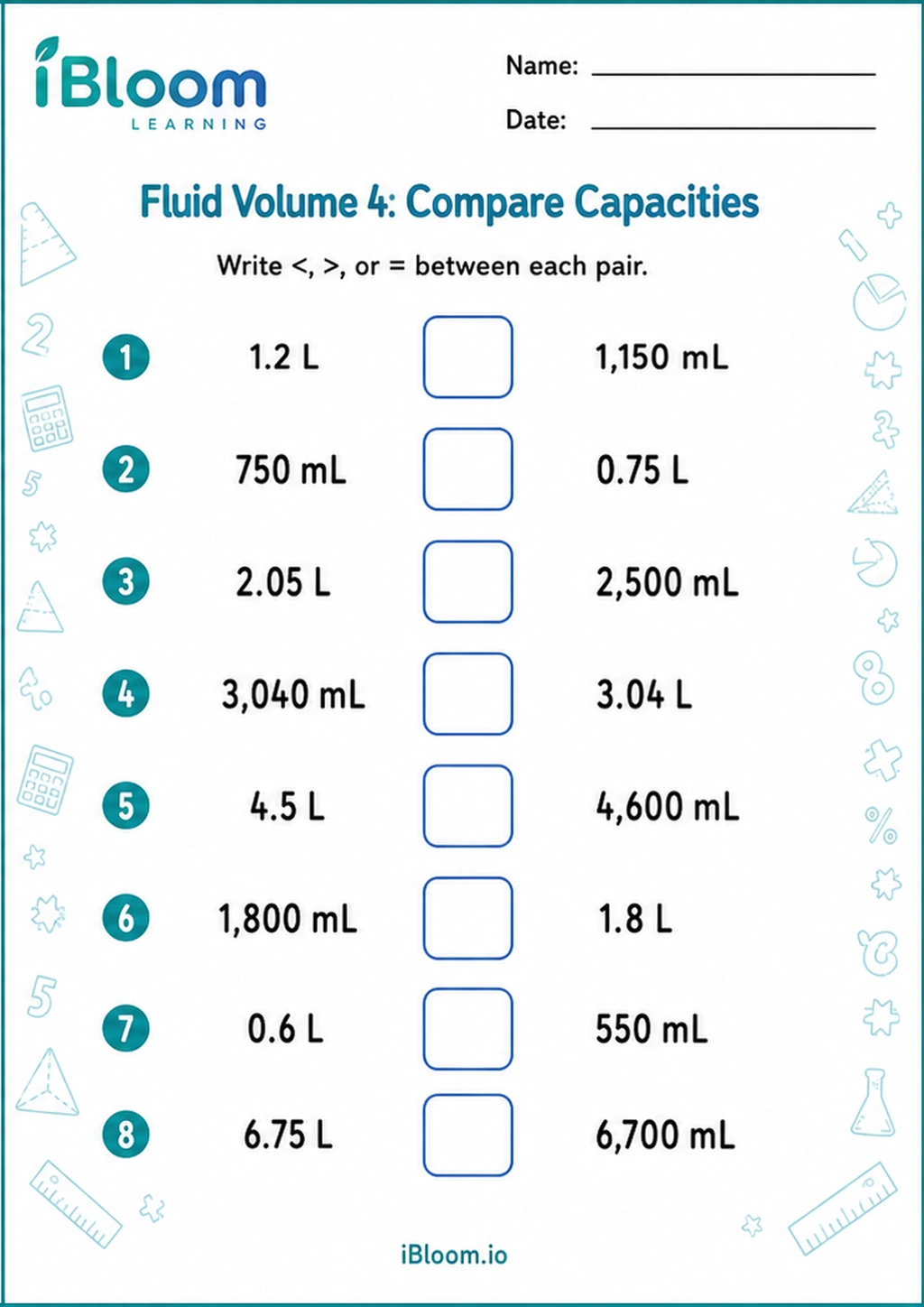 Fluid Volume 4: Compare CapacitiesClass 5 printable practice for Decimal Fluid Volume Conversions.Class 5Free PDF preview
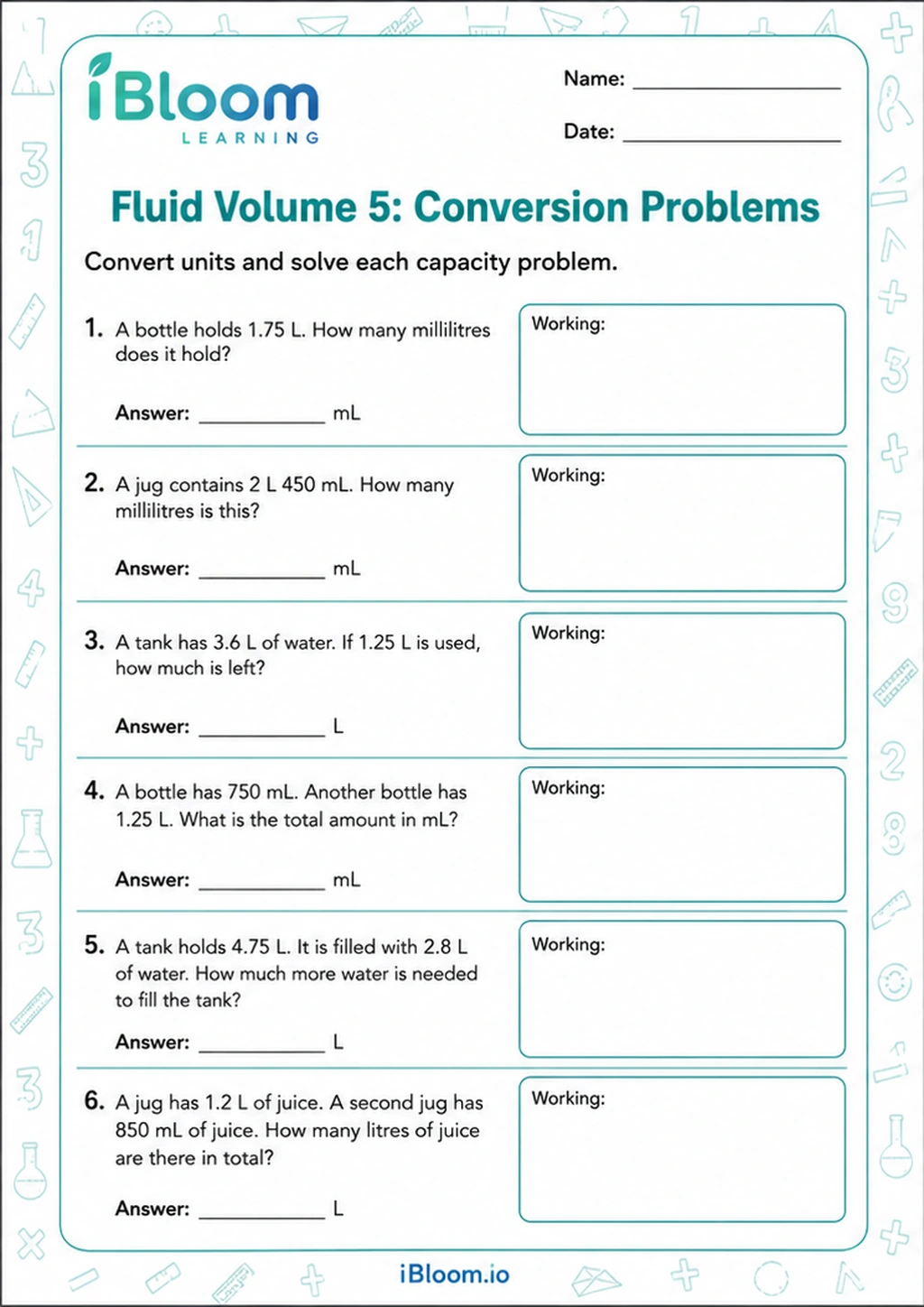 Fluid Volume 5: Conversion ProblemsClass 5 printable practice for Decimal Fluid Volume Conversions.Class 5Free PDF preview
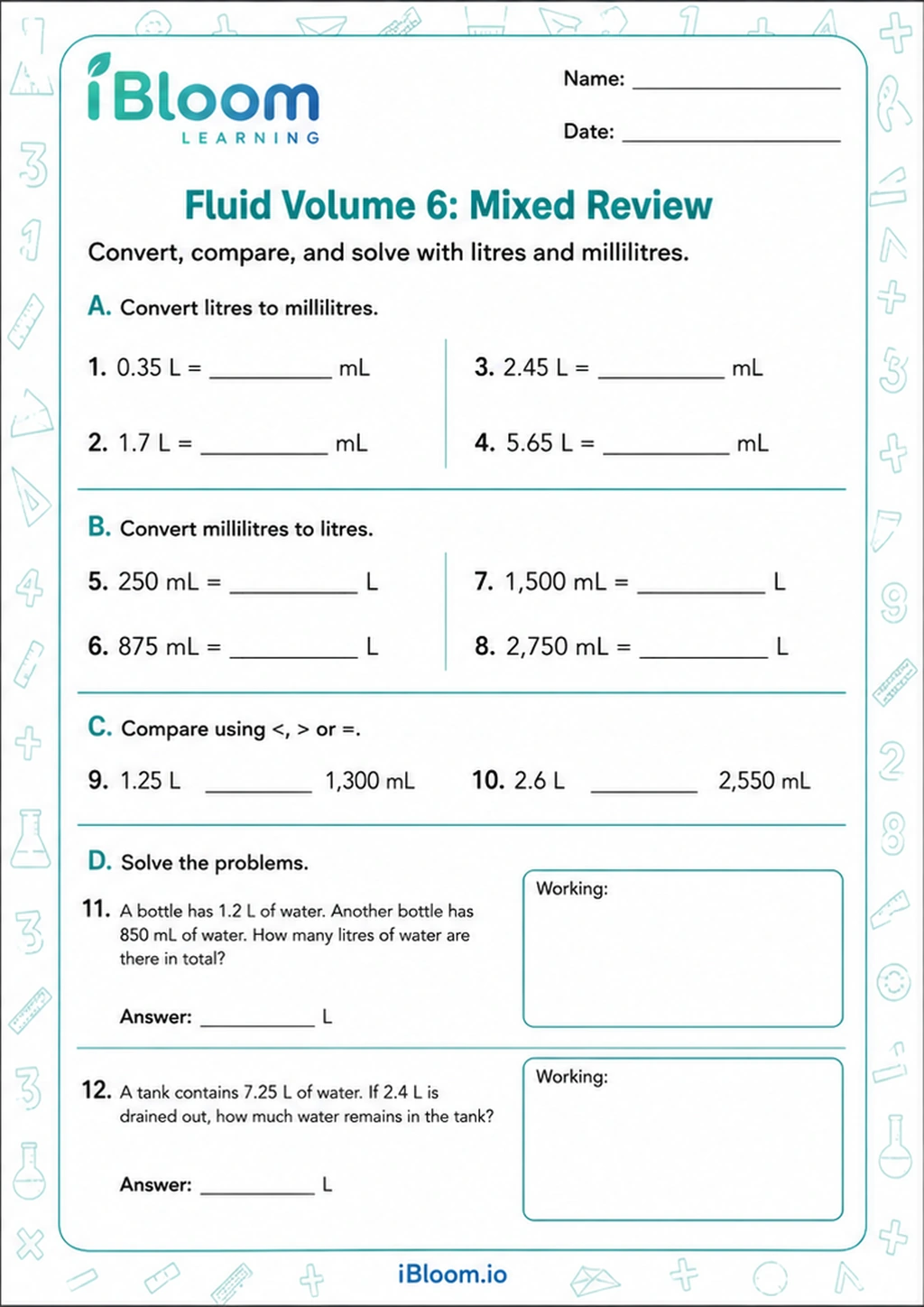 Fluid Volume 6: Mixed ReviewClass 5 printable practice for Decimal Fluid Volume Conversions.Class 5Free PDF preview
Practice that builds confidence
What children learn
These Class 5 measurement worksheets help children practise converting fluid volume units with decimal numbers. Learners work with capacity in litres and millilitres, reading values such as 0.5 L, 1.25 L, and 750 mL and changing them into the required unit.
The printable activities include direct conversions, mixed practice, comparison-style questions, and simple word problems based on everyday liquids such as water, juice, milk, and medicine. They are useful for strengthening place value, multiplication and division by 1,000, and accurate use of unit labels.
In this measurement set, children connect decimal notation with real quantities of liquid. They practise that 1 litre = 1,000 millilitres, so 0.75 L is 750 mL and 1,250 mL is 1.25 L. The focus is not only on getting an answer, but also on understanding why the digits shift when converting between a larger unit and a smaller unit.

How the practice progresses
The worksheets begin with clear litre-to-millilitre and millilitre-to-litre conversions, then move into mixed questions where children must choose the correct operation. Later items may ask them to compare two capacities, complete missing values, or solve short everyday problems. This gradual movement helps Class 5 learners use decimals with confidence instead of treating each question as a separate trick.
Parent routine at home
Use a water bottle, measuring jug, or milk packet to make the maths visible. Ask your child to read the capacity, say whether it is in L or mL, and convert it. For example: “This bottle is 0.5 L. How many millilitres is that?” Then reverse the question: “If a glass holds 250 mL, what is that in litres?” Encourage your child to write both the number and the unit every time.

Classroom uses for teachers
Teachers can use these printables after introducing metric capacity, as revision before a measurement test, or as maths centre tasks. Pair work is effective: one child explains the conversion step while the other checks the unit. A quick exit question such as “Convert 2.4 L to mL” can show whether students understand the place value shift.

Common errors to watch for
Some children multiply when they should divide, or move the decimal point the wrong way. Others write 0.750 mL instead of 750 mL, or forget the unit completely. Watch for confusion between capacity and mass, such as mixing up mL and g. A good check is to ask, “Should the number become larger or smaller when I change to this unit?”
Free printable PDF download
Use this Class 5 converting fluid volume units decimals worksheet page to preview the activity, print it, or download it as a PDF for quick practice. It works well for homework, homeschool lessons, tutoring, morning work, revision, and classroom centers.
Answers and answer key support
After the child completes the worksheet independently, parents and teachers can use the answer support or answer key information to check the work, review mistakes, and choose the next practice step.
Why iBloom worksheets help
The questions are focused on one skill: converting fluid volume units with decimals. The layout gives enough repetition for fluency while including varied formats so children must think about the unit relationship. A child-friendly strategy is: “Bigger unit to smaller unit, multiply by 1,000. Smaller unit to bigger unit, divide by 1,000.”
Helpful answers
Frequently asked questions
What units are practised in these Class 5 worksheets?
The worksheets focus on metric fluid volume units, mainly litres and millilitres, using decimal values such as 0.25 L, 1.5 L, and 2.75 L.
How do children convert litres to millilitres?
They multiply the number of litres by 1,000 because 1 litre equals 1,000 millilitres. For example, 1.2 L = 1,200 mL.
How do children convert millilitres to litres?
They divide the number of millilitres by 1,000. For example, 650 mL = 0.65 L and 1,500 mL = 1.5 L.
Do these worksheets include word problems?
Yes. Some activities use simple real-life contexts such as bottles, glasses, milk, juice, or water to help children apply capacity conversions.
What mistake should I check first when my child gets an answer wrong?
First check whether your child chose the correct direction: litres to millilitres should make the number larger, while millilitres to litres should make the number smaller.
Is this Class 5 converting fluid volume units decimals worksheet free?
Yes. You can preview it for free and use the printable worksheet for home or classroom practice.
Can I download this Class 5 converting fluid volume units decimals worksheet as a PDF?
Yes. Use the worksheet download option to save a printable PDF, or print the worksheet directly from the page.
Does this Class 5 converting fluid volume units decimals worksheet include answers or an answer key?
When the activity has fixed answers, iBloom includes answer support so parents and teachers can check the completed worksheet.