





About this worksheet
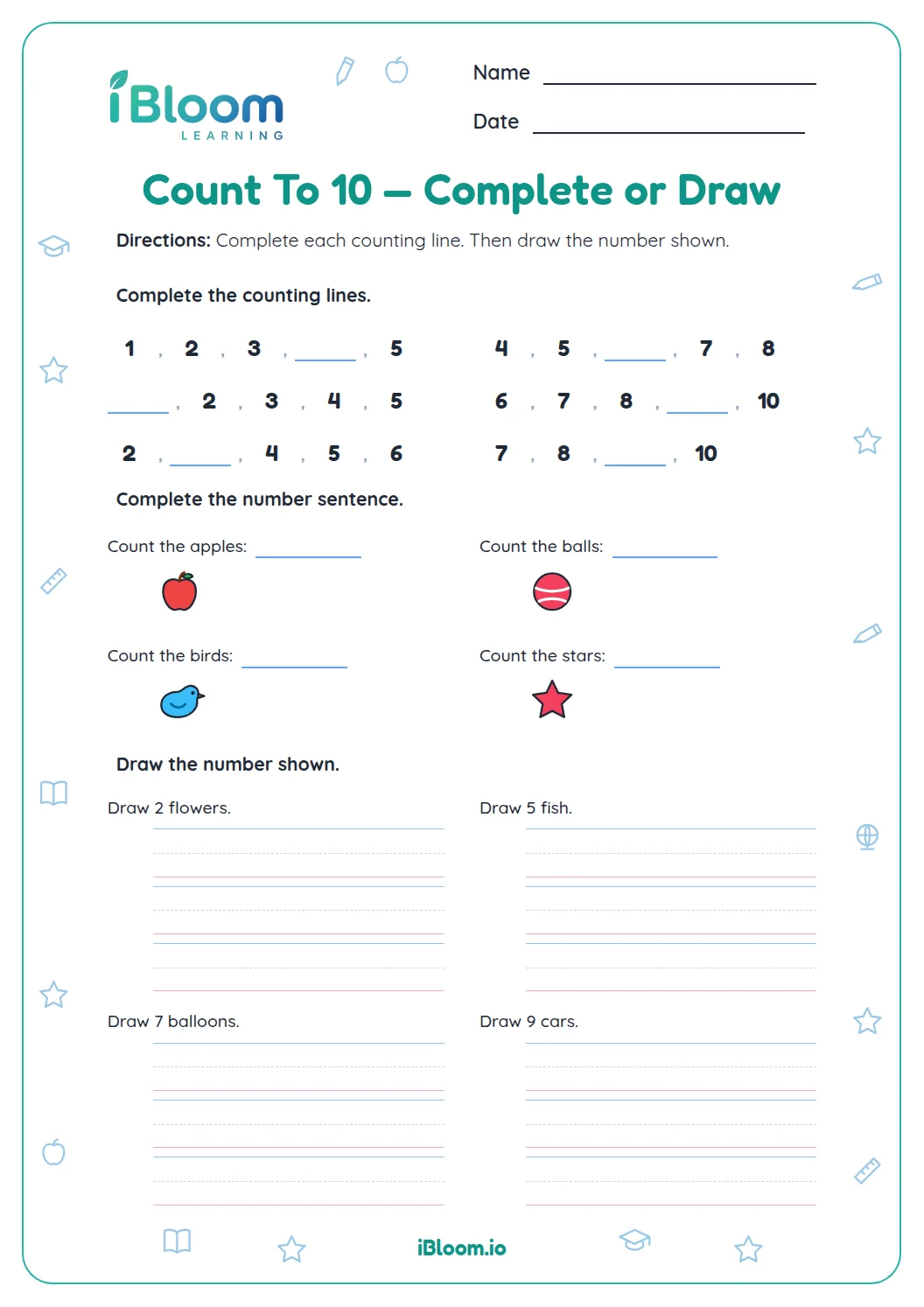
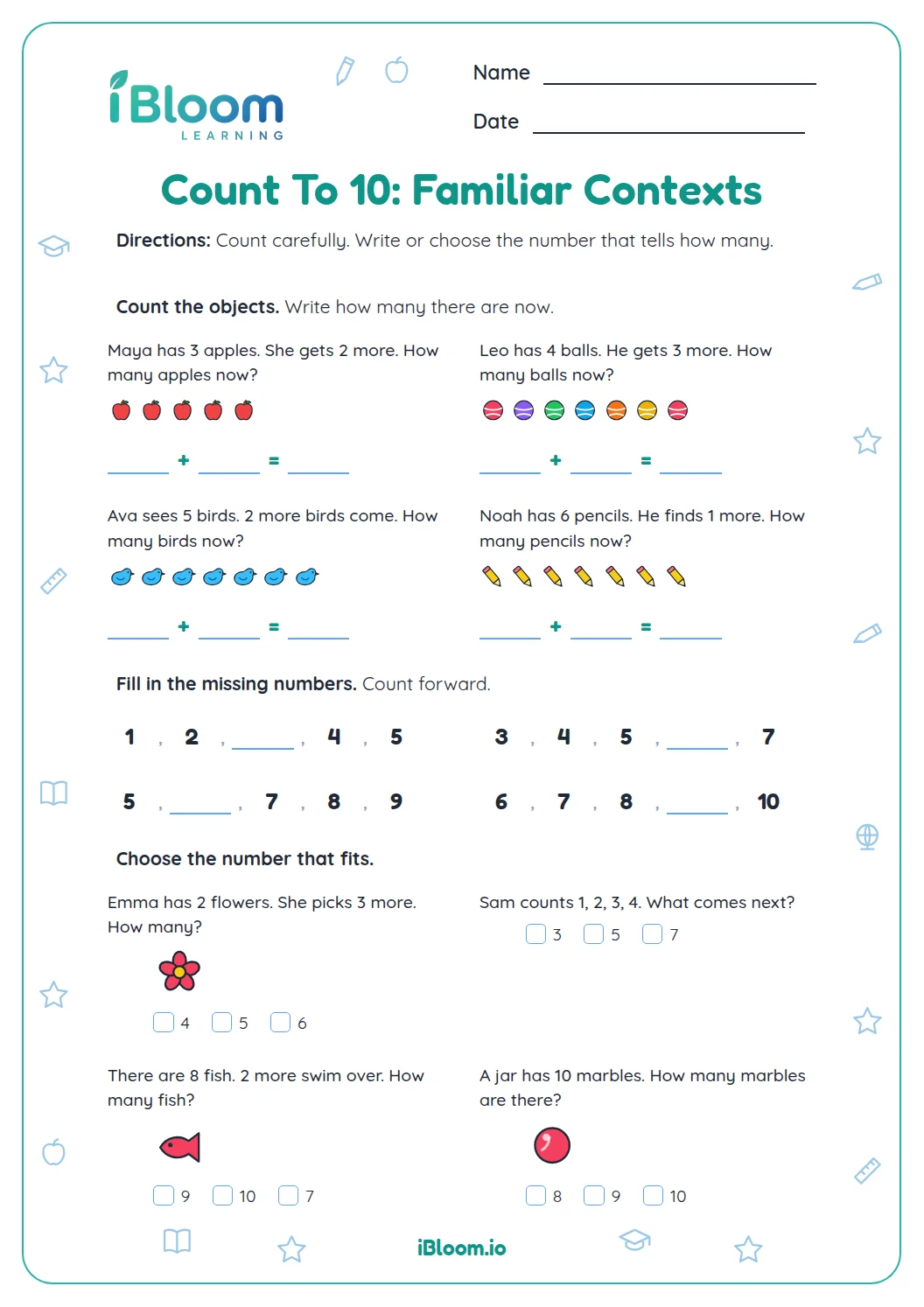
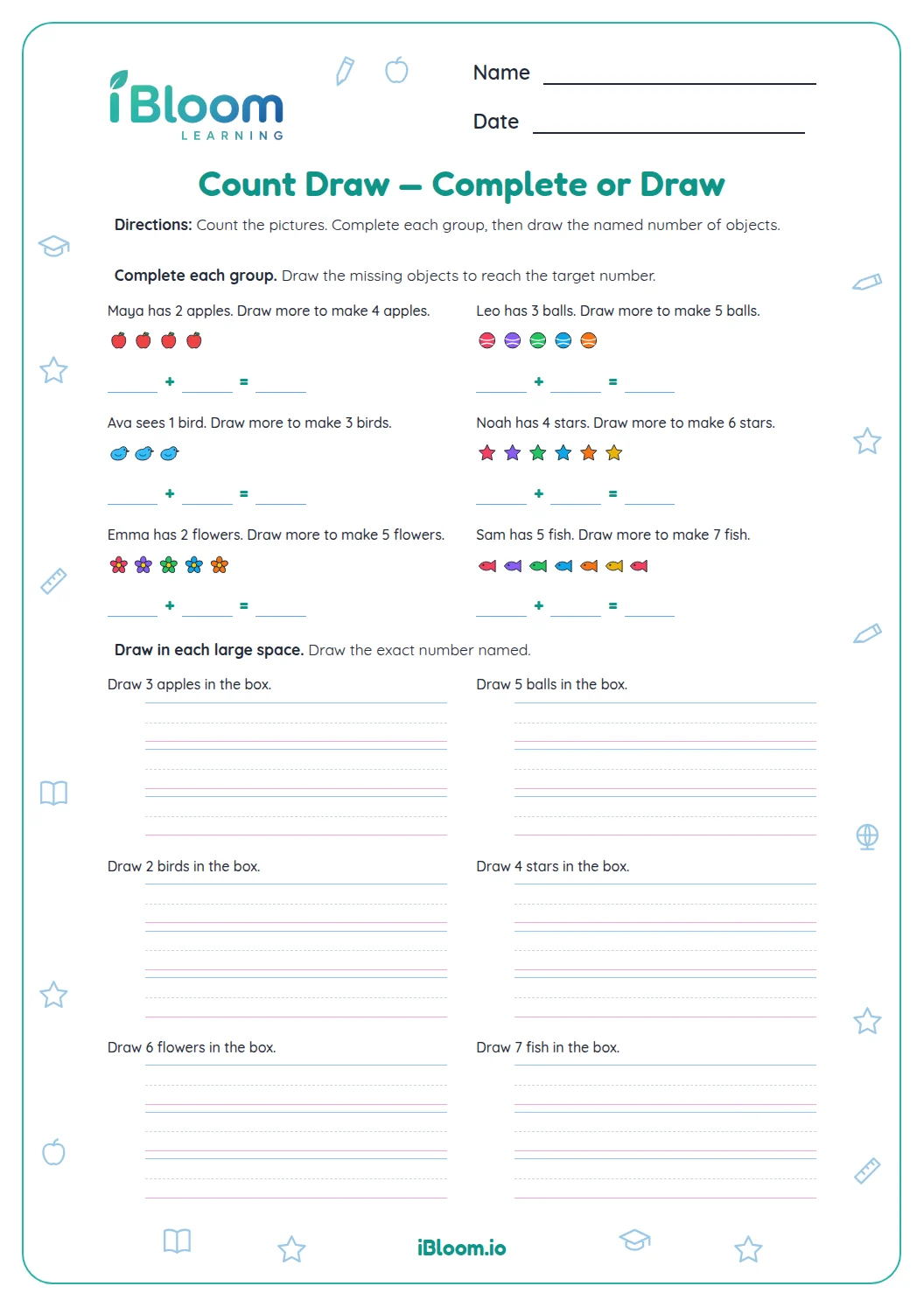
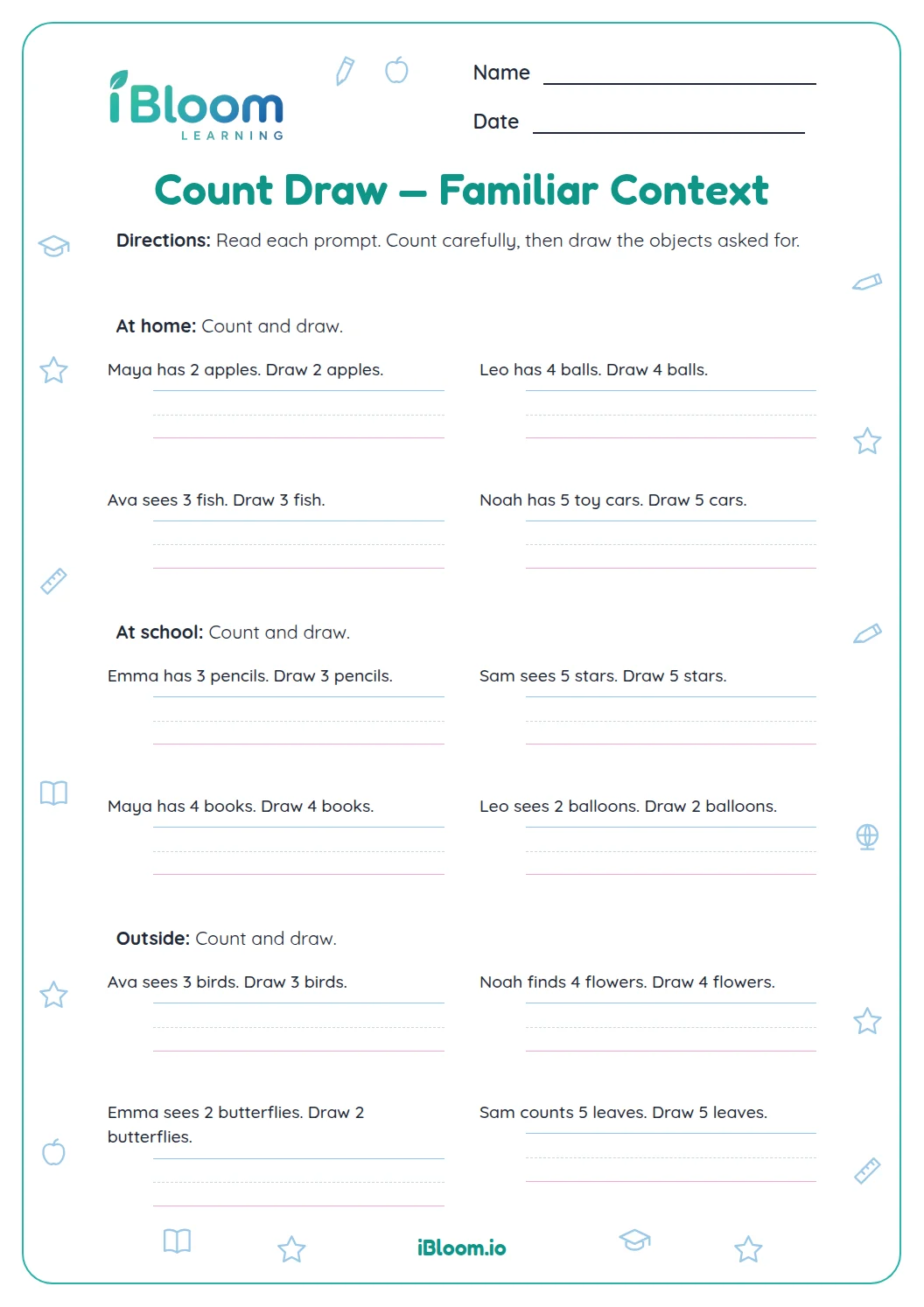
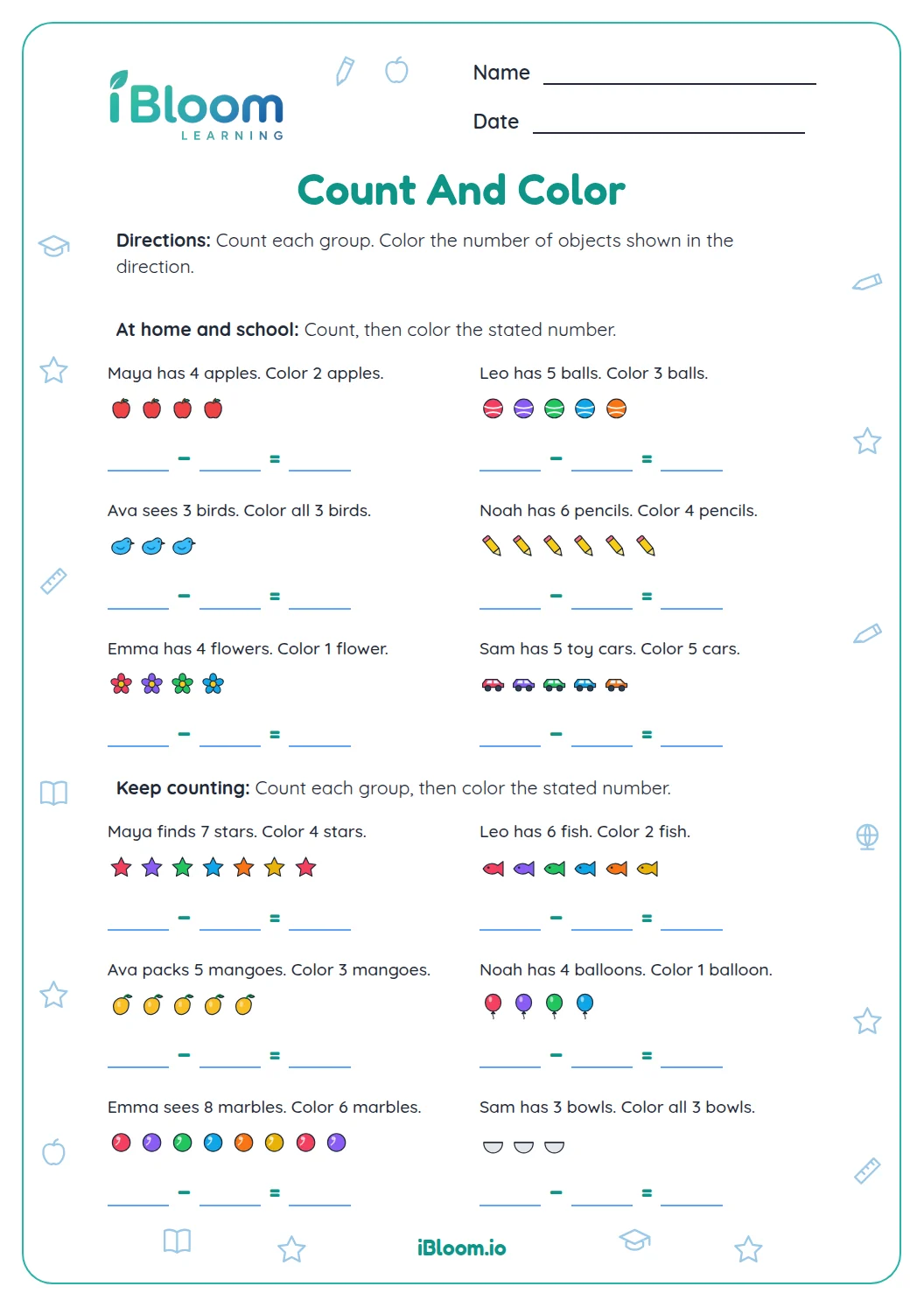
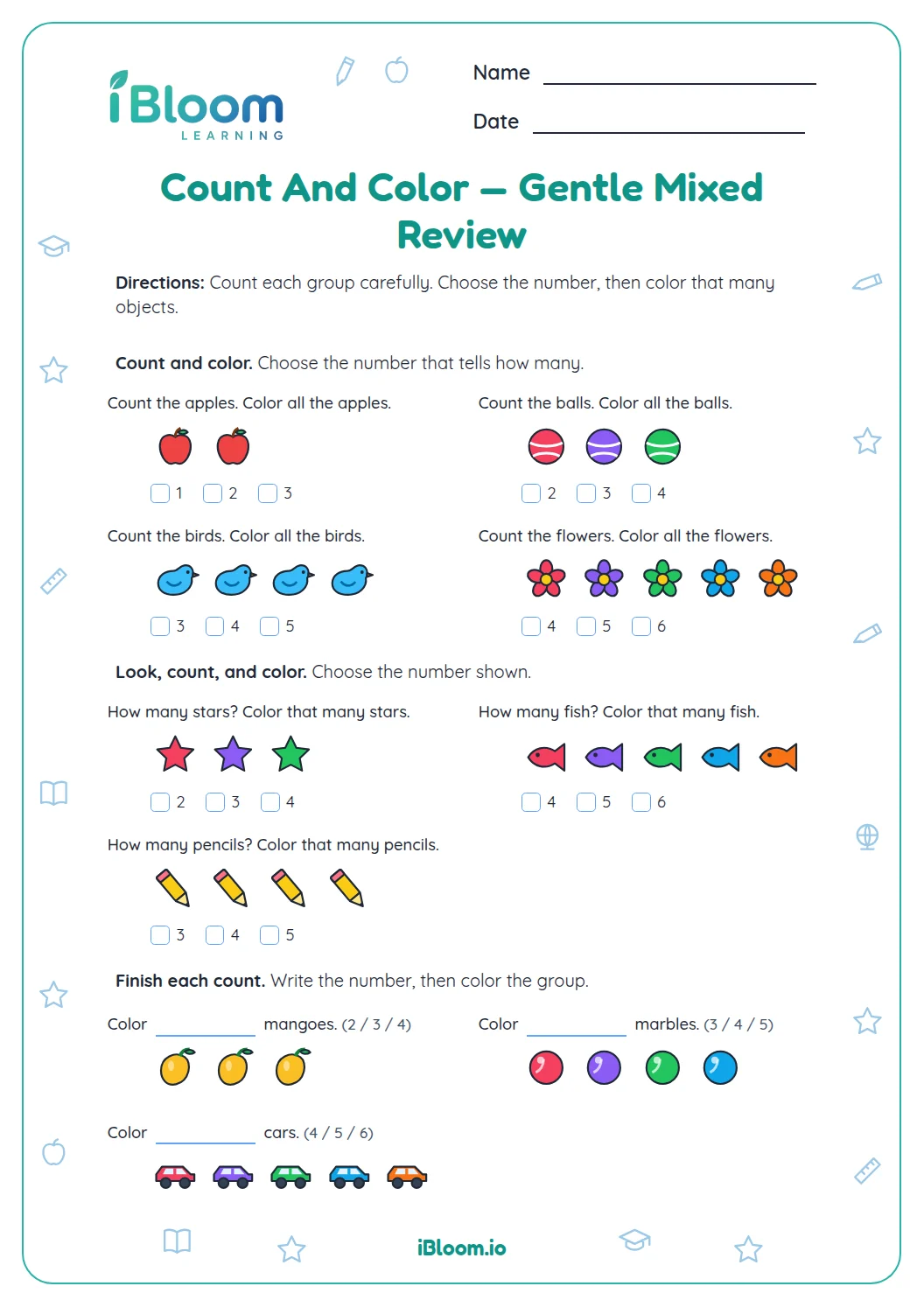
This Preschool–Kindergarten printable uses familiar pictures to practice counting. Children count groups, cross out a stated number and count what remains, then draw five groups of objects. A separate answer key gives the counting answers and examples for the drawings.
Aligned to K.CC.B.5
How does this page practice counting?
The first five items ask children to count pictured objects. The next five start with a complete pictured group, ask the learner to cross out a stated number, then count what remains. The last five ask children to draw a specified number of familiar objects.
What should a child do in the cross-out part?
Count the whole group first, cross out the number named in the prompt, and count the objects that remain. For example, starting with 4 apples and crossing out 1 leaves 3 apples.
How can an adult support the drawing part?
Read one prompt aloud, then let the child make one mark for each object while saying the count sequence. Check that the finished group has the requested number; the objects do not need to look polished.
- 1Cross out 1 apple from a group of 4.
- 2Count the apples that are not crossed out: 3.
- 3Answer: 3 apples remain.
How to use this worksheet
- 1Read the short direction at the start of each part.
- 2Point to each picture once while counting it.
- 3In the cross-out part, count the whole group before crossing anything out.
- 4For each drawing prompt, make one mark per object and stop at the named number.
- 5Use the answer key to check counts and compare drawings.
Common mistakes and quick fixes
The mistake
Skipping a picture while counting.
The fix
Touch or point to each picture once as you say one counting word.
The mistake
Counting crossed-out pictures as remaining.
The fix
Count only the pictures that are not crossed out.
The mistake
Drawing one too many objects.
The fix
Say each count word as one object is added, then stop at the target number.
Common Core alignment
This worksheet gives practice with the skill named in the standard.
Count groups and count out a named number of objects.
On this sheet: The pictured groups and drawing prompts ask children to count objects and make groups of a given size.
Show the official wordingHide the official wording
Count to answer “how many?” questions about as many as 20 things arranged in a line, a rectangular array, or a circle, or as many as 10 things in a scattered configuration; given a number from 1-20, count out that many objects.
What to practice next
Make more practice
Further reading
Questions parents and teachers ask
How many items are on the worksheet?
There are 15 items in three parts. Children count five pictured groups, cross out objects in five groups, and draw five groups. The sheet uses pictures for the count and cross-out tasks, then gives open drawing space for the final part.
Does the answer key show the drawings?
The key lists the requested number and object for each drawing prompt. Children may draw the objects in different ways; check that each group contains the correct number rather than expecting a particular artistic style. Count each object once as you check.
Should a child count before crossing out?
Yes. First count all the objects in the pictured group. Then cross out the number named and count the objects left uncrossed. This makes it easier to connect the original group, the action, and the remaining count. Count each object once as you check.
Can an adult read the directions aloud?
Yes. An adult can read each direction while the child does the counting and drawing. Point to each picture or new drawing mark one at a time, and invite the child to say the number words aloud. Count each object once as you check.
How long does this printable take?
Plan for about 20 minutes, including the drawing prompts. A child may finish sooner when counting is familiar or take longer to draw each requested group. Pause between parts if needed, then check answers together. Count each object once as you check.