


About this worksheet
This free printable worksheet gives Grades Pre-K–K learners focused practice with counting and representing 16. Children work through the illustrated or written prompts, then check their responses with the answer key. The questions move from recognizing examples to applying the skill in familiar contexts.
Aligned to K.CC.B.4
How do children count a group of 16?
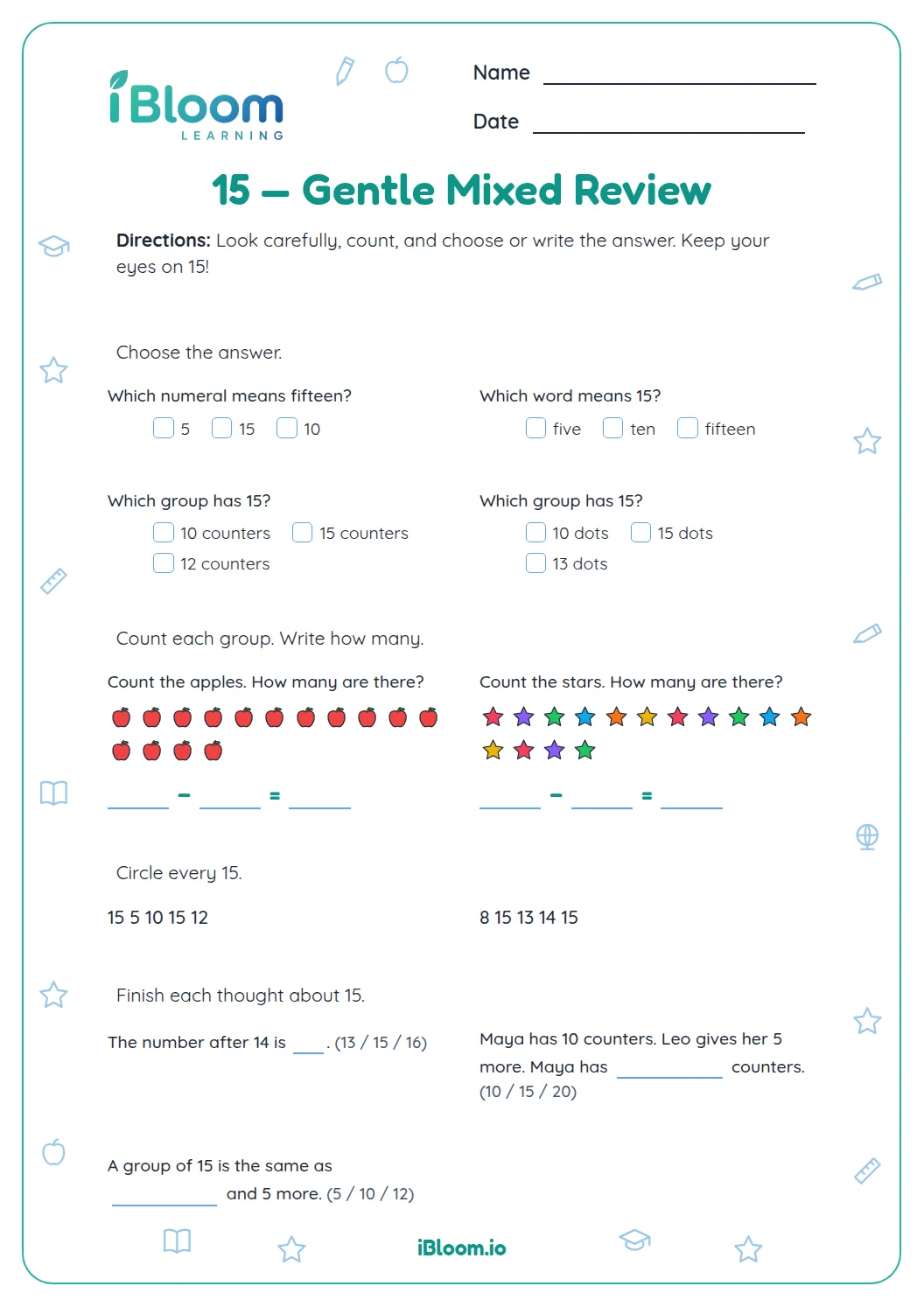
Touch or point to one picture at a time and say one number for each. The 16 apples on question 1 can be counted in three groups of five and one more.
- 1Count each apple once; the last count word is sixteen.
How can a ten-frame help show 16?
A full ten-frame shows ten. Six more counters make sixteen, so 16 is 10 and 6. The same idea appears in the base-ten blocks and number bond.
How does 16 fit between nearby numbers?
Counting forward from 15 gives 16, then 17. Counting back from 16 gives 15. Say the sequence aloud before filling the blanks.
How to use this worksheet
- 1Read the direction for each part together.
- 2Complete one question at a time, pointing back to the sentence or drawing when useful.
- 3Pause after each part and ask the learner to explain one answer.
- 4Use the answer key to review answers and talk through any changes.
Mistakes to watch for
The mistake
Answering from a guess instead of using the words or model.
The fix
Point to the clue that supports the answer.
The mistake
Skipping a direction when the question type changes.
The fix
Read the part heading and its one-line direction before starting.
The mistake
Rushing past a small detail.
The fix
Check the full sentence or count each item once.
Common Core State Standards for Mathematics alignment
This worksheet gives children practice with the named skill.
Connect counting objects to the number 16 and its numeral.
On this sheet: Connect counting objects to the number 16 and its numeral.
Show the official wordingHide the official wording
Understand the relationship between numbers and quantities; connect counting to cardinality.
What to practice next
Make more practice
Further reading
Questions parents and teachers ask
What does this Grades Pre-K–K worksheet include?
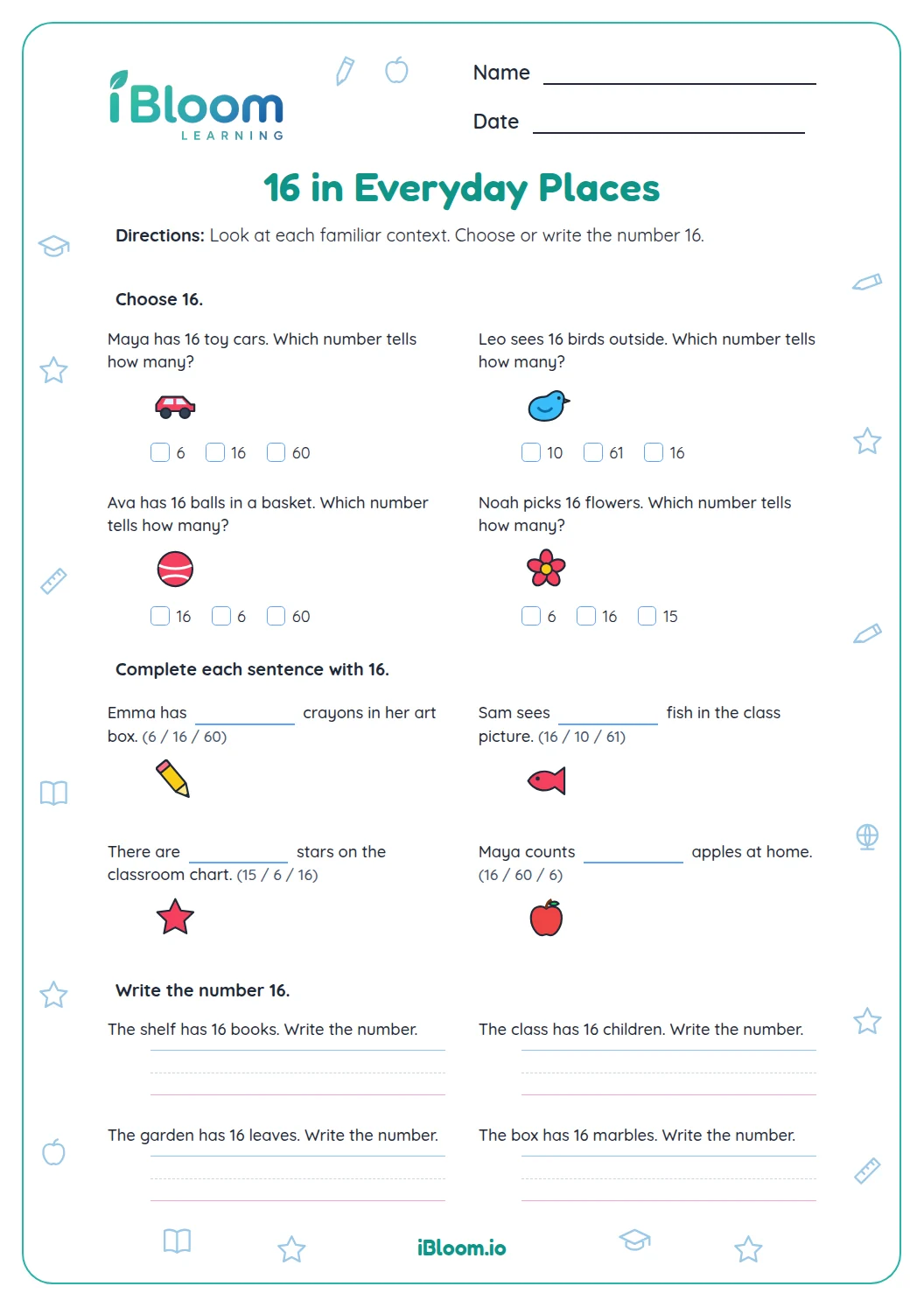
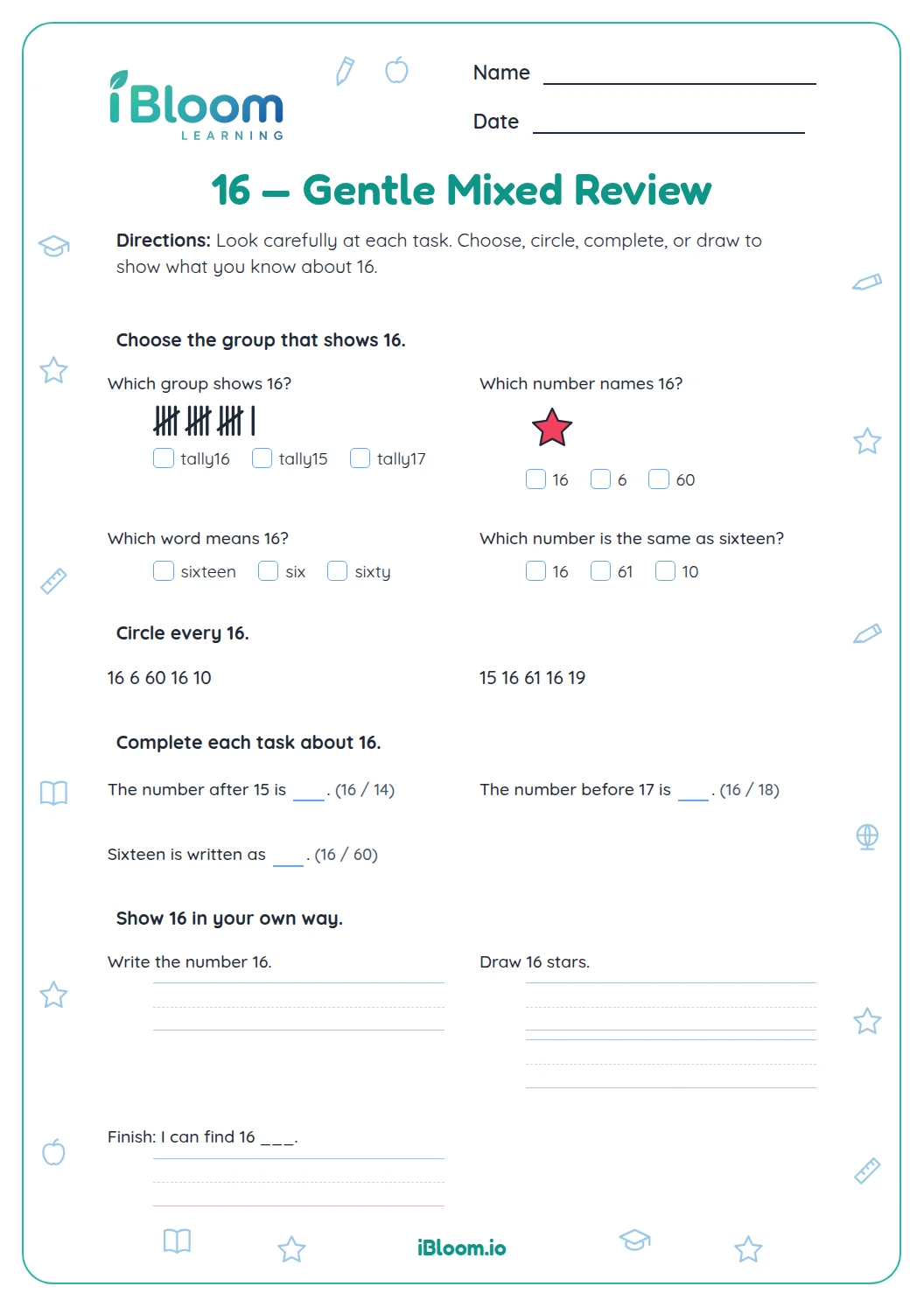
The worksheet has 16 questions in three parts, followed by a separate answer key. The prompts move from recognizing examples to using the skill in a familiar context. Review the key after each part and ask the child to explain a response.
Can an adult read the directions aloud?
Yes. An adult may read the directions aloud, then let the child answer each prompt. Pause to ask what clue, picture, or word helped the child decide. This keeps the learner focused on the question while making the sheet usable for early practice.
How should we use the answer key?
Use the key after a section is complete. If an answer differs, return to the prompt and talk through the clue, model, or sentence that supports the correct response. For open responses, the key gives a sample that may be phrased in other clear ways.
Can this be used in a classroom?
Yes. The worksheet can support independent work, a small group, or a brief review with an adult. Its three parts make it easy to pause between kinds of practice and discuss an answer before moving to the next set. together.
What should we do after finishing?
Ask the child to explain one answer in their own words, then revisit any item that felt difficult. A related worksheet from the same skill collection offers another example and gives the learner a chance to apply the same idea again.