







About this worksheet
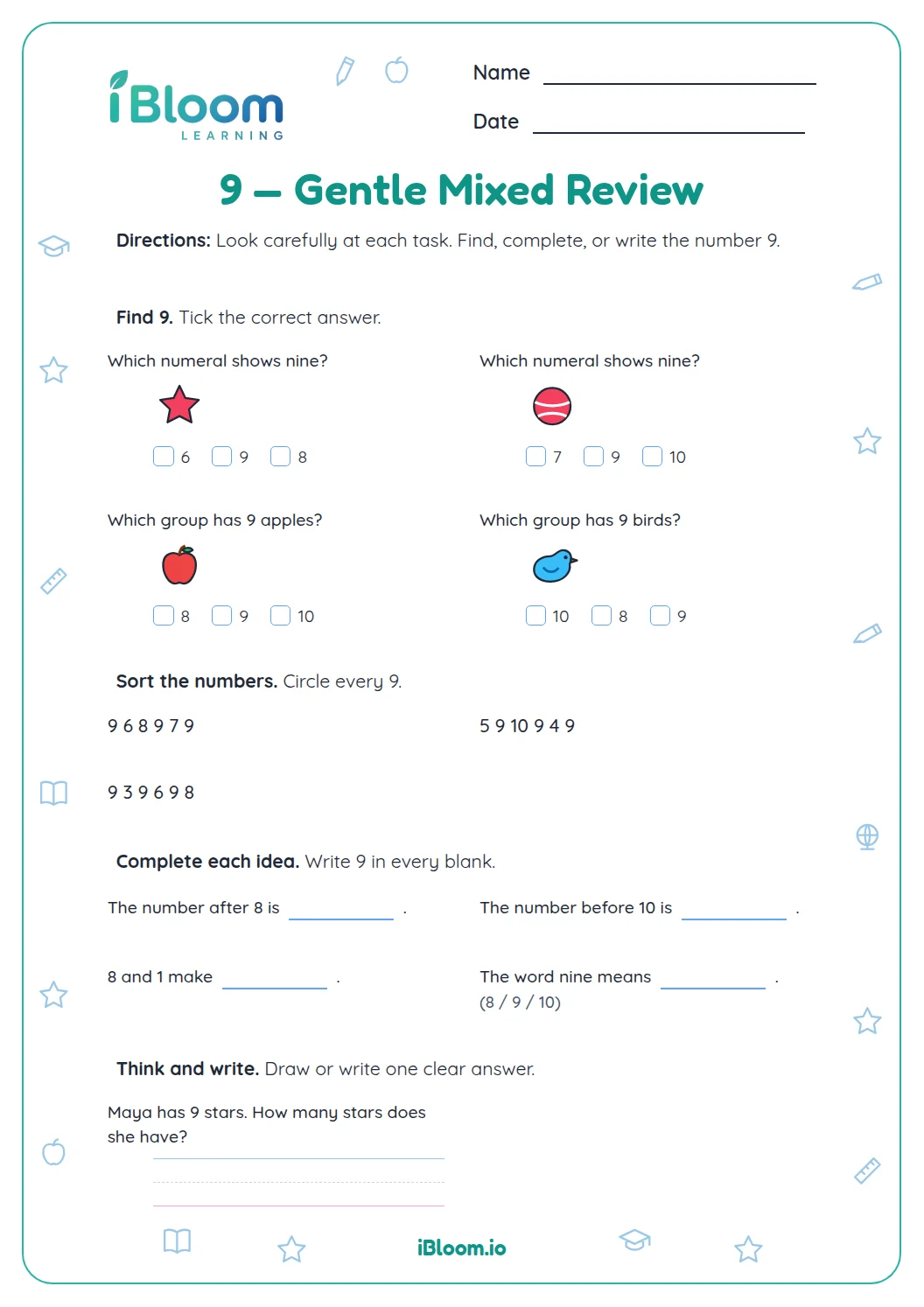
This printable helps preschool and kindergarten children connect the number word nine, a group of nine familiar objects, and the numeral 9. Part A has four picture groups to count. Part B has ten short everyday situations with picture cues and three numeral choices. The answer key identifies 9 for every item.
Aligned to K.CC.B.4
What does 9 look like?
Children practice one-to-one counting with familiar objects. Every group contains nine items, so children can compare their count with the target numeral.
How do you count a group of nine?
Count one group aloud, touching each item once. The final number name gives the total.
- 1Count each bird once, pointing as you go.
- 2There are nine birds.
- 3Answer: 9
Where do children see the numeral 9?
Part B repeats the count-and-match task with choices 8, 9, and 10. Ask the child to recount before choosing if two numbers look close.
How to use this worksheet
- 1Count each object once, then say the total.
- 2Look closely at the numerals 8, 9, and 10.
- 3Point to each object while counting so none are skipped.
- 4Stop when the last object is counted; that last number tells how many.
- 5Check that the numeral has a rounded loop and a straight stem.
- 6Recount a group if the chosen number does not match.
Common mistakes and quick fixes
The mistake
Count an object twice while moving across the group.
The fix
Point to each object once, moving in one direction as you count.
The mistake
Say the number names but lose track of the total.
The fix
Pause on the last object; the last number said is how many.
The mistake
Choose 8 or 10 without recounting.
The fix
Touch each picture again and compare the count with the numeral choices.
Common Core alignment
Connect a counted set with the number that tells how many are in it.
On this sheet: Children count each pictured set and connect nine objects with the numeral 9.
Show the official wordingHide the official wording
Understand the relationship between numbers and quantities; connect counting to cardinality.
What to practice next
Make more practice
Further reading
Questions parents and teachers ask
Can an adult read the prompts aloud?
Yes. An adult can read each short prompt while the child points to the objects and counts aloud. The goal is to count the pictured set and connect the total with 9, so reading support keeps attention on the number skill.
What is practiced in Part A?
Part A has four pictured groups of nine objects. Children point to each item as they count, then say the total. Seeing nine apples, birds, flowers, and ducks connects the number word with the same quantity across familiar objects.
What is practiced in Part B?
Part B gives ten familiar situations and asks children to choose 8, 9, or 10 for the number word nine. Each prompt has a small picture cue. The child matches the number word, read aloud or independently, to its numeral choice. Recounting Part A can help build confidence.
Does the answer key come with the worksheet?
Yes. The separate key identifies 9 for every question. An adult can use it after the child has counted the four pictured groups and chosen a numeral for each of the ten familiar situations. It is designed for checking completed work.
How long will this activity take?
About 15 to 20 minutes is a reasonable estimate for the 14 short items. Children can pause between the four counting groups and the ten numeral choices. Pointing to objects and comparing numerals may take extra time while a child is learning to recognize 9.