


About this worksheet
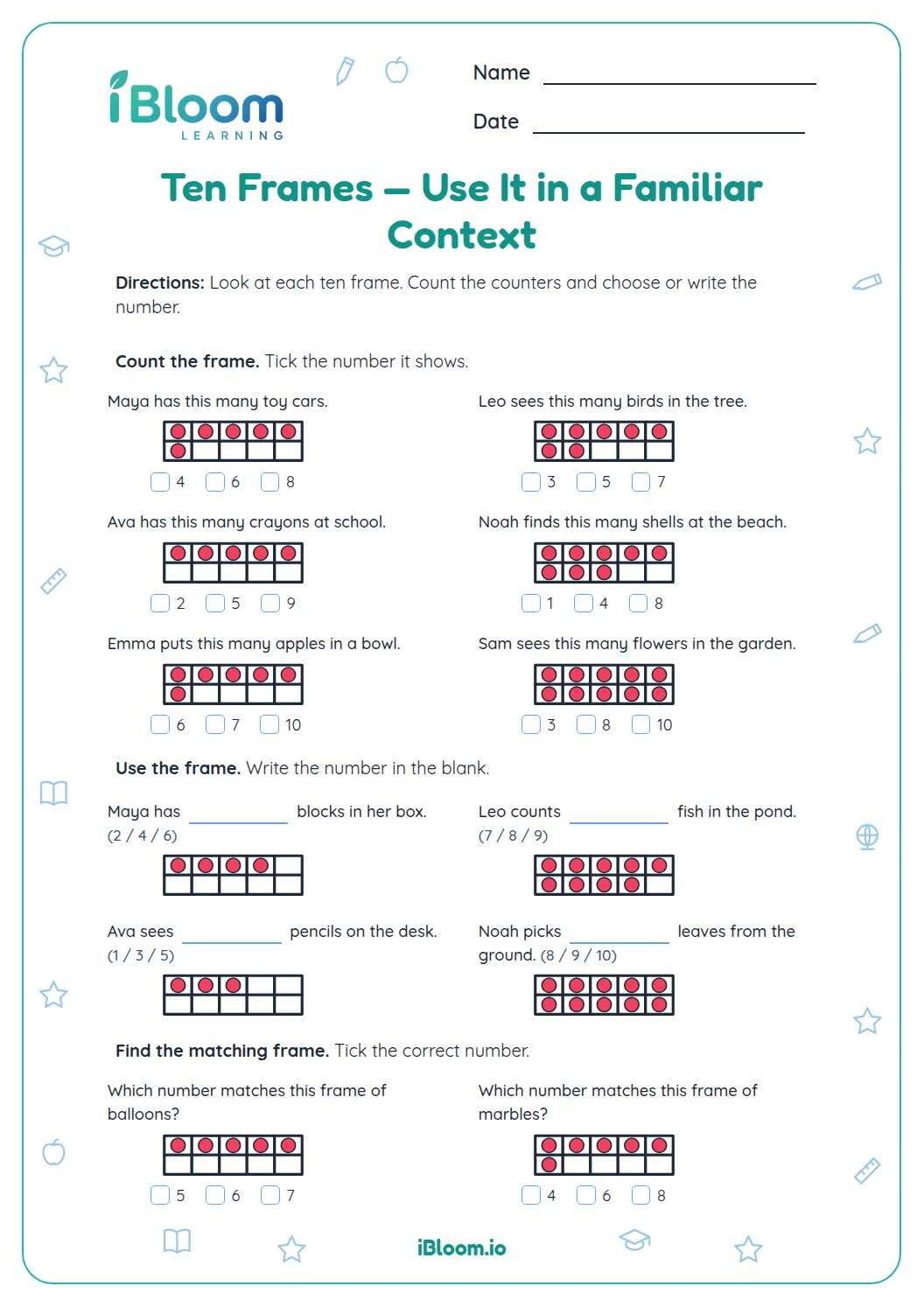
This free printable Preschool–Kindergarten worksheet gives children focused practice with ten-frame counting. It replaces the old mixed or placeholder activity with questions built around the named skill. It supports Kindergarten CCSS K.CC.B.5. The sheet has 12 questions across short parts, with a separate answer key for checking work.
Aligned to K.CC.B.5
What does ten-frame counting mean?
A ten frame organizes counters in rows of five, so children can count each counter or notice a full row. The second part uses number bonds to find a missing part.
How can a ten-frame count be checked?
For q5, count the ten counters in the full frame, then count two more in the next frame. The total is 12.
- 1A full ten frame holds 10 counters.
- 2Count 2 more counters.
- 310 + 2 = 12.
How is the practice organized?
Part A has eight ten-frame counts from 3 to 18. Part B has six number bonds with one missing part; subtract the shown part from the whole.
How to use this worksheet
- 1Count each counter once, moving across each row.
- 2For two frames, count the full ten before the extra counters.
- 3In a number bond, keep the whole and both parts in view.
- 4Subtract the known part from the whole to find the missing part.
- 5Use the key to check each response.
Common mistakes and quick fixes
The mistake
Skipping a counter while counting.
The fix
Touch or point to each counter once, left to right.
The mistake
Counting a full ten frame as nine.
The fix
Check that the top and bottom rows each have five.
The mistake
Writing the known part in the empty number-bond circle.
The fix
Ask what must join the known part to make the whole.
Common Core alignment
Count the counters in each ten frame to answer how many.
On this sheet: Each ten-frame question asks children to count up to 15 objects.
Show the official wordingHide the official wording
Count to answer “how many?” questions about as many as 20 things arranged in a line, a rectangular array, or a circle, or as many as 10 things in a scattered configuration; given a number from 1-20, count out that many objects.
What to practice next
Make more practice
Further reading
Questions parents and teachers ask
How many questions are on the Preschool–Kindergarten sheet?
There are 14 questions, grouped into short parts. Children can complete the parts in order and use the separate answer key to review their work. Invite the learner to explain one answer aloud and point to the clue or pattern that supports it.
Is an answer key included?
Yes. A separate answer key lists the answers for the worksheet. Use it after the child has tried each question, then revisit any answer that needs another look. Ask the child to compare each answer with the prompt and talk through any correction together.
How should I introduce the activity?
Read the directions together and talk through the first prompt. Ask the child to explain how the clue, model, or pattern helps with counting counters in ten frames and finding missing number-bond parts before moving on. That short conversation can make the written practice clearer and give you a chance to clear up confusion.
Can I use this at home or in class?
Yes. Print the worksheet for independent practice, a small group, or a short review with an adult. The answer key makes it easy to check completed work. The activities are grouped so learners can move through them at a comfortable pace.
What if a question feels difficult?
Pause and return to the prompt. Point out the information it gives, then solve one step at a time. The child can skip a tricky item and return after completing the next question. Keep the focus on the thinking process, not speed.