


About this worksheet
This free printable counting worksheet helps preschool and kindergarten children connect spoken number sequences with groups of ten. Part A has four missing numbers in tens sequences. Part B has four missing numbers in ones sequences, including the move from 99 to 100. Part C gives nine rows of dots to count by tens. In Part D, children draw ten more dots and count all the printed and drawn dots to 100 by tens and by ones. These ten tasks practice Common Core K.CC.A.1. An adult can read directions and listen to the counting; a separate key supplies answers and activity notes.
Aligned to K.CC.A.1
Which number sequences do children complete?
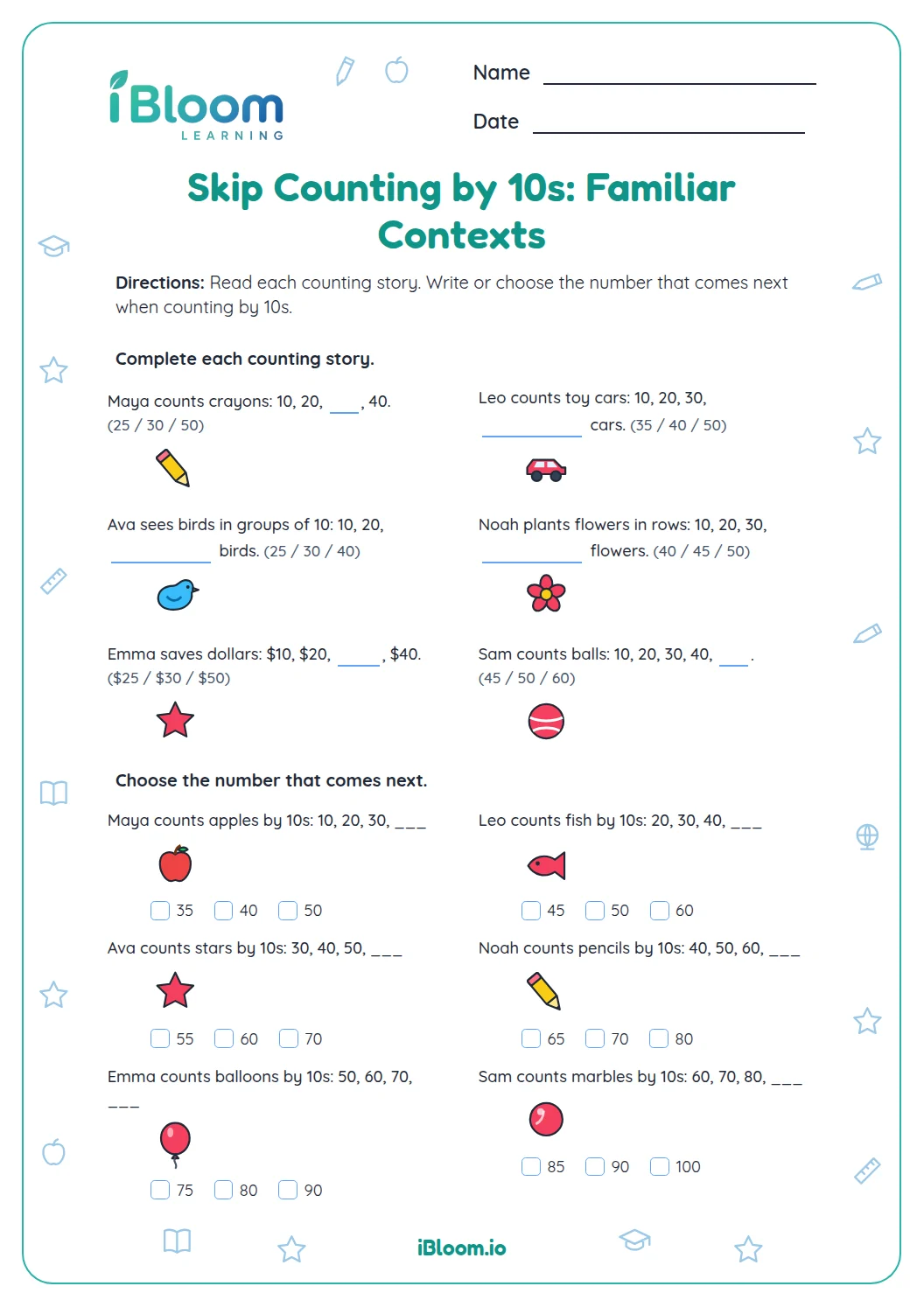
The four Part A sequences move in tens, beginning with 10, 20, a blank and 40. Together they include every multiple of ten through 100. Part B changes to steps of one and includes transitions into 20, 50, 80 and 100.
Read each sequence aloud and name the step size before filling the blank. Switching from tens to ones is part of the task, so pause at the Part B heading.
- 110, 20, ___, 40
- 2Say the tens: ten, twenty, thirty, forty.
- 3Write 30 in the blank.
How do we count the printed rows?
Part C has nine rows with ten dots in each row. Point to a row at a time and say 10, 20, 30, continuing to 90. Circle the last dot at the bottom right after counting all nine rows.
Part D adds the last ten. Once those dots are drawn, count all ten rows by tens to 100. Then touch each dot in Part C and each new dot in Part D, saying every number from 1 to 100.
What belongs in the drawing box?
Children draw one row of ten dots in the Part D box. Together with the nine printed rows in Part C, this completes ten rows of ten, or one hundred altogether.
Simple pencil dots are enough. After drawing, start at the top-left dot in Part C and count all the printed dots by ones. Continue into the new row in Part D with 91, 92, through 100. The key describes the added dots and the full spoken count.
Count, complete and draw
- 1Say the tens from 10 to 100 together before filling Part A.
- 2Complete each tens sequence and read it back with the missing number.
- 3Change to counting by ones for Part B and listen carefully at each new ten.
- 4Count the nine rows in Part C by tens and circle the final printed dot.
- 5Draw ten dots in Part D, then count all ten rows by tens to 100 and every dot by ones from 1 to 100.
Mistakes to discuss and fix
The mistake
Continuing 18, 19 with 30.
The fix
Say “eighteen, nineteen, twenty, twenty-one” slowly, keeping the step size at one.
The mistake
Counting a dot twice at the start of a new row.
The fix
Move a finger from left to right and begin the next row at its leftmost dot only after finishing the current row.
The mistake
Drawing 100 new dots beside the ninety already printed.
The fix
Part C already has ninety dots. Draw only one new row of ten in Part D to complete one hundred.
Common Core alignment
Complete a hundred dots, then count to 100 by tens and by ones.
On this sheet: Children complete number sequences and add a final ten to ninety dots before counting all 100 by tens and ones.
Show the official wordingHide the official wording
Count to 100 by ones and by tens.
What to practice next
Make more practice
Further reading
Questions parents and teachers ask
Does my child count every number from 1 to 100?
Yes, after drawing the final ten dots, your child counts every printed and drawn dot from 1 to 100. Begin at the top left of Part C and count across each row. After the ninety printed dots, continue into the new Part D row with 91 through 100.
How many dots should my child draw?
Your child draws ten new dots in Part D. Nine rows of ten dots are already printed in Part C, giving ninety. The empty box is for the missing group of ten. After drawing, count all the printed and drawn dots by ones to reach one hundred.
Can a preschooler use this sheet with help?
Yes, an adult can read the directions and work through the counting with a preschooler. Start with the tens sequences and point together during the array activity. If the full count is tiring, pause between rows and return later. Keep the spoken count and the finger on the same dot.
Why does the sheet switch between ones and tens?
The two step sizes show different ways to reach one hundred. Parts A and B ask children to notice whether numbers increase by ten or by one. Parts C and D connect those sequences: each dot adds one, while each full row adds a whole group of ten.
How do I check the counting and drawing tasks?
Listen while your child counts the nine Part C rows by tens, then check for ten new dots in Part D. Have them count all ten rows by tens to 100, then every dot by ones. The key gives activity notes and the twelve missing numbers.