





About this worksheet
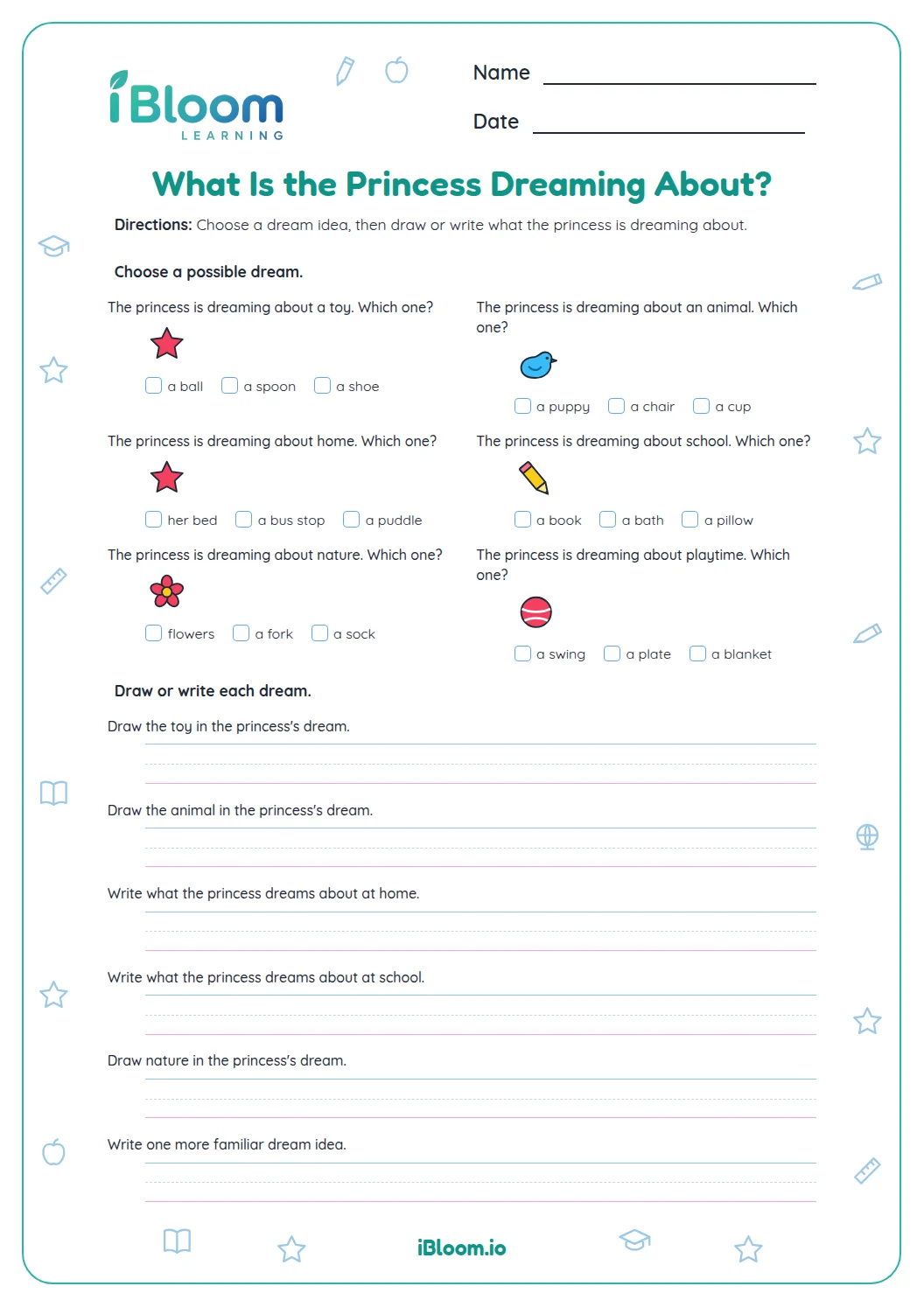
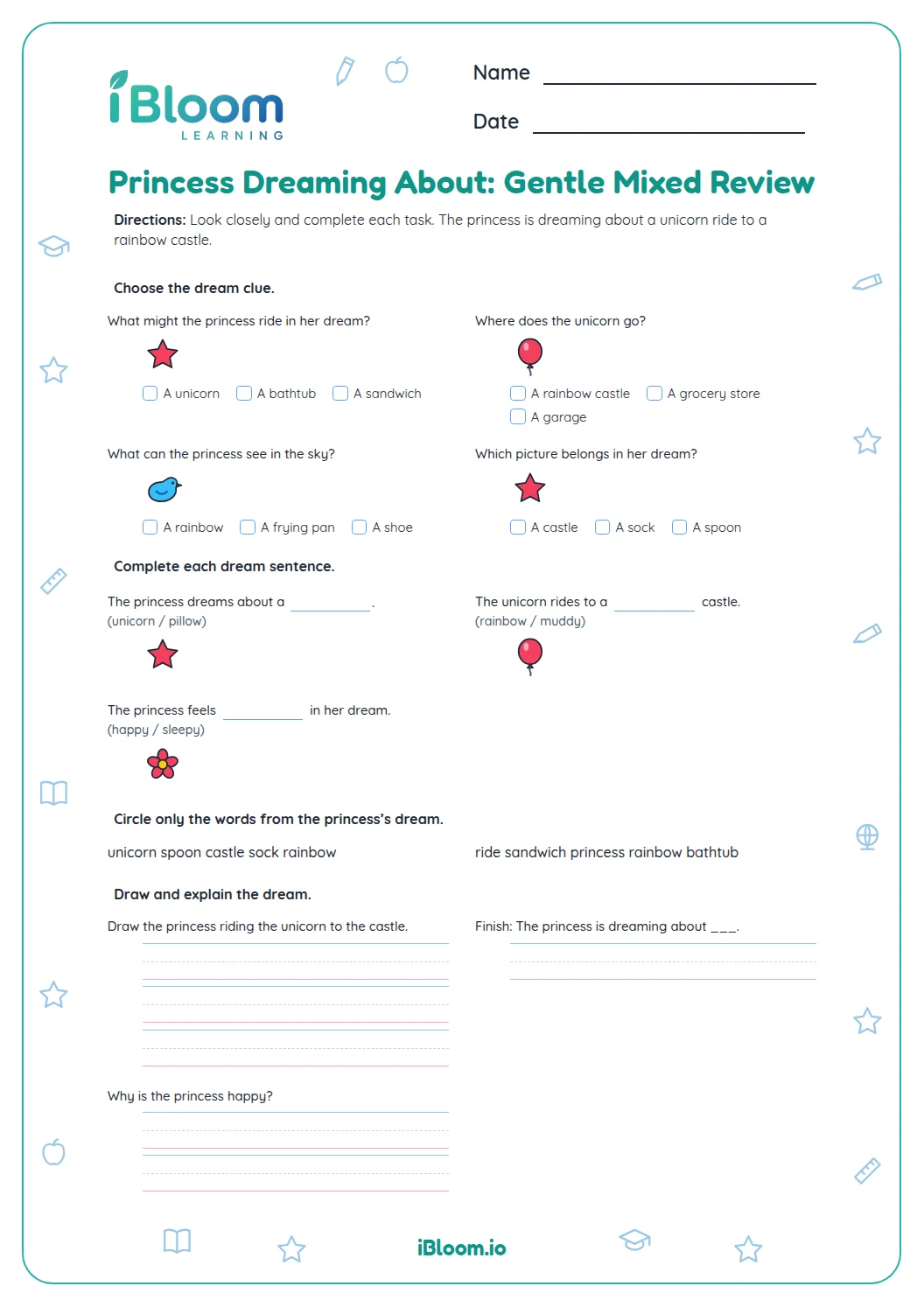
This free printable for preschool and kindergarten invites children to imagine what a princess might dream about. Fourteen picture, sentence-completion, and drawing prompts let children choose or create dream details and share ideas aloud or in writing. The separate key describes suitable responses while leaving room for children’s own imaginative choices.
What will learners practice in imaginative drawing and writing?
The three parts begin with picture clues and short ideas, continue with large boxes for drawing dream details, and finish with picture choices. Children can tell or write their ideas where the prompt allows either response.
- 1Question 2: Finish the sentence: “The princess dreams of ___.”
- 2A fitting completion names something the princess could dream about, such as a castle.
- Imagine from picture clues
- Draw the dream
- Choose a picture
How can learners work through imaginative drawing and writing?
The three parts begin with picture clues and short ideas, continue with large boxes for drawing dream details, and finish with picture choices. Children can tell or write their ideas where the prompt allows either response.
- 1Question 2: Finish the sentence: “The princess dreams of ___.”
- 2A fitting completion names something the princess could dream about, such as a castle.
How can an adult support this imaginative drawing and writing practice?
Yes. The directions allow a child to tell an idea or write it. An adult can record the child’s words if needed, while keeping the drawing prompts open for the child to complete with pictures.
How to use this worksheet
- 1Look at the picture clues and listen to the prompt.
- 2Say an idea aloud before writing, if that helps.
- 3Draw one clear detail in each drawing box.
- 4Choose the picture that matches the question in the final part.
- 5Share or name the drawing when the prompt asks.
Common mistakes and quick fixes
The mistake
Choosing a picture without listening to the clue.
The fix
Repeat the clue and compare it with each picture.
The mistake
Drawing several details when asked for one.
The fix
Pick one clear object or place for that box.
The mistake
Thinking the key’s idea is the only answer.
The fix
Accept another imaginative answer that fits the prompt.
What to practice next
Make more practice
Questions parents and teachers ask
What does “complete or draw” mean on this princess page?
Children complete short dream sentences, choose picture answers, and draw imagined details. The prompts keep the ideas centered on what the princess might see, feel, find, or do in a dream. Children can point to a picture or tell an idea before drawing it.
How many prompts and pages are included?
There are 14 prompts in three parts: imagine from picture clues, draw details, and choose a matching picture. The worksheet is five pages, with a separate five-page answer key. Children can point to a picture or tell an idea before drawing it.
Can a child answer aloud instead of writing?
Yes. The directions allow a child to tell an idea or write it. An adult can record the child’s words if needed, while keeping the drawing prompts open for the child to complete with pictures. Children can point to a picture or tell an idea before drawing it.
Do children have to draw the same ideas shown in the key?
No. The key describes what a clear response can include, such as one imagined place or object. Children can draw different dream details as long as they follow the prompt. Children can point to a picture or tell an idea before drawing it.
What picture choices appear on the page?
Children choose a kind dream friend, an object for the dream sky, and a dream place. Each question shows picture clues with word labels, so the child can connect the prompt to a familiar image. Children can point to a picture or tell an idea before drawing it.