








About this worksheet
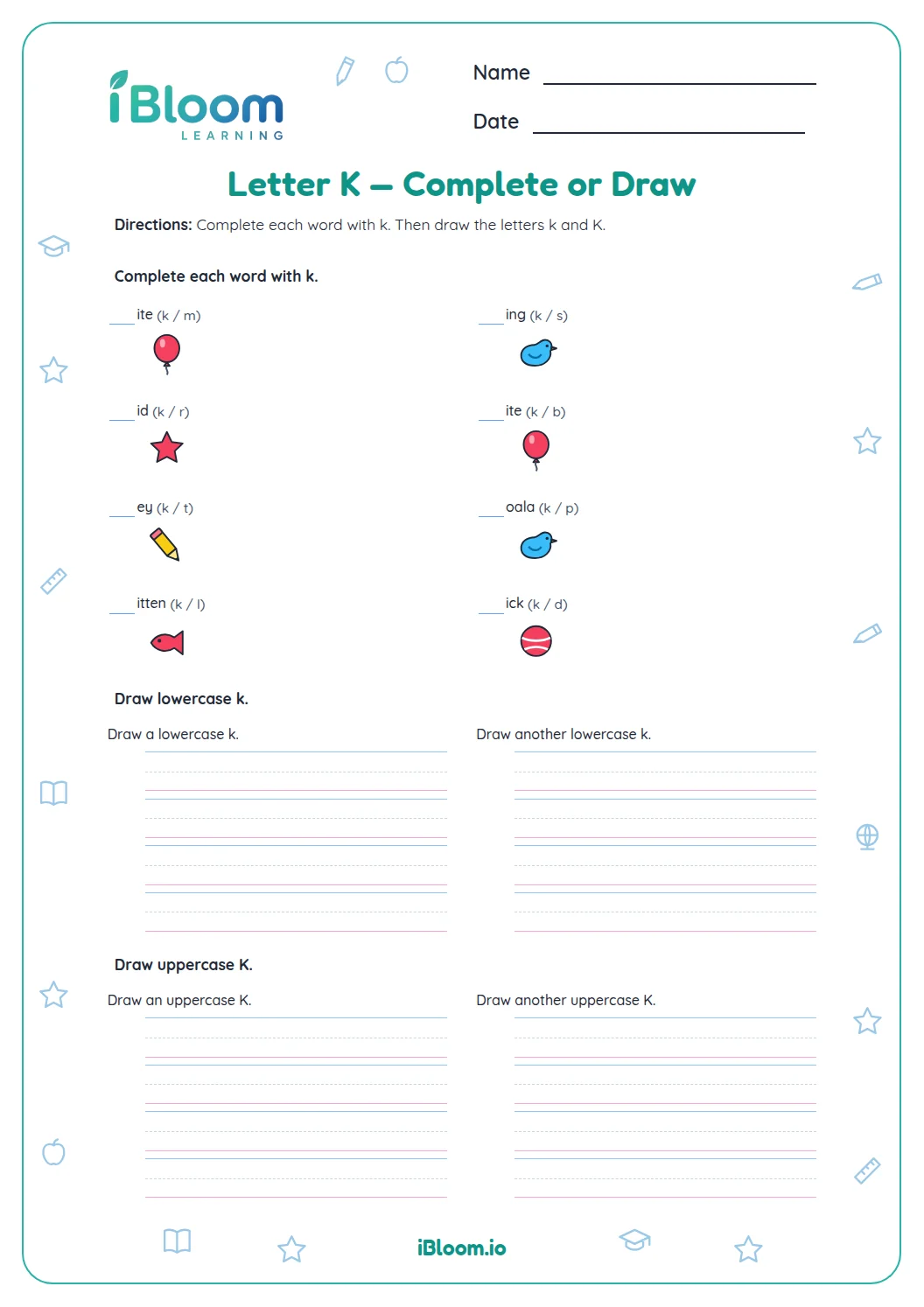
This printable gives preschool and kindergarten learners 12 ways to practice the letter K: recognize uppercase and lowercase forms, identify picture words that begin with /k/, complete words, and trace “kite.” Picture clues keep early items concrete, while later items ask children to notice the beginning sound and form the letter.
How do children recognize K and k?
The first part asks children to choose lowercase k and uppercase K, then identify familiar pictured words beginning with the /k/ sound.
- 1Choose the pictured word that begins with /k/: kite, sun or fish.
- 2Kite starts with the /k/ sound.
Which words begin with the /k/ sound?
In the sound-search part, children find words such as kite, key, king, kid and kangaroo. They attend to the first sound, not just a letter later in a word.
How does the page practice writing K?
Children complete the beginning of three familiar words with k, then trace the short word kite. An adult can say each word slowly and invite the learner to listen for its first sound.
How to use this worksheet
- 1Name the letter choices aloud.
- 2Say each picture word and listen for its first sound.
- 3Circle every /k/ word in each short row.
- 4Add k to complete each familiar word.
- 5Trace kite, then check the key together.
Common mistakes and quick fixes
The mistake
Confusing uppercase K with lowercase k.
The fix
Compare the two forms and name each one before choosing.
The mistake
Choosing a word with k later in the word.
The fix
Say the word slowly and listen to its first sound.
The mistake
Leaving out the first letter in a word.
The fix
Say the completed word aloud after adding k.
What to practice next
Make more practice
Questions parents and teachers ask
How many items are on this letter K page?
There are 12 questions in four parts. Children recognize uppercase and lowercase K, find words that begin with /k/, complete familiar words, and trace kite. The separate answer key accompanies the practice pages. The activities are arranged from recognition through tracing.
Does this page include both uppercase and lowercase K?
Yes. The first two questions ask children to recognize lowercase k and uppercase K. Later tasks use lowercase k at the beginning of words and include a tracing activity to practice forming a familiar word. The remaining items use K at the start of familiar words.
Which sound does K make in these words?
K makes the /k/ sound at the beginning of kite, key, king, kid and kangaroo. Picture clues support the first choices; children can say each pictured word and listen to its first sound. Listen to the first sound rather than a sound in the middle.
Can an adult help with the word search?
Say each word slowly and ask the learner what sound comes first. In each short row, the child circles all words that start with /k/, rather than every word that contains the letter k. The word rows include all the words to consider.
Is there a tracing activity?
Yes. The final item asks the learner to trace the word kite. The answer key shows the target word, while an adult can look for the starting K and a recognizable copy on the line. The target word is short enough for an early tracing attempt.