






About this worksheet
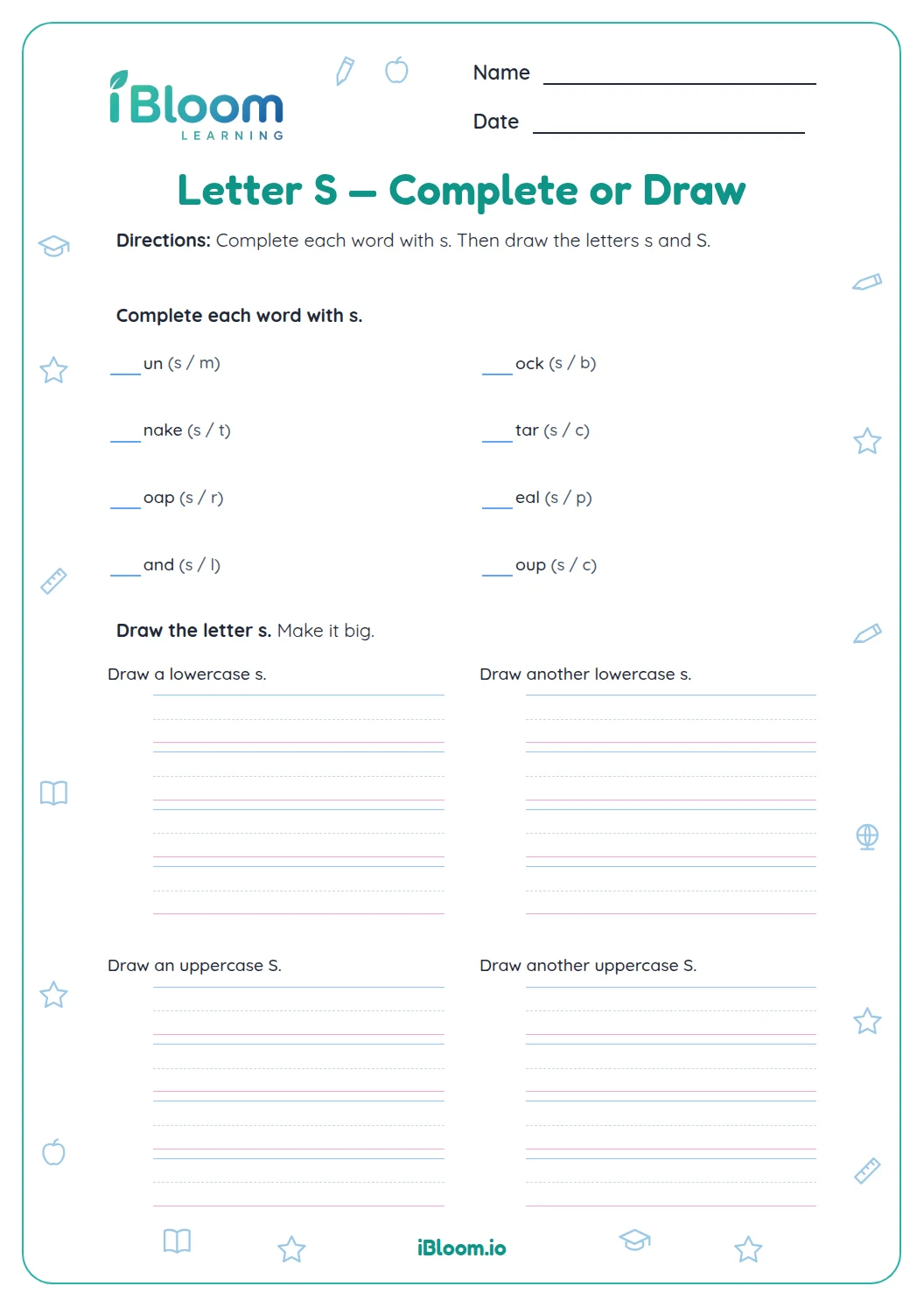
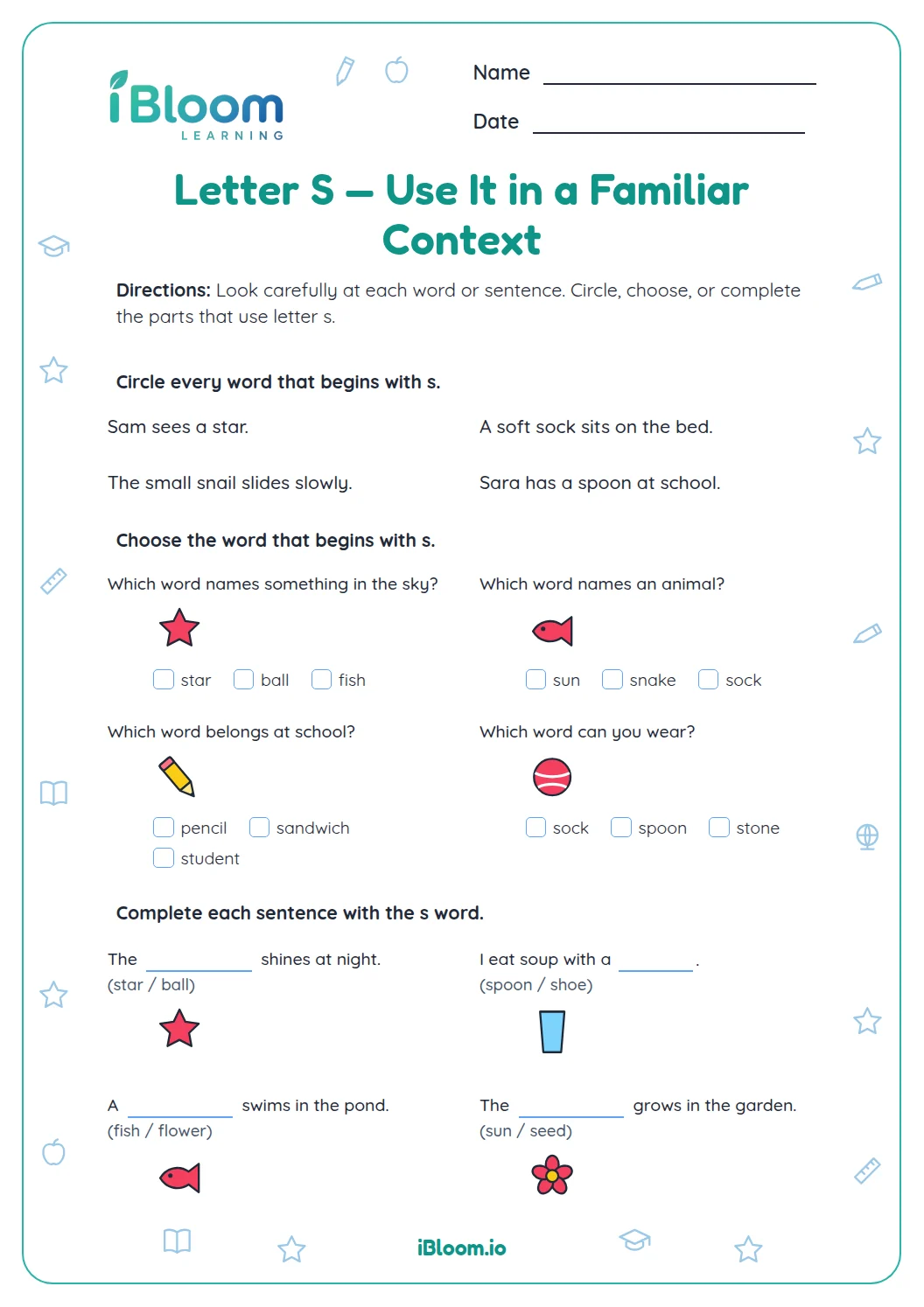
This preschool and kindergarten Letter S worksheet mixes letter tracing, picture naming, beginning sounds, and letter matching. Children trace uppercase S and lowercase s, identify picture names that start with /s/, and count familiar pictures. The 16 short activities revisit S in several ways, and the separate key gives the fixed picture, letter, and number answers.
How can a child trace S?
Trace uppercase S and lowercase s slowly, following each curved shape from top to bottom.
- 1S s
Which picture names start with /s/?
Say each picture name aloud and listen for /s/ at the beginning, as in “sun,” “sock,” and “snake.”
- 1sun begins with /s/
How does a sound connect to a letter?
Listen to the beginning sound, then choose the letter that represents it.
- 1sock starts with S
How to use this worksheet
- 1Read the direction at the start of each part.
- 2Work one item at a time and use the clue named in the prompt.
- 3Read the whole sentence or say the picture name aloud.
- 4Check the completed page with the answer key.
- 5Review any item that needs another try.
Common mistakes and quick fixes
The mistake
Listening to the ending sound instead of the first sound.
The fix
Say the picture name slowly and focus on its first sound.
The mistake
Confusing uppercase S with lowercase s.
The fix
Compare the pair S s and trace each shape.
The mistake
Guessing before naming a picture.
The fix
Say each picture name aloud before choosing.
What to practice next
Make more practice
Questions parents and teachers ask
What does this worksheet practice?
It practices tracing uppercase S and lowercase s, hearing /s/ at the start of picture names, and matching sounds to letters. The 16 activities include familiar picture clues and a separate key for checking answers. Ask the learner to name the clue that helped before moving on.
How many activities are on the page?
There are 16 short activities in four parts: tracing, listening for the first sound, matching sounds to letters, and counting picture groups. Children can say each picture name aloud as they work. Ask the learner to name the clue that helped before moving on.
How should we use the answer key?
Invite the child to trace and name pictures before checking the key. For sound questions, say each picture name slowly and listen to its first sound. The key shows the matching picture, letter, or count. Ask the learner to name the clue that helped before moving on.
Can an adult use this in a small group?
Yes. Introduce the letter pair S and s, then model saying a picture name and listening for its first sound. Children can take turns naming pictures and complete the tracing or counting tasks at their own pace. Ask the learner to name the clue that helped before moving on.
What if an answer differs from the key?
Say the pictured word aloud together and listen carefully to the first sound. If the child chose a letter, compare that sound with the beginning of the word; if the count differs, point to each picture once. Ask the learner to name the clue that helped before moving on.