






About this worksheet
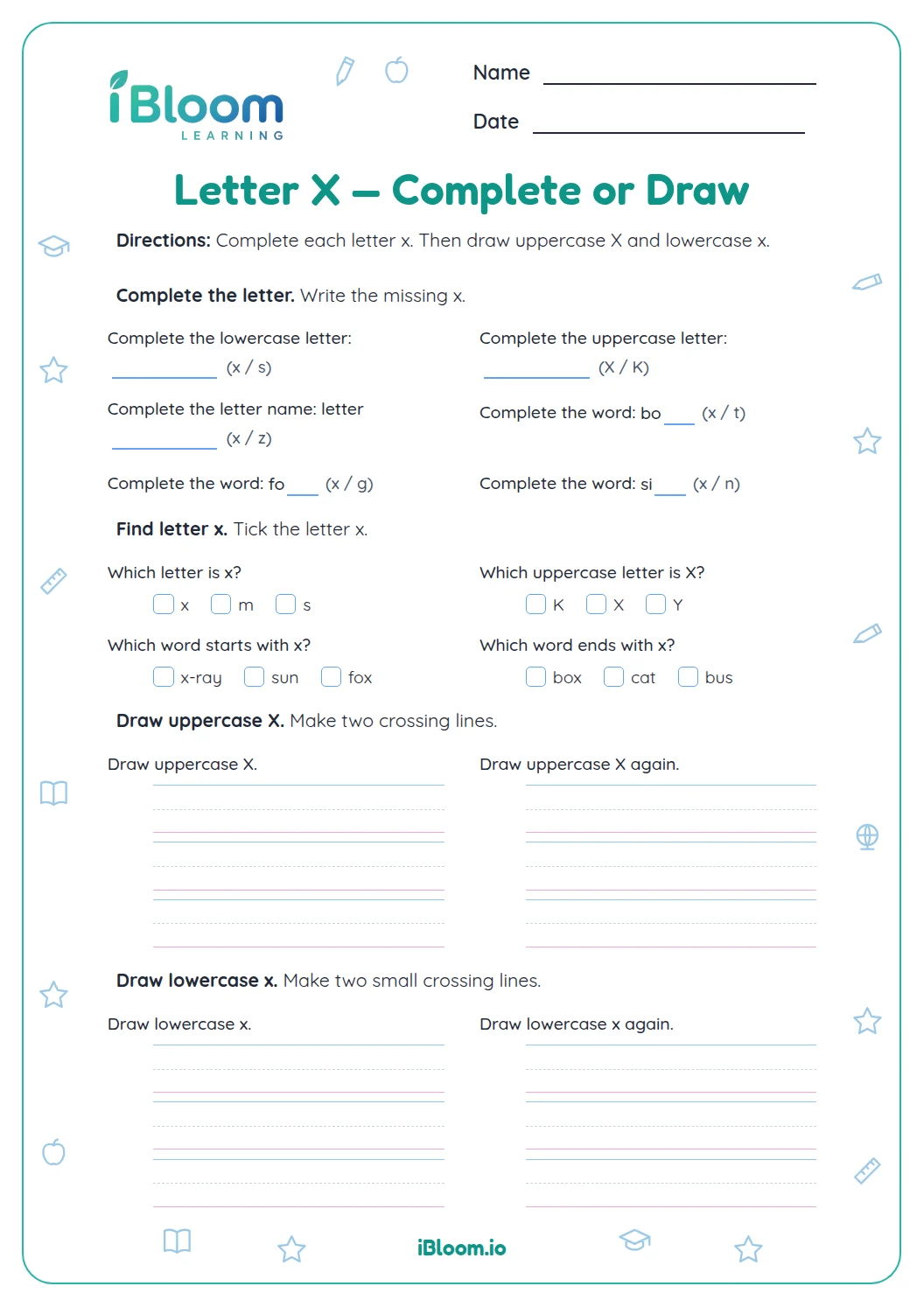
This free printable letter X review gives preschool and kindergarten children fourteen short tasks with adult support as needed. Children choose uppercase and lowercase forms, trace and copy both, find x in short word rows, and complete box, fox and ax beside matching pictures. The sheet practices Common Core RF.K.1d through letter recognition and L.K.1a through printing. Its focus is the shape and identity of X and x. An adult can read the directions and word rows aloud while the child studies the letters. A separate answer key shows the intended responses.
Aligned to RF.K.1d and L.K.1a
What should children notice about X and x?
Both forms use two slanting strokes that cross. Say the letter name, then trace its shape in the air. On handwriting lines, uppercase X is tall and lowercase x is shorter.
Part A has six questions asking children to identify uppercase X, lowercase x, the pair X x, the word box, a word that starts with x and a word with x in the middle. The box picture connects a familiar object with a printed word containing the target letter.
How can an adult guide the tracing rows?
Part B has one row for uppercase X and one for lowercase x. Children trace the gray models and then copy the letter on the empty handwriting line. Use a finger first if a pencil feels difficult.
Make one slanting stroke and cross it with the second. Look for two strokes crossing near the middle; ask the child to try again if the strokes only meet at an end.
How does the letter review connect to words?
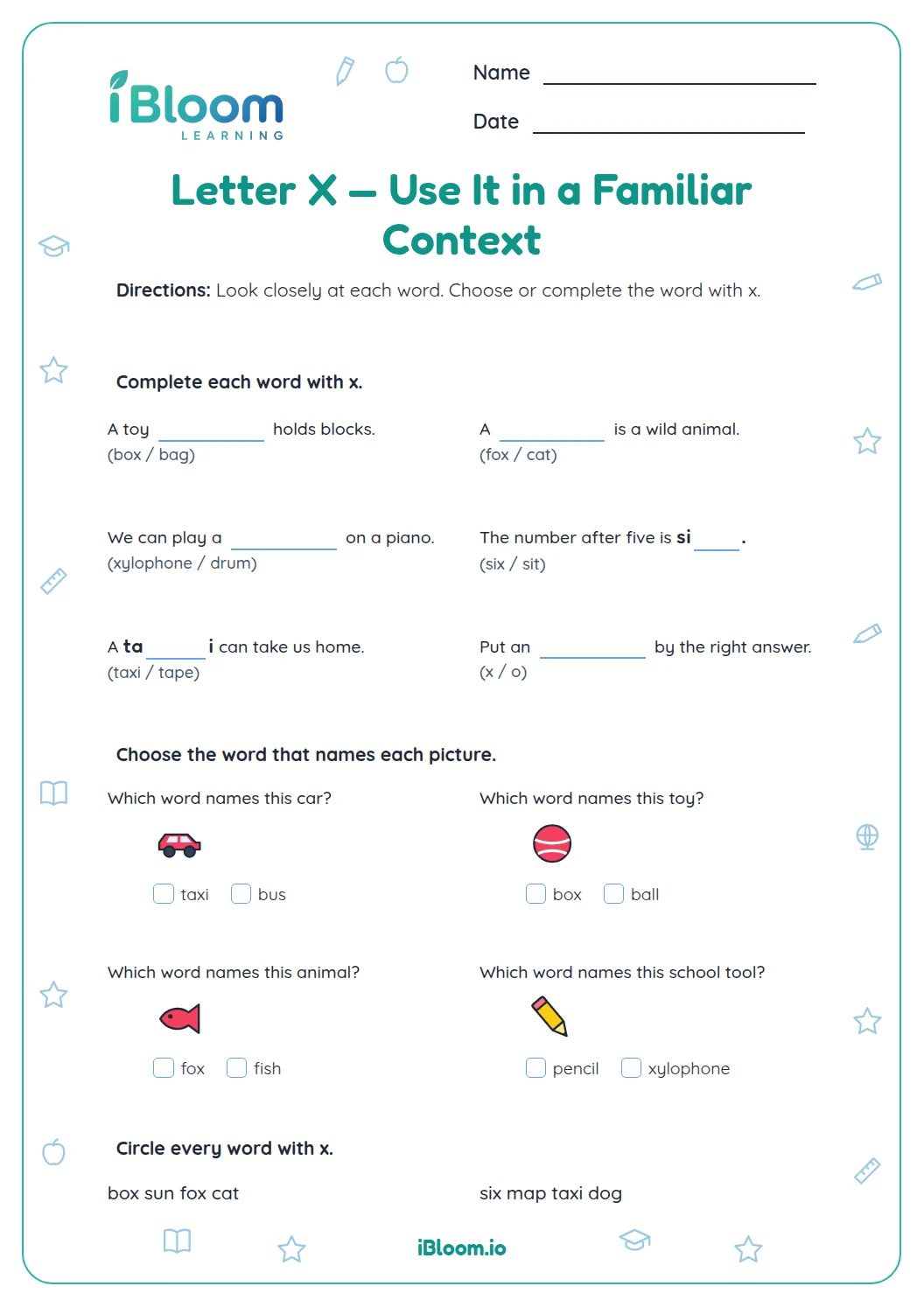
Part C asks children to circle every word with x in three short rows. Part A also checks x at the start and in the middle of a word. An adult can read the words while the child looks for the letter. Part D supplies box, fox and ax pictures beside words missing their final letter. Ax is a US spelling of axe.
- 1Name the picture: box.
- 2Look at bo___.
- 3Write lowercase x in the blank.
- 4The complete word is box.
How to use this worksheet
- 1Point to uppercase X and lowercase x and say the letter name together.
- 2Read each Part A prompt aloud and let the child choose the answer.
- 3Trace the two forms in the air, then use the printed rows to trace and copy.
- 4Read the three word rows slowly and check every word for x.
- 5Name the box, fox and ax pictures, let the child write x in each blank, and review the key together.
Mistakes to check together
The mistake
Choosing Y because it has slanting strokes.
The fix
Trace both shapes: X crosses in the middle; Y has strokes that meet above a stem.
The mistake
Circling only box in the row box fox dog.
The fix
Check each word separately; both box and fox contain x.
The mistake
Writing the whole word in a one-letter blank.
The fix
Point to the letters already printed and add only the missing x.
Common Core alignment
Recognize uppercase X and lowercase x in letter choices and short words.
On this sheet: Children identify the two forms of X and locate x within printed words.
Show the official wordingHide the official wording
Recognize and name all upper- and lowercase letters of the alphabet.
Trace and print X and x, including x at the end of three picture words.
On this sheet: The trace-and-copy rows and picture-word blanks ask children to form the target letters.
Show the official wordingHide the official wording
Print many upper- and lowercase letters.
What to practice next
Make more practice
Further reading
Questions parents and teachers ask
Does my child need to read box and fox independently?
No, an adult can name the pictures and read the words aloud. The child’s task is to recognize or write x. Point to the letters already printed in bo___ and fo___, then let the child add the final letter and look at the completed word with you.
How many activities are on the sheet?
There are fourteen numbered tasks in four parts. Children answer six choice questions, complete two trace-and-copy rows, search three word rows and fill three picture-word blanks. The tracing rows repeat the model so children can practice the same letter shape more than once within a single task.
Should my child circle letters or whole words in Part C?
Circle the whole word whenever it contains x. In box fox dog, the correct words are box and fox. In six sun mix, they are six and mix. An adult can read each row first, then ask the child to point to the x that explains each choice. The third row has x-ray and ax.
How should I judge the handwriting?
Look for two slanting strokes crossing near the middle, with the intended uppercase or lowercase size on the handwriting lines. Accept a recognizable attempt and practice one clear model together. The key identifies the target forms; it is useful for checking letter identity alongside your observation of the strokes.
Can we finish the review in two short sessions?
Yes, stop after the choice and tracing parts if your child needs a break. Return to the word rows and picture-word blanks later. Begin the second session by pointing to X and x again, then let the child complete the remaining tasks with the directions read aloud as needed.