





About this worksheet
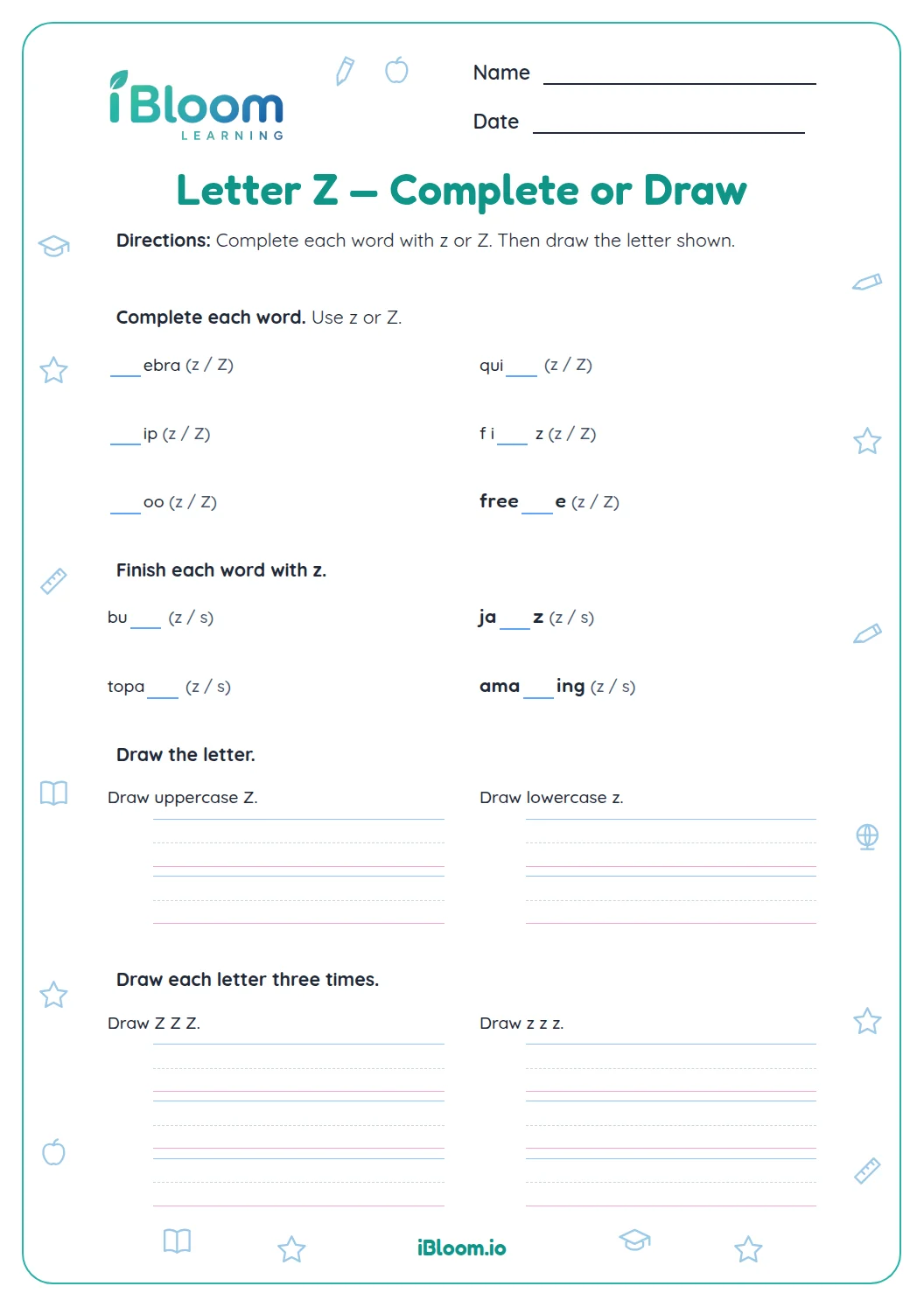
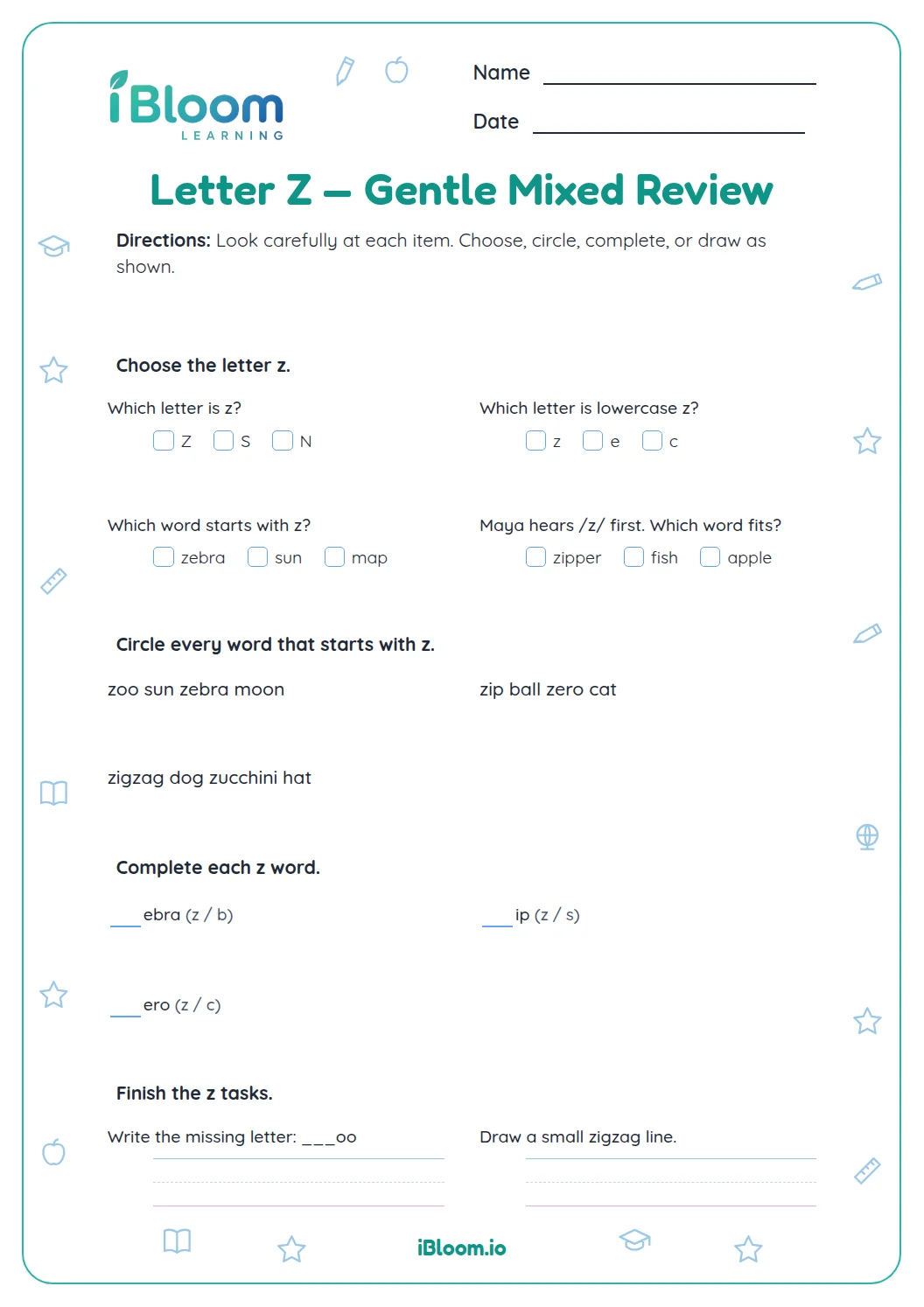
This printable is for preschool and kindergarten learners practicing the letter Z. Children name familiar pictures, listen for /z/ at the beginning, find matching words, trace both letter forms, and write picture names. It offers 18 short questions across picture recognition, sound sorting, tracing, and writing. The picture clues keep the letter sound connected to familiar words. The page practices Kindergarten Common Core RF.K.3.a.
Aligned to RF.K.3.a
Which pictures begin with Z?
In Part A, say the picture name before choosing the matching word. Listen to the first sound rather than guessing from the picture alone.
- 1[pic:zebra] → zebra begins with /z/.
How do children spot the sound in print?
Part B mixes picture words with other familiar words. Read each one slowly and circle only words whose first sound matches the target.
Why trace and write the letter?
Part C traces uppercase Z and lowercase z; Part D uses picture names for independent writing. Linking the sound, symbol, and a word gives children several ways to recall the letter.
How to use this worksheet
- 1Read each picture name aloud before choosing.
- 2Say the first sound and listen for /z/.
- 3Circle only words that begin with the featured sound.
- 4Trace uppercase and lowercase Z.
- 5Name and write the final picture words.
Common mistakes and quick fixes
The mistake
Choosing a picture because its name contains Z, even when it starts with another sound.
The fix
Say the first sound alone; the task is to hear /z/ at the start.
The mistake
Mixing up uppercase and lowercase forms.
The fix
Compare the traced capital Z with lowercase z, then say the same sound for both.
The mistake
Naming the picture without checking its beginning sound.
The fix
Stretch the word slowly and listen to the very first sound.
Common Core alignment
This printable practices the listed Common Core skills through short, grade-level tasks.
Connect each consonant with its most common sound.
On this sheet: Picture words focus on the featured consonant and its beginning sound.
Show the official wordingHide the official wording
Demonstrate basic knowledge of one-to-one letter-sound correspondences by producing the primary sound or many of the most frequent sounds for each consonant.
What to practice next
Make more practice
Further reading
Questions parents and teachers ask
What sound does letter Z make?
This page practices the common beginning sound /z/ using familiar words. Children name each picture, listen to its first sound, and compare it with the letter. The page also traces both letter forms and invites children to write picture names.
Why are pictures included?
Picture clues help young learners connect a spoken word to its first sound. Children name each picture before choosing or circling a word, so the task practices listening as well as recognizing the printed letter. Invite the child to say the word aloud and point to the first letter sound before checking the answer key together.
Should children write the whole word?
The later questions invite children to write familiar picture names. Accept reasonable early spelling attempts, then model the conventional spelling from the answer key so children can compare their work. Invite the child to say the word aloud and point to the first letter sound before checking the answer key together.
What is the difference between uppercase and lowercase?
Uppercase Z is the capital form, while lowercase z is the small form. They look different but represent the same letter and sound. Children trace both forms on this page. Invite the child to say the word aloud and point to the first letter sound before checking the answer key together.
How many questions are on the page?
There are 18 questions: picture word choices, two sound-spotting rows, a tracing activity, five picture-word writing prompts, and two final sound or writing prompts. The answer key includes suggested responses for open writing. Invite the child to say the word aloud and point to the first letter sound before checking the answer key together.