






About this worksheet
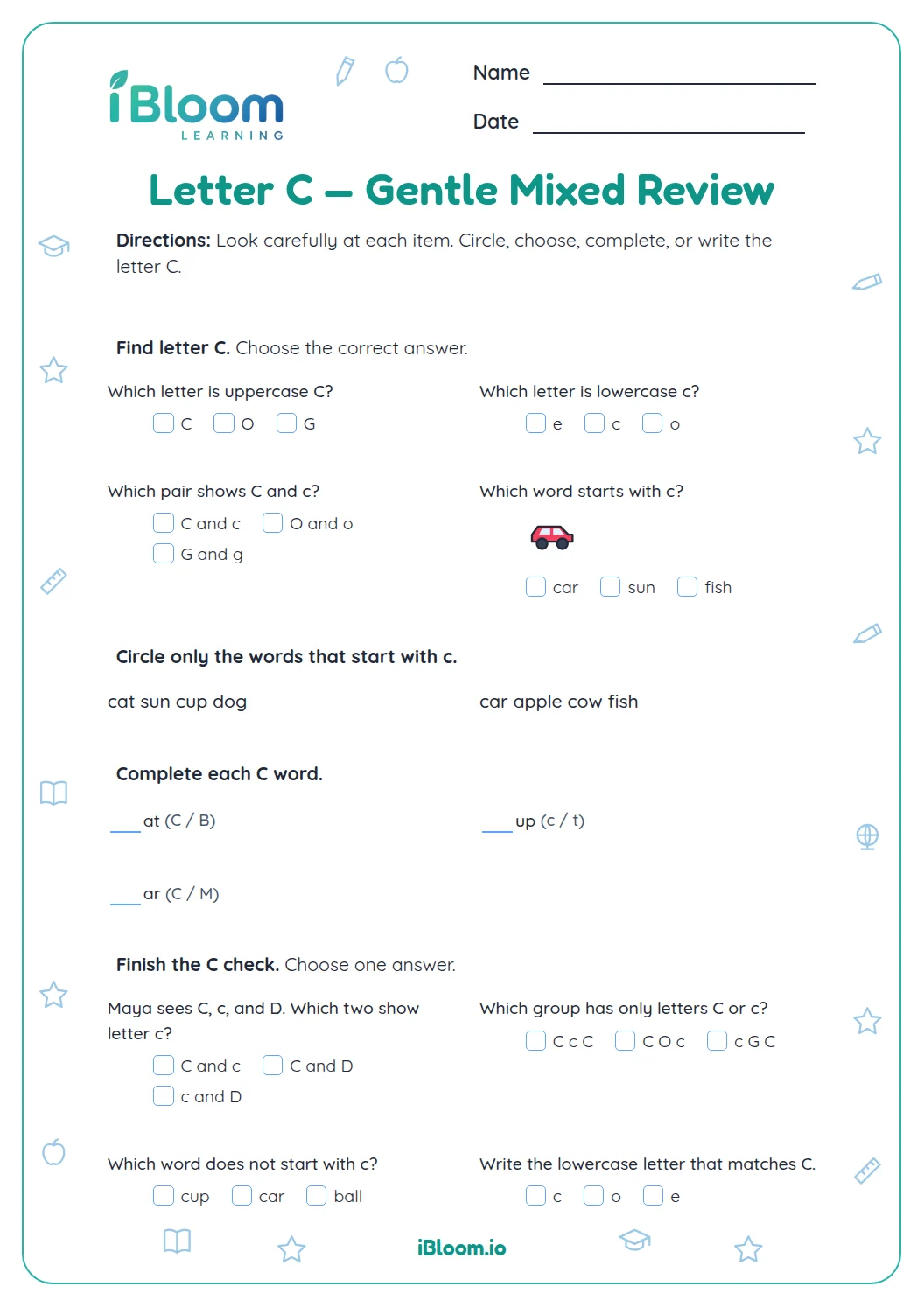
This printable Letter C page helps Preschool and Kindergarten learners connect a letter shape with a familiar beginning sound. Children trace uppercase C, lowercase c and Cc. They then name picture choices such as car, cake, cup, and cow, listening for /k/ at the beginning, before circling C words in short rows. A separate answer key lists each picture answer and tracing model. The page practices Common Core L.K.1.a and RF.K.3.a.
Aligned to L.K.1.a and RF.K.3.a
How does the sheet practice letter C?
Part A begins with uppercase C, lowercase c, and the pair Cc. Part B uses pictures to connect familiar names with the beginning sound. Part C asks children to spot the letter in short word rows.
How can a child hear the first sound?
Say every picture name aloud, then listen to its first sound. Keep the whole word in mind and compare the opening sound with C.
What is one example from the C page?
Say “cake” slowly. It begins with /k/, so choose the cake picture.
- 1Say “cake” slowly and listen for /k/ at the start.
- 2Choose the cake picture.
What can an adult check in the answer key?
The key identifies each picture choice and repeats the tracing forms. For the short word rows, it shows which word or words begin with C. The final drawing key gives a model when that activity is included.
How to use this worksheet
- 1Say the letter name C.
- 2Trace uppercase C and lowercase c slowly.
- 3Name each picture from left to right.
- 4Listen for /k/ at the beginning of the word.
- 5Circle the printed words that begin with C.
Common slips and quick fixes
The mistake
Choosing a picture because the word contains the letter later.
The fix
Say the word slowly and listen to its first sound for C.
The mistake
Mixing uppercase C with lowercase c.
The fix
Compare the two trace models, then practice them as a pair.
The mistake
Rushing through a curved letter shape.
The fix
Start at the model’s top and follow its curve with one steady motion.
Common Core alignment
The worksheet connects letter forms with familiar beginning sounds for C.
Trace and print uppercase and lowercase C.
On this sheet: The tracing rows practice uppercase and lowercase C.
Show the official wordingHide the official wording
Print many upper- and lowercase letters.
Connect C with its consonant sound in familiar words.
On this sheet: Picture and word choices connect C with the /c/ sound.
Show the official wordingHide the official wording
Demonstrate basic knowledge of one-to-one letter-sound correspondences by producing the primary sound or many of the most frequent sounds for each consonant.
What to practice next
Make more practice
Further reading
Questions parents and teachers ask
Which C words are pictured on the worksheet?
The picture choices include cat, car, cake, cup, cookie, cow, carrot, and crab. Say each name aloud and listen for /k/ at the beginning. The short word rows give another chance to notice C at the start of a familiar word.
What sound does C make in these words?
In the familiar words on this worksheet, C represents /k/, as in cat, cup, and car. Children can say a name slowly and listen to the first sound before choosing. The page focuses on these words and their beginning sound.
How does the sheet practice uppercase and lowercase C?
The tracing section includes uppercase C, lowercase c, and the pair Cc. A child can compare the larger capital with the smaller lowercase form, then follow each dotted model with a finger or pencil. Compare the printed models when checking pencil work.
How should a child answer the picture questions?
Have the child name all three pictures in a row, then listen for /k/ at the beginning of each name. Choose the picture whose name starts with that sound. The key gives the intended picture for each row. Take a short break if the hand gets tired.
What is in the answer key?
The separate key identifies the picture selected in every choice row and repeats the tracing letters and word. For tracing, check that the child followed the model and made a recognizable form; pencil control develops at different paces. Use the model as a guide for the next attempt.