





About this worksheet
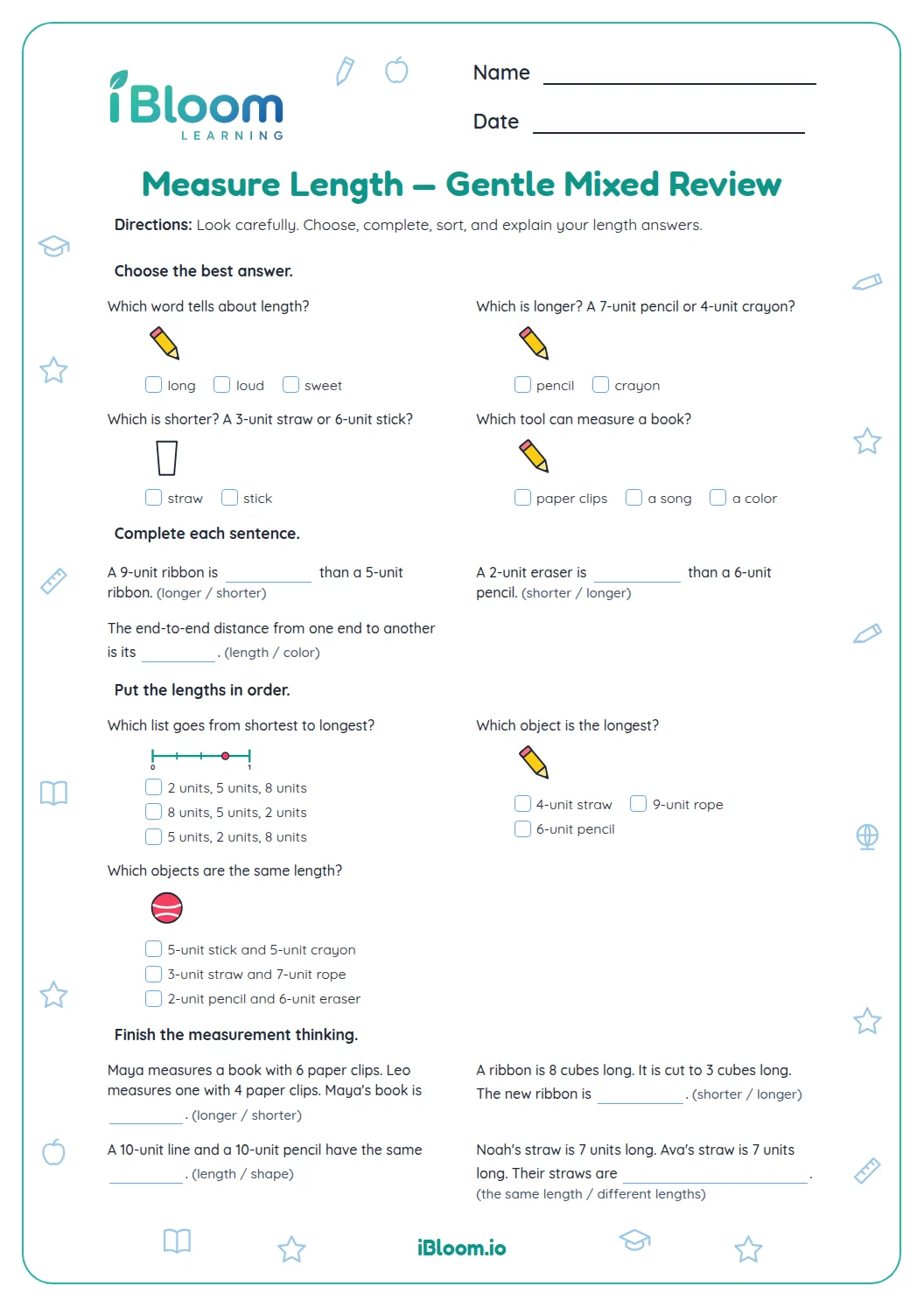
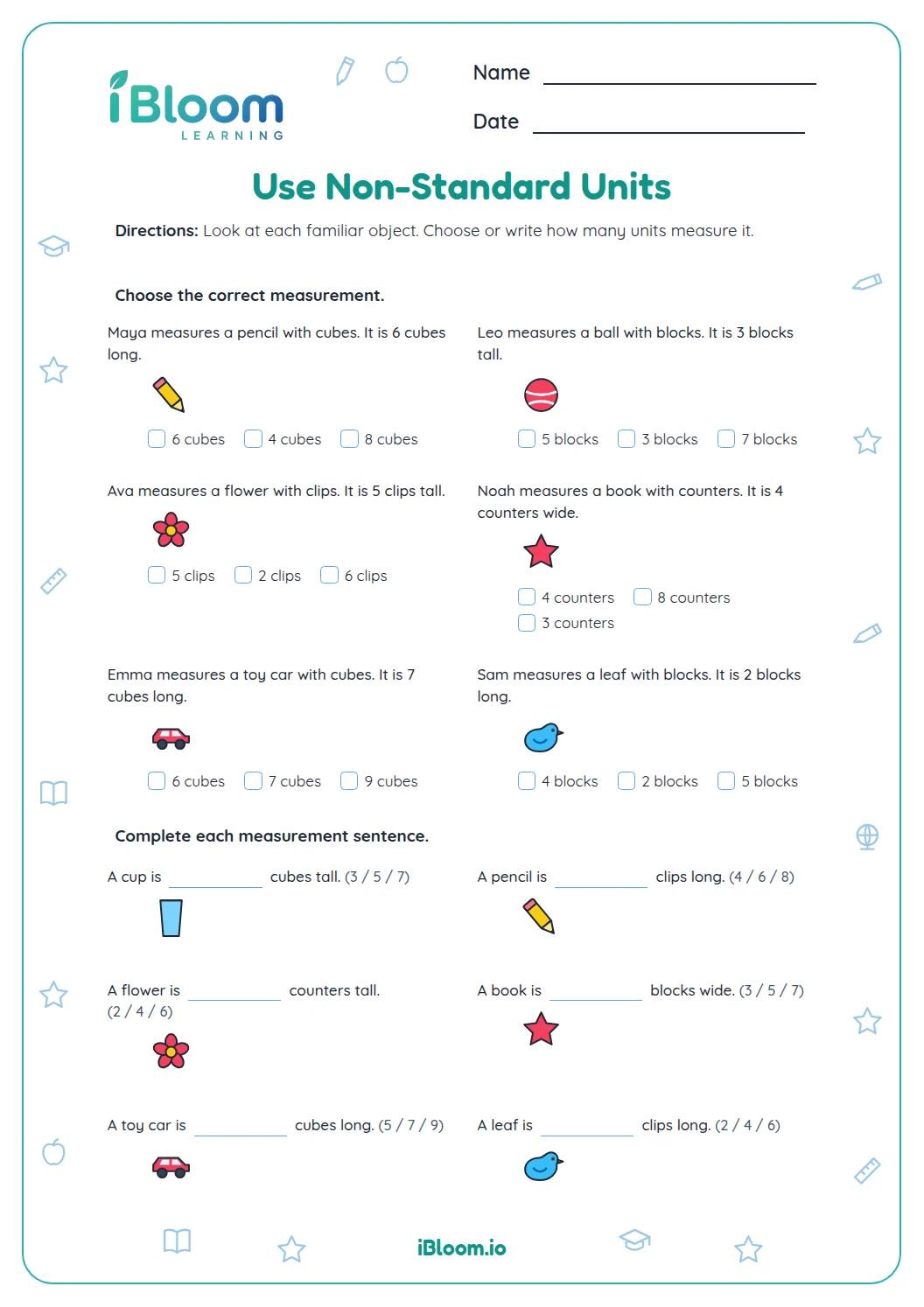
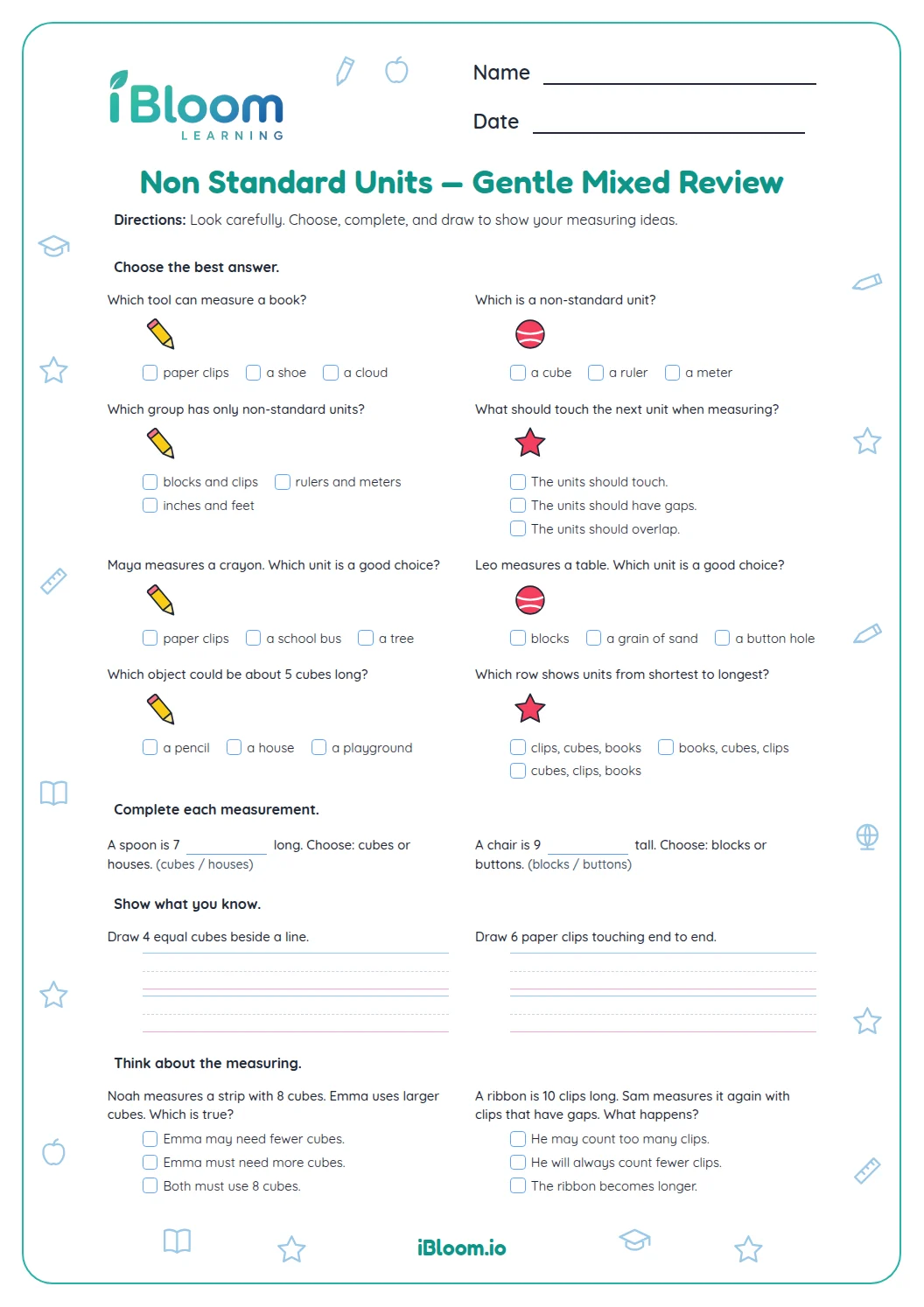
This Kindergarten and Grade 1 measurement worksheet practices length with ruler drawings and familiar object comparisons. Children read whole-inch lengths, compare named objects, order three lengths, and draw marks of different lengths. The ruler drawings start at zero and make each endpoint visible. The answer key gives the ruler readings and criteria for open-ended marks.
Aligned to 1.MD.A.1 and K.MD.A.2
How do ruler drawings show length?
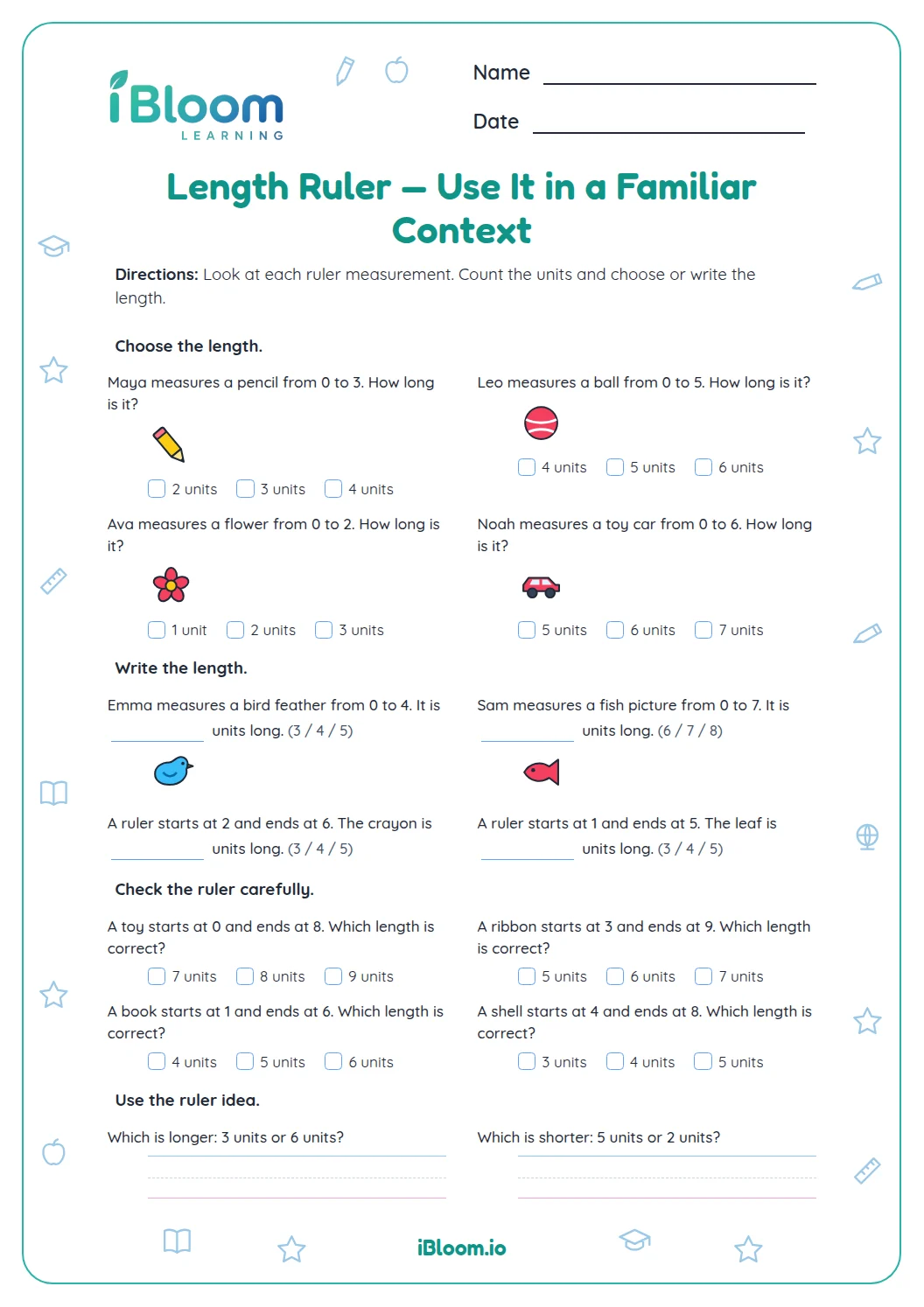
Each object sits along a ruler that starts at zero. Read the mark at the object’s endpoint to find its length in whole inches.
Question 2 shows a crayon ending at 2 inches, so its length is 2 inches.
- 1How long is the crayon? → 2 inches
How can you compare two lengths?
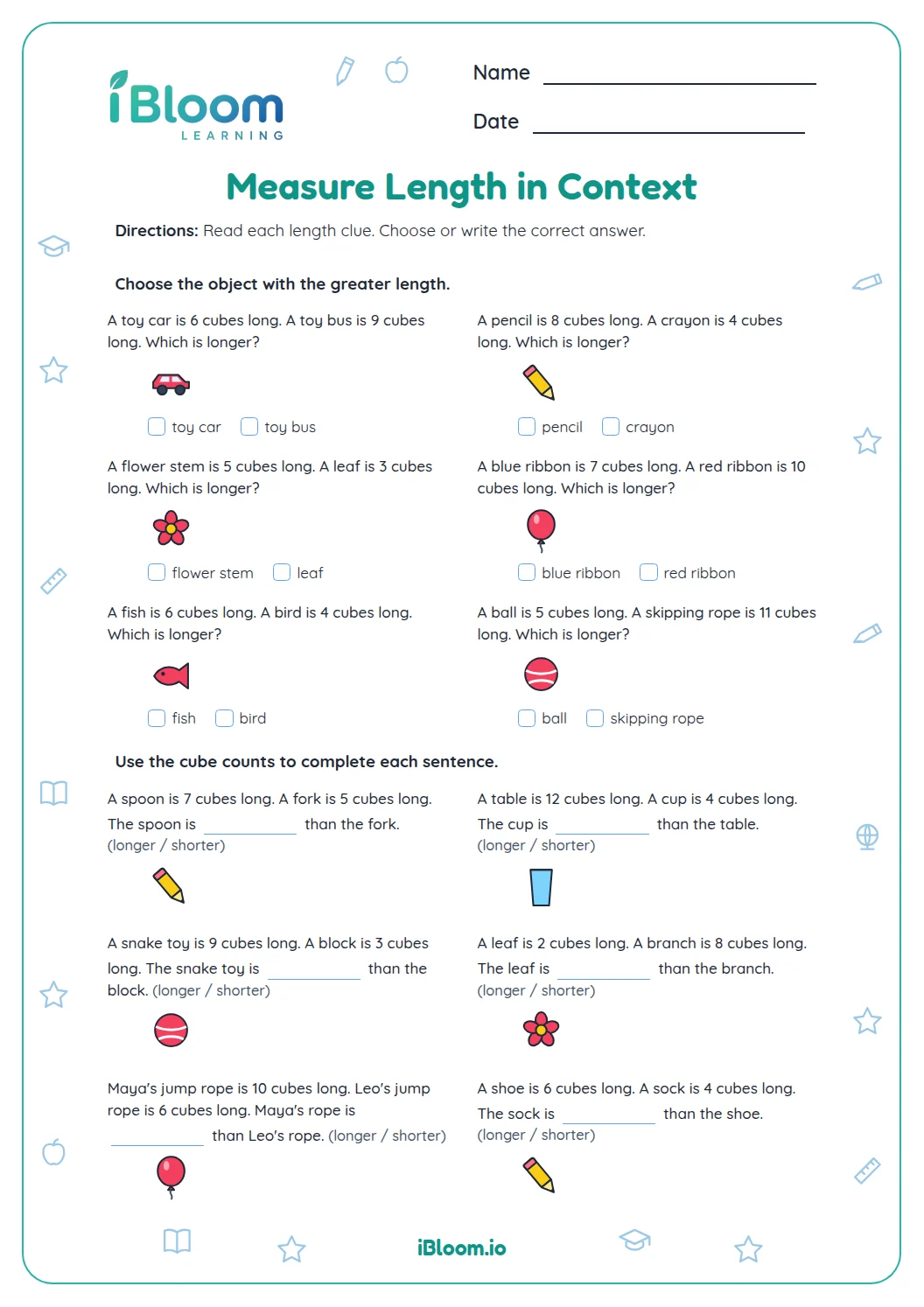
A larger inch count means a longer object when the units are the same. The comparison prompts name both lengths; the pictures help children connect familiar objects with each length. Two equal lengths are the same length.
What makes a mark short or long?
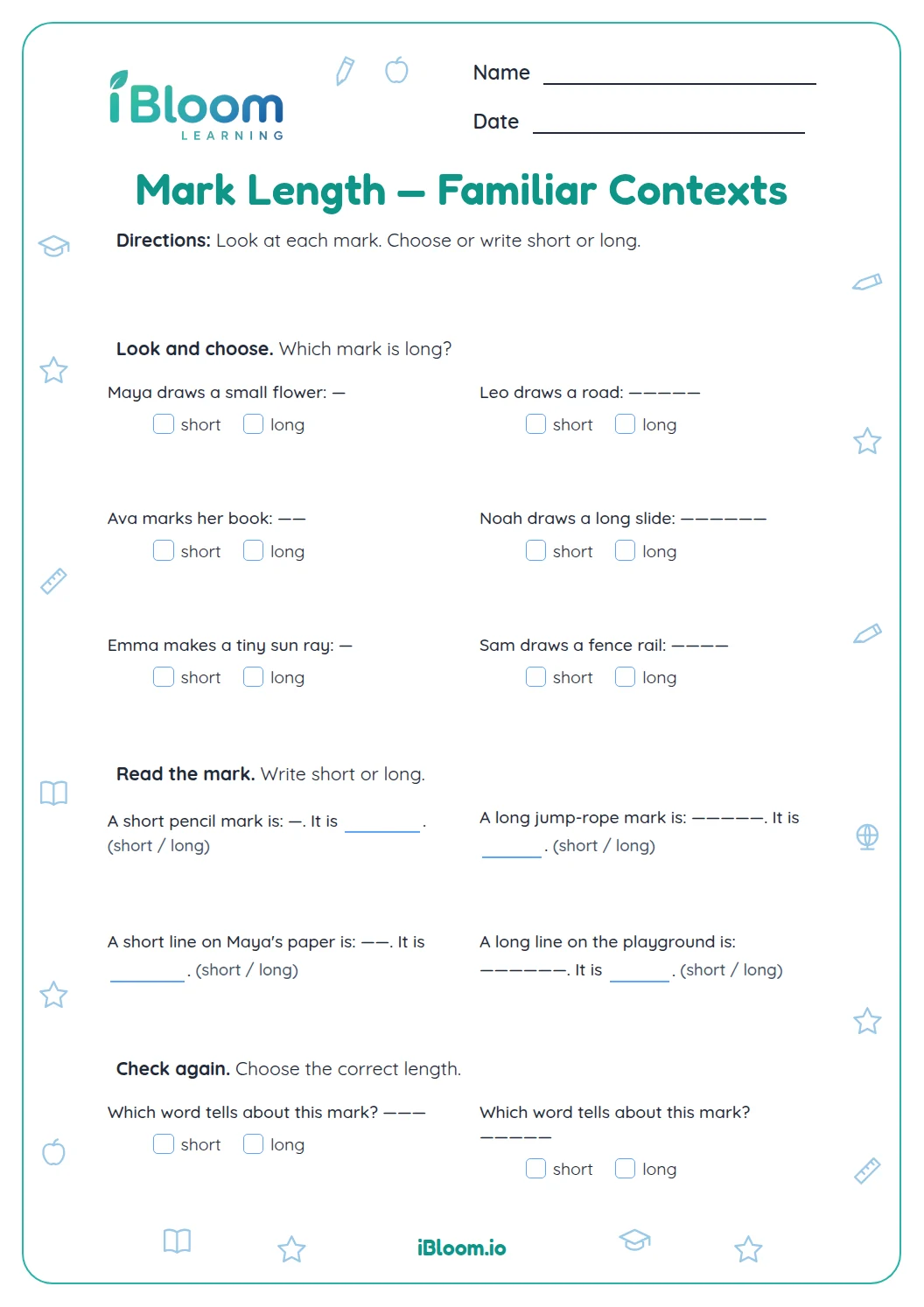
For the drawing items, make two horizontal marks that are clearly different lengths. The second mark should be longer than the first.
How to use this worksheet
- 1Start at zero on each ruler drawing.
- 2Find the object endpoint and read its whole-inch mark.
- 3For a comparison, look for the greater or smaller length.
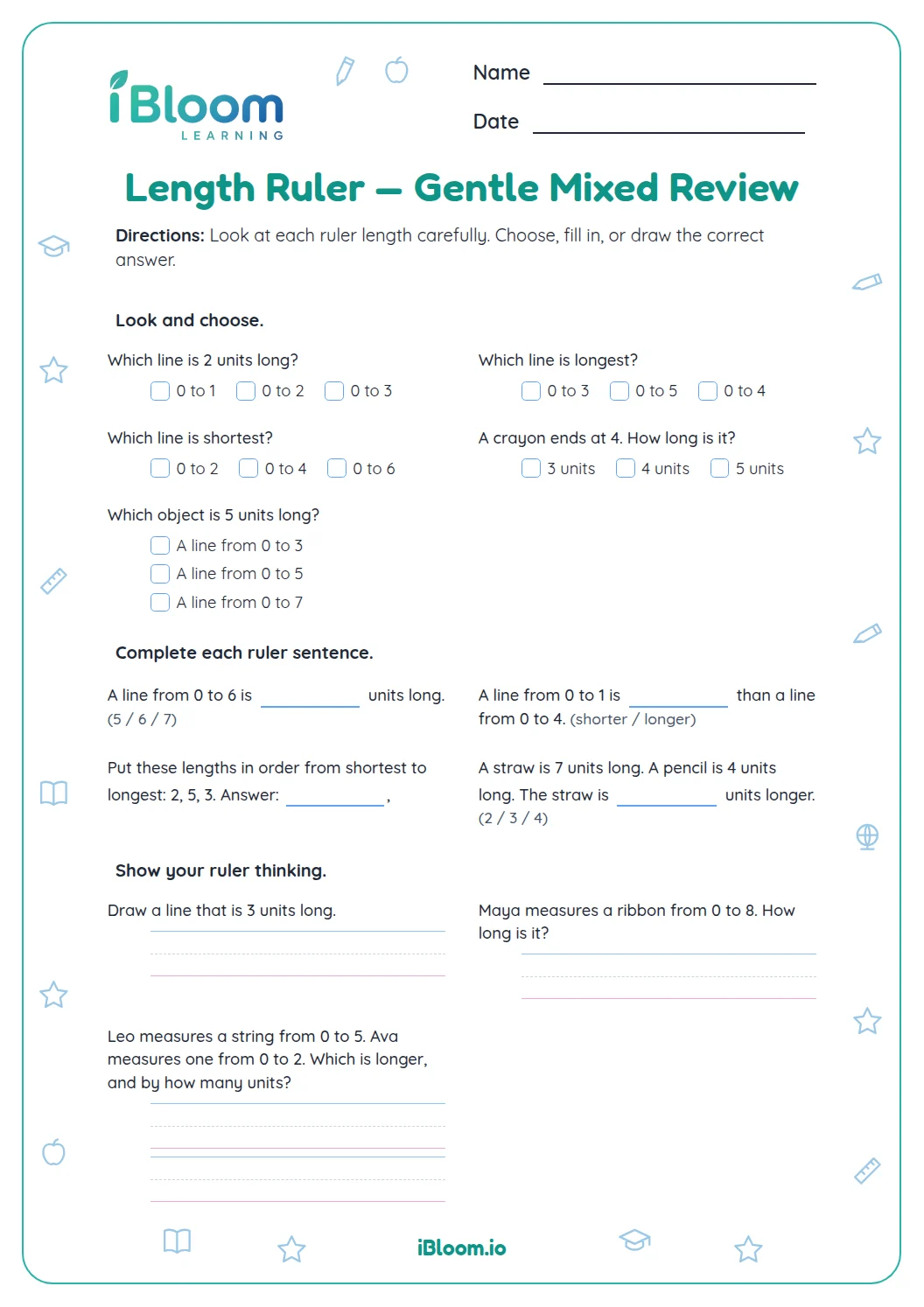
- 4Order the three listed lengths from least to greatest.
- 5Draw two marks with a visible difference in length.
Common slips and helpful fixes
The mistake
Reading the ruler from its far end.
The fix
Begin at zero and follow the object to its endpoint.
The mistake
Calling the shorter object longer because it is named first.
The fix
Compare the actual inch lengths or endpoints.
The mistake
Drawing two marks that are almost the same length.
The fix
Make the second mark clearly longer than the first.
Common Core alignment
Children describe and compare lengths using visible ruler marks and informal language.
Order objects by length and compare lengths indirectly.
On this sheet: Students read and compare illustrated object lengths, then order given lengths.
Show the official wordingHide the official wording
Order three objects by length; compare the lengths of two objects indirectly by using a third object.
Directly compare two objects by length.
On this sheet: Students use direct visual comparisons to decide which object or mark is longer.
Show the official wordingHide the official wording
Directly compare two objects with a measurable attribute in common, to see which object has “more of”/“less of” the attribute, and describe the difference.
What to practice next
Make more practice
Further reading
Questions parents and teachers ask
Are children measuring in inches?
Yes. The ruler drawings show whole inches and familiar objects. Children read each object endpoint, then compare lengths stated in the prompts; the page keeps the focus on reading and comparing length without changing units. The zero mark is the starting point.
Why are ruler pictures used instead of dash marks?
Ruler drawings make each length visible from zero to the object’s endpoint. The original dash marks could be hard to distinguish or order, so this replacement uses ruler visuals for readings and draw boxes for mark-making. Each line gives a clear endpoint.
How many items are on this review?
There are 16 items across five worksheet pages, followed by a five-page answer key. Children read ruler lengths, compare or order lengths, match equal lengths and draw two marks that show different lengths. The key gives the ruler readings and drawing criteria.
What should a child draw for the last questions?
Draw one short horizontal mark and one long horizontal mark. For the comparison prompt, make the new mark visibly longer than the reference mark. The exact lengths can vary as long as the relationship is clear. The key describes the expected comparison.
What objects appear in the ruler questions?
The page includes pencils, a crayon, a flower, a car and a key on ruler drawings, plus comparisons using familiar objects such as a book, spoon and fork. Their lengths are named in the comparison prompts so children can focus on comparing.