





About this worksheet
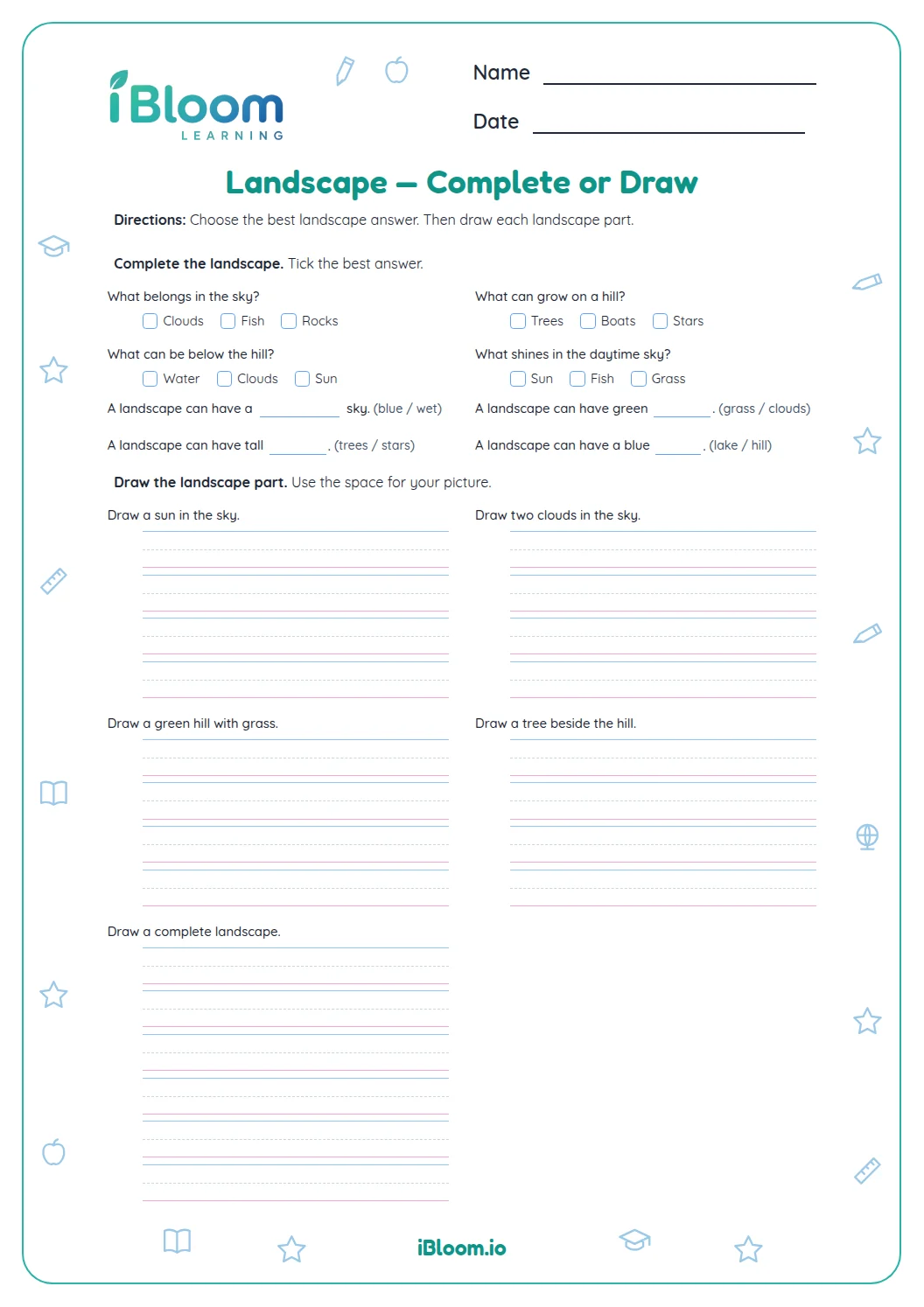
This printable Landscape Words page helps Preschool and Kindergarten learners name familiar outdoor features. Across 15 questions, children identify the sky, land, water, trees, houses, and roads; complete short place sentences; sort natural and human-made features; and circle natural features in a picture group. The pictures support the vocabulary while the final prompts invite children to show where features belong. A key describes the expected choices and drawing details.
Which landscape features does this page name?
The page includes features in the sky, on land, and made by people. Children identify a cloud, mountain, water, tree, house, and road, then use those words in sentence completions and picture choices.
Part A sorts natural features from a built feature. Part B uses picture-supported choices, and Part C completes short sentences about places and features.
- 1Question 6 reads “A cloud is in the ___.” The word sky completes the sentence because clouds are seen overhead.
- Part A: circle natural features
- Part B: name features from picture clues
- Part C: complete place and feature sentences
How can a child sort natural and built features?
Ask whether the feature occurs naturally or was made by people. A tree and a mountain are natural; a house and a road are built. Some scenes include both kinds, so children can practice naming each one without treating them as opposites.
How does the opening activity sort landscape features?
The opening activity groups a mountain, tree, cloud, and house. The child circles the mountain, tree, and cloud because these occur in nature, and leaves the house unmarked because people build it.
How to use this worksheet
- 1Look at each picture and name the landscape feature.
- 2In Part A, circle the features that occur in nature.
- 3In Part B, choose the feature that fits each place or description.
- 4Use the sentence clue to complete each item in Part C.
- 5Check the key and talk about whether each feature occurs naturally or is built.
Common mistakes and quick fixes
The mistake
Calling a house a natural feature because it is outside.
The fix
Ask whether people made the house; compare it with a tree or mountain.
The mistake
Putting a cloud on land instead of in the sky.
The fix
Use the sentence clue and look upward in the picture or outdoors.
The mistake
Reversing “in front of” and “behind.”
The fix
Place a finger on the tree and mountain, then describe which one is closer to the viewer.
What to practice next
Make more practice
Questions parents and teachers ask
What landscape features does this page ask children to name?
Children identify a cloud, mountain, water, tree, house, and road. They sort natural features from a built feature, choose features that fit short descriptions, and complete sentences about places. The answer key gives the expected choice or word for each item.
What is the difference between a natural and a built feature?
Natural features occur in the environment, such as trees, clouds, and mountains. People make built features such as houses and roads. Ask who or what made the feature, then use that idea to sort the examples in the first activity.
Can I read the questions aloud?
Yes. Read each short prompt and its choices aloud if that helps. The pictures offer familiar clues, while the printed words let children practice naming landscape features and matching them to a place. The key gives a quick way to check each response.
How can my child decide where a feature belongs?
Use familiar relationships: clouds are in the sky, trees grow on land, and water fills a pond. Read the whole sentence and ask what word completes the idea. Picture choices provide additional clues for several questions, and the answer key confirms the intended feature or place.
What if my child says a house is part of nature because it is outdoors?
A landscape can include both natural and human-made things. A house may stand outdoors, but people build it. Compare it with a mountain or tree, which occurs naturally, and ask how each feature came to be. The opening sort practices this distinction.