



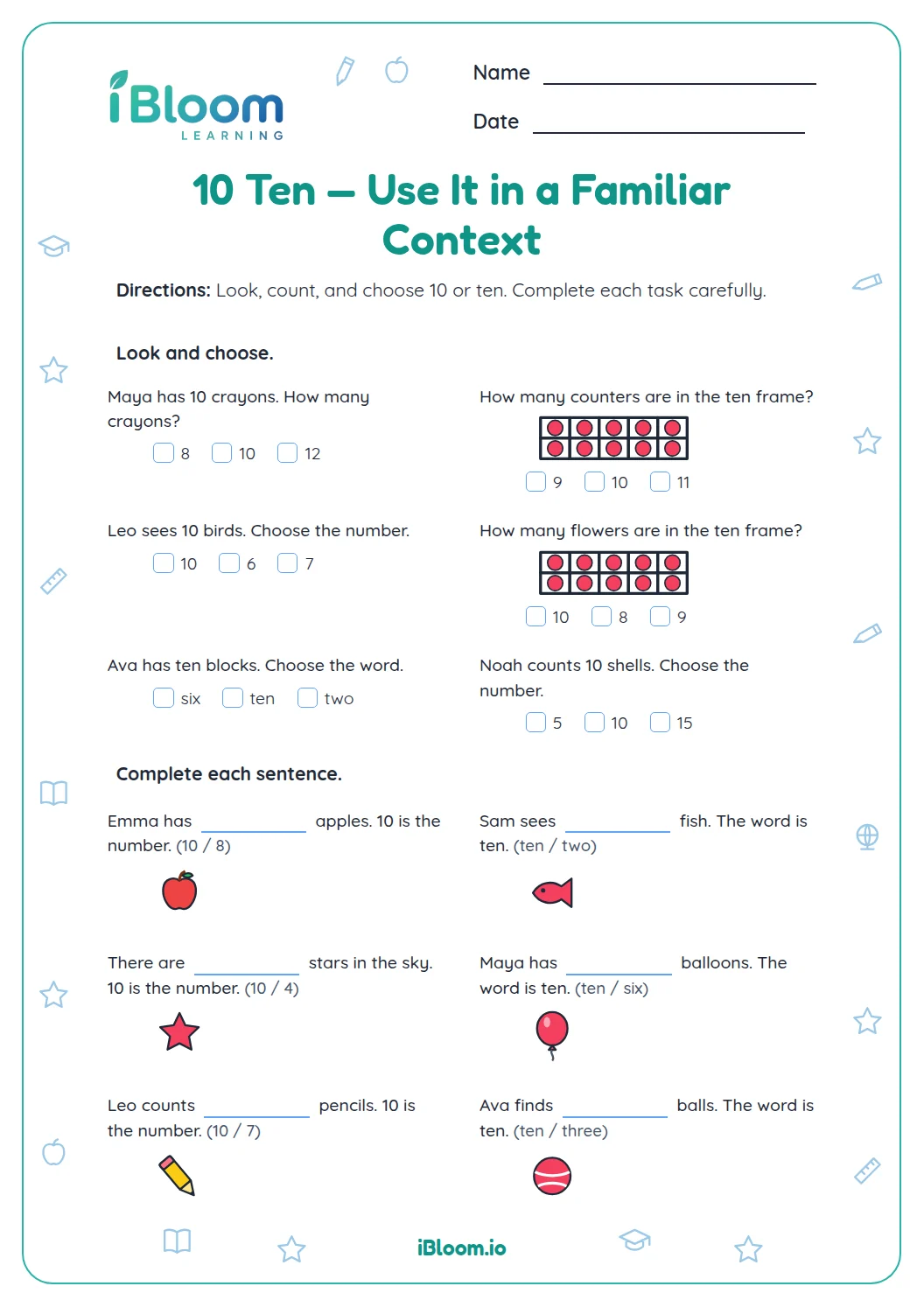
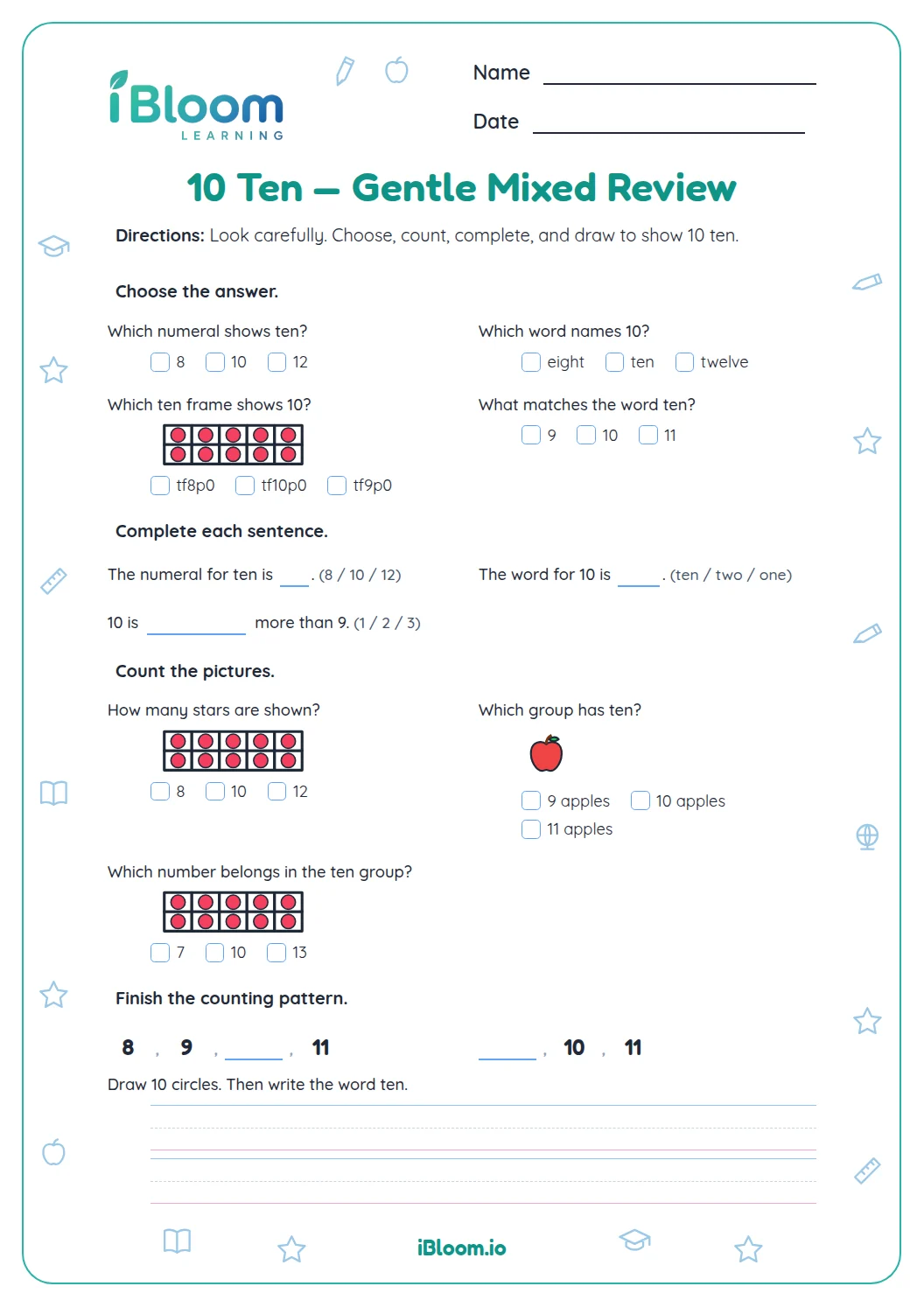
About this worksheet
This free preschool and kindergarten worksheet helps children connect the numeral 6 and the word six with familiar groups of objects. Learners count picture groups, choose the numeral or number word, finish a small “how many more?” problem, and mark six objects. The 14 questions include apples, birds, flowers, fish, pencils, stars, cookies, and balloons. A separate answer key gives the counts and short activity notes. The counting practice aligns with CCSS K.CC.B.5.
Aligned to K.CC.B.5
How can a child count each picture once?
Point to one object at a time while saying the count sequence. Stop when every picture has been counted; the last number said tells how many are in the group. The opening questions include groups of five, six, and seven so children practice counting, not guessing the target.
- 1Count each apple one time: 1, 2, 3, 4, 5, 6.
- 2There are 6 apples.
How does the worksheet connect six to 6?
Questions 5–8 link groups, the written numeral, and the number word. A child can count the pencils, choose 6, and then read “six” as the word for that number. The ten-frame gives another way to see six objects.
Where does six appear in a familiar situation?
The final part uses stars, cookies, apples, balloons, and toy cars. In question 11, the basket shows four apples and needs six; counting on from four gives five, six, so two more apples are needed. Marking tasks let children circle the requested number of objects.
How to use this worksheet
- 1Count each pictured object once.
- 2Say the last number again to tell how many.
- 3Choose or write the numeral or number word that matches.
- 4For “how many more,” count on until you reach six.
- 5Color exactly six objects when a direction asks you to color.
- 6Use the answer key after the child has tried each item.
Checks for this skill
The mistake
Counting one picture twice.
The fix
Touch or point to each object as you say one number name.
The mistake
Stopping at the number before the last object.
The fix
Count the full group; the last number said is the total.
The mistake
Coloring every object instead of the requested six.
The fix
Count six objects first, then color only those six.
Common Core alignment
This page practices the Common Core skill named below.
Count pictured groups to answer how-many questions and identify a requested quantity.
On this sheet: Children count pictured groups and answer how-many questions; the activity asks them to color a set of six.
Show the official wordingHide the official wording
Count to answer “how many?” questions about as many as 20 things arranged in a line, a rectangular array, or a circle, or as many as 10 things in a scattered configuration; given a number from 1-20, count out that many objects.
What to practice next
Make more practice
Further reading
Questions parents and teachers ask
What does the worksheet include?
It has 14 questions using picture groups, number choices, a ten-frame, and two picture-marking tasks. Children count groups, connect six with 6 and the word “six,” and solve one small question about how many more apples make a group of six. A short answer key helps an adult check the count and confirm the picture-marking tasks.
Does the child need to read the directions alone?
An adult can read the directions aloud while the child counts and marks the pictures. The activity focuses on counting objects and recognizing six, so a child does not need to read every sentence independently to take part.
What does “how many more” mean in the apple question?
The story gives four apples and sets a goal of six. Count on from four: five, six. That makes two more apples needed. Children can use the count sequence instead of recounting the whole group. It is a count-on question.
Is coloring included?
Yes. One activity asks the child to circle six cookies, and another shows seven balloons and asks the child to circle six, leaving one outside the circle. The answer key gives a short note describing each activity. It reminds the adult that one balloon should remain outside the circle in the second task.
Which standard does the counting practice support?
The page practices CCSS K.CC.B.5 by asking children to count pictured objects to answer “how many?” questions. It also connects a counted group with a written numeral and number word for six. The questions use groups no larger than seven objects, keeping the count within the target practice.