








About this worksheet
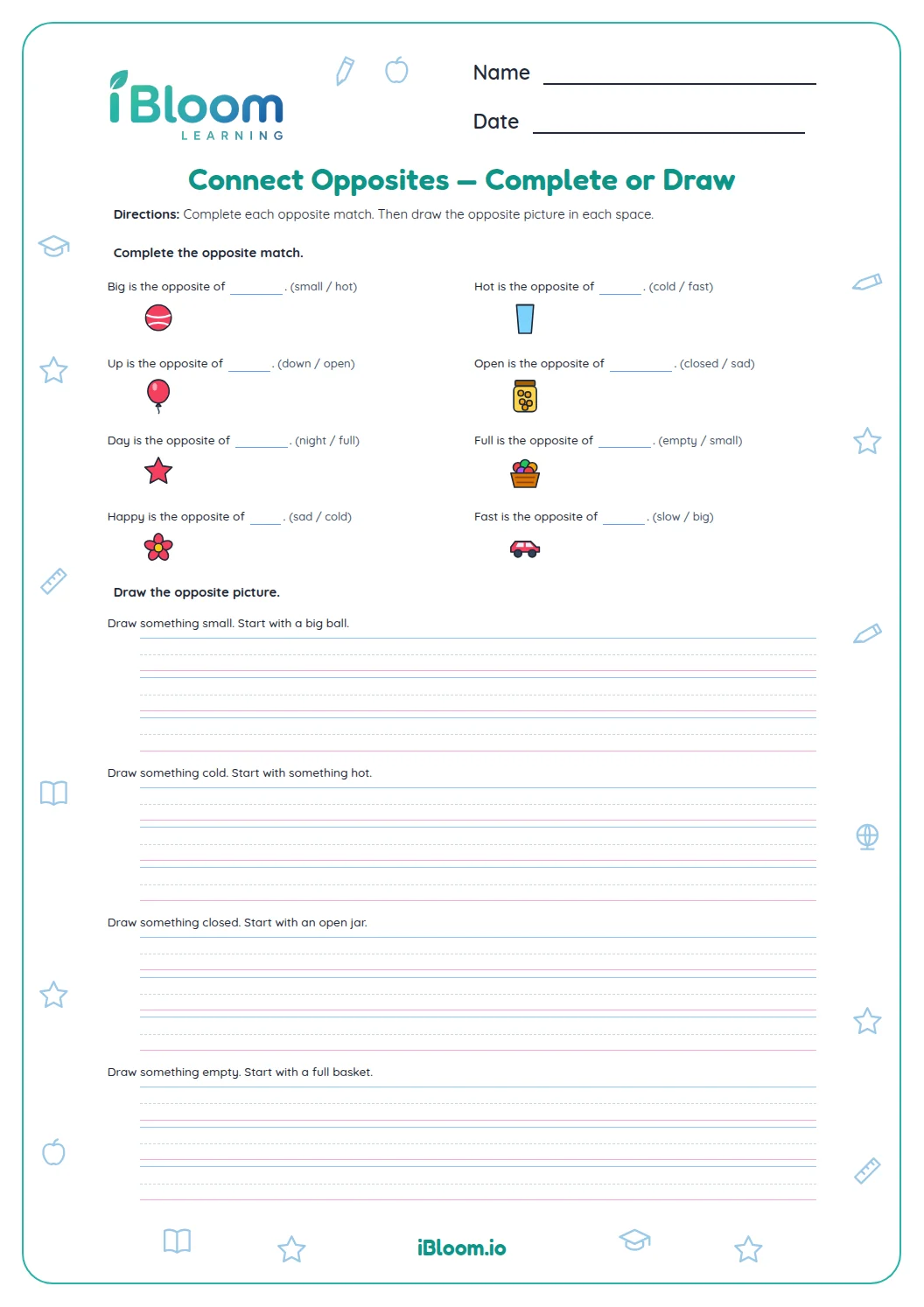
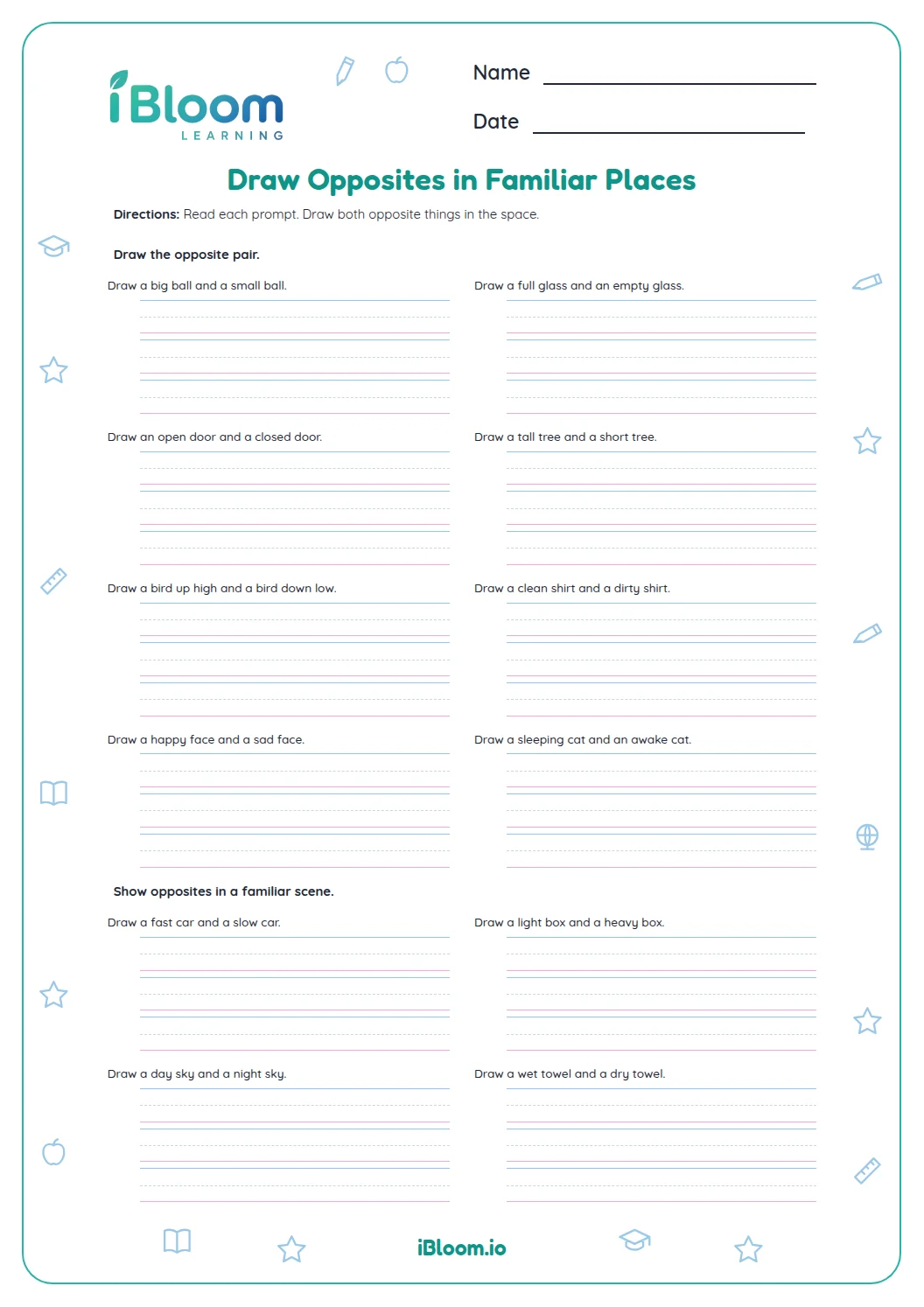
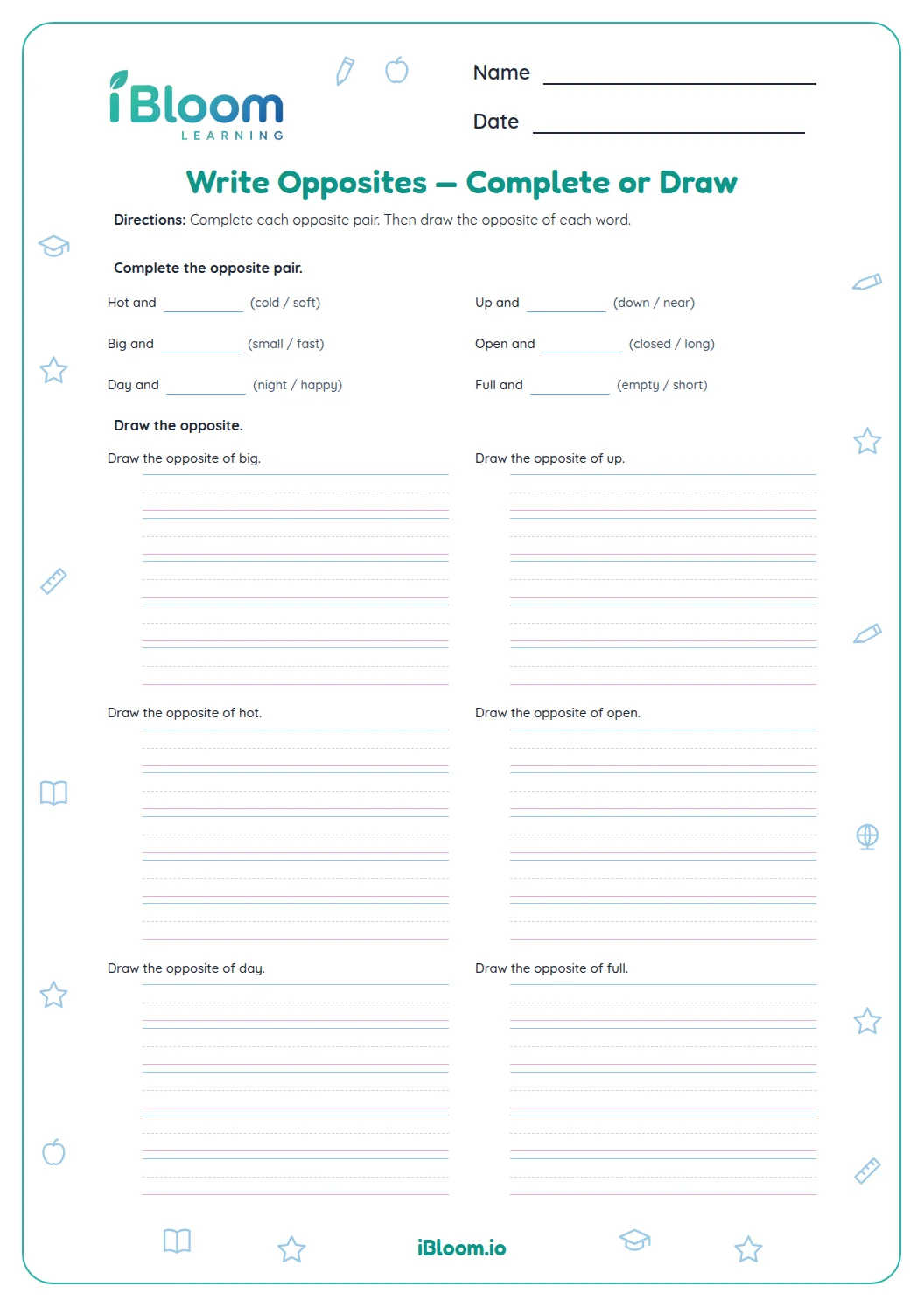
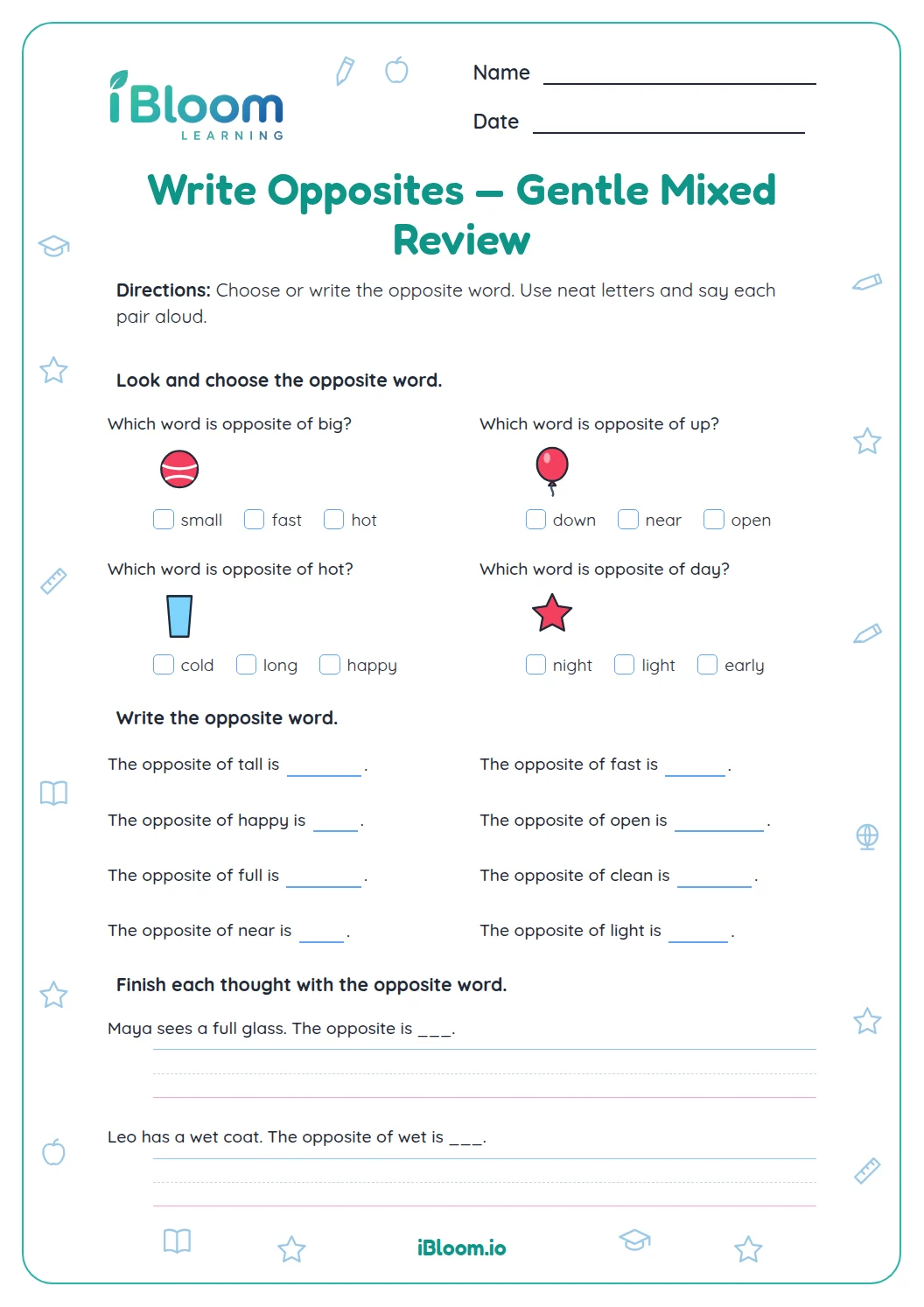
This printable supports preschool and kindergarten learners as they connect opposite words to familiar situations. Each of the 14 sentences includes a picture clue and three word choices, such as a big ball and a small ball. Children use the sentence meaning to choose the word that completes the idea. A separate answer key is included. It practices a kindergarten language standard about real-life word use.
Aligned to L.K.5.b
How do children find the opposite word?
Look at the picture, read or listen to the whole sentence, and think about the word that completes the idea. In question 1, the clue is a big ball: “A big ball is not a ___ ball.” Small completes the contrast.
- 1A big ball is not a ___ ball.
- 2Choices: small, round, soft
- 3Answer: small
Why use a familiar sentence?
The same word can appear in many situations. A sentence such as “An open door is not a ___ door” makes the intended contrast clear and connects the pair to a familiar object.
What picture clues are included?
The worksheet includes balls, vehicles, animals, household objects, food, and nature. Each question has one best word choice among three options.
How to use this worksheet
- 1Name the pictured object together.
- 2Read the sentence aloud and pause at the blank.
- 3Ask what word would make the sentence show a contrast.
- 4Read all three choices before marking one.
- 5Invite your child to say the opposite pair aloud.
Common mistakes and quick fixes
The mistake
Choosing a word that describes the picture but is not its opposite
The fix
Say both words together and check that they contrast.
The mistake
Picking a choice without hearing the full sentence
The fix
Read the sentence from the beginning so its meaning guides the choice.
The mistake
Mixing up up and down
The fix
Use a hand or toy to act out both directions.
Common Core alignment
The sentence choices connect familiar vocabulary to how words are used in everyday situations.
Relate familiar verbs and adjectives to their opposites.
On this sheet: Children select familiar opposite words that complete short real-life sentences.
Show the official wordingHide the official wording
Demonstrate understanding of frequently occurring verbs and adjectives by relating them to their opposites (antonyms).
What to practice next
Make more practice
Further reading
Questions parents and teachers ask
How should I explain an opposite?
An opposite is a word with a contrasting meaning. You might show open and closed by opening and closing a book, or hot and cold by naming soup and ice water. The worksheet pairs familiar objects with a sentence that helps children choose the fitting word.
Should an adult read the questions aloud?
Yes, especially for children who are still learning to read. Read the sentence naturally, pause at the blank, then read each choice. Children can point to the picture and say the opposite aloud before they select an answer. Invite your child to explain the choice in their own words, then point to the clue that helped them decide.
Why are pictures included on the page?
The pictures give young learners a concrete clue for each sentence. They also make the worksheet usable before a child can read every word independently. Children still need to use the sentence, because the picture alone does not state the missing opposite.
How can I help if my child picks a different choice?
Ask your child to say the sentence with the chosen word and listen for whether it makes a contrast. Then compare the two words aloud, such as “big” and “round.” This supports reasoning without simply telling the answer. Invite your child to explain the choice in their own words, then point to the clue that helped them decide.
Does the worksheet have an answer key?
Yes. The key lists the best choice for all 14 sentences. It is designed for quick checking after a child circles or marks each word on the printable pages. Invite your child to explain the choice in their own words, then point to the clue that helped them decide.
How long does the activity take?
Most families can work through the 14 short items in about 10 minutes. Read a few at a time, act out movement words, and stop when your child is ready to continue another day. Invite your child to explain the choice in their own words, then point to the clue that helped them decide.