






About this worksheet
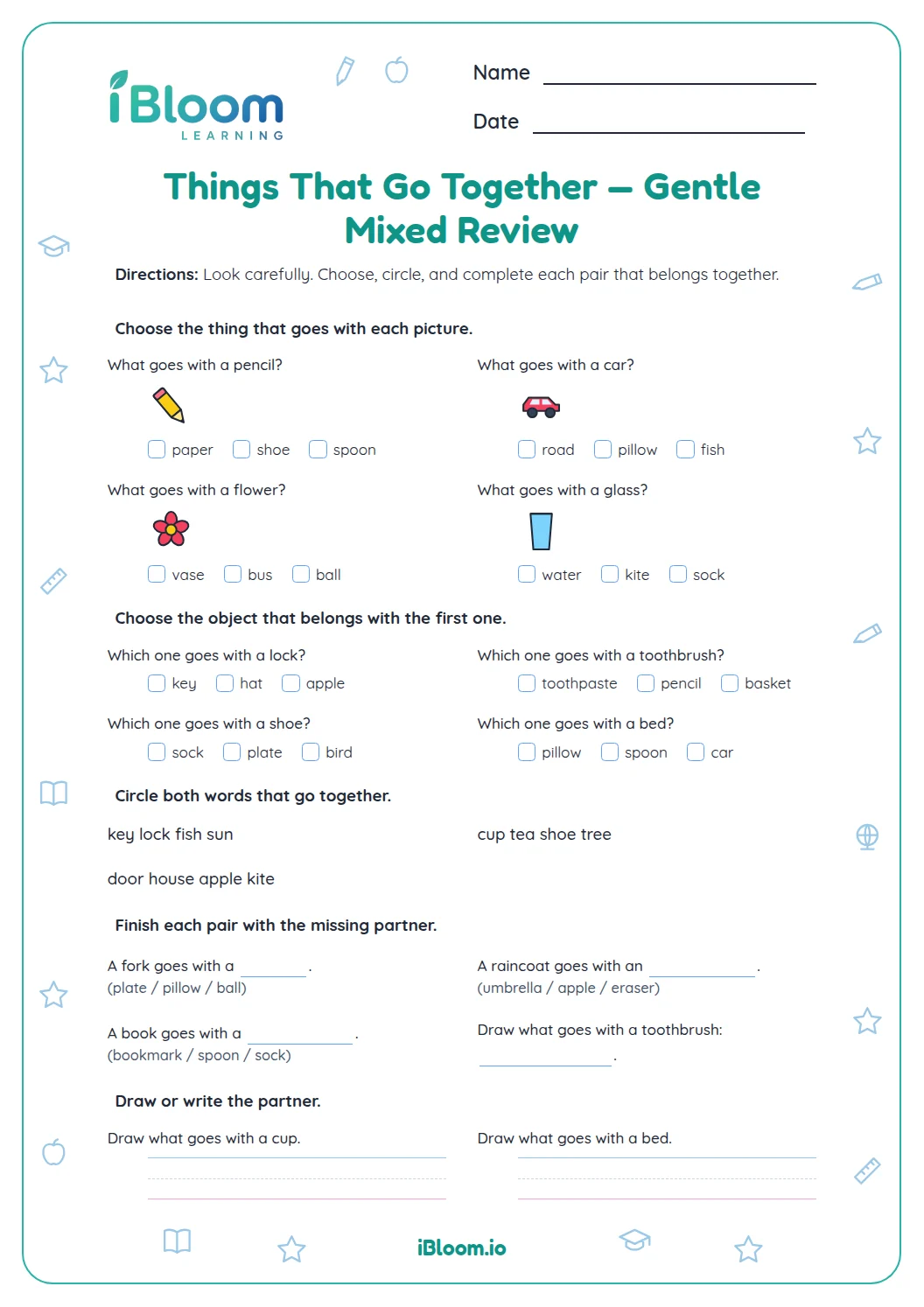
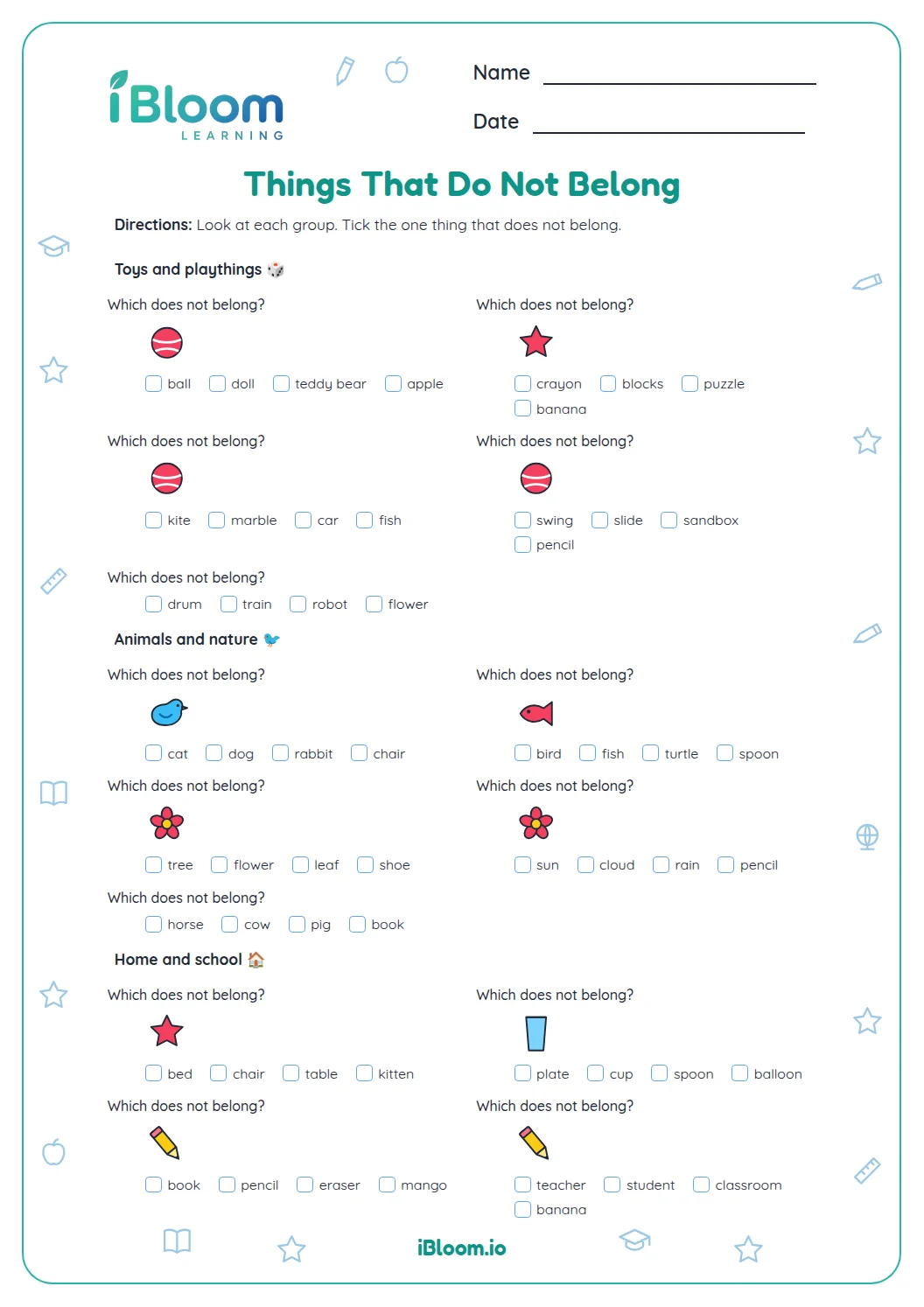
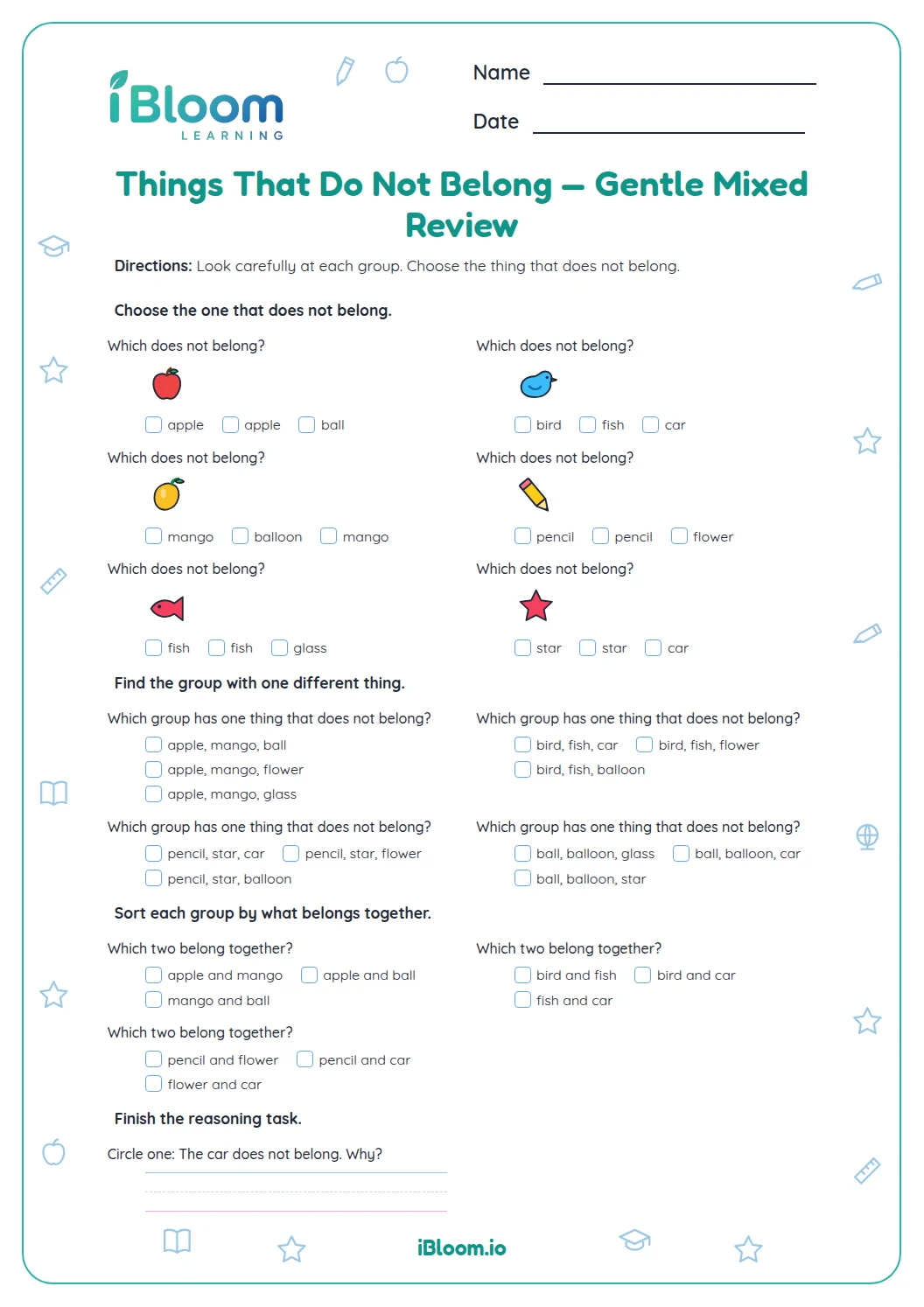
This free printable worksheet helps preschool and kindergarten children notice which things belong together, such as a sock and a shoe or a bee and a flower. A grown-up reads each question aloud and the child marks the picture that fits. Part A shows an animal or object and asks what goes with it, Part B finishes everyday sentences, and Part C asks which two pictures make a pair. Every answer choice is a big picture, so no reading is needed. The sheet supports Common Core L.K.5.c, connecting words to real life, and a two-page answer key is included.
Aligned to L.K.5.c
What does it mean for things to go together?
Some things belong together because of how we use them: a bowl and a spoon, toothpaste and a toothbrush. Others go together because of where they live or what they do, like a bird and its nest or a bee and a flower. Young children learn these links from their daily routines long before they can read about them.
Naming the link helps in two ways. It grows vocabulary, because each pair puts two words in the same sentence. It also builds the habit of asking how one thing relates to another, which later helps with sorting, sequencing and comparing.
Why are the answer choices pictures?
Children at this age think in things they can see, so each choice is a large picture with a bubble beside it. A child does not need to sound out a word. The grown-up says the name of each picture, and the child decides which one goes with the clue.
Say the names slowly and in order, and point to each picture as you go, so the last one you say is not the one that gets picked. If a child does not know a picture, say its name and let them tell you what it is used for.
- 1You squeeze toothpaste on a ___.
- 2Think of the morning. What do you hold to clean your teeth?
- 3Point to each picture: a balloon, a coat, a toothbrush.
- 4A toothbrush. We squeeze toothpaste onto it.
- 5Answer: the toothbrush
How do familiar situations help children choose?
Each question puts a pair into a moment children already know: getting dressed, a rainy day, bedtime, the farm. The moment gives a clue, so a child can think about what happens next instead of guessing.
If your child chooses a different picture, ask for the reason. Sometimes the answer shows careful thinking and sometimes it shows the name was not heard. Both are useful to know.
What is on this worksheet?
Ten questions in three parts. Every wrong choice is clearly unrelated, so there is one sensible answer for each question.
- Part A, What goes with it?: a sock, a bird, a bee and a cow each shown beside three choices (questions 1 to 4)
- Part B, Finish the sentence: soup, rain, toothpaste and bedtime, each with three picture choices (questions 5 to 8)
- Part C, Which two go together?: a dog and a bone, and a key and a lock, each among three pairs (questions 9 and 10)
- A matching two-page answer key
How to use this worksheet at home or in class
- 1Put a sock, a shoe, a bowl and a spoon on the table. Hold up the sock, ask, "What goes with the sock?" and let your child find the shoe.
- 2Read question 1 aloud and name the three pictures slowly, then let your child mark the one that goes with it.
- 3Finish Part A the same way. After each answer, say, "Tell me why."
- 4In Part B, read each sentence with a pause at the blank, then name the three pictures and let your child choose.
- 5In Part C, name each pair, such as "dog and bone," and ask which pair sounds right and why.
- 6Check with the answer key together and cheer for each right answer. Draw one of the pairs on the back for fun.
Common mistakes and quick fixes
The mistake
Picking the first picture named, or the last, because it is freshest in memory.
The fix
Point to each picture while you name it, and vary the order you say them. Ask your child to say the pair out loud before marking it.
The mistake
Choosing a picture that fits the place but not the pair, such as the ball in question 6 because balls are also played with outside.
The fix
Ask, "What keeps you dry when it rains?" Act it out with an open umbrella. The pair is the thing you use in that moment.
The mistake
Marking the picture they like best, such as the kite or the balloon, instead of the one that fits.
The fix
Ask, "Does a kite go with a cow?" Have your child say each pair in a short sentence and listen for the one that makes sense.
Common Core alignment
The sheet practices the Kindergarten Language standard below.
Connect words to how things are used in real life, like a sock and a shoe.
On this sheet: Main standard: every question links a word to how the thing is used in a familiar moment.
Show the official wordingHide the official wording
Identify real-life connections between words and their use (e.g., note places at school that are colorful).
What to practice next
Make more practice
Further reading
Questions parents and teachers ask
What does "things that go together" mean for preschoolers?
It means noticing that some things belong in a pair because of how we use them or where they are found, like a sock and a shoe or a bird and a nest. Preschoolers learn these pairs from daily routines, and talking about why they belong together builds vocabulary.
Is this the same as opposites?
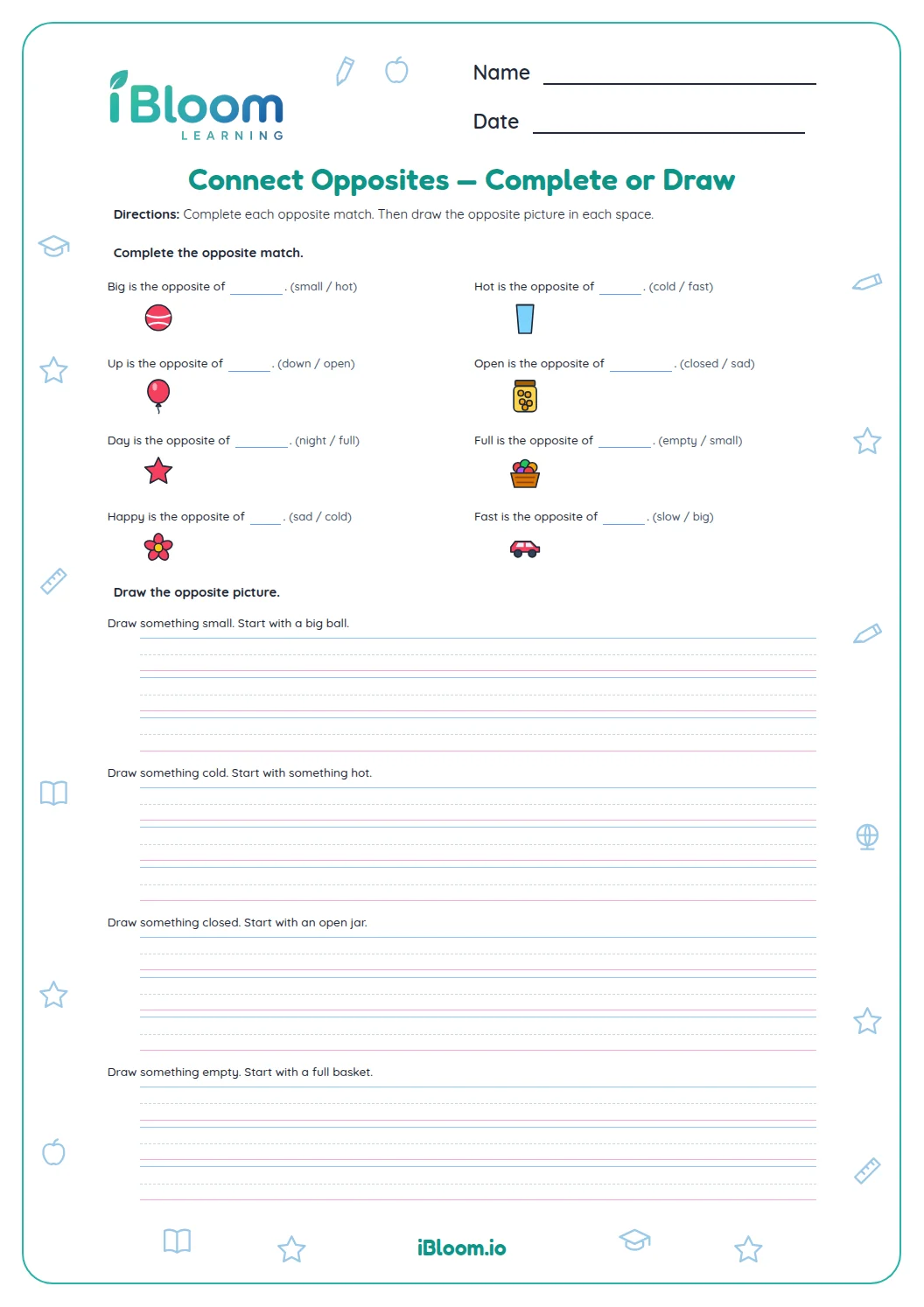
No. Opposites are words that contrast, like hot and cold. Things that go together are linked by use or place, like a bowl and a spoon. This sheet sits next to the opposites sheets because both teach children to think about how two words relate.
My child cannot read yet. Can they still do this worksheet?
Yes. Every answer choice is a picture, and a grown-up reads each question aloud. The child marks the bubble beside the picture that fits. Name each picture as you point to it, and let your child tell you the reason after each answer.
What if my child does not know the name of a picture?
Say the name and what it is for, such as "a spoon, you eat soup with it," then ask the question again. Naming pictures is part of the learning. A few pictures are simple drawings, so hold up the real object too when you have it nearby.
What are the answers to Part A?
In Part A, a sock goes with a shoe, a bird goes with a nest, a bee goes with a flower and a cow goes with milk. Part B is spoon, umbrella, toothbrush and bed, and Part C is dog and bone, then key and lock. The answer key shows all ten.
How long does it take, and is there an answer key?
With a grown-up reading aloud, most children finish in about 10 minutes. Allow more time if your child likes to tell stories about each pair. Yes. A two-page answer key follows the worksheet, so you can print the worksheet pages alone for your child.