





About this worksheet
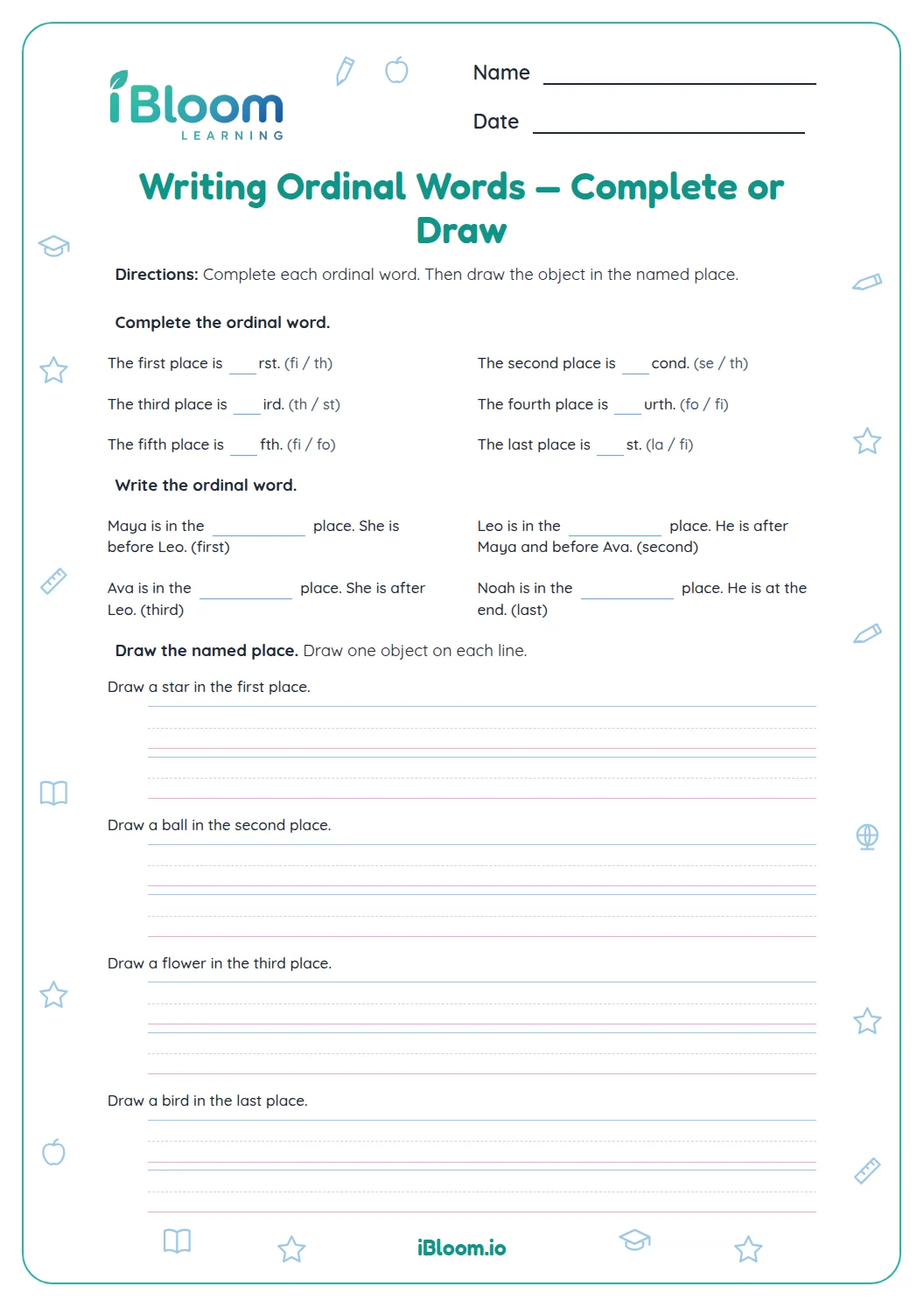
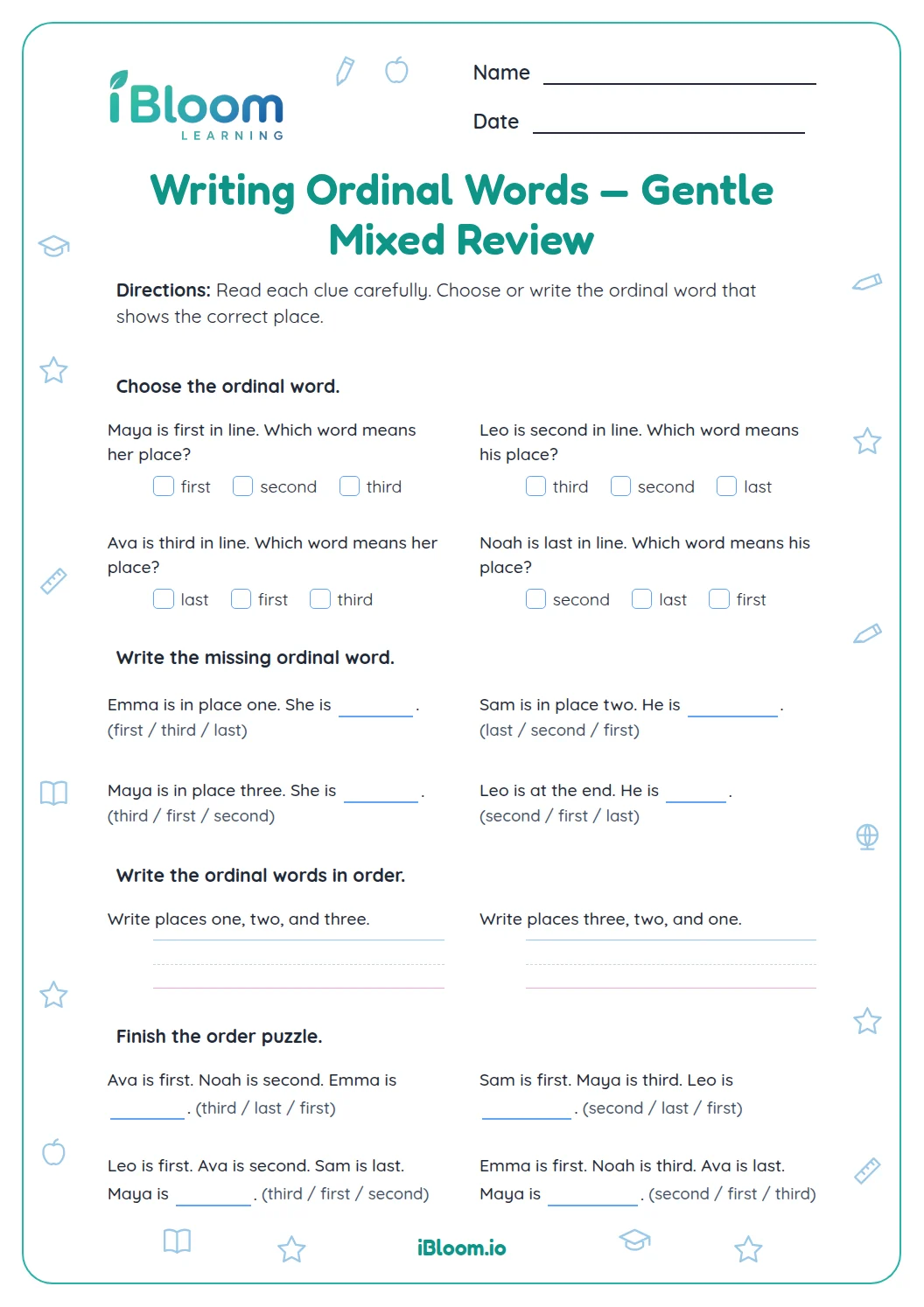
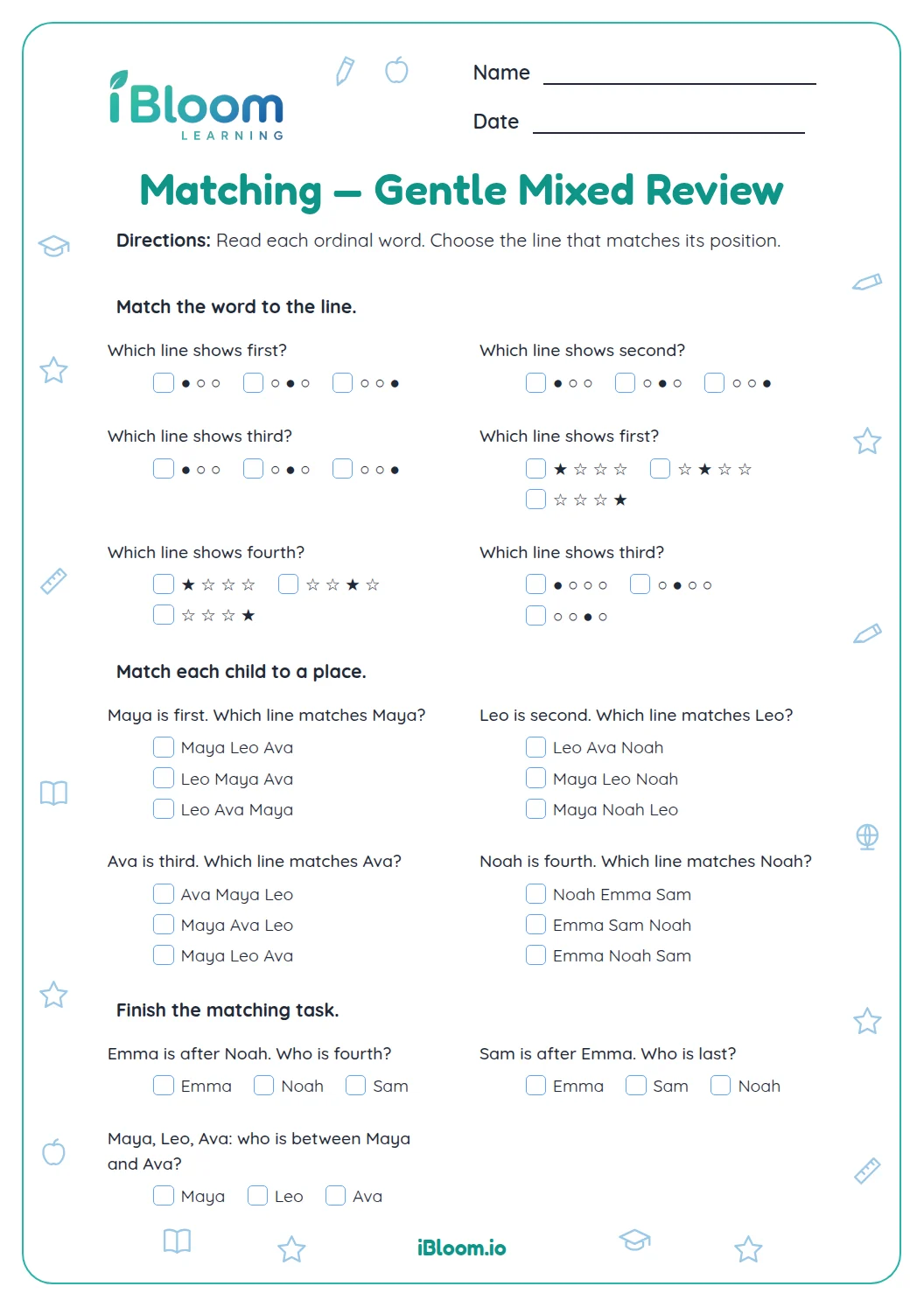
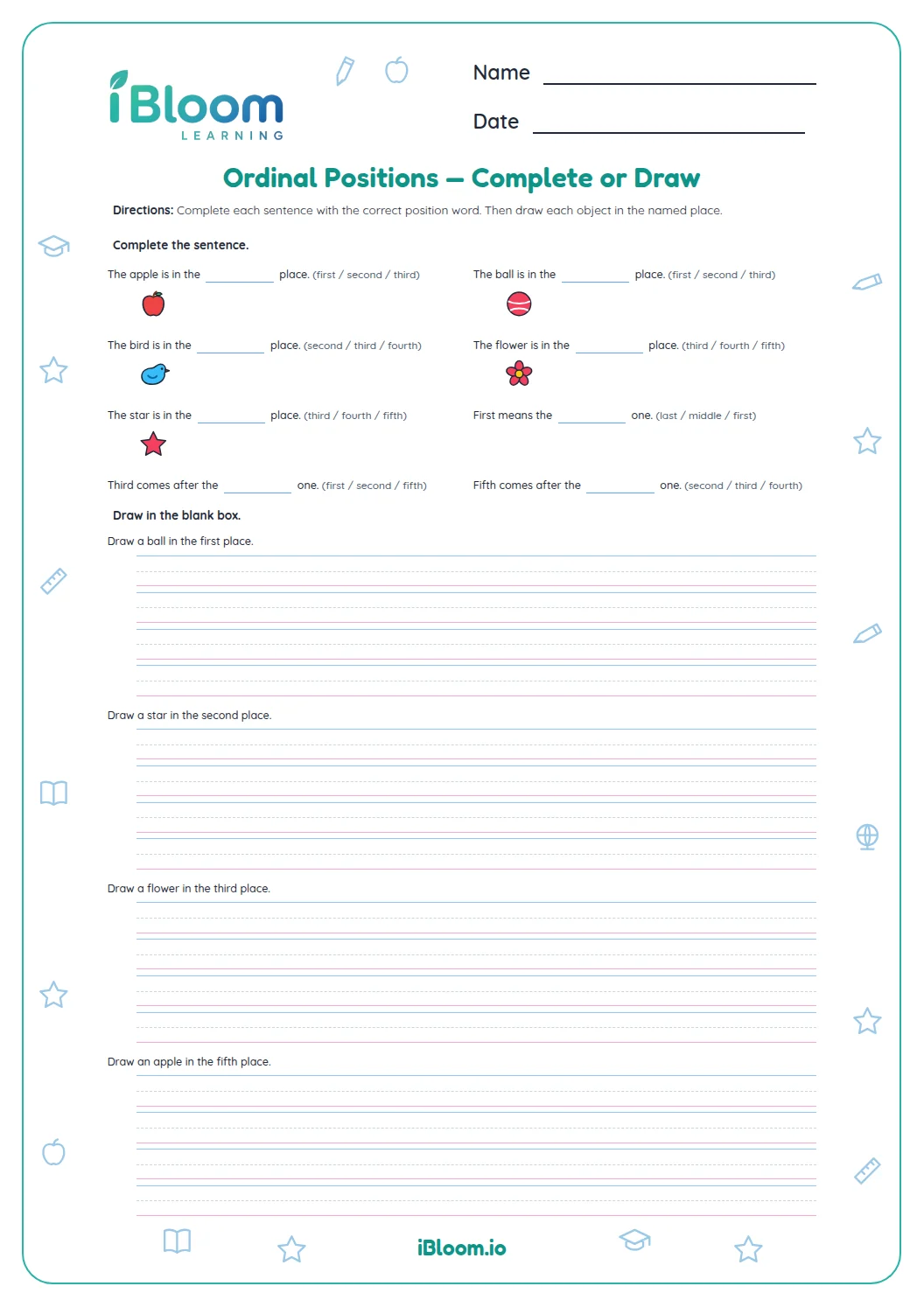
This free printable worksheet helps preschool and kindergarten children write ordinal words in familiar settings. Children look at rows of snack foods and toys, start at the left, and write the word that names an item’s place. The word bank supplies first, second, third, fourth and fifth, so an adult can help with reading while the child identifies the position. Part A uses snack rows; Part B changes to toys and asks for positions in a mixed order. Ten picture questions and a separate answer key support practice at home or in a small group.
Where should children start counting positions?
Every row on this sheet starts at the left. Point to the leftmost object before naming any positions, then move one picture at a time. Repeated rows let children check the same order while writing a different word.
Say the position words rather than the counting numbers: first, second, third, fourth, fifth. This makes the connection between pointing and the words the child will write.
How do the snack pictures help with writing?
The first snack row is apple, banana, carrot, cheese, strawberry. Question 1 asks for the apple’s position. It is at the left end, so the child copies first. Question 4 asks for the cheese, which comes after the carrot.
- 1Start at the apple on the left.
- 2Apple: first; banana: second; carrot: third; cheese: fourth.
- 3The cheese is fourth.
- 4Copy fourth into the blank.
What changes in the toy questions?
Part B uses a train, a teddy bear, a kite, a robot and a drum. The questions ask about fifth, second, fourth, first and third positions in that order. Children have to find the named toy each time.
Keep the word bank visible while children write. If a child names the correct position but copies a letter incorrectly, acknowledge the correct position, then help with the letter formation.
Point, say and write
- 1Read the five words in the subtitle aloud together.
- 2Point to the left end of the first snack row.
- 3Read each prompt and let the child point to the named item.
- 4Say the item’s ordinal position, then copy its word into the blank.
- 5In Part B, start again at the left for each toy question.
- 6Check the words against the key, then line up five real toys for oral practice.
Mistakes to notice and how to help
The mistake
Writing four when the cheese is fourth.
The fix
Ask for its place in the row, then locate fourth in the word bank.
The mistake
Starting at the right end of a row.
The fix
Mark the left starting point with a finger and move toward the right.
The mistake
Writing the next word in the bank without finding the toy.
The fix
Point to the named toy first; Part B asks for positions in a mixed order.
What to practice next
Make more practice
Questions parents and teachers ask
Which ordinal words are practiced?
Children use first, second, third, fourth and fifth. Each word is an answer once in the snack section and once in the toy section. The words appear together in the subtitle as a bank to copy, so children can focus on matching a position to its written word.
Can I read the questions to my preschooler?
Yes, read the directions, word bank and item names aloud as needed. Let your child point to the item and say its position before writing. You can also name the pictures together first, especially the teddy bear and cheese, so recognizing an object does not interrupt the position practice.
Does first mean the object on the left?
On this worksheet, first always means the leftmost object. The directions specify left to right for every row. Before starting a question, point to that end together. In real activities, such as lining up for a slide, explain where the front of the line is before naming positions.
Why do the picture rows repeat?
The snack row repeats so children can practice all five ordinal words with a stable reference. The toy row then provides a new set of objects, and its questions ask for positions in a different order. Repeating a row also lets each question stand on its own visually.
How can we use this skill after the worksheet?
Line up five toys and ask your child to place a finger on the third toy or name the fifth one. Keep the starting end clear. Then switch two toys and ask again. Children can say the position words aloud before trying to write them on another piece of paper.