




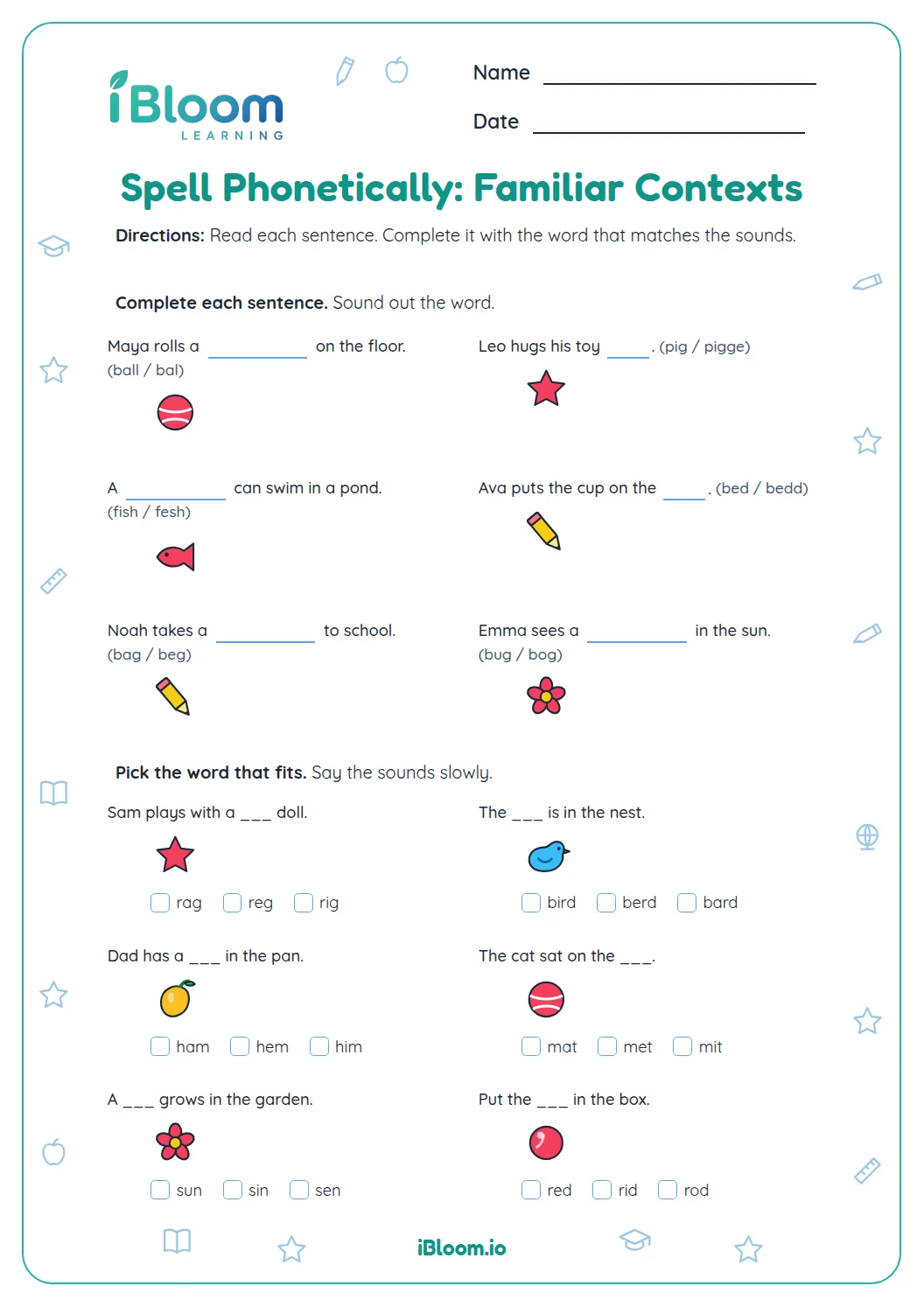
About this worksheet
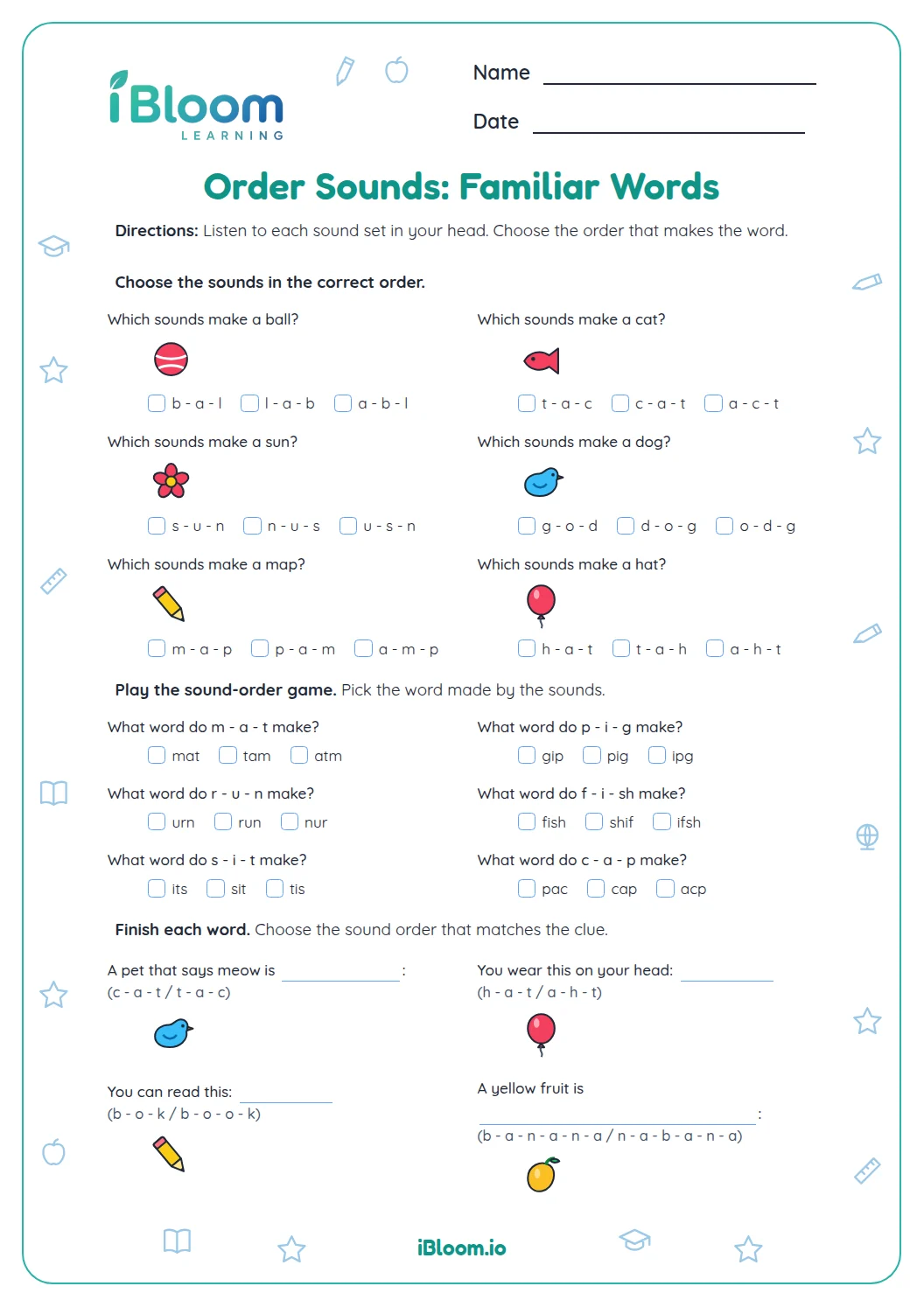
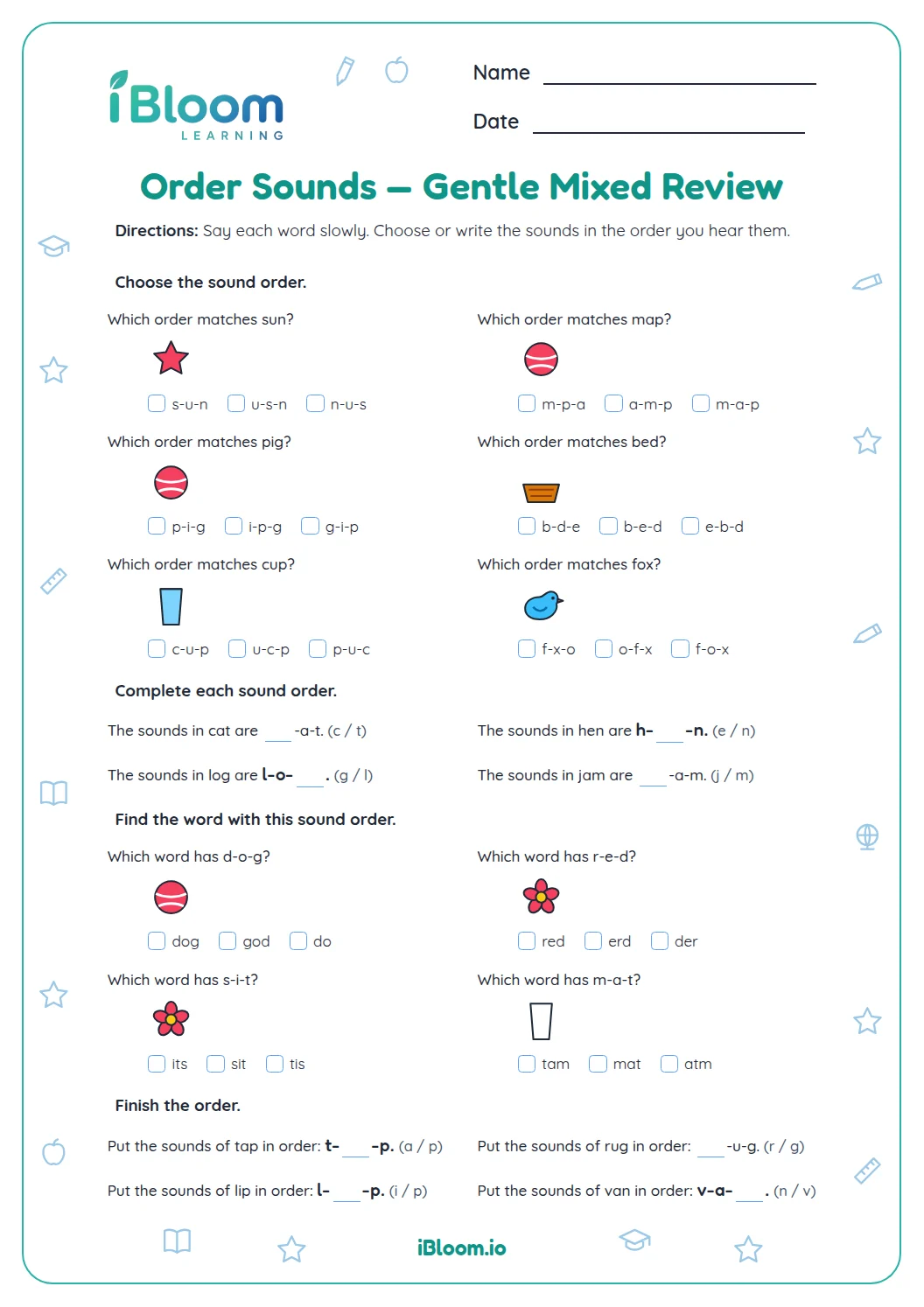
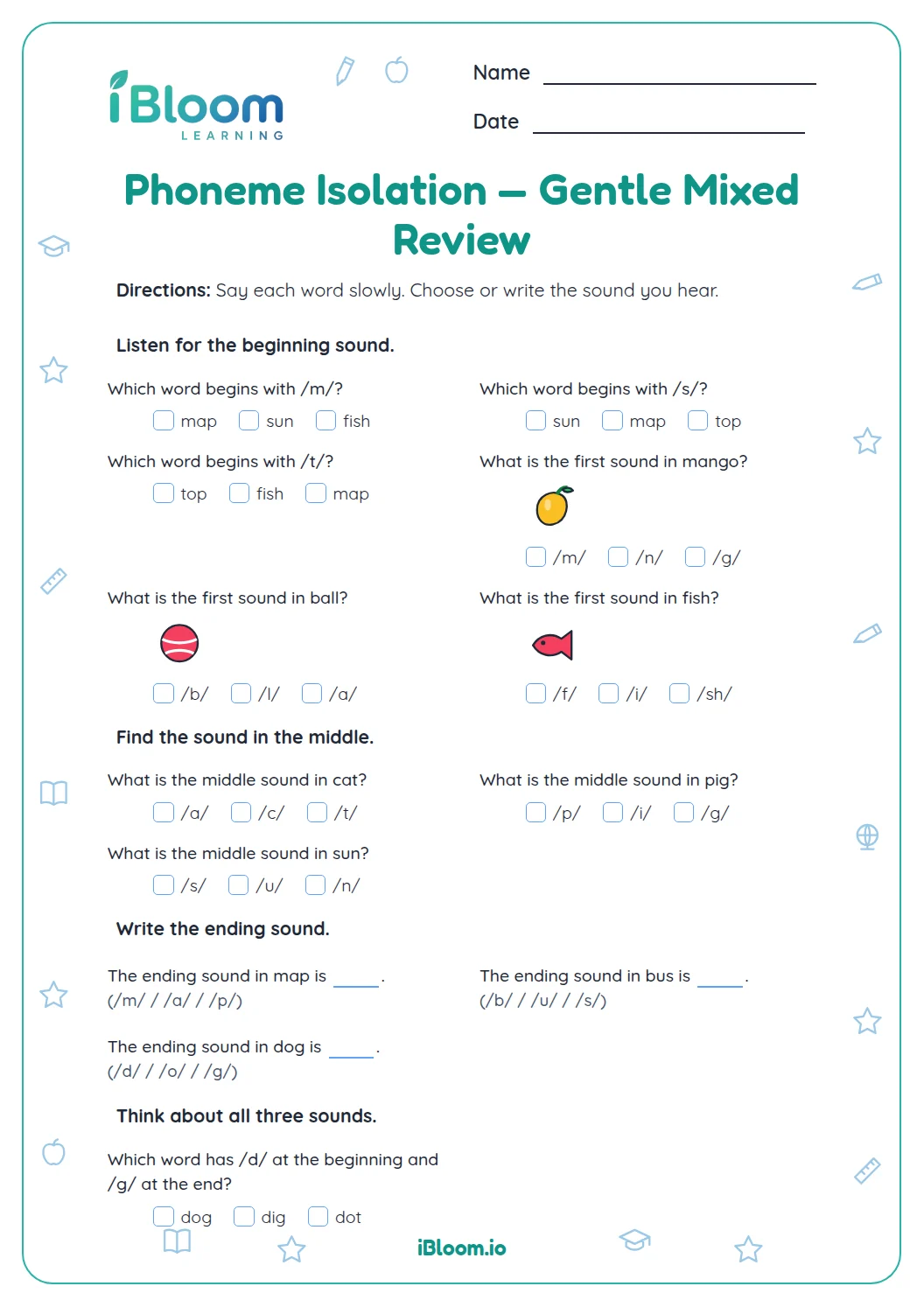
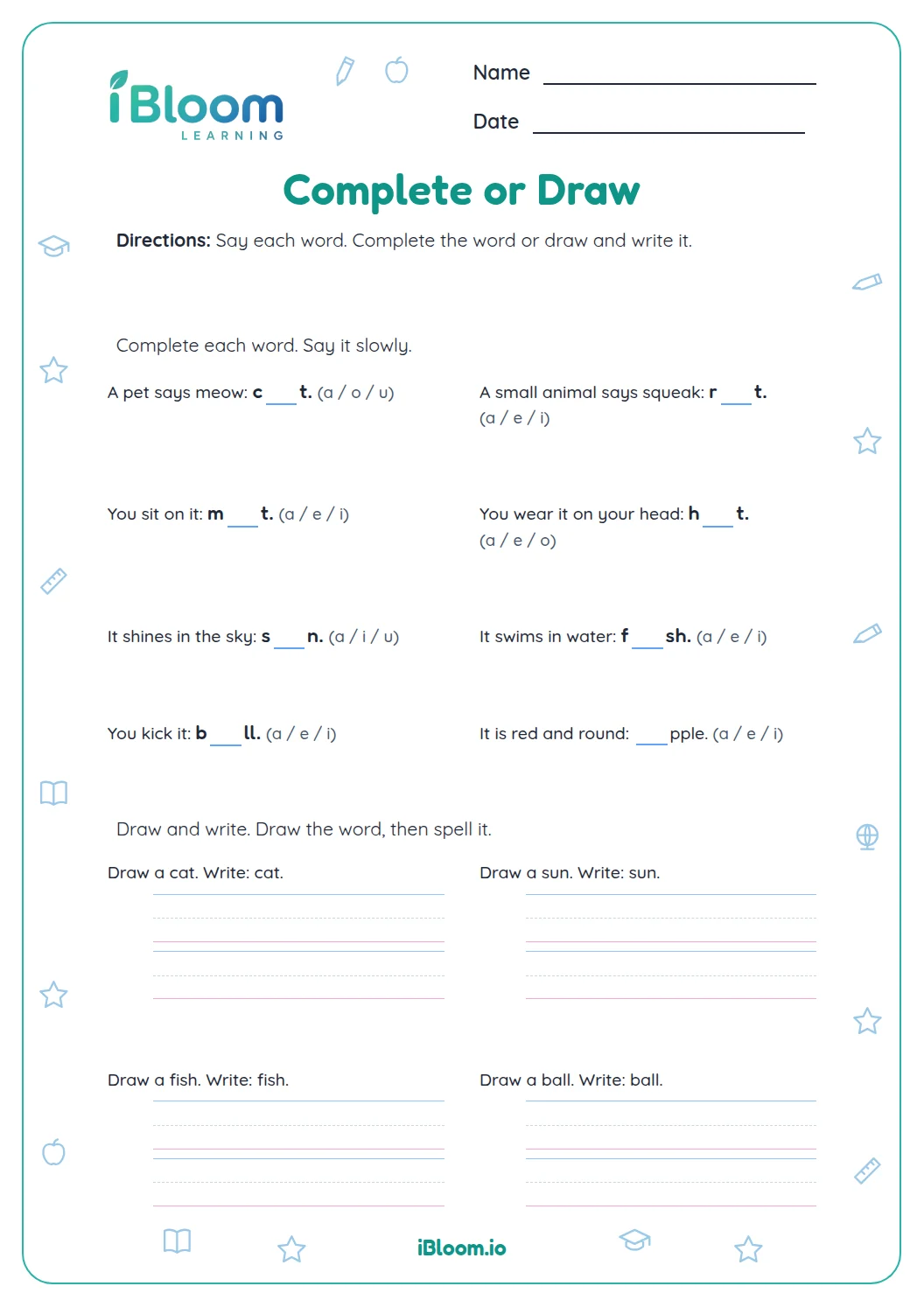
This free worksheet gives preschool and Kindergarten children adult-supported practice hearing phonemes in order. In Part A, children complete 12 sound sequences by choosing a missing beginning, middle, or ending sound. In Part B, an adult says six CVC words one sound at a time; children blend each sequence and draw the word they hear in two boxes. The first 12 tasks practice isolating sounds in spoken words, in line with CCSS RF.K.2d. The key lists each missing sound and names the drawings in order.
Aligned to RF.K.2d
How do children complete each sound order?
Read each sequence aloud, pausing where the blank appears. Have the child say the missing sound before choosing its spelling from the choices. The first four items leave off an ending sound, the next four ask for a middle vowel, and the last four ask for a beginning sound.
Say sounds, not letter names. For example, cat has /k/ /a/ /t/.
How can an adult lead the drawing tasks?
For Part B, say each set of three phonemes separately without adding an extra vowel sound. Let the child repeat them, blend them into a word, and draw all three words in order in the box. The key names each word; any clear drawing of that word is fine.
What is one sound-order example?
In Question 1, the sequence is /m/ /a/ ___. The choices are p, s, and t. Saying the sounds in order gives mat, so the missing sound is /t/.
- 1Question 1: /m/ /a/ ___
- 2The choices are /t/, /p/, and /s/.
- 3/m/ /a/ /t/ makes mat.
- 4The missing sound is /t/.
How to use this worksheet
- 1Read each Part A sound sequence aloud, pointing left to right.
- 2Let the child say the missing sound before choosing a sound spelling.
- 3Repeat each completed sequence and blend it into a familiar word.
- 4For Part B, say each set of three sounds slowly and have the child blend all three words.
- 5Invite the child to draw the three words in order; the key names the words.
Mistakes to check together
The mistake
Saying letter names instead of speech sounds.
The fix
Model /k/ /a/ /t/ for cat, using the short vowel sound.
The mistake
Skipping a sound or changing the left-to-right order.
The fix
Tap once for each phoneme and point to each sound as it is said.
The mistake
Adding “uh” after a consonant.
The fix
Keep consonants brief, such as /t/, then blend the sounds smoothly.
Common Core alignment
Identify the first, middle vowel, and last sounds in spoken CVC picture words.
On this sheet: The eight picture-word questions ask children to isolate a missing first, middle, or last sound.
Show the official wordingHide the official wording
Isolate and pronounce the initial, medial vowel, and final sounds (phonemes) in three-phoneme (consonant-vowel-consonant, or CVC) words.
What to practice next
Make more practice
Further reading
Questions parents and teachers ask
Does my child need to read the directions alone?
No. An adult should read the sound sequences and say the spoken words for the drawing tasks. The child listens, repeats the sounds, and chooses or draws. If writing a sound spelling is still difficult, the adult can write the child’s spoken answer.
What does “sound order” mean here?
It means hearing each phoneme from the beginning of a word to the end. Part A leaves one sound blank in an ordered sequence, and Part B gives all three sounds for children to blend. Point left to right and tap once for every sound.
Are letter names used for the sound choices?
No. The choices show speech sounds, not alphabet names. For example, the final sound in mat is /t/, while the middle sound is short a. Say each sequence slowly, tap once per sound, and let the child listen before selecting a choice.
What should the child draw in Part B?
Each box contains three sound sequences. The child listens, blends each sequence, and draws the word it names from left to right. The six words are pig, sun, cat, dog, fish, and hen. Any clear drawing that matches the named word is acceptable.
Why does fish have three sounds if “sh” has two letters?
In fish, sh works together to spell one final phoneme, /sh/. The sounds are /f/ /i/ /sh/, so there are three phonemes even though the last sound uses two letters. Have the child tap once for /f/, once for /i/, and once for /sh/.