






About this worksheet
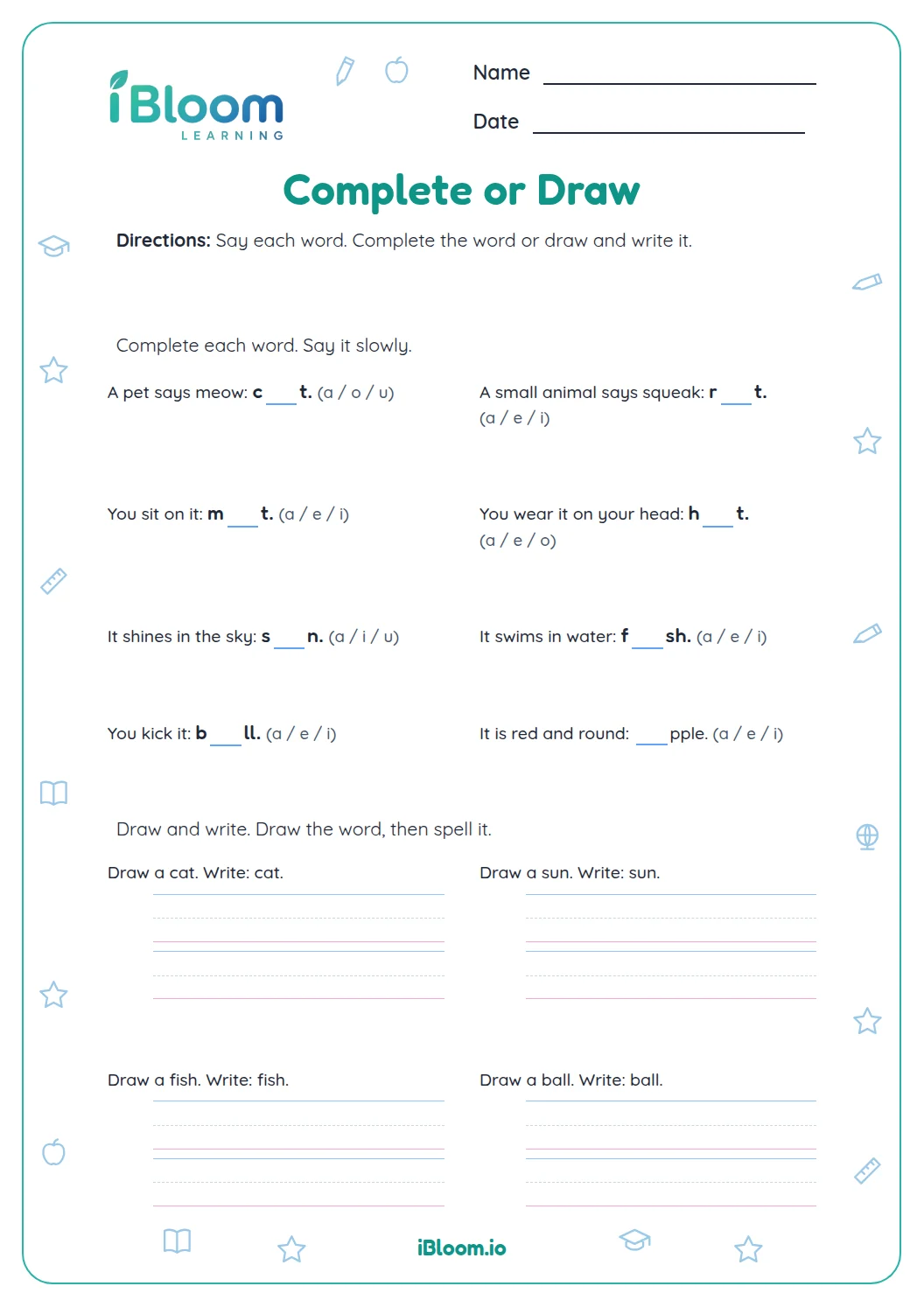
This free printable worksheet helps Pre-K and Kindergarten children connect the sounds they hear in a word to the letters that write them. Each question has a picture. In Part A, children choose the letter for a first sound. In Part B, they write a missing first letter, as in ___ un for sun. In Part C, they write a missing last letter, as in ca___ for cat. It practices CCSS L.K.2.c and RF.K.2.d, and the answer key is on a separate page.
Aligned to L.K.2.c and RF.K.2.d
What does it mean to write a sound?
Writing a sound means hearing one sound in a spoken word and putting down the letter that stands for it. If a child hears /b/ at the start of bus, they write b. This is the first step toward spelling, because every word is built from sounds.
The words on this sheet are short, common words with a picture beside each one: apple, bear, fish, star, kite, rabbit, sun, pig, hat, map, cat, bed, dog and bus. The pictures let children name each word themselves, so a grown-up only needs to read the short directions aloud.
- 1Picture of a pig, with ___ ig beside it.
- 2Say the word slowly: p-i-g.
- 3What sound is first? /p/
- 4Write the letter p on the line.
- 5Read it back: pig.
How do the three parts build on each other?
Part A asks children to choose from three letters, so they only have to recognize the right one. In Parts B and C, they have to remember the letter and write it, first at the start of a word and then at the end.
Many Pre-K children can do Part A with a grown-up, pointing to or circling a letter, and come back to Parts B and C later when writing feels easier.
What is on this worksheet?
Fourteen questions over two pages, with a picture for every word.
- Part A, Choose the first sound: apple, bear, fish, star, kite and rabbit, with three letters to pick from
- Part B, Write the first letter: sun, pig, hat and map, each missing its first letter
- Part C, Write the last letter: cat, bed, dog and bus, each missing its last letter
- Answer key on separate pages
Why does question 2 offer d next to b?
The letters b and d are mirror images of each other, so young writers often mix them up. Question 2 puts d beside the right answer b for bear, and question 12 asks for the d at the end of bed, so children meet both letters in one sitting and have to listen for the difference.
A helpful trick is to say the sound while making the shape: for b, draw the straight line down first, then the bump on the right, and say /b/. For d, draw the round part first, then the tall line.
How to use this worksheet at home or in class
- 1Warm up by saying a word, such as sun, and asking your child to say just the first sound. Stretch it out: /sss/-un.
- 2Do question 1 together. Say apple, then say the first sound, then point to the letter that matches it.
- 3Let your child finish Part A, saying each word aloud before choosing a letter.
- 4In Parts B and C, say the word, stretch the sound, then let your child write the letter. Ask them to read the whole word back.
- 5Check with the answer key and celebrate every letter written, even if it is large or uneven.
Common mistakes and quick fixes
The mistake
Writing b for d, or d for b, such as choosing d for bear or writing b at the end of bed.
The fix
Make the shape in the air while saying the sound. For b, go down first, then add the bump on the right. For d, make the round part first, then the line.
The mistake
Writing the first letter when the last is asked, such as c for cat in ca___.
The fix
Say the word and slide a finger from left to right under the blank. The blank is at the end, so listen for the sound at the end: ca-/t/.
The mistake
Writing the vowel from the middle of the word, such as i for pig in ___ ig.
The fix
Say only the first sound by itself: /p/, not /pi/. Stretch the sound that comes first, then stop.
Common Core alignment
Most US states use the Common Core standards or a close state version. This sheet practices the two Kindergarten standards below.
Write letters for consonant and short-vowel sounds.
On this sheet: Children choose or write a letter for a sound in all 14 questions.
Show the official wordingHide the official wording
Write a letter or letters for most consonant and short-vowel sounds (phonemes).
Say the first and last sounds in simple words.
On this sheet: Children isolate the first sound in Parts A and B and the last sound in Part C.
Show the official wordingHide the official wording
Isolate and pronounce the initial, medial vowel, and final sounds (phonemes) in three-phoneme (consonant-vowel-consonant, or CVC) words.
What to practice next
Make more practice
Further reading
Questions parents and teachers ask
What does write sounds mean on a phonics worksheet?
It means a child hears a sound in a spoken word and writes the letter that stands for it. On this sheet they do it with first sounds, as in ___ un for sun, and with last sounds, as in ca___ for cat. They also choose letters from three options.
Does my child need to know every letter first?
No. Start with the letters in the words on the sheet and help with the rest. Children can choose letters in Part A before they write unaided in Parts B and C. Come back to the writing parts once they are more confident.
Why does the sheet use pictures instead of printed words?
Young children are still learning to read, so the picture tells them which word to say. They can then listen for the sound without decoding anything. A grown-up can name each picture first if needed, and then the child focuses on the sound and letter.
Why do some questions ask for the last sound?
Hearing the last sound is the next step after the first sound. Part C asks for the final letter in cat, bed, dog and bus, which are all three-sound words. Saying the word slowly and listening to the end helps children notice the whole word, not just its start.
My preschooler cannot write yet. Can they still use this sheet?
Yes. Choose letters in Part A by pointing or circling. A grown-up can write the letter in Parts B and C while the child says the sound, or the child can try with a thick crayon. Any marks they make count as practice for later writing.
Is there an answer key for this worksheet?
Yes. The separate answer key pages show the correct letter for every question: the first sounds in Parts A and B, and the last sounds in Part C. Print the worksheet alone, keep the key for checking, or download both as a free PDF.