






About this worksheet
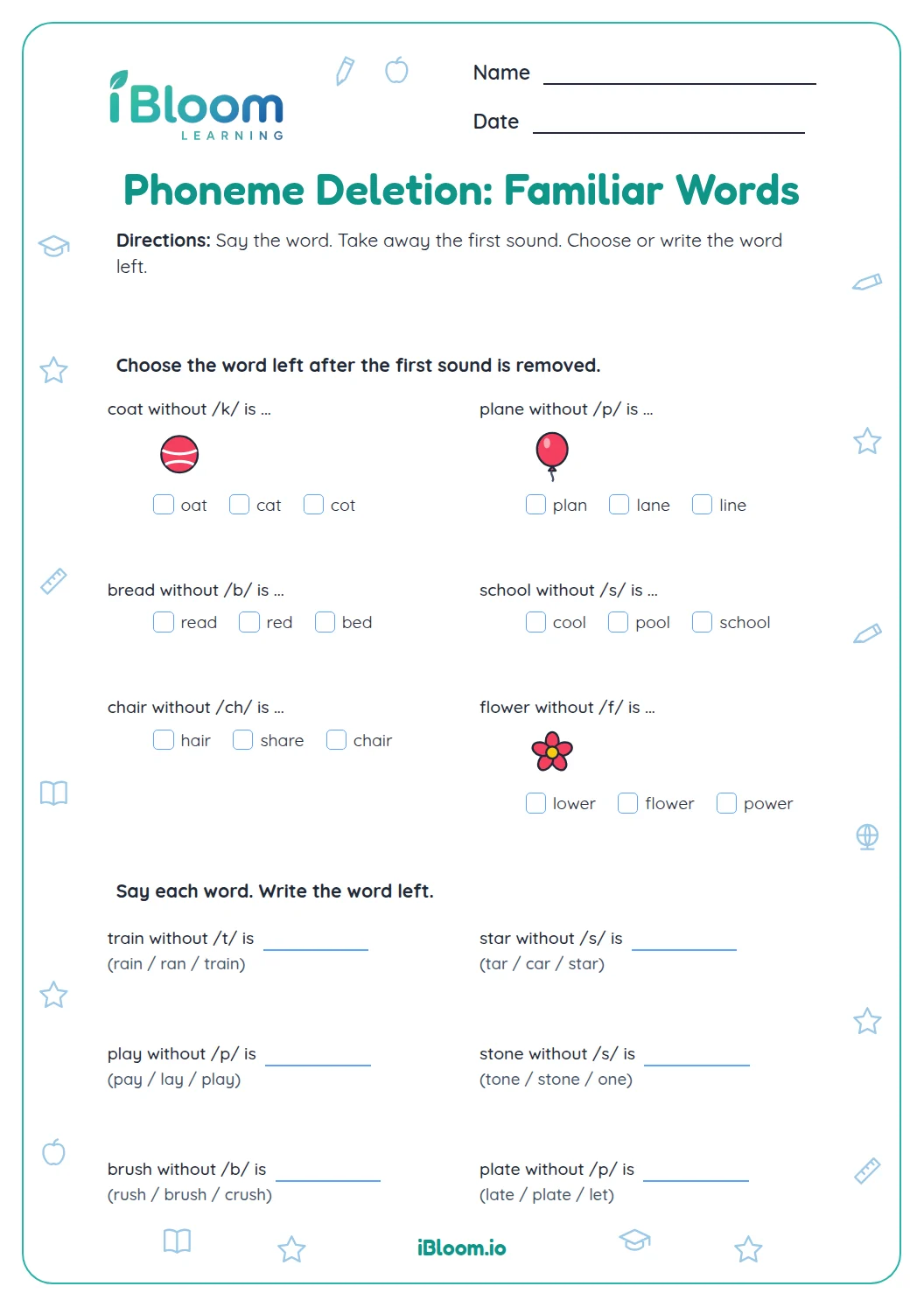
This free printable phoneme deletion worksheet gives preschool and kindergarten children fourteen spoken-word puzzles with picture answers and short oral practice. An adult says each word and names the sound to remove; the child says the word that remains and chooses its picture or writes a short answer. Part A removes first sounds, Part B removes last sounds, and Part C removes one sound from a consonant blend. Children attend to individual sounds in spoken words. A separate answer key lets adults check the choices. Read the prompts aloud and name unfamiliar pictures before beginning.
Aligned to RF.K.2
What does taking away a sound mean?
A phoneme is one speech sound. Phoneme deletion means saying a word again with one of its sounds removed. This is listening and speaking work: the child can answer by pointing before making a mark.
The marks /h/ and /p/ tell the adult which sounds to say. Use the sound, not the letter name, and keep consonants short so an extra “uh” does not become part of the word.
- 1Say hear.
- 2Say hear without /h/.
- 3The sounds left make ear.
- 4Choose the ear picture.
How does the review become more challenging?
Part A changes hear to ear, pant to ant and train to rain. Part B changes cart and card to car, and beep and beak to bee. The same answer from different starting words gives children a way to check what remains.
Part C changes grain to rain, clap to cap, crab to cab, spare to pear, bread to bed, cart to cat and clean to keen. Remove only the named sound. For crab, the taxi picture represents a cab; say “cab” when naming that choice.
How can an adult help without giving the answer?
Name the pictures before reading a question, then say the starting word naturally. Repeat the instruction once and give the child time to respond. If needed, say the word slowly and ask which sound is being removed.
For a difficult blend, an adult can demonstrate the first item in Part C and let the child try the next one. Revisit only a few items at a time so the activity remains a short listening game.
How to use this worksheet
- 1Name the picture choices, using cab for the taxi in question 9.
- 2Say hear and model removing /h/ to leave ear.
- 3Read each prompt aloud using the sound inside the slashes, not its letter name.
- 4Have the child say the new word before choosing its picture.
- 5Check each part with the answer key and repeat a tricky item slowly.
Mistakes to notice and how to help
The mistake
Saying the letter name “aitch” instead of /h/.
The fix
Model the breath sound at the start of hear, then say ear.
The mistake
Removing the whole blend in grain and answering ain.
The fix
Remove only /g/; the /r/ sound stays, making rain.
The mistake
Choosing a picture before listening to the sound to remove.
The fix
Cover the choices briefly, say the sound puzzle and ask for the new word aloud first.
Common Core alignment
Attend to individual sounds while changing spoken words.
On this sheet: Children listen for a named sound, remove it and blend the remaining sounds into a word.
Show the official wordingHide the official wording
Demonstrate understanding of spoken words, syllables, and sounds (phonemes).
What to practice next
Make more practice
Further reading
Questions parents and teachers ask
Does my child need to read the words?
No, an adult reads all fourteen prompts aloud and the child chooses picture answers or says a short response. Name the pictures first so vocabulary does not get in the way. Ask the child to say the new word before pointing or marking a choice, keeping the focus on the sounds heard.
How should I say the sounds in slashes?
Say the speech sound between the slashes, rather than the letter name. For /p/, use a short puff of sound instead of saying “pee” or adding “uh.” Read the whole word naturally first, then ask the child to remove the named sound and say what remains.
Why do cart and card both become car?
Cart and card both leave car when their last sound is removed. The new cart question removes /r/ and leaves cat. Say the starting word clearly, remove only the named sound, and compare what remains. The different examples help children listen for the exact sound named in each prompt.
What should we call the taxi picture?
Call it a cab for question 9, which asks for crab without /r/. Name that picture before starting the question so the child knows the intended word. Cab and taxi name the same vehicle, but cab is the word made by this particular sound change.
What if the blend questions are difficult?
Work through Part C together and remove only the sound named in each prompt. In clap, taking away /l/ leaves cap, while /k/ stays. In clean, removing /l/ leaves keen. Say both words slowly, then naturally. It is fine to stop after a few questions and return to the rest in another short session.