






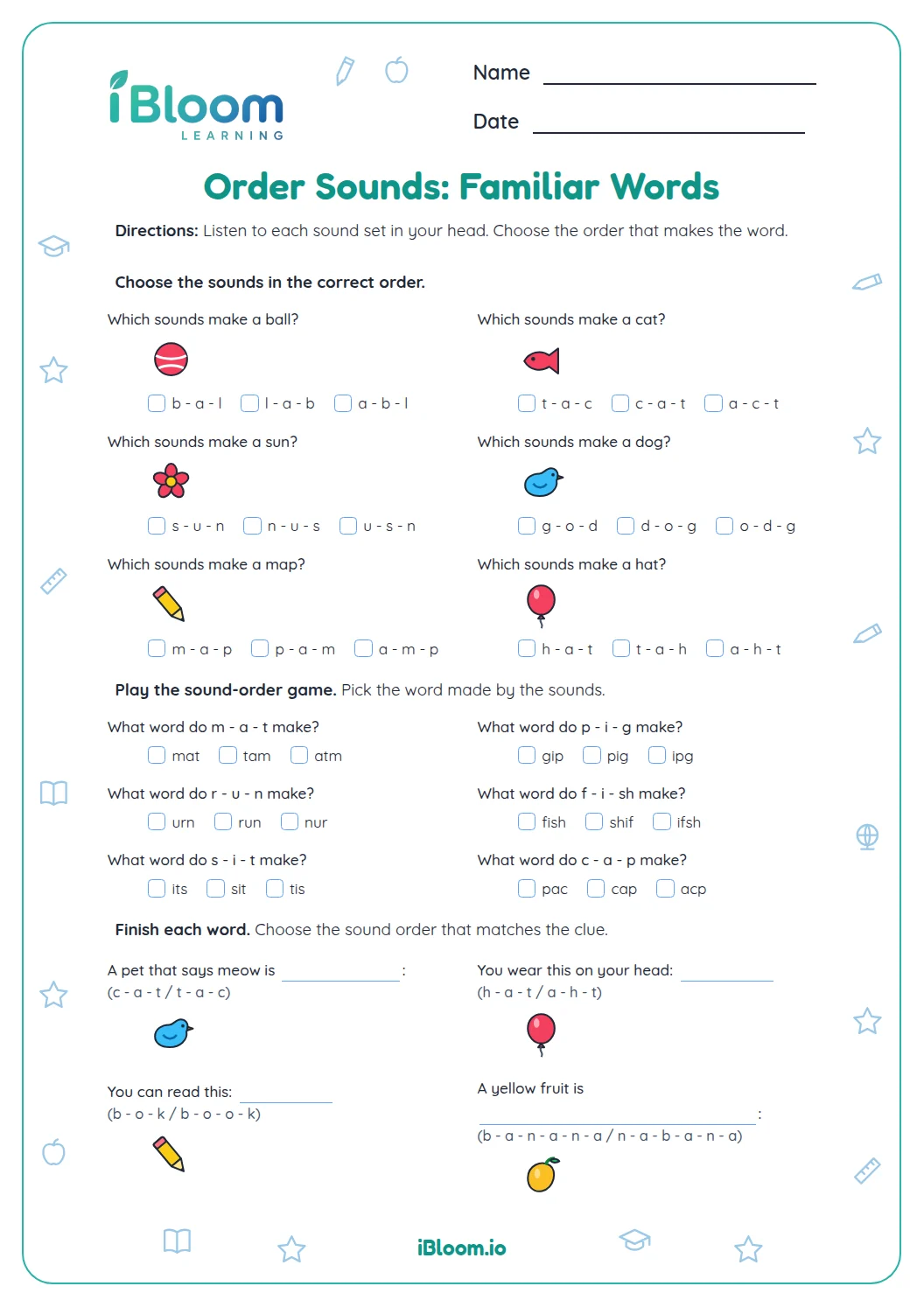
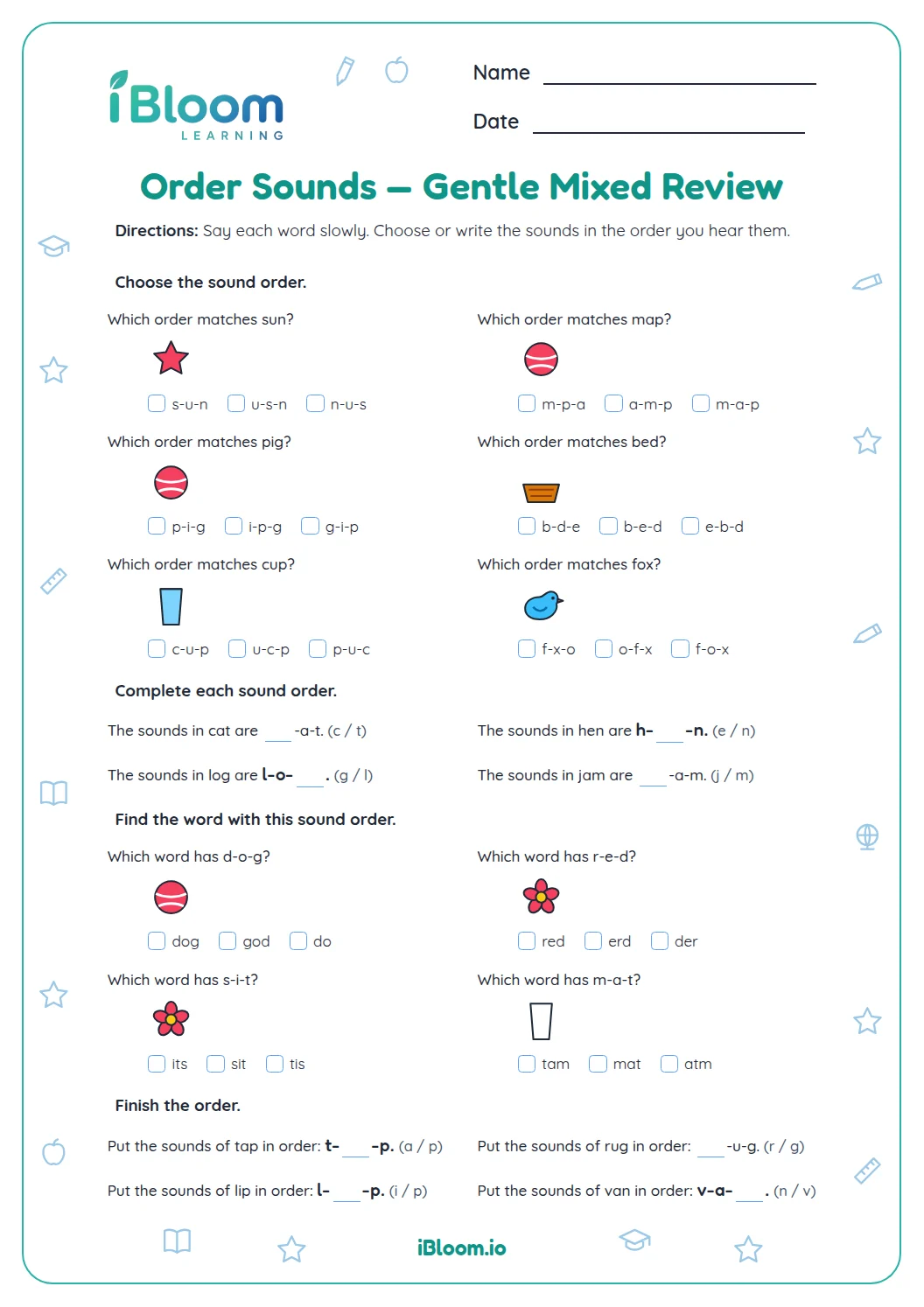
About this worksheet
This preschool and kindergarten printable gives children 15 picture-supported chances to listen for a beginning sound in a familiar spoken word and say what remains when it is removed. An adult can read each prompt aloud; the child repeats the word without the target sound, then chooses a response. The items practice phoneme manipulation in CCSS RF.K.2.e. A separate answer key is included.
Aligned to RF.K.2.e
How does phoneme deletion work?
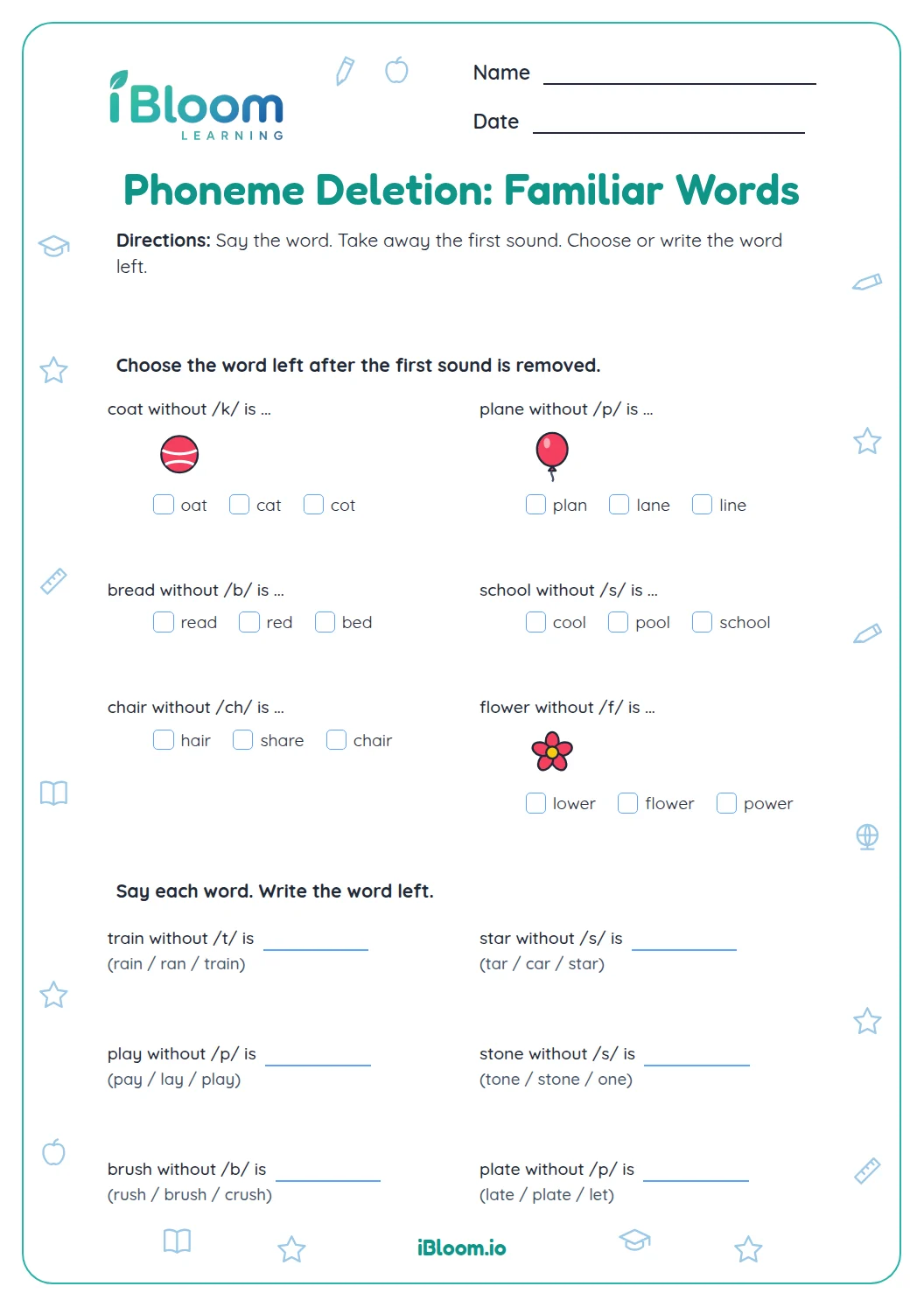
A child says a word, removes one sound, and says what remains. In question 6, taking /t/ away from “train” leaves “rain.”
- 1Say “train” without /t/.
- 2Listen to /t/ /r/ /ā/ /n/ and remove /t/.
- 3The remaining word is “rain.”
How do picture cues support listening?
Pictures help young learners identify the starting word before they listen for its sounds. An adult can name the pictured item, then say the deletion prompt aloud.
How can you make this an oral activity?
Read each prompt aloud and invite the child to say the answer before looking at the choices. The choices then help the child check what they heard.
How to use this worksheet
- 1Name the picture together if the child needs a cue.
- 2Say the whole word aloud slowly.
- 3Repeat the target sound and take it away.
- 4Say the sounds that remain and blend them into a word.
- 5Point to the matching choice, then check the answer key.
Common mistakes and quick fixes
The mistake
Removing a letter name instead of its sound.
The fix
Say the sound /s/, not the letter name “ess.”
The mistake
Taking away the whole first syllable.
The fix
Remove only the single sound named in the prompt.
The mistake
Guessing from the picture without listening.
The fix
Say the word aloud and repeat it after removing the sound.
Common Core alignment
These oral sound tasks ask children to manipulate phonemes in spoken words.
Add or substitute individual sounds in simple one-syllable words.
On this sheet: Each prompt asks children to remove an individual phoneme and say the remaining sound sequence.
Show the official wordingHide the official wording
Add or substitute individual sounds (phonemes) in simple, one-syllable words to make new words.
What to practice next
Make more practice
Further reading
Questions parents and teachers ask
What does phoneme deletion mean?
Phoneme deletion means saying a word after taking away one sound. For example, “train” without /t/ becomes “rain.” Children listen to the sounds in a word rather than remove a written letter. An adult can model the word aloud first.
Should an adult read the prompts aloud?
Yes, especially for preschool learners. Say the pictured word and sound-removal prompt clearly, then let the child answer aloud before pointing to a choice. This keeps practice focused on listening and speaking sounds. Keep the pace unhurried so the learner can repeat the word and listen carefully.
Why do some answers sound unusual?
Removing one sound can leave a playful or unfamiliar sound sequence, such as “poon.” The task is to notice and say the sounds that remain, rather than find a new real word. The picture identifies the starting word, and the adult can model how its first sound is removed.
Does this page include pictures?
Yes. Each prompt has a picture cue that matches its starting word, such as a train for “train” and a map for “map.” The child can name the picture before listening for the sound to remove. An adult can say the picture word aloud if needed.
How many practice items are included?
There are 15 picture-supported questions. Every question asks children to remove a beginning sound, then choose the remaining sound sequence. The key lists each response for review. An adult may reread the starting word and sound if a child needs another listening try.