



About this worksheet
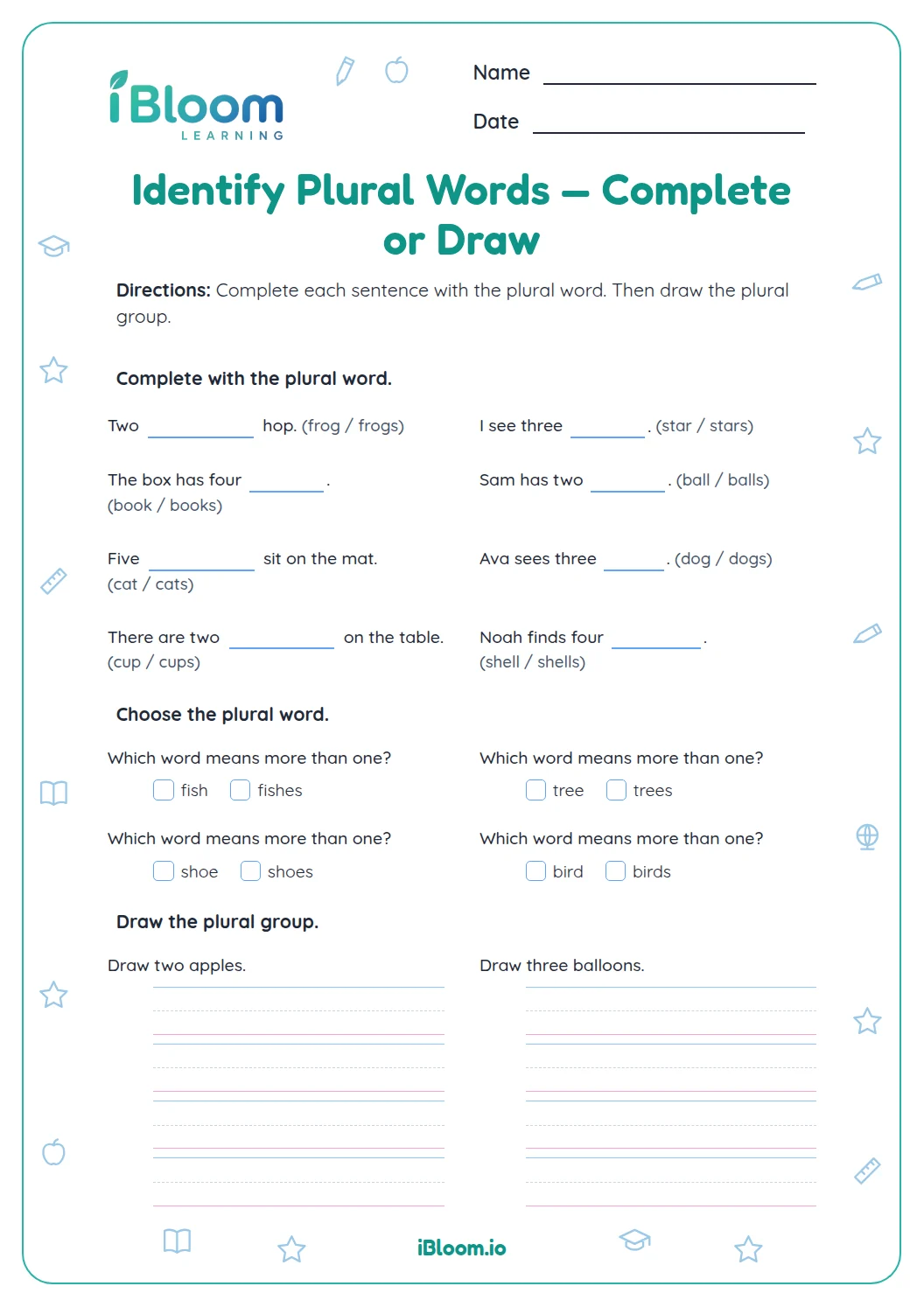
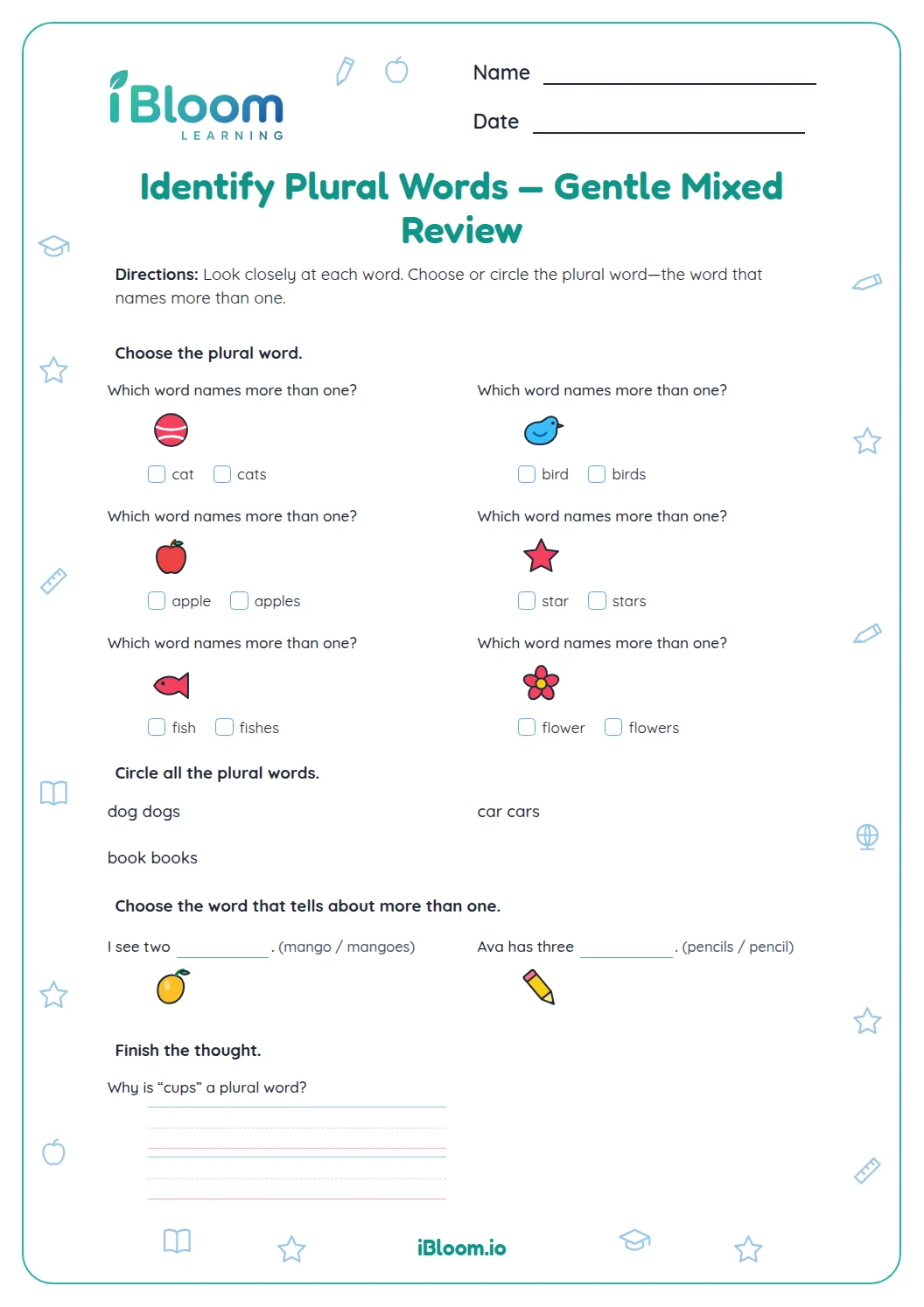
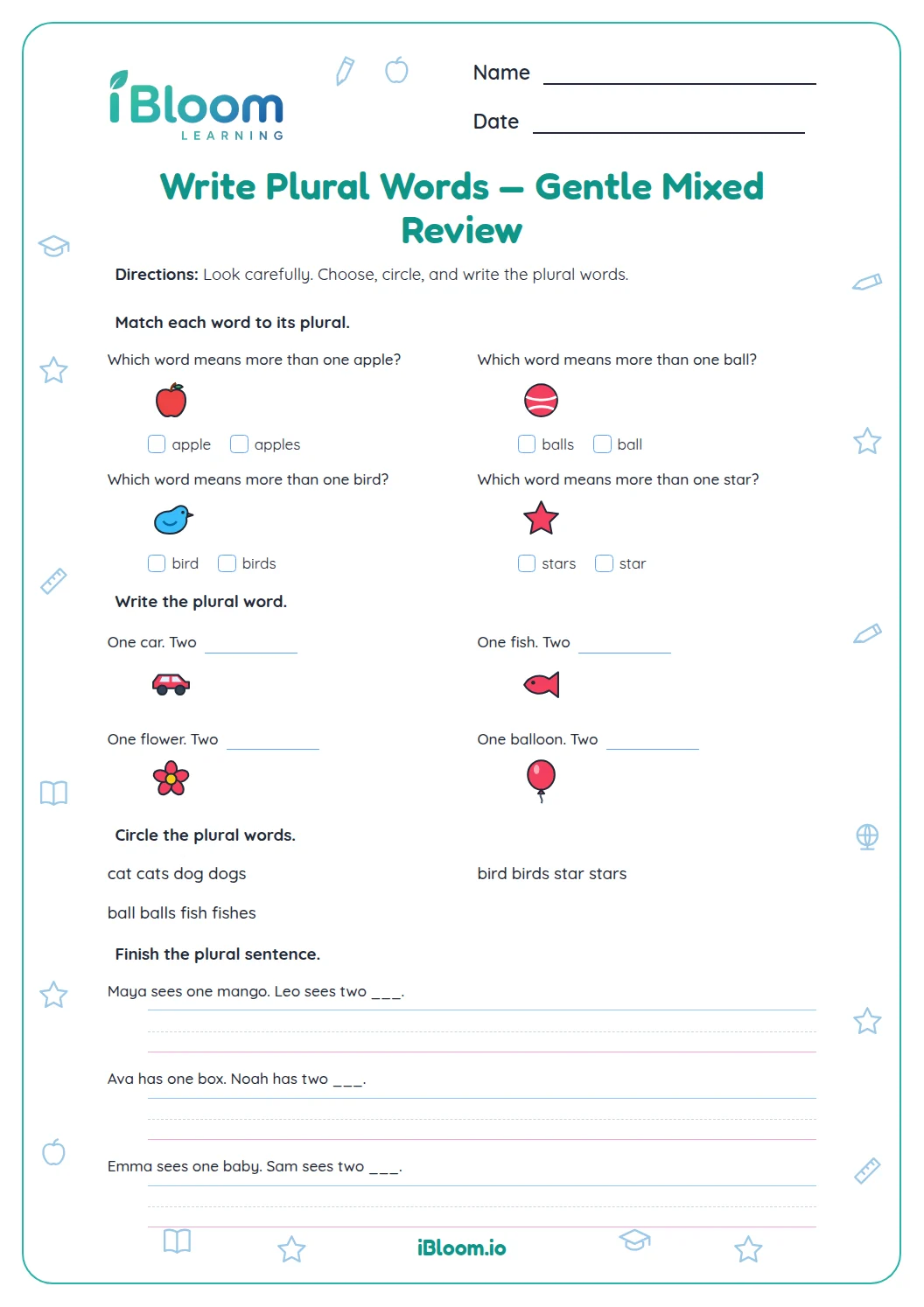
This free printable worksheet helps Pre-K and Kindergarten children finish everyday sentences with the right plural word. Each question has a row of pictures to count, so children see that two birds or four cats means more than one. Part A uses words that add -s, Part B uses words that add -es, and Part C asks children to write the plural themselves. It practices Common Core L.K.1.c, forming regular plural nouns by adding -s or -es. The answer key has its own page.
Aligned to L.K.1.c
What is a plural word, and how do young children learn it?
A plural word names more than one thing. Ball is one, and balls is more than one. Children already use plurals when they talk, so the written work is mostly about noticing the ending and matching it to a count.
That is why every question on this sheet comes with a row of pictures. A child counts the balls, sees there are three, and knows the sentence needs balls, not ball.
- 1Noah has three ___ to pack.
- 2Count the pictures: 3 boxes.
- 3One box, but three boxes.
- 4Box ends in x, so it adds -es.
- 5Answer: boxes
When do plural words add -es instead of -s?
Most plurals add -s, as in ball and balls. Words that end in s, x, ch or sh, such as bus, box, peach, sandwich and watch, add -es, because boxs or watchs would be hard to say. Reading both words aloud helps: children hear that boxes has an extra beat.
Part B has four of these words: boxes, buses, peaches and sandwiches. Part C ends with watches, so children write an -es word on their own.
What is on this worksheet?
Eleven sentences, each with a picture row to count. The sentences are about home, school and the farm: toys, lunch, a school bus and cows.
- Part A, One or more than one: 4 questions with -s words (ball, bird, apple, cat), including one with just one apple
- Part B, Words that add -es: 4 questions (box, bus, peach, sandwich)
- Part C, Write the plural: 3 words to write (book, cow, watch)
- Answer key on separate pages
How to use this worksheet at home or in class
- 1Warm up with real objects: hold up one block, then three, and say "one block, three blocks."
- 2Read question 1 aloud together and count the balls. Ask whether the sentence needs ball or balls.
- 3Let your child finish Part A, counting each picture row first.
- 4Before Part B, say box and boxes, bus and buses. Ask what extra beat the plural has.
- 5In Part C, say the word in ( ) and then say the plural aloud before writing it. Help with letters as needed.
- 6Check with the answer key and celebrate the correct plurals.
Common mistakes and quick fixes
The mistake
Choosing the singular word when the picture row shows more than one, such as ball for three balls.
The fix
Have your child count the pictures out loud, then say the sentence both ways. "Three ball" sounds odd, and that is the clue.
The mistake
Adding only -s to words that end in s, x, ch or sh, so box becomes boxs.
The fix
Say box and boxes slowly. The extra beat in boxes is written as -es.
The mistake
Choosing apples for one apple because the answer seems to be plural every time.
The fix
Point to the single picture in question 3. One thing is singular, so the word stays apple.
Common Core alignment
Most US states use the Common Core Language standards or a close state version, so this sheet fits Kindergarten language work in most classrooms.
Make regular plurals by adding -s or -es: dog, dogs; wish, wishes.
On this sheet: Every question asks children to choose or write the -s or -es plural that fits a picture row and a sentence.
Show the official wordingHide the official wording
Form regular plural nouns orally by adding /s/ or /es/ (e.g., dog, dogs; wish, wishes).
What to practice next
Make more practice
Further reading
Questions parents and teachers ask
What is a plural word for preschoolers and kindergartners?
A plural word names more than one thing, such as balls, boxes or books. On this sheet children count a row of pictures, then finish a sentence with the plural that matches. Seeing two birds beside the sentence helps them connect the written ending to a real amount.
Why do some words add -es?
Words that end in s, x, ch or sh, such as bus, box, peach, sandwich and watch, add -es so they are easy to say. Boxs and watchs are hard to pronounce, while boxes and watches have a clear extra beat. Part B and the last question in Part C practice this pattern.
Why is there a sentence with only one apple?
Question 3 includes one apple so that children do not assume every answer is plural. They look at the picture row, see that there is just one, and keep the singular word. Checking the count before choosing an ending is the habit this sheet builds.
What are the answers to Part C?
The three answers are books, cows and watches. Books and cows just add -s. Watches adds -es because watch ends in ch. Your child counts the pictures first, then adds the ending to the word in parentheses and writes the whole plural on the line, with help spelling if needed.
My child cannot write words yet. Can they still use this?
Yes. Parts A and B only ask children to color a circle, so they can do those on their own. For Part C, say the plural aloud and let your child tell you each letter, or write the word lightly for them to trace. Writing can come later.
Is there an answer key, and how long does the sheet take?
Yes, the answer key is a separate set of pages with every correct choice and plural filled in. Most children finish in about 15 minutes. For a younger child, you can stop after Part A and do Parts B and C another day, since each part works on its own.