


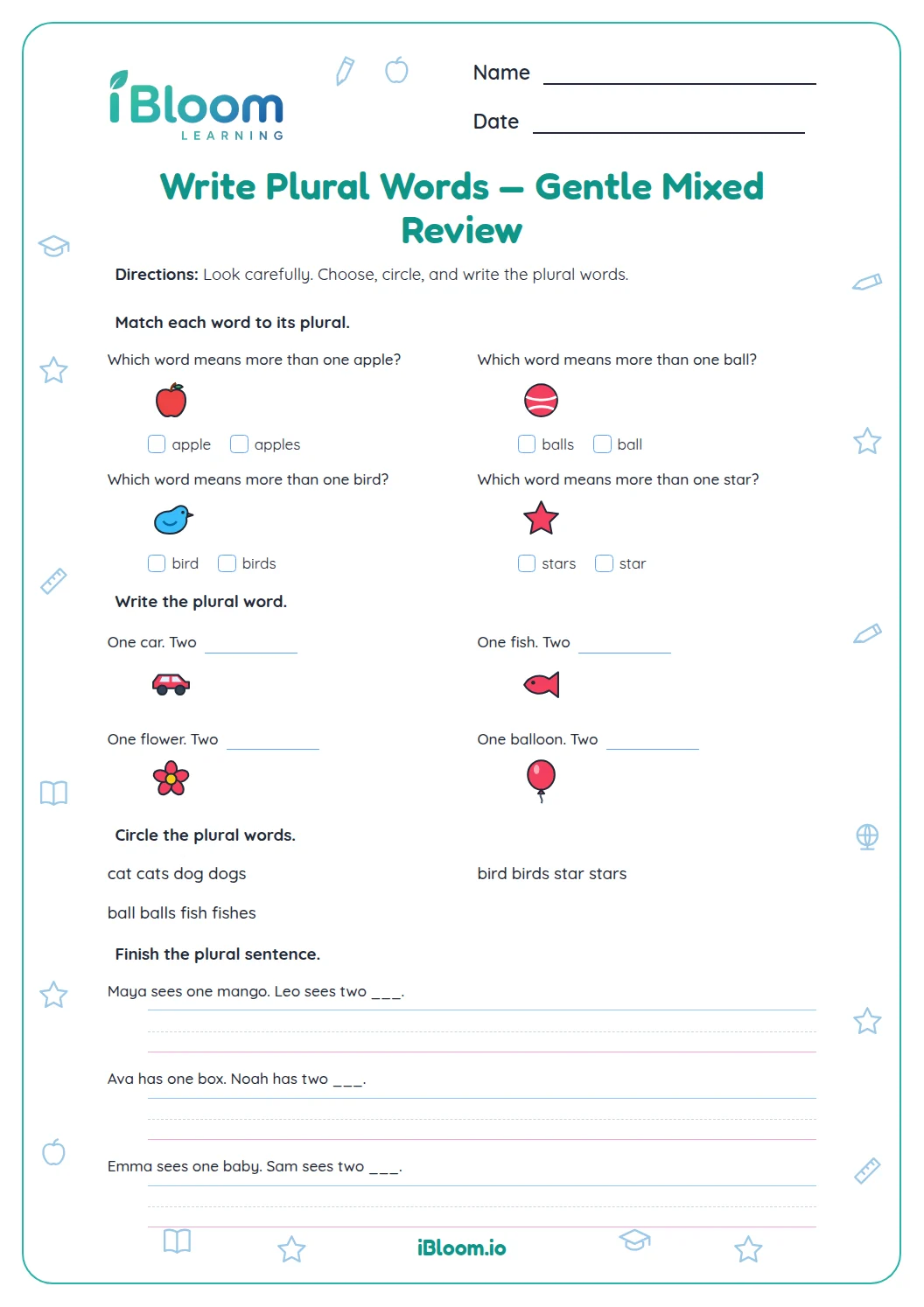


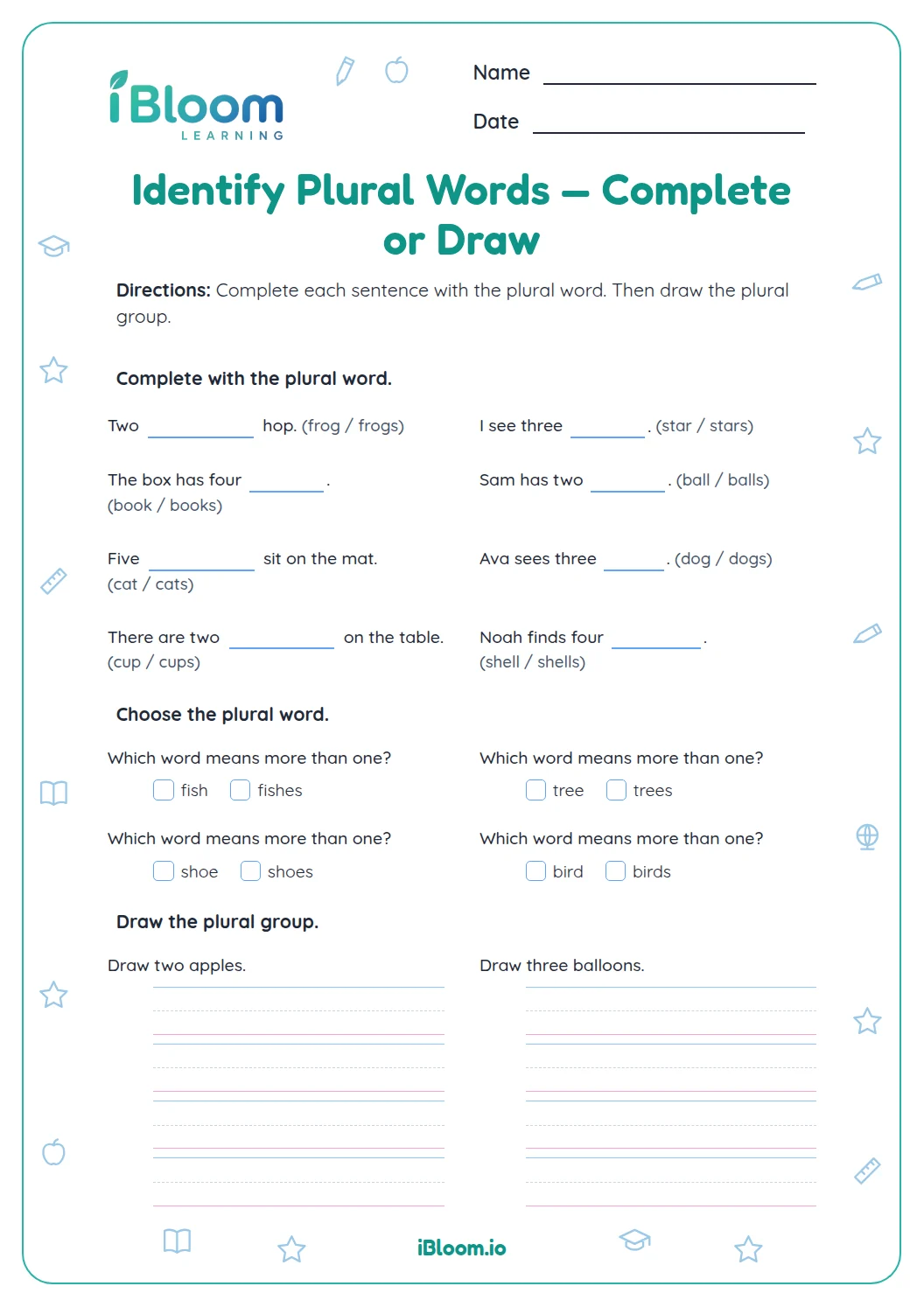
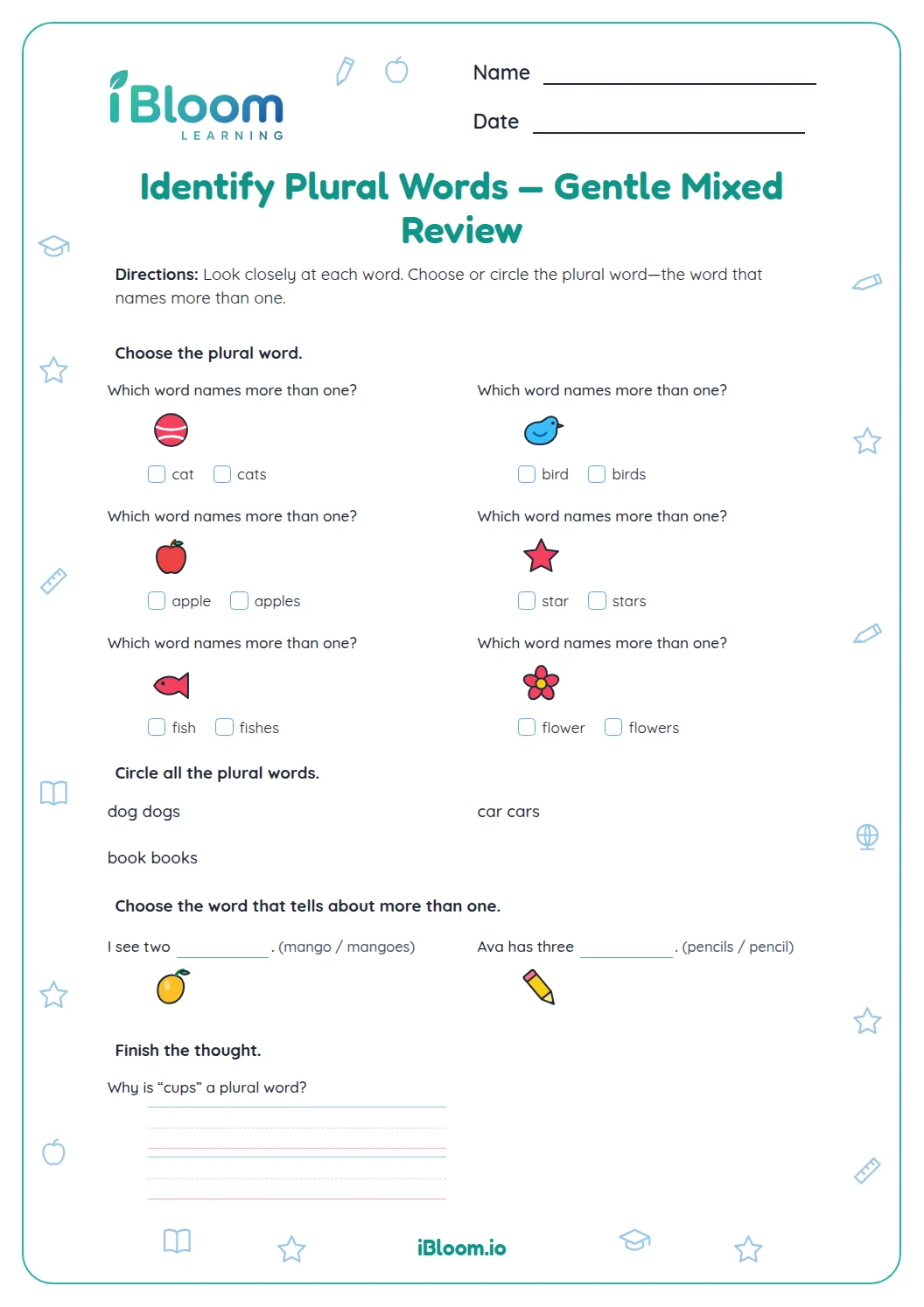


About this worksheet
This printable gives Preschool and Kindergarten learners 16 picture-supported prompts for writing plural nouns. Children see a group of familiar objects, name the singular word, and write the word for more than one. Part A practices adding s; Part B practices adding es to words ending in s or x. It aligns with Common Core L.K.1.c, forming regular plural nouns orally by adding /s/ or /es/. A separate answer key is included.
Aligned to L.K.1.c
When should children add s?
For many familiar nouns, add s to show more than one. The pictures provide a group to name, and the child writes the plural form.
In question 2, two dogs are shown. Say “dog,” then add s to write dogs.
- 1dog → dogs
When should children add es?
For the words practiced in this part, add es after endings such as s or x. In question 8, fox ends in x, so two foxes is spelled f-o-x-e-s.
How can an adult support the practice?
Say the singular word while pointing to one object, then count the group together. Ask what ending the plural needs before the child writes it. The key lists all 16 spellings.
How to use this worksheet
- 1Point to one object and say its name.
- 2Count the group together.
- 3Say the plural word aloud.
- 4Listen for the ending and write s or es.
- 5Check the spelling with the answer key.
Common mistakes and quick fixes
The mistake
Adding es to a noun that usually takes s
The fix
Check the last letters. Most nouns in Part A add s; use es for the endings practiced in Part B.
The mistake
Leaving out the e in an es ending
The fix
Say the ending aloud and write both letters: box → boxes, dress → dresses.
The mistake
Writing the singular word for a group
The fix
Look at the two objects, say “more than one,” and add the plural ending before writing.
Common Core alignment
This worksheet practices forming regular plural nouns by adding s or es.
Form regular plural nouns by adding s or es while writing each word.
On this sheet: Children form regular plurals from familiar singular nouns by adding s or es.
Show the official wordingHide the official wording
Form regular plural nouns orally by adding /s/ or /es/ (e.g., dog, dogs; wish, wishes).
What to practice next
Make more practice
Further reading
Questions parents and teachers ask
What does this worksheet teach?
Children look at familiar groups and write the plural noun. The first part uses common words that add s, such as cat and dog. The second part practices es endings with words such as bus, fox, box, dress, and glass.
How many questions are there?
There are 16 picture-supported questions in two parts. Six prompts practice adding s, and ten practice adding es. Each prompt shows two objects to connect the spoken singular word with a group of more than one. An adult can say each word before the child writes it.
When do children add es?
The second part practices adding es to words ending in s or x, such as bus, dress, box, and fox. The child looks at a group, names the singular word in the prompt, and writes its plural form. The answer key shows the spelling for each item.
Why are pictures included?
The pictures give young learners a concrete group to name before they write. An adult can point to one object and say its name, then count the pair together. This supports the connection between one noun and its plural spelling.
Does the printable have an answer key?
Yes. The separate answer key lists each plural spelling. An adult can check whether the child added s or es, then say the singular and plural aloud together if a spelling needs another try. The adult can point to the matching question number on the key.