







About this worksheet
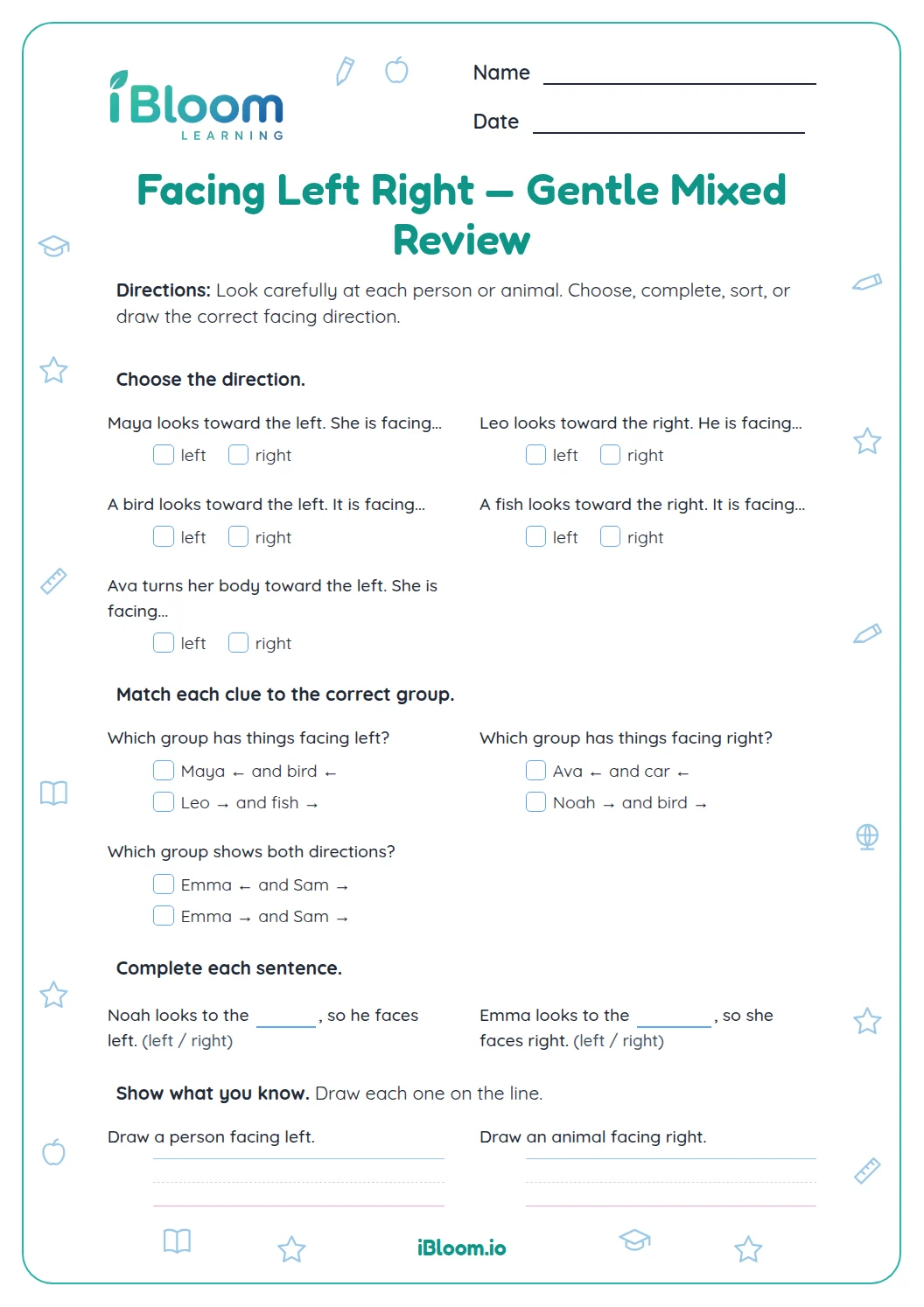
This free printable Preschool–Kindergarten worksheet gives learners focused practice with facing left right printable practice. The questions move from supported examples to independent application, and a separate answer key helps an adult check work. It is designed around the exact skill named on this page, with short directions and room to solve or respond.
How does this sheet practice facing left right printable practice?
The first section warms up with the core idea. Later questions ask learners to use that same idea in a fresh problem, so each answer has a clear purpose.
- 1Which item is to the left of the moon?
- 2Check the answer with the key: the sun
How can an adult support the practice?
Read the directions aloud if needed, then let the learner do the thinking. Ask them to explain one answer in their own words before checking the key.
What will learners practice?
The sheet includes 16 questions in a sequence of short parts, followed by an answer key.
- Look left and right
- Draw facing directions
How to use this worksheet
- 1Read the one-sentence directions together.
- 2Complete the first item in each part as a warm-up.
- 3Work through the remaining questions in order.
- 4Say how one answer was found.
- 5Use the answer key to check and revisit any missed item.
Common mistakes and quick fixes
The mistake
Rushing past the directions.
The fix
Pause and restate what each question asks.
The mistake
Giving an answer without checking the details.
The fix
Return to the numbers, picture, or passage and verify it.
The mistake
Changing an answer after a quick guess.
The fix
Explain the reason for the answer before changing it.
What to practice next
Make more practice
Questions parents and teachers ask
How many questions are included?
The worksheet includes 16 questions in several short parts. The answer key is on a separate page, so you can print just the practice pages or keep the key nearby for checking. After each part, ask the learner to explain one answer before moving on.
Who can use this worksheet?
This printable is written for Preschool–Kindergarten. An adult can read the directions aloud, while the learner completes the questions and explains a choice or answer. The short sections make it easy to pause and return to the practice later.
How should I check the answers?
Use the separate answer key after the learner finishes a part. If an answer differs, ask the learner to show the step, picture, or story detail that supports it, then try the item again. This keeps checking connected to the skill being practiced.
Can learners work independently?
Many items can be completed independently after the directions are clear. A short read-aloud or worked example can help learners get started, especially in the first part. Encourage the learner to explain one answer aloud before using the key.
What comes after this practice?
Choose another related skill from the links below when the learner is ready for a new kind of practice. Repeating a missed question after a short break can also reinforce the idea. The linked pages follow related skills from the same worksheet collection.