






About this worksheet
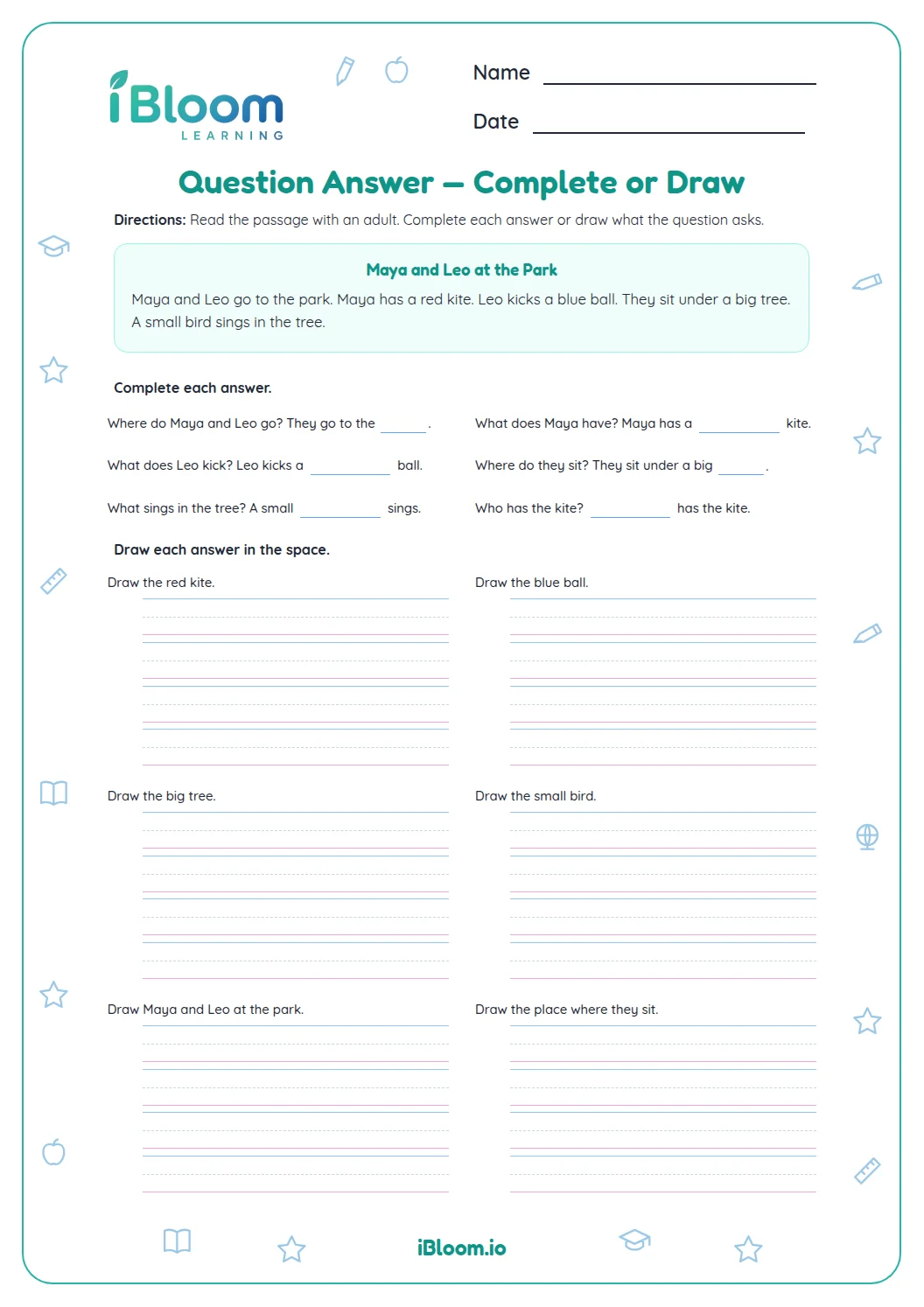
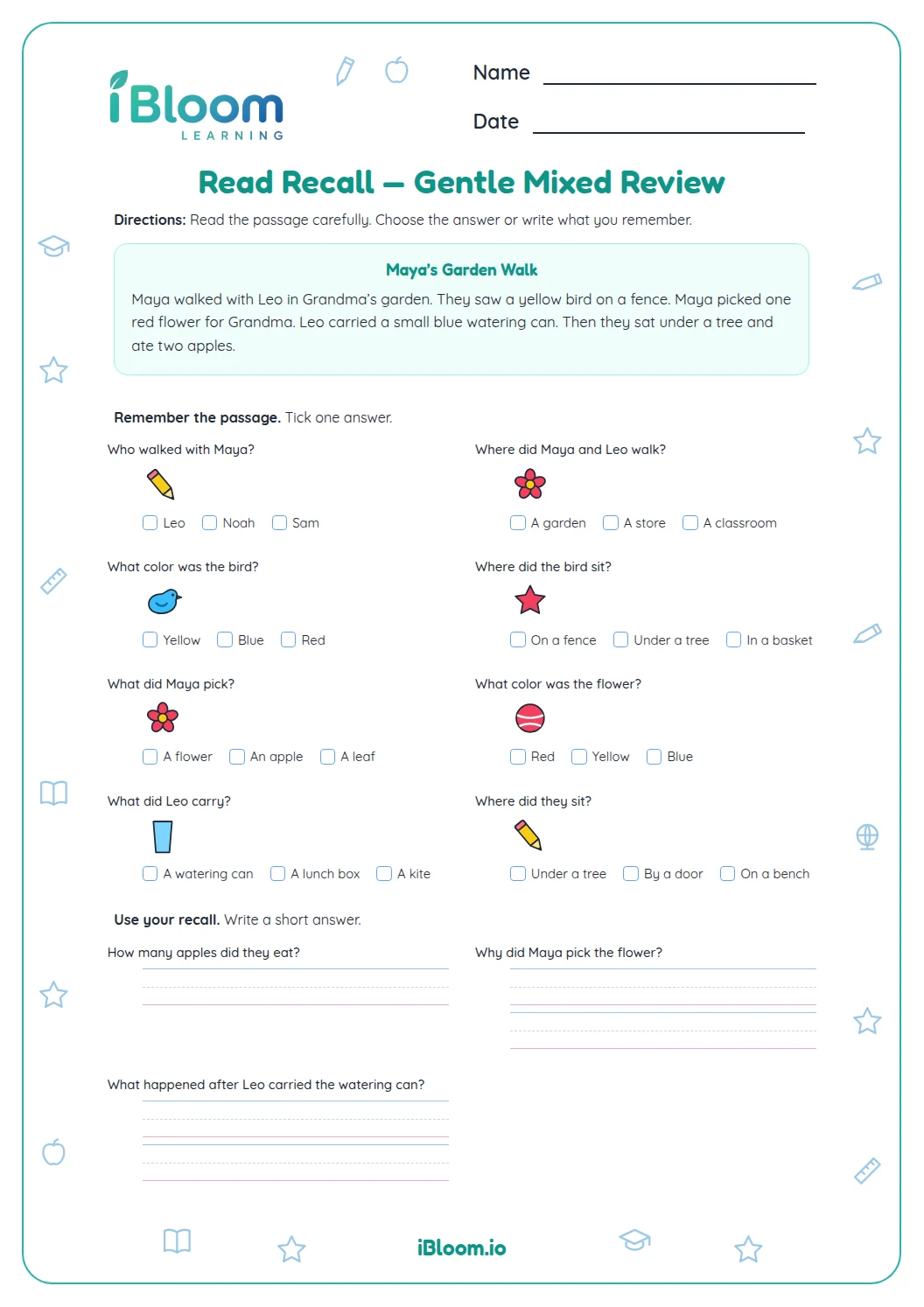
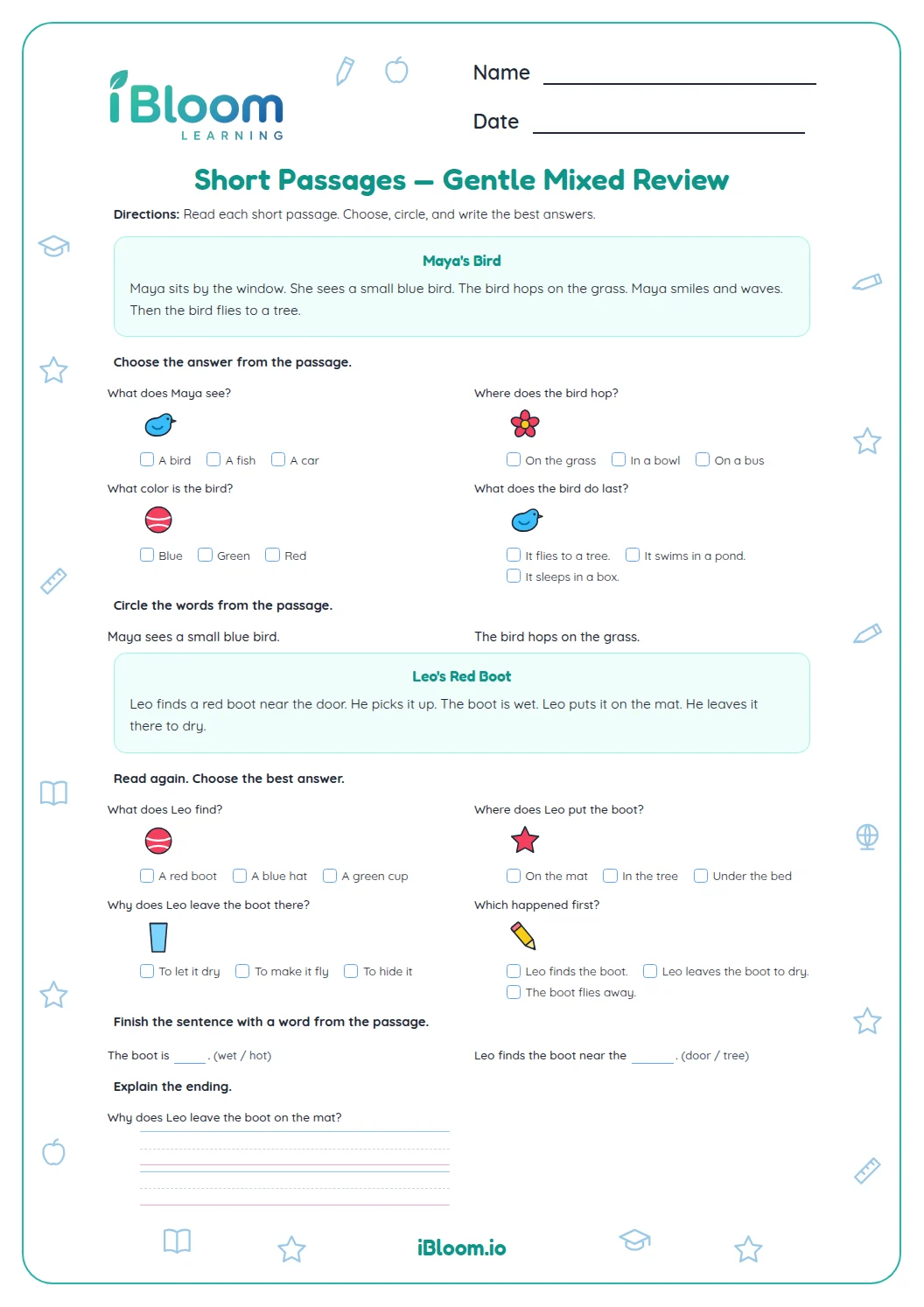
This preschool and kindergarten worksheet uses a short garden story to practice listening for details, answering questions, and connecting story ideas to familiar objects. Children answer 14 questions: five about story details, four picture-choice questions, and five short retell prompts. The answer key accepts clear sample responses for the retell items.
Aligned to RL.K.1
How can a listener find a story detail?
The passage says Mia walks with Dad, carries a blue cup, waters yellow flowers, and sees a red bird near the fence. Part B asks children to recall these stated details.
For question 2, look for the blue cup Mia carries.
How does a familiar idea help answer?
Part C uses pictures to connect the story to familiar things. A cup can hold water, a flower can grow in a garden, a bird is the animal Mia sees, and a bucket can carry water.
What can a short answer sound like?
Part D has five short prompts about details in the same story. A clear phrase such as “Mia sees yellow flowers” answers the first prompt. The key offers sample responses; children may use their own clear wording.
How to use this worksheet
- 1Read the garden passage aloud, then invite the child to answer from memory.
- 2Reread a sentence when the child wants to check a detail.
- 3For picture choices, name each object and ask how it fits the question.
- 4Invite a short spoken or written retell for Part D.
- 5Use the key’s samples as examples, while accepting another accurate response.
Common mistakes and quick fixes
The mistake
Choosing an answer from memory without listening for the detail.
The fix
Repeat the sentence in the story that contains the answer.
The mistake
Mixing up Dad, who walks with Mia, and Mom, who hears the story at home.
The fix
Recall who is named in the first and last sentences.
The mistake
Treating every picture as a detail from the story.
The fix
Choose the familiar picture that best connects to the question asked.
Common Core alignment
This worksheet practices the skill described in the standards below.
Answer questions about key details in a short story read aloud.
On this sheet: Answer questions about key details in a short story read aloud.
Show the official wordingHide the official wording
With prompting and support, ask and answer questions about key details in a text.
What to practice next
Further reading
Questions parents and teachers ask
How should I use the passage with a preschooler?
Read the short passage aloud, pausing naturally between sentences. Then ask the child to answer by pointing, speaking or marking a choice. Rereading is fine; the goal is to connect a question with a detail the child heard. This gives the learner another chance to explain the idea clearly.
Does my child have to write every answer?
No. The multiple-choice and picture choices can be answered by pointing or marking. In the final part, a child may answer aloud while an adult records the words, especially if writing is still developing. This gives the learner another chance to explain the idea clearly.
What does “use it in a familiar context” mean here?
It means connecting an idea in the story to an everyday object or place. For example, a cup can hold water, and flowers grow in a garden. The child uses a familiar connection while still answering the question. This gives the learner another chance to explain the idea clearly.
Are there picture choices on the worksheet?
Yes. Part C includes picture choices such as a cup, flower and bird. These give young learners a visual way to connect the story to familiar things instead of relying on print alone. This gives the learner another chance to explain the idea clearly.
What counts as a correct short answer?
A short response that answers the question clearly is correct. For “Who does Mia tell at home?” saying “Mom” or “She tells Mom” works. The key gives sample wording, and a child’s equivalent answer can also be accepted. This gives the learner another chance to explain the idea clearly.
How many pages will print?
The worksheet uses three pages because it includes a passage and 14 questions. A separate answer key page follows, with selected answers and sample responses for the short-answer questions. This gives the learner another chance to explain the idea clearly.