





About this worksheet
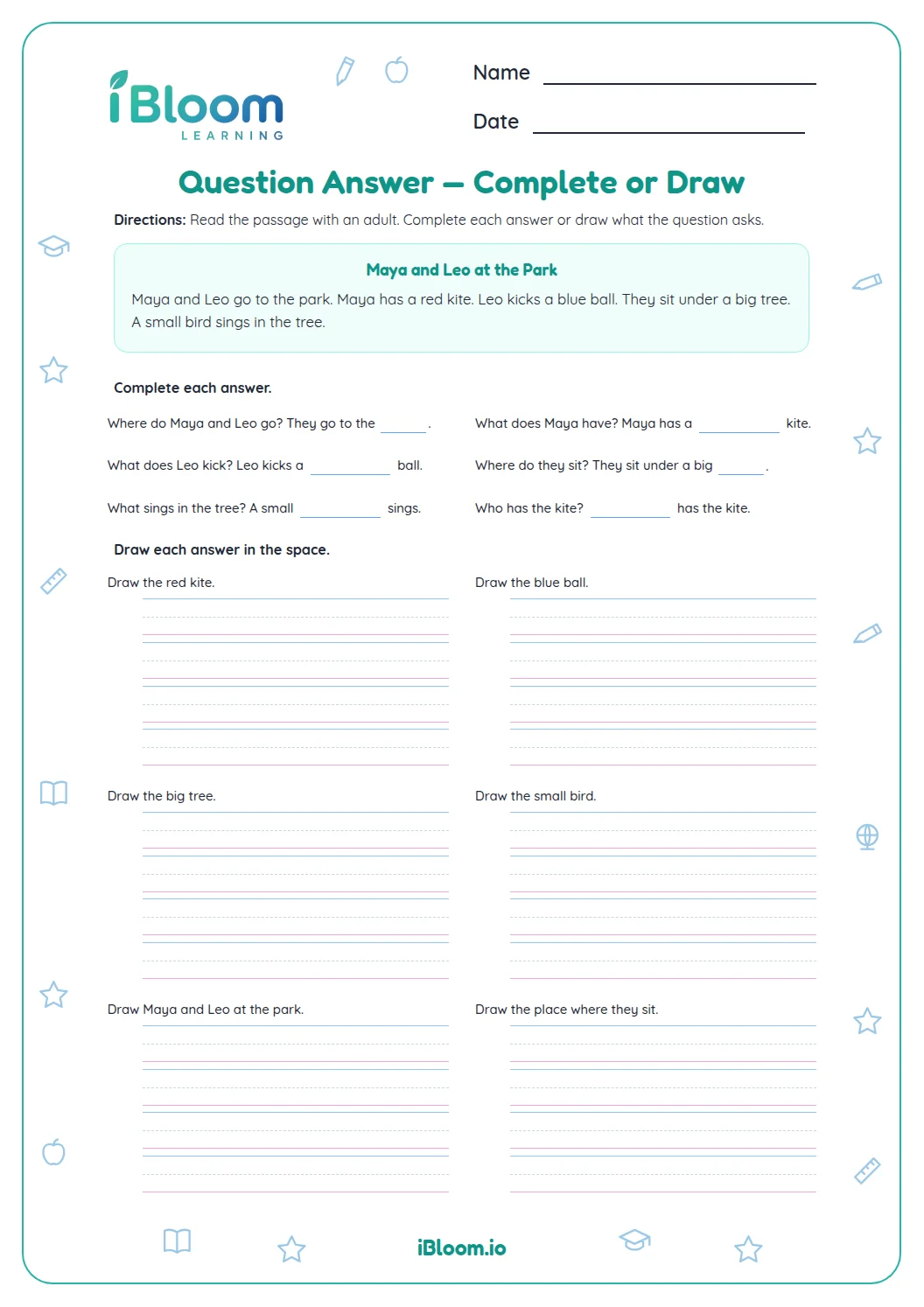
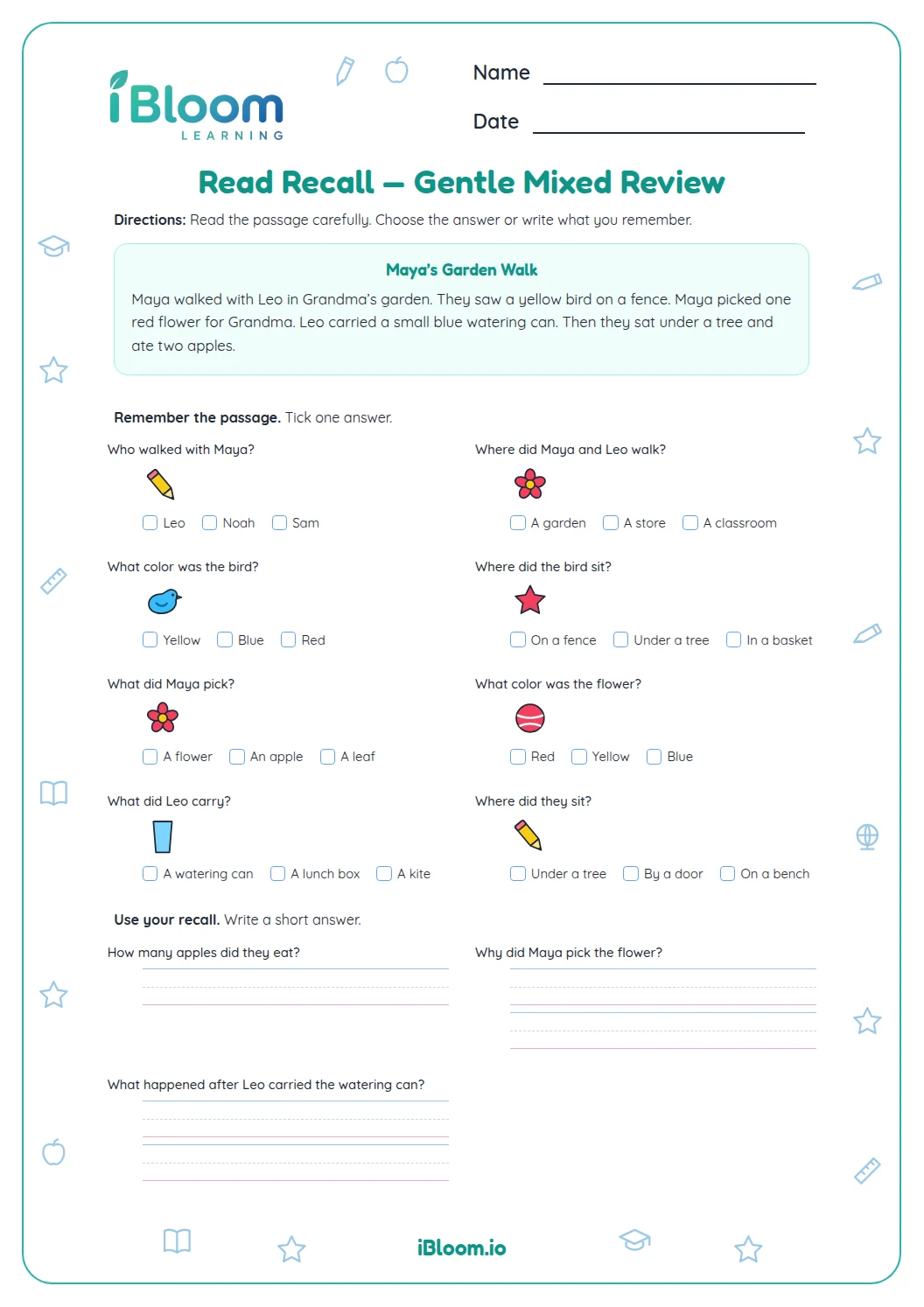
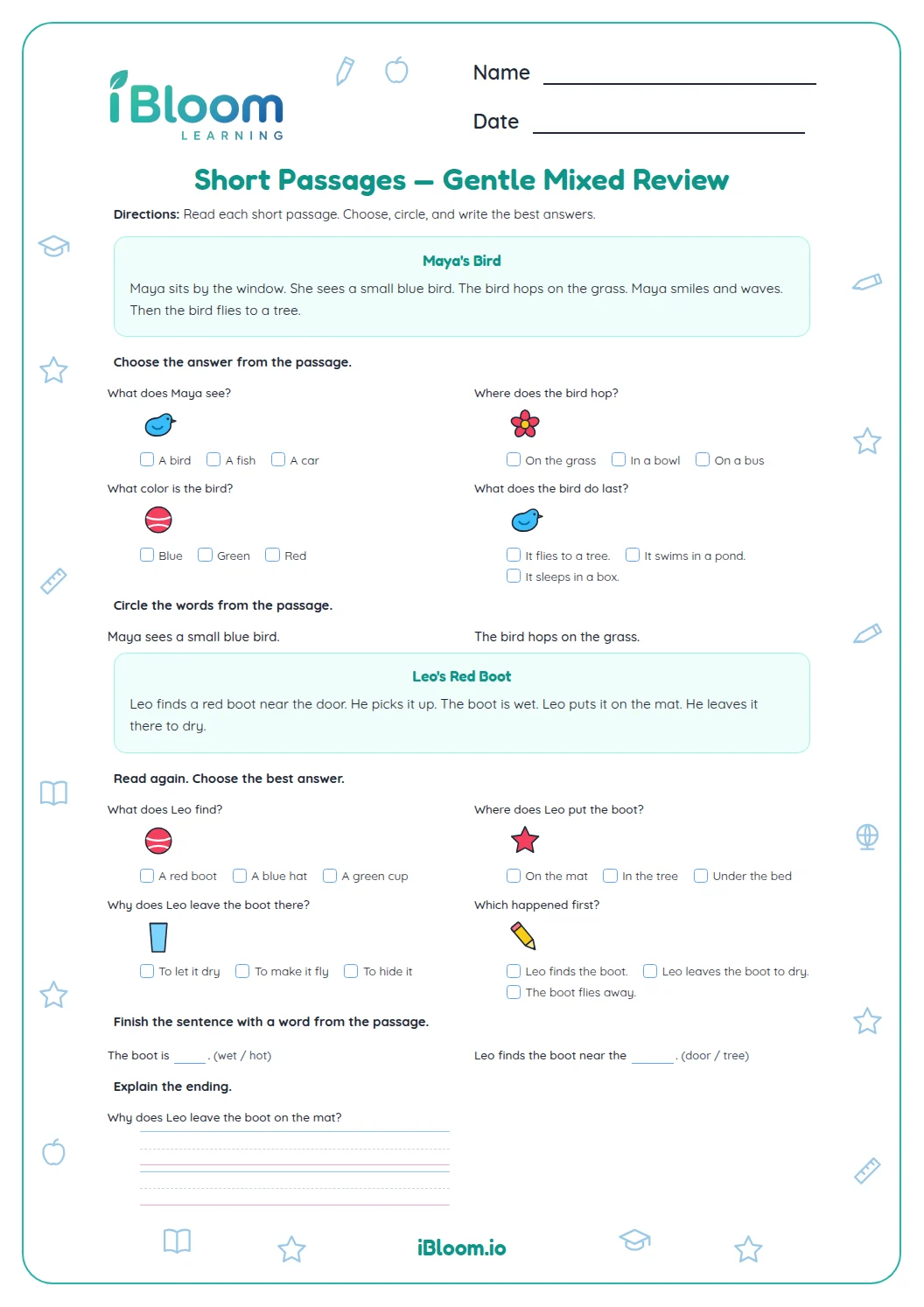
This preschool and kindergarten printable pairs a short original passage with questions and drawing prompts. In “Milo Gets Ready,” Milo packs a blue cup, finds two red socks, zips his coat, and waves to his dog before heading to the bus. Eight questions ask children to recall details; five drawing prompts let them show what they understood. The answer key gives short responses and sample drawing descriptions.
Aligned to RL.K.1
What happens in “Milo Gets Ready”?
Milo gets ready for school: he puts a blue cup by his lunch bag, finds one sock under a chair and another by the bed, and zips his coat. Dad holds the door, and Milo waves to Pip before walking to the bus.
How can children find an answer in the passage?
Read the passage once for the story, then return to the sentence that answers a question. For example, the passage says Milo puts his blue cup beside his lunch bag, so “blue cup” answers what he places there.
How do the drawing prompts connect to reading?
The first four prompts ask children to draw details from Milo’s morning. The last invites them to connect the story to their own routine. Adults can accept different drawings when the child includes the requested detail.
How to use this worksheet
- 1Read or listen to the passage once.
- 2Read one question at a time.
- 3Look back at the passage for a matching detail.
- 4Say the answer before writing it.
- 5For a drawing, include the people or objects named in the prompt.
- 6Use the key to check details and discuss the final personal drawing.
Common mistakes and quick fixes
The mistake
Remembering a detail differently from how the passage states it.
The fix
Return to the sentence and check the exact object, place, or action.
The mistake
Drawing an object but leaving out the detail that identifies it.
The fix
Include the color or location named in the prompt, such as the blue cup beside the lunch bag.
The mistake
Treating the final personal drawing as if there were only one right answer.
The fix
Accept any familiar before-school activity the child can describe or draw.
Common Core alignment
Children answer questions about details in a short literary text.
Answer questions about details in the passage with adult prompting and support.
On this sheet: The questions ask children to recall key details from the original passage.
Show the official wordingHide the official wording
With prompting and support, ask and answer questions about key details in a text.
What to practice next
Make more practice
Further reading
Questions parents and teachers ask
Can I read the passage aloud to my preschooler?
Yes. Read the short passage aloud and pause when the child wants to talk about a detail. Then ask the questions and invite the child to answer orally, point to a detail, or draw it. Have the learner explain the clue before checking the answer key together. A nearby calendar or model can make the sequence easier to see.
What happens in the passage?
Milo gathers a cup and lunch bag, finds two socks in different places, zips his coat, and heads toward the bus with his dad holding the door. He waves to Pip, his dog, before leaving. Have the learner explain the clue before checking the answer key together. A nearby calendar or model can make the sequence easier to see.
How many questions and drawings are included?
The page has 13 items: eight questions about details in the passage and five drawing prompts. The final drawing asks children to show one thing they do before school. Have the learner explain the clue before checking the answer key together. A nearby calendar or model can make the sequence easier to see.
Does every drawing need to look the same as the key?
No. The key gives a sample description to help adults check for the requested detail. Children can draw in their own style as long as the picture matches the passage or personal prompt. Have the learner explain the clue before checking the answer key together. A nearby calendar or model can make the sequence easier to see.
Which reading standard does the page practice?
It practices CCSS RL.K.1: with prompting and support, children ask and answer questions about key details in a text. The eight comprehension questions focus on details stated in Milo’s morning story. Have the learner explain the clue before checking the answer key together. A nearby calendar or model can make the sequence easier to see.