






About this worksheet
This printable gives preschool and kindergarten children a simple way to respond to short text. They read or listen to a sentence, choose a matching picture, trace a related word, draw what a sentence describes, or complete a sentence with a fitting word. The picture choices preserve visual support for emerging readers, and the drawing prompts give children a way to show what they understood. A separate answer key offers sample drawings and answers.
Aligned to RL.K.1
How can adults support early reading?
Read the prompt aloud when needed, then give the child time to point, say a word, or try the task. The goal is to connect the sentence with its meaning. Picture choices give young children a concrete way to respond.
How does drawing show understanding?
A drawing can show the main people or objects and how they relate. Invite the child to reread or repeat the sentence before drawing; after, ask them to point to each detail they included.
Why trace and complete words?
Tracing helps children attend to a word’s letters, while a sentence completion asks them to connect words with meaning. Say the finished sentence aloud so the child hears how the chosen word completes the idea.
- 1Grass is usually ___.
- 2Choose the color word that completes the idea.
- 3Grass is usually green.
How to use this worksheet
- 1Read or listen to the whole sentence.
- 2Say what the sentence means in your own words.
- 3Choose a matching picture or trace the named word.
- 4For a drawing prompt, include the important details.
- 5Reread completed sentences and check with the answer key.
Common mistakes and quick fixes
The mistake
Choosing before listening to the whole sentence.
The fix
Repeat the sentence and identify the detail it describes.
The mistake
Drawing an object but missing its relationship to another object.
The fix
Reread words such as in, on, or beside and show them in the drawing.
The mistake
Filling a blank with a word that does not make sense in the sentence.
The fix
Read the whole sentence with each choice and listen for a sensible meaning.
Common Core alignment
Ask and answer questions about key details in a short text.
On this sheet: Children use short sentences to identify a picture or draw details described in the text.
Show the official wordingHide the official wording
With prompting and support, ask and answer questions about key details in a text.
What to practice next
Further reading
Questions parents and teachers ask
Can an adult read the sentences aloud?
Yes. An adult may read a prompt aloud and let the child point, choose, trace, or draw. This keeps the activity focused on understanding short prompts while the child builds early reading confidence through picture-supported responses. Reading aloud can help children hear the prompt again before they make a choice.
What kinds of activities are included?
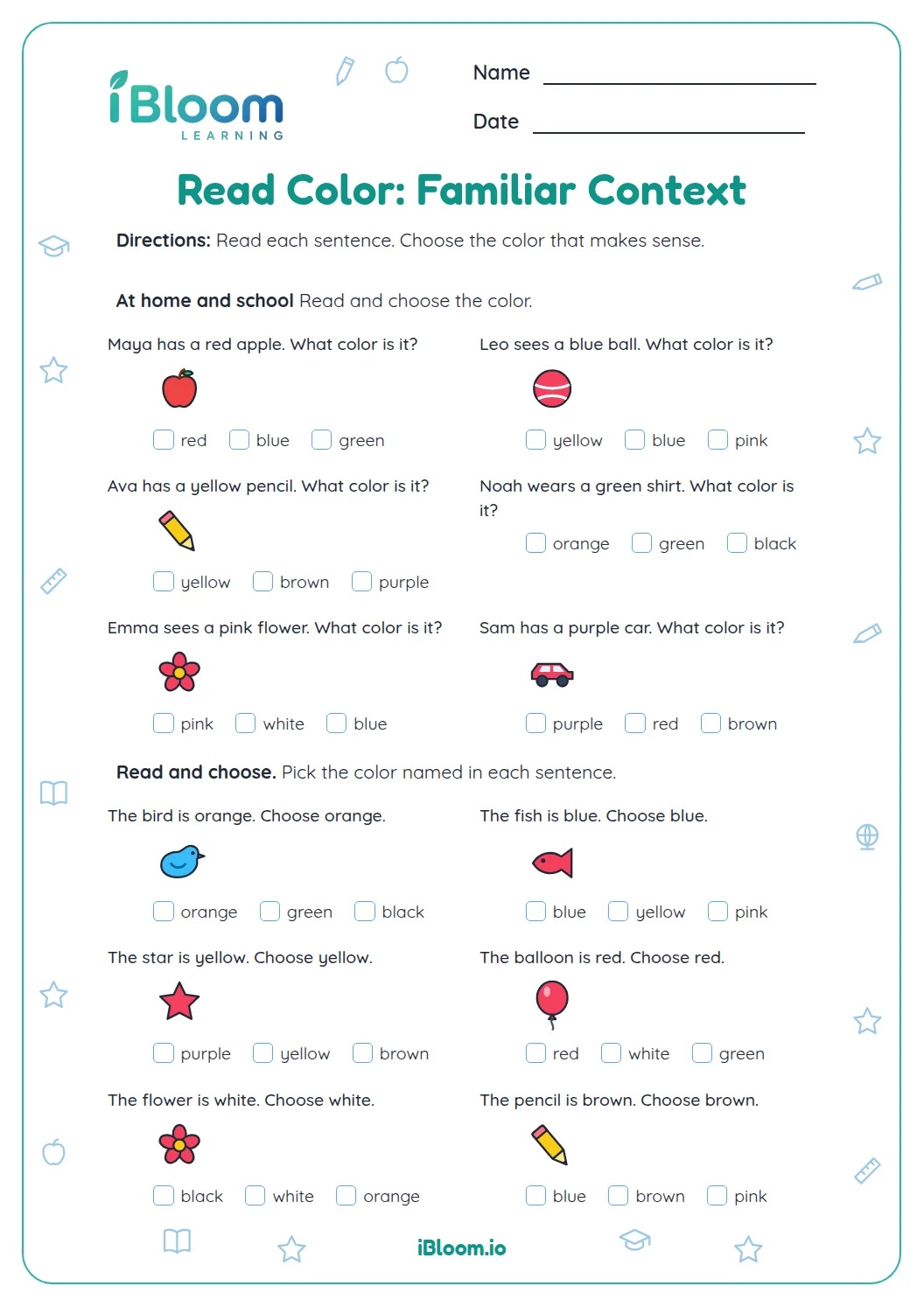
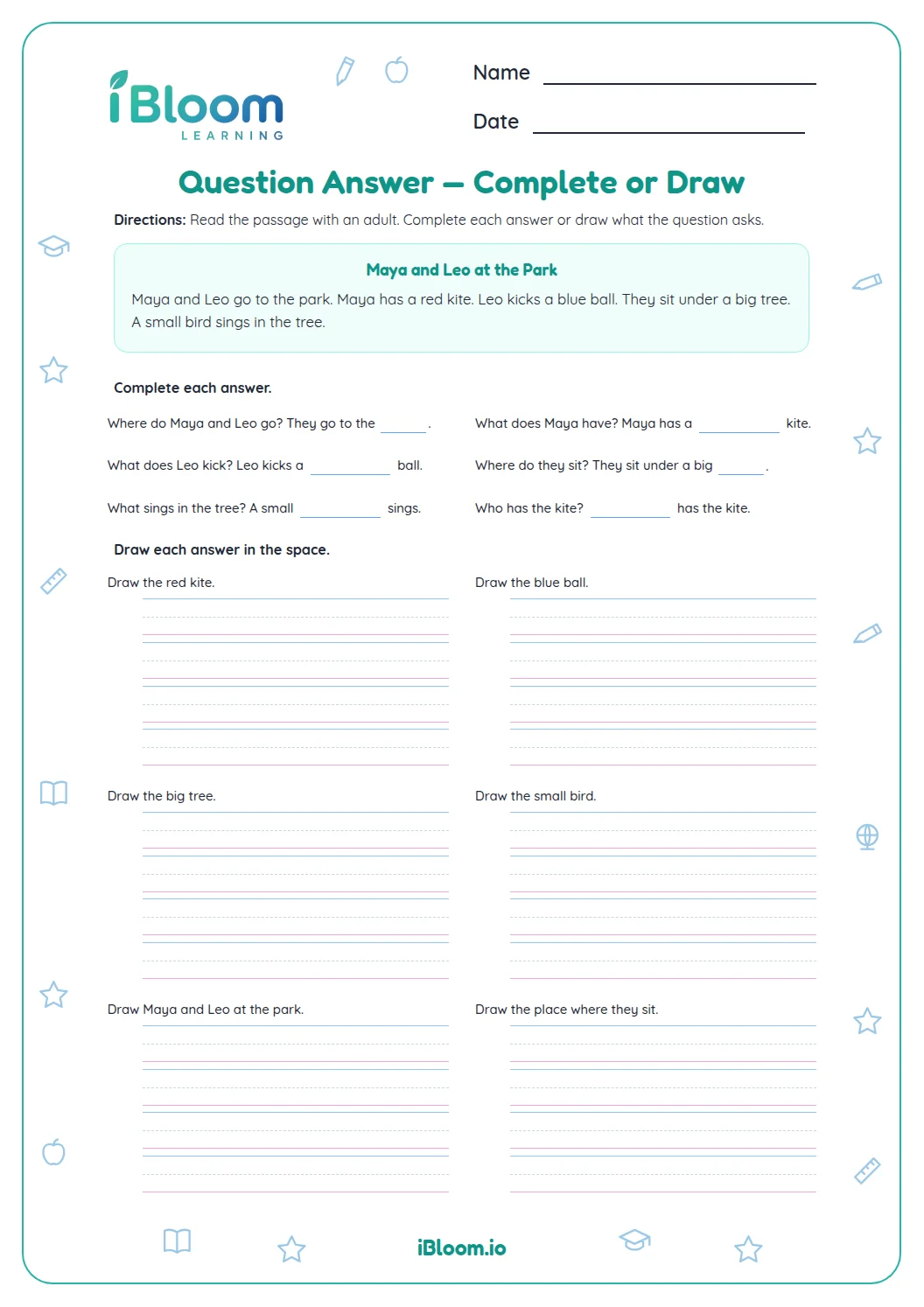
There are 16 prompts: four picture choices, four trace-the-word prompts, four drawing responses, and four color-word sentence completions. The key includes the picture choices, color words, and simple examples of what each drawing could show. An adult can accept a clear drawing that matches the sentence.
Do children need to color the pictures?
The worksheet asks children to read short prompts, trace words, draw what a sentence describes, and complete color sentences. Children may color their drawings after finishing the reading task. Ask the child to point to the words that helped them choose a picture or complete a sentence.
What should count as a correct drawing?
A drawing should show the important objects and relationship named in its sentence. For example, a bird sitting in a tree should include both a bird and a tree, with the bird placed in or on the tree. The key gives a simple sample while allowing different clear drawings.
Is this worksheet suitable for a child who is not reading alone yet?
Yes. An adult can read each prompt aloud while the child points to a picture or draws what the words describe. A child who recognizes familiar words can try tracing and sentence choices independently, then check the key. Children can name the color words aloud as they complete those sentences.