




About this worksheet
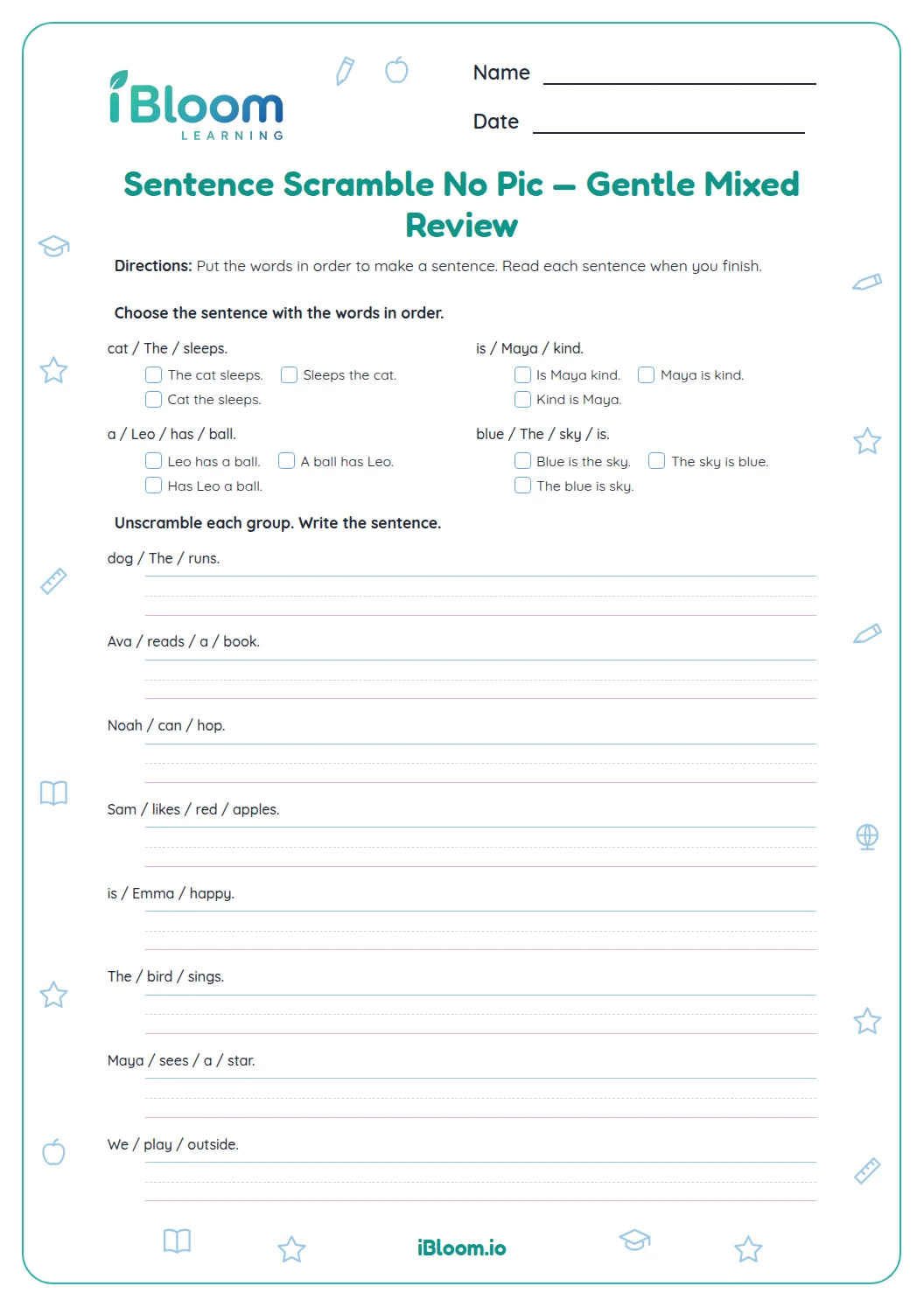
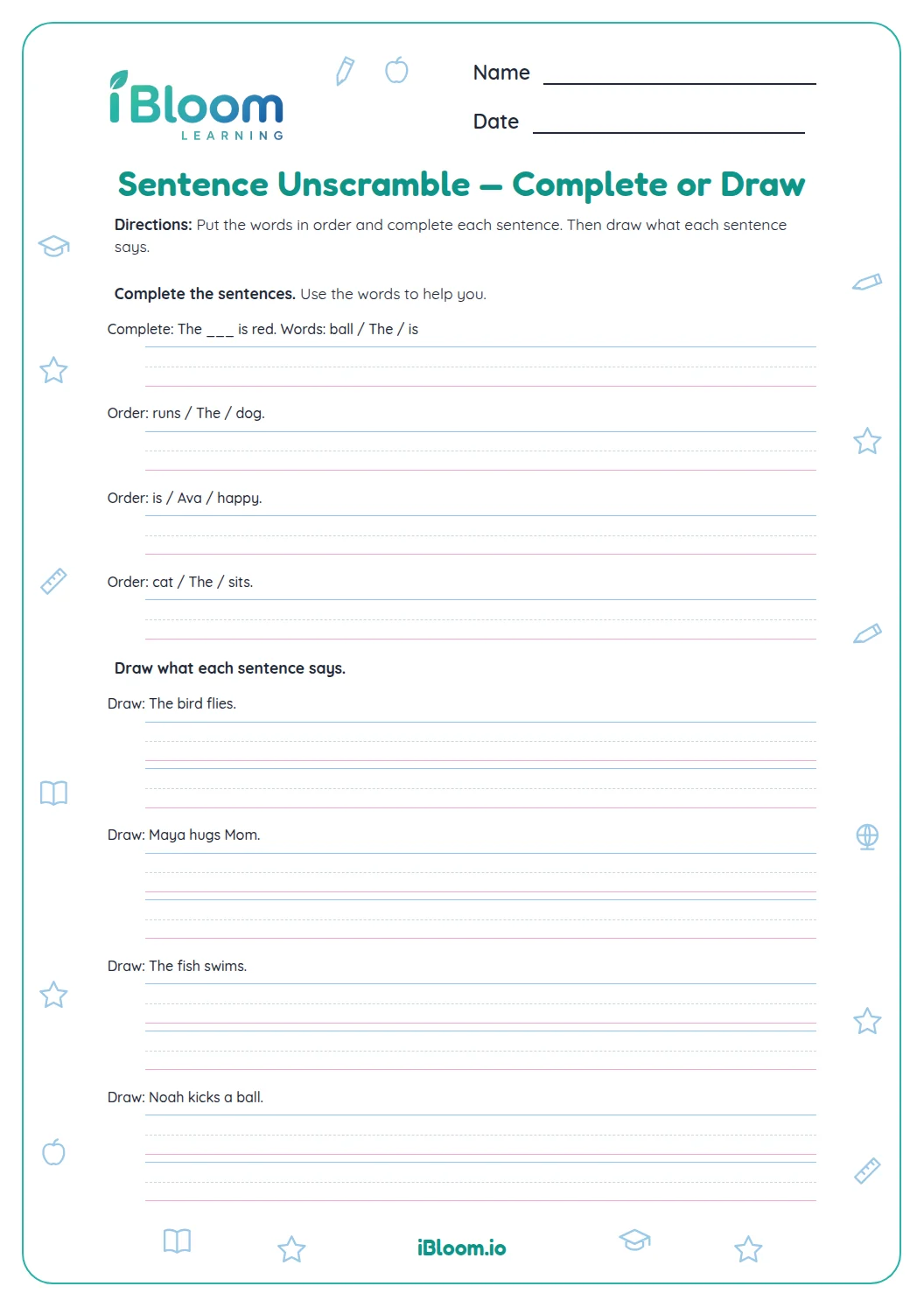
This printable helps preschool and kindergarten learners practice putting familiar words in sentence order. Fourteen short scrambles use familiar people, animals, and actions. The work supports complete-sentence practice aligned with L.K.1f. A separate answer key shows the expected word order, capital letter, and period.
Aligned to L.K.1f
What does sentence order practice?
Learners reorder three or four familiar words to make a complete sentence. Each item practices the same word-order idea with a different subject and action.
How can a learner work through each part?
Read every direction, then look carefully at the whole item before answering. Use the answer key to discuss the thinking behind a response, not only whether it matches.
- 1Words: The / dog / runs.
- 2Put who or what first, then the action.
- 3Write: The dog runs.
What is on the printable?
The two-page worksheet has 14 sentence scrambles across 3 parts. The separate key gives the expected sentence for each group. The old sheet asked children to circle a colored shape; this replacement practices the sentence-order skill named by the page.
How to use this worksheet
- 1Read the whole direction before starting.
- 2Complete the first item together and name the helpful clue or step.
- 3Work through the questions in order, taking a short pause between parts.
- 4Check answers with the separate key and revisit any tricky item.
Common mistakes and quick fixes
The mistake
Rushing after noticing only one word or number.
The fix
Read the entire item and check that the response fits all of it.
The mistake
Changing an answer without checking the clue or calculation.
The fix
Point to the evidence or redo the step before revising.
The mistake
Skipping a direction at the start of a new part.
The fix
Read each part heading and its direction before continuing.
Common Core alignment
This printable gives learners practice with the listed skill.
Produce and expand complete sentences in shared language activities.
On this sheet: The questions directly practice sentence order.
Show the official wordingHide the official wording
Produce and expand complete sentences in shared language activities.
What to practice next
Make more practice
Further reading
Questions parents and teachers ask
What skill does this sentence order worksheet practice?
The worksheet practices putting familiar words into sentence order. Learners make 14 short sentences, beginning with a capital and ending with a period. The answer key gives a complete model for each scramble, so an adult can check word order and punctuation together.
How should we start the worksheet?
Start with one group of words and read each word aloud. Ask who or what the sentence is about, then find the action and say the sentence naturally. The worksheet repeats this routine with familiar subjects and actions, and the key shows one complete sentence for each item.
Is an answer key included?
Yes. The separate answer key follows the worksheet and shows a complete sentence for all 14 word groups. It can help an adult check capitalization, word order, and end punctuation while talking through a sentence that was tricky to arrange.
Can an adult read the questions aloud?
Yes. Reading a prompt aloud can make the activity accessible while the learner still does the target thinking. Pause after each item and ask the child to point to the words, pictures, or numbers that helped them decide.
How long will this worksheet take?
Plan for about 15 to 20 minutes, with extra time for reading directions together or discussing answers. A short break between parts can help children return to the second page ready to focus and finish carefully. Work at the learner’s pace.