







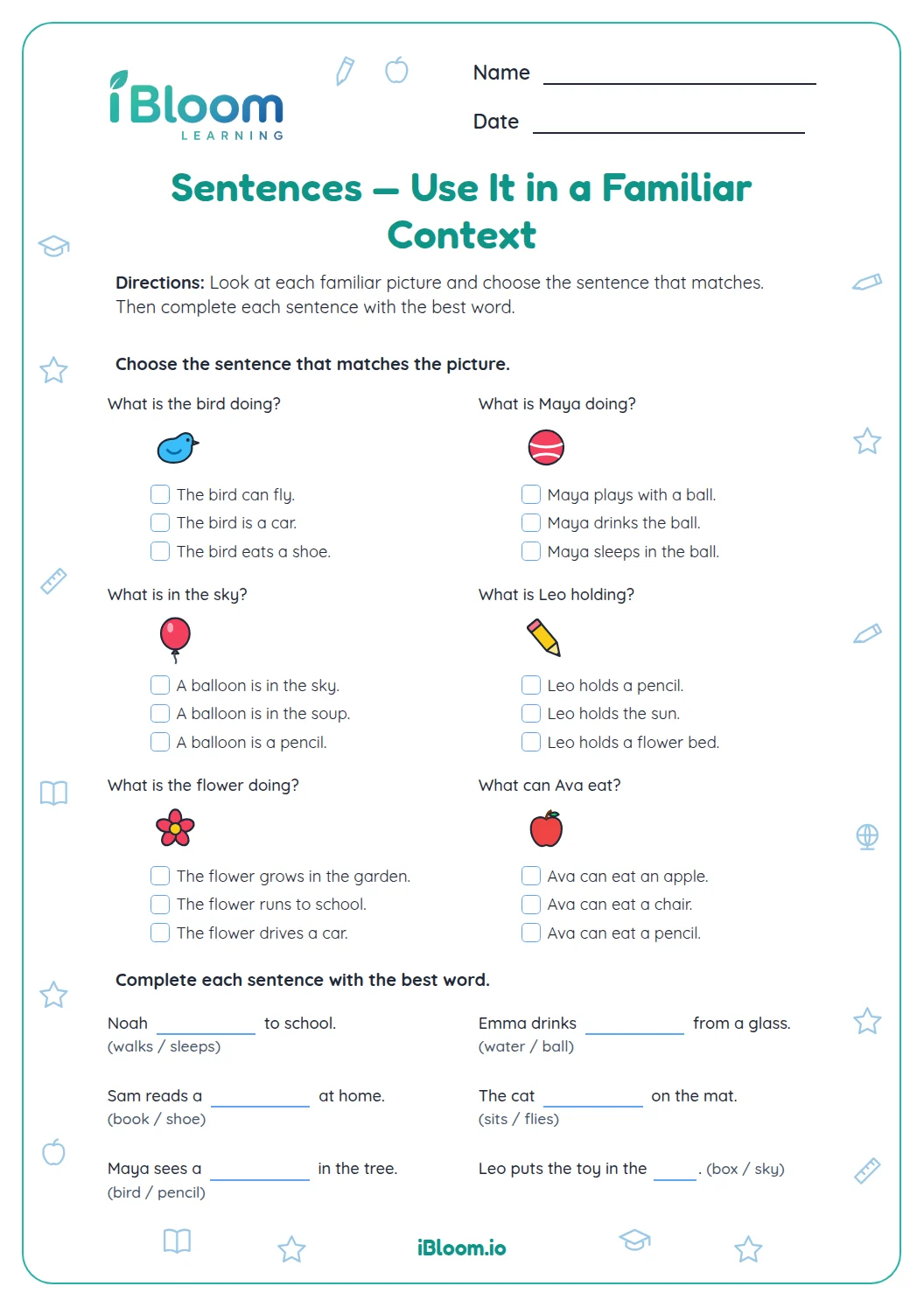

About this worksheet
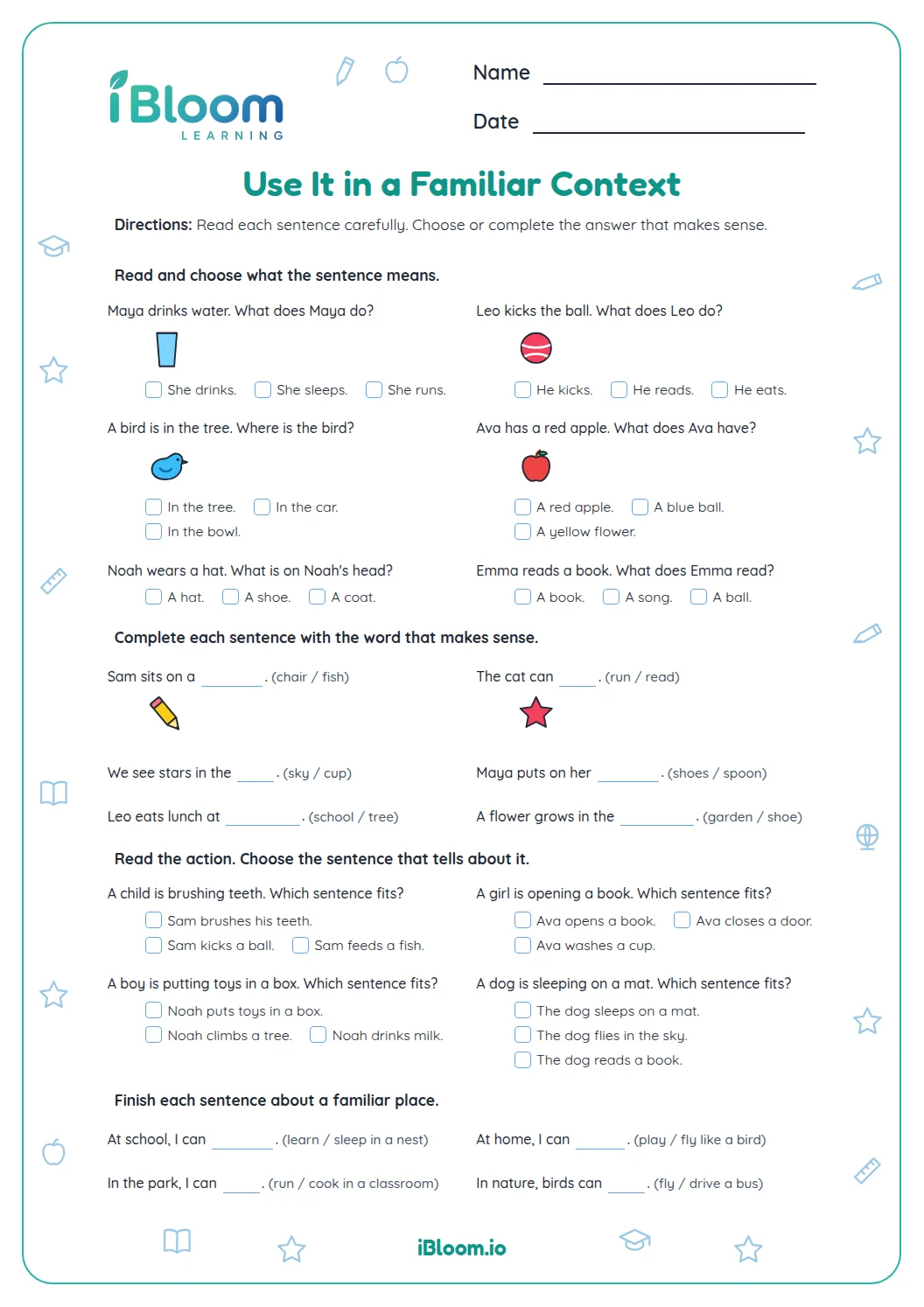
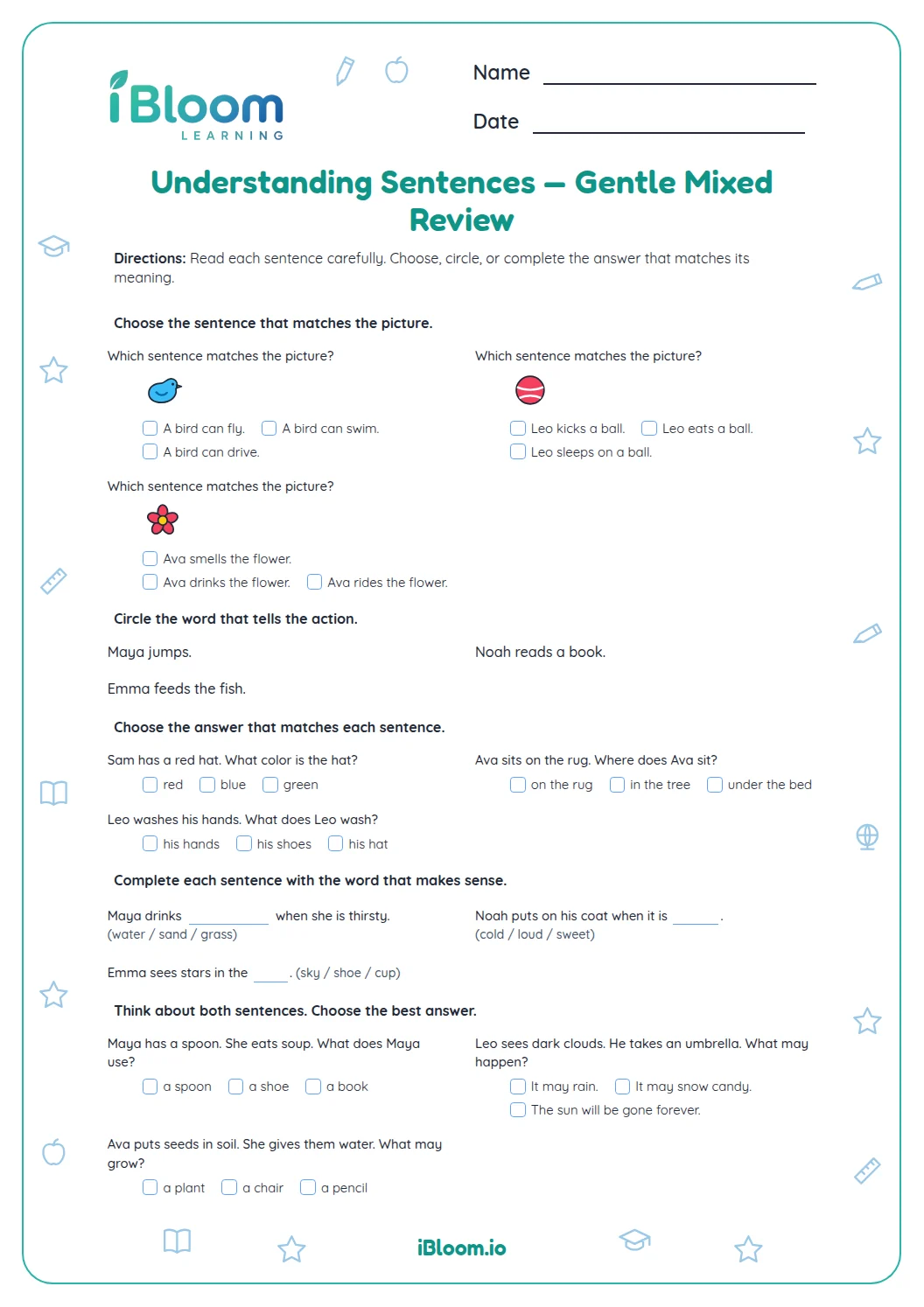
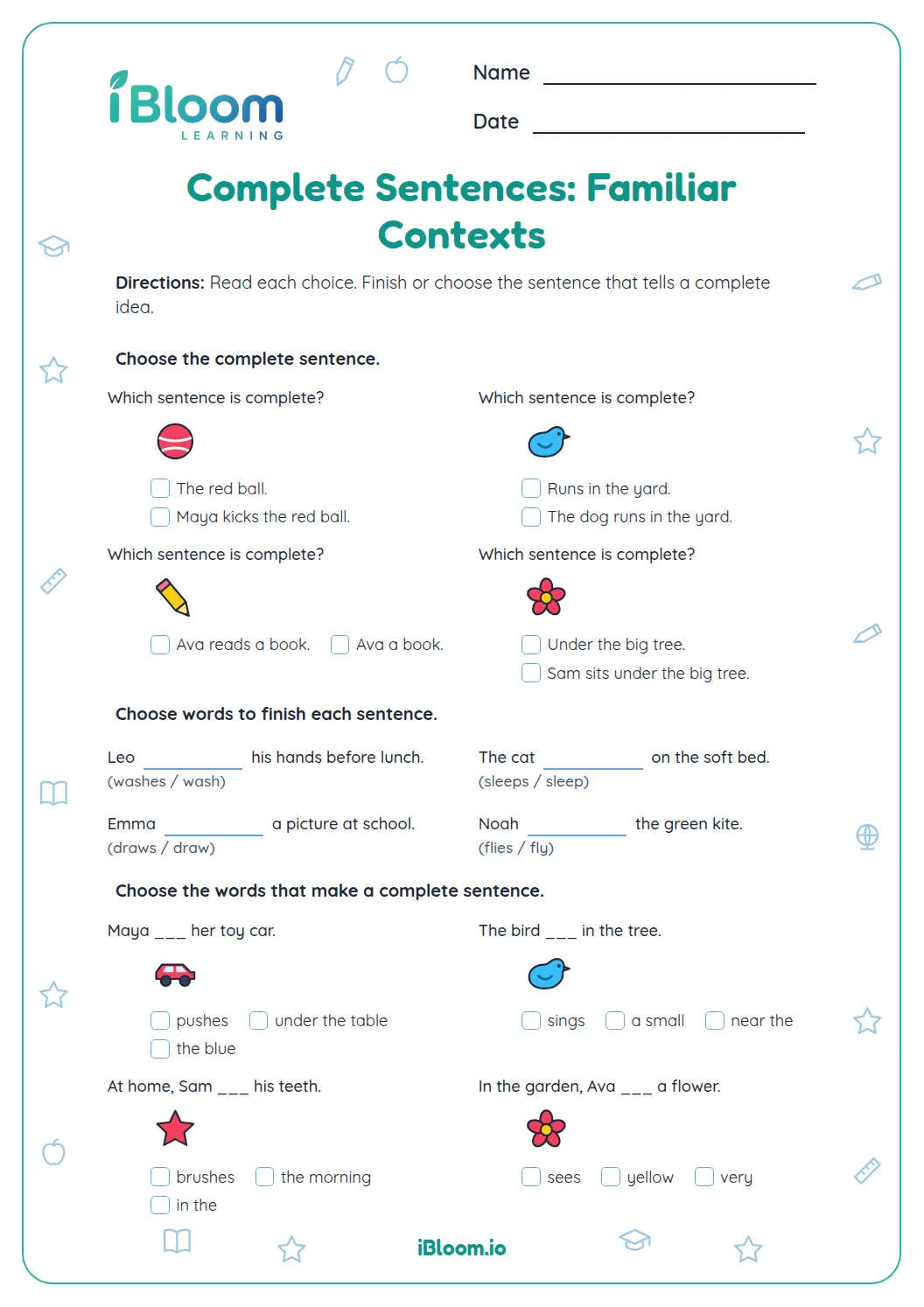
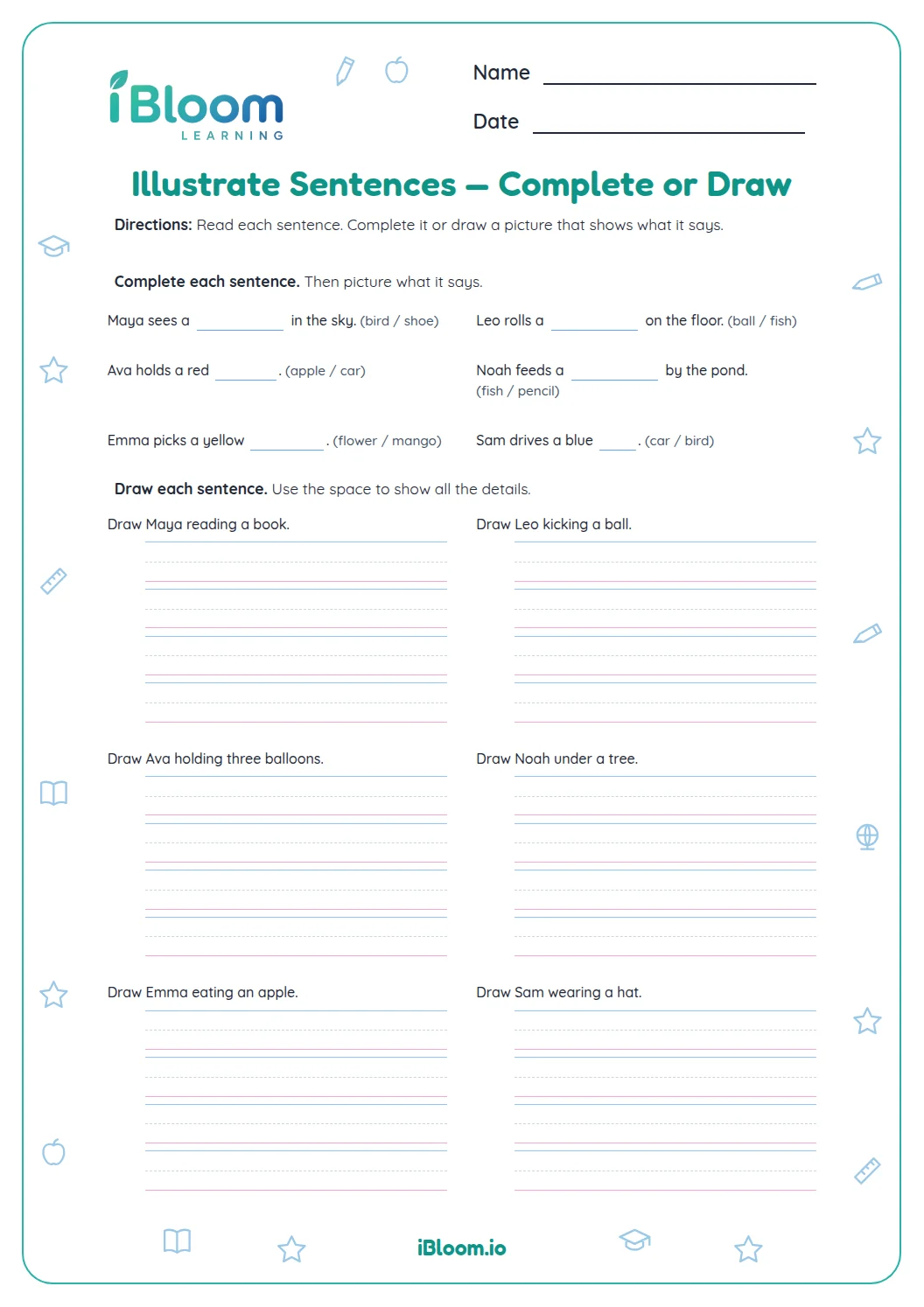
This printable gives Preschool and Kindergarten learners two ways to show they understand a simple sentence. In Part A, children choose a picture that completes a sentence. In Part B, they draw the people, objects and positions named in each sentence, such as a bird on a tree or a car under a cloud. The answer key shows the picture choices and describes what an acceptable drawing includes. These activities support early language comprehension and the ability to use sentence context.
How do picture choices help with sentence meaning?
The sentence gives clues about the object and what is happening. A child can listen to or read the sentence, compare the two pictures, and select the one that fits all the words.
Part A uses familiar objects and actions, such as reading a book or kicking a ball.
- 1“Leo kicks the ___.” Choose the ball because it can be kicked in this sentence.
What should a sentence drawing include?
A drawing should show the objects and the relationships named by the words. Position words matter: “under,” “beside,” “next to,” and “above” tell where to place things.
Part B asks children to draw one clear scene for each sentence.
- 1For “Draw a car under a cloud,” show both a car and a cloud, with the car lower than the cloud.
How can an adult support a young reader?
Read the sentence aloud once, then invite the child to point to each important word or repeat the sentence. After the child chooses or draws, ask them to tell how the response matches the words.
The goal is to connect language with a complete idea, not to make a detailed or polished picture.
- 1Ask, “What must be in your picture? Where should it go?”
How to use this worksheet
- 1Read each sentence aloud if the child is not yet reading independently.
- 2In Part A, name both picture choices and decide which one fits the entire sentence.
- 3In Part B, listen for the object words and the position words before drawing.
- 4Invite the child to describe how the drawing matches the sentence.
- 5Check Part A with the answer key; accept clear drawings that show all named details.
Common mistakes and quick fixes
The mistake
Choosing an object that fits only one word.
The fix
Reread the whole sentence and check every clue.
The mistake
Leaving out a position word such as “under.”
The fix
Point to the position word and place objects accordingly.
The mistake
Thinking a drawing needs to look realistic.
The fix
Look for the named objects and their correct relationship.
What to practice next
Make more practice
Further reading
Questions parents and teachers ask
Can an adult read the sentences aloud?
Yes. The child can listen, choose a matching picture, and explain the choice. Reading aloud keeps the activity focused on understanding what the sentence says while the child is still developing independent reading. You can pause after each sentence so the child can name its clues.
What counts as a correct drawing?
A correct drawing clearly includes the named objects and their relationship. For “a bird on a tree,” for example, the bird should be on or perched on the tree. Artistic detail, color choice and spelling are not the focus.
Why are there both picture choices and drawing prompts?
The two parts let children show understanding in different ways. Picture choices offer familiar objects, while drawing asks children to hold the sentence in mind and represent details, including position words. Talk about what each word contributes before the child begins.
Should my child write a sentence under each drawing?
No sentence writing is required. Ask the child to tell you what the drawing shows if you want to hear their thinking. The response space is for the drawing itself, and the key describes the idea each picture should communicate.
What does “under” or “above” mean in a drawing?
These words describe where one object is compared with another. “Under” means lower than; “above” means higher than. Have the child point to those words and then place the objects in the same relationship on the page. A simple sketch is enough to communicate the idea.