





About this worksheet
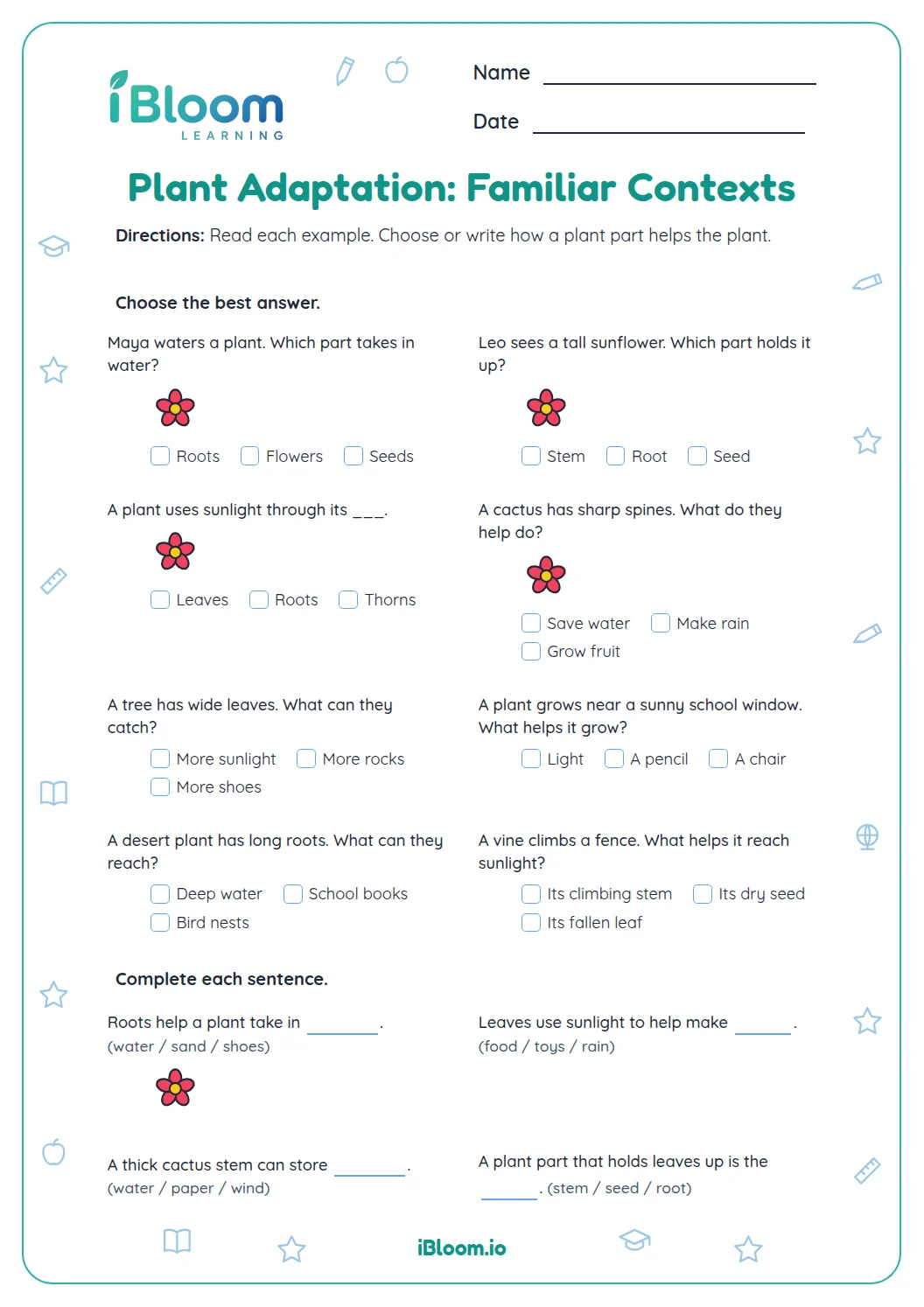
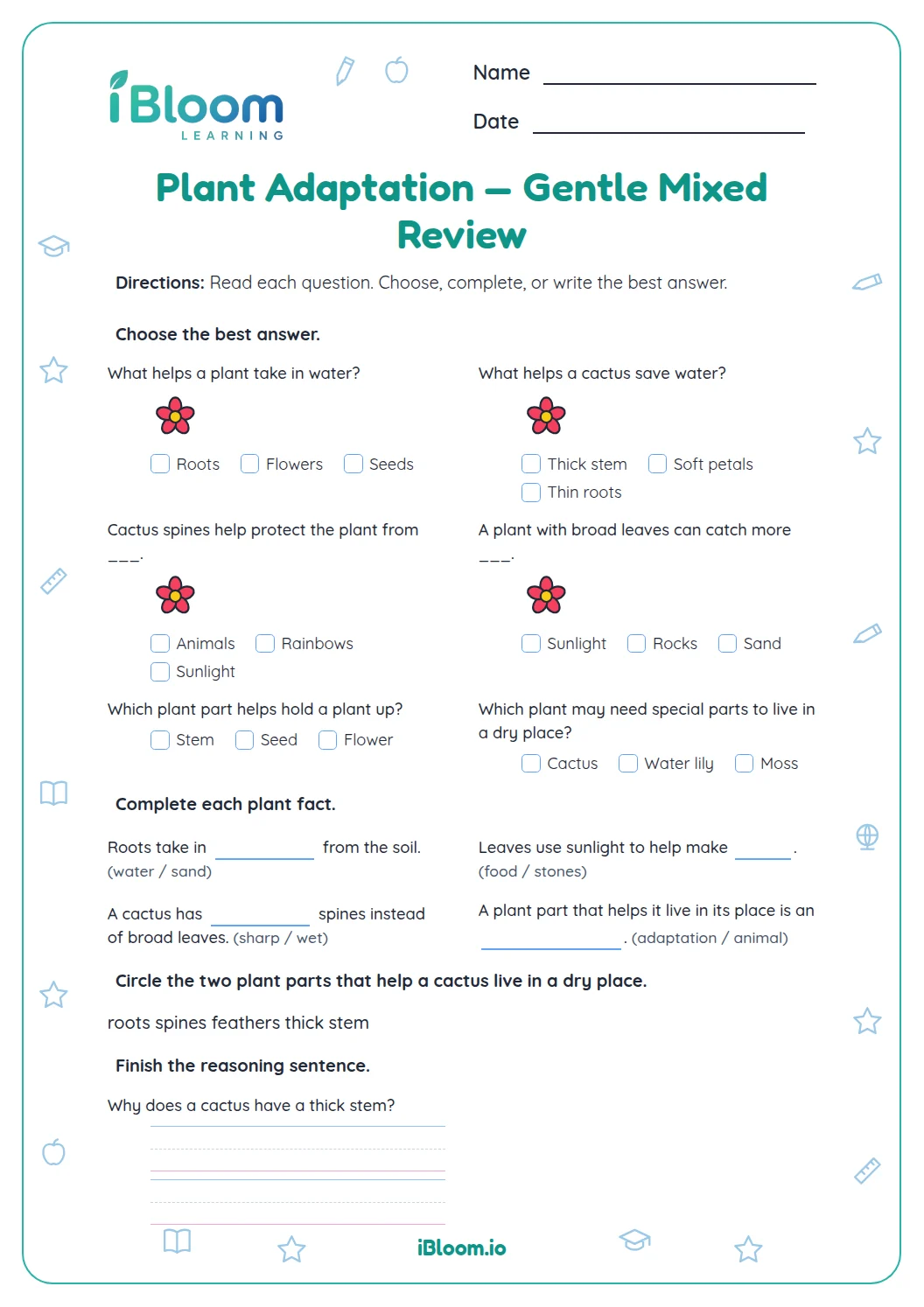
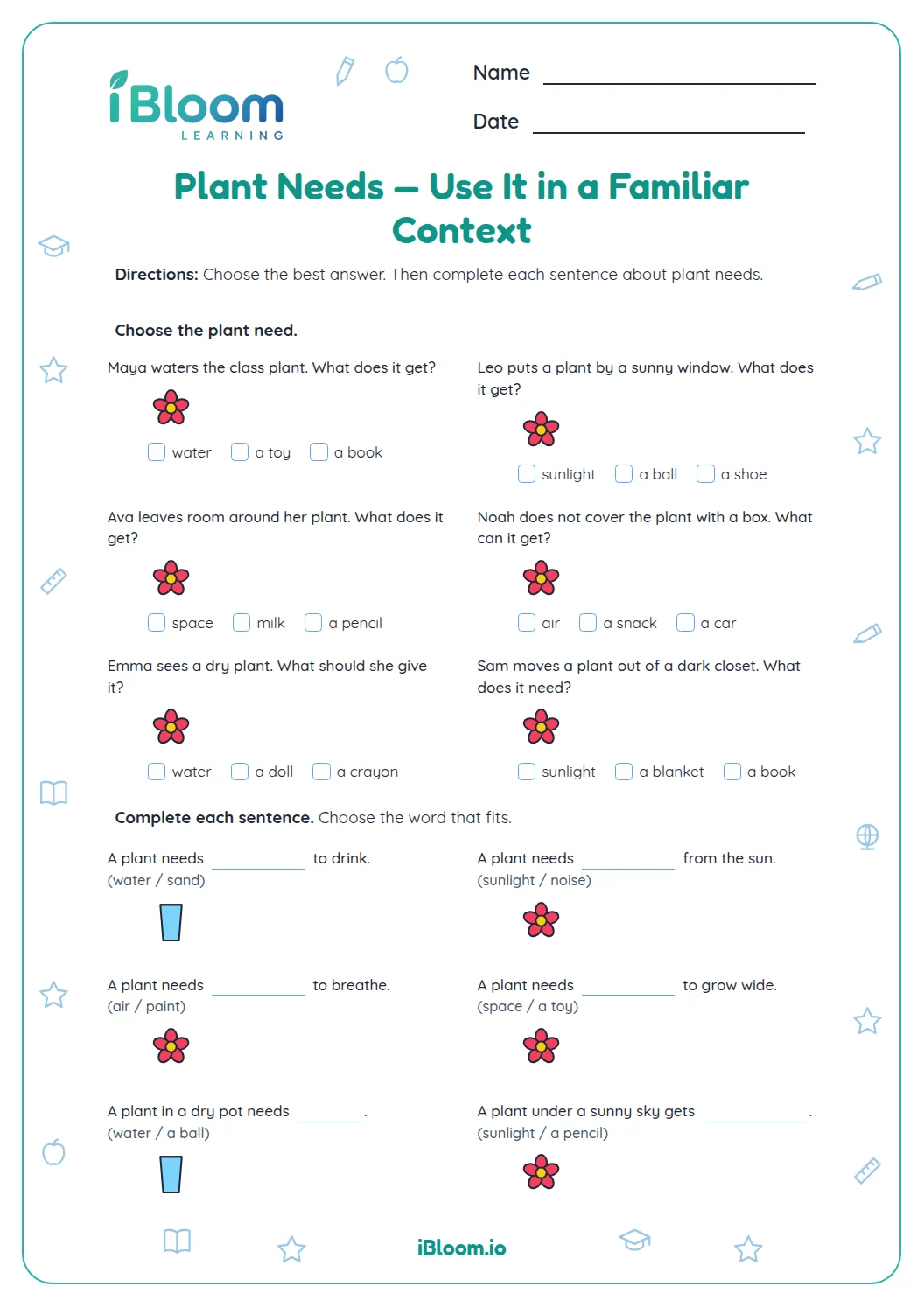
Young learners compare familiar plant features and connect them to what a plant needs or where it grows. Thirteen picture activities invite children to circle or point to cactus spines, leaves, a seedling, and other features. A final drawing prompt asks them to add roots and leaves to a young plant. The worksheet is labeled as science because plant adaptation is a life-science topic.
Aligned to K-LS1-1
What is on this worksheet?
Ten short items ask children to choose words about roots, sunlight, spines, stems, and leaves. Four final prompts use plant pictures as drawing starters for spines, floating leaves, roots, and a thick stem.
- Choose a word to finish each plant fact (1–10).
- Use each plant picture as a starting point for a drawing (11–14).
- The key gives a sample feature to look for in each drawing.
How can young children understand plant adaptations?
Begin with a feature children can see, then connect it to a simple job. Roots take in water from soil, leaves use sunlight, and a cactus stem stores water. Spines may help protect a cactus. The worksheet asks children to notice these examples and show a few features in drawings.
- Point to the feature in a picture or real plant.
- Connect one feature to one helpful job.
- Accept a simple drawing when the feature is clear.
What can a child draw for each plant feature?
The picture prompts give a starting point for each drawing. Look for cactus spines, broad leaves resting on water, roots extending into soil, or a thick cactus stem. The key gives a sample, while a child’s drawing may look different and still show the named feature.
How to use this worksheet
- 1Read the two word choices and say each one aloud.
- 2Choose the word that completes the plant fact.
- 3Look at the plant picture before beginning each drawing.
- 4Add the named feature so another person can recognize it.
- 5Use the key to talk about how the feature helps the plant.
Common mix-ups and quick fixes
The mistake
Saying leaves take water from the soil.
The fix
Trace the idea from soil to roots: roots take in water, while leaves catch light.
The mistake
Thinking cactus spines store the water.
The fix
Point to the thick stem as the water-storing part; spines can help protect the plant.
The mistake
Expecting every plant to have the same leaves or roots.
The fix
Compare features and ask how each could help in that plant’s surroundings.
Curriculum alignment
The activity practices the skill named in its title. The standard below describes the closest Common Core connection.
Use observations to describe patterns of what plants and animals need to survive.
On this sheet: Children observe examples of roots, leaves, stems, and spines and connect plant features with water, sunlight, or protection.
Show the official wordingHide the official wording
Use observations to describe patterns of what plants and animals (including humans) need to survive.
What to practice next
Make more practice
Questions parents and teachers ask
What plant ideas does this worksheet cover?
Children choose words about roots, sunlight, leaves, stems, and spines, then draw four plant features. The prompts connect what a plant part looks like with a simple role, such as roots taking in water or a thick cactus stem storing it.
Do children need to write full sentences?
No. The first ten items ask children to choose a word from two options. An adult can read the short sentence aloud, and the child can point to or say the word that completes the plant fact. Picture starters support the final drawings.
What should the drawings include?
The four drawing prompts ask for cactus spines, broad water lily leaves floating on water, roots reaching into soil, and a thick cactus stem. The plant pictures offer a starting point. The key lists a sample feature for each prompt.
How can I help a preschooler use the worksheet?
Read one item at a time and let the child point to the two choices. Ask what the plant part does in everyday words. For drawings, invite the child to add the named part while keeping the plant picture visible.
Is there one correct way to draw each feature?
No. The answer key gives a simple sample, not a required art style. A drawing is on target when the named part is recognizable, such as roots beneath the plant or spines on the cactus. Accept different shapes and colors.
What does the science connection describe?
The sheet invites children to observe plant features and connect them to needs such as water and sunlight. Adults can ask what the feature looks like and how it may help the plant. The drawing prompts make those visible examples concrete.