






About this worksheet
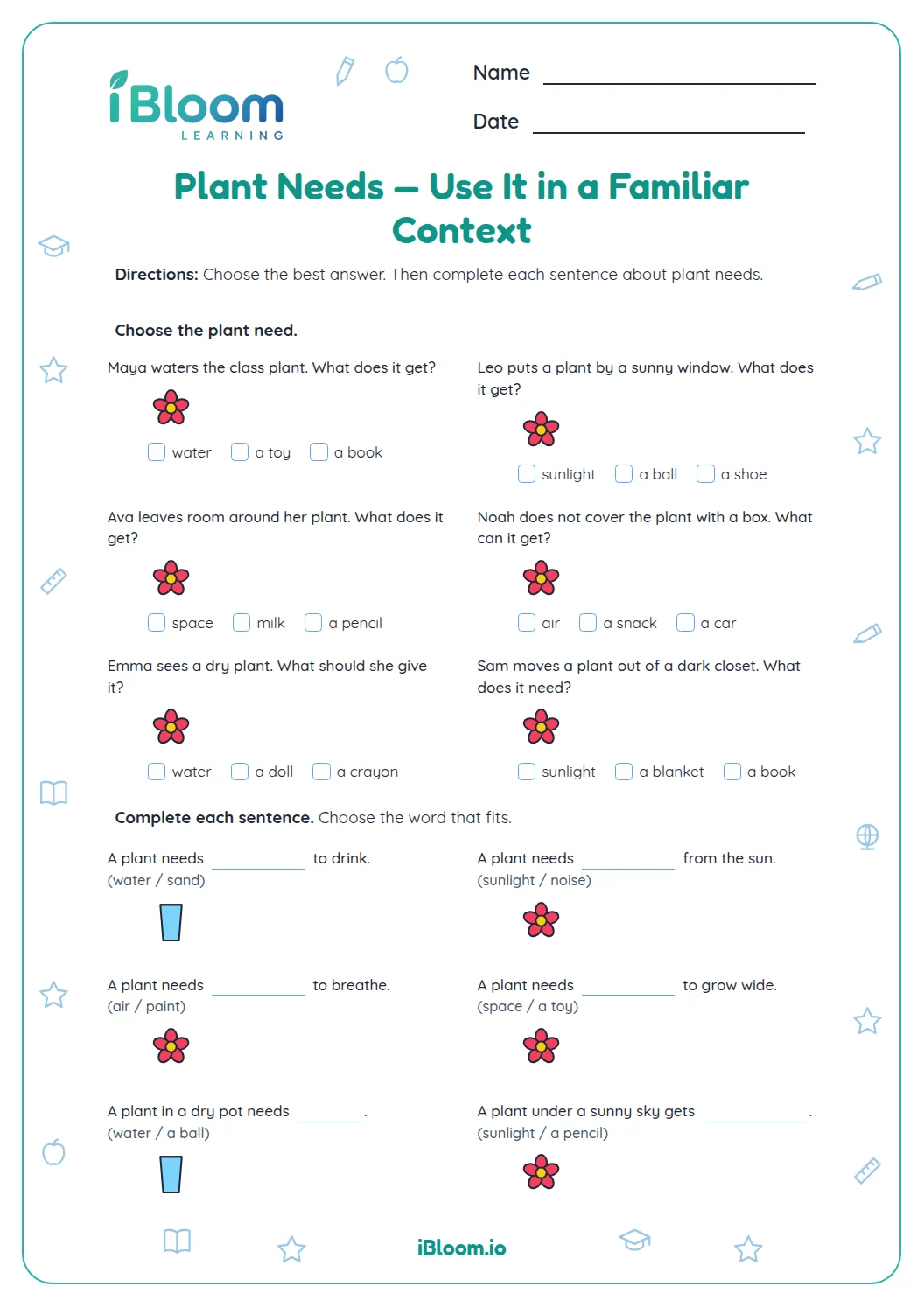
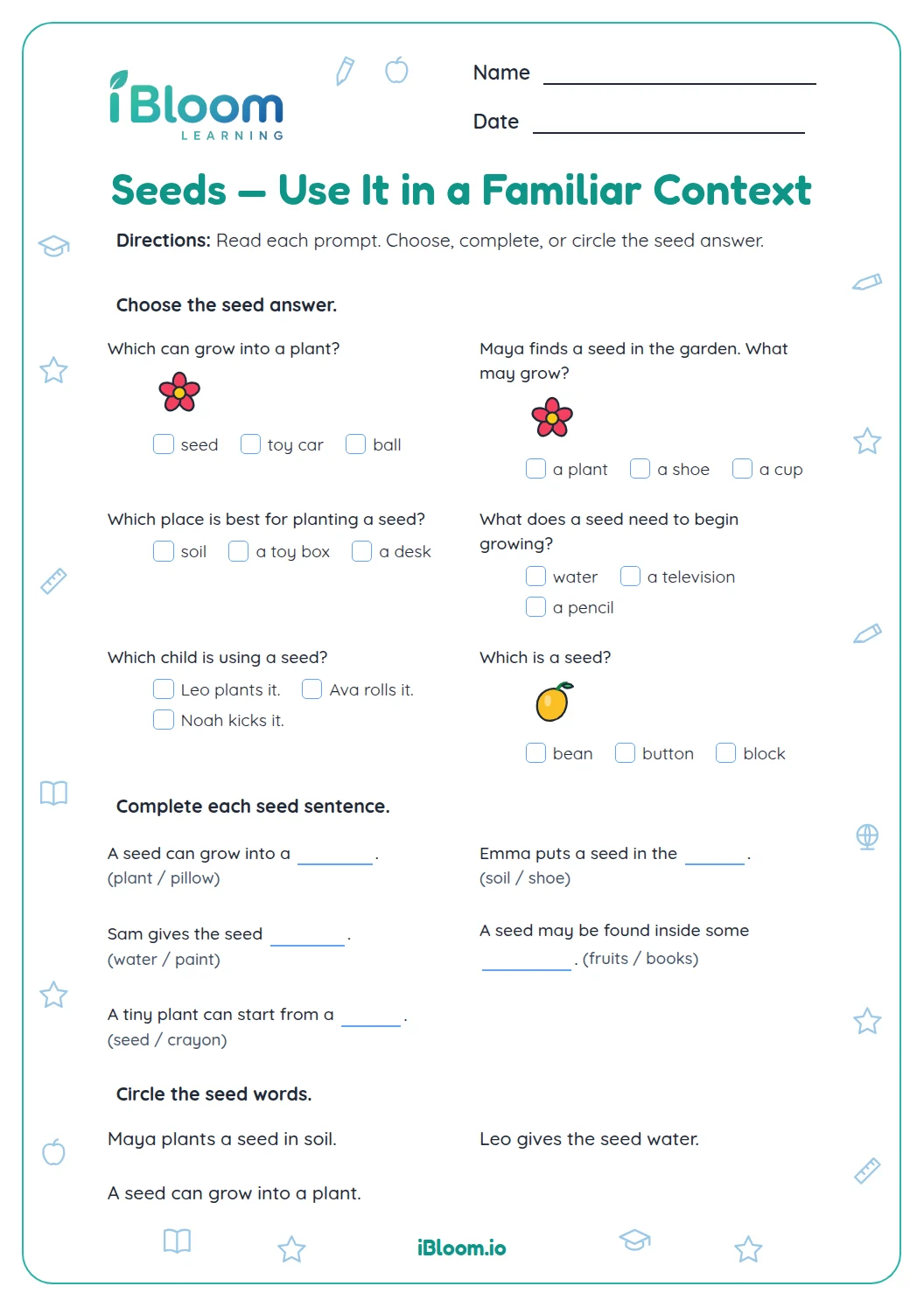
This preschool and kindergarten printable introduces roots, stems, leaves, flowers, and seeds. Children identify parts from picture choices, count familiar plant pictures, draw a plant with named parts, and complete simple sentences. The varied activities replace the old sheet’s unsupported picture task with pictures and drawing prompts the worksheet template can print. A separate answer key describes the expected responses.
Aligned to K-LS1-1
What plant parts will children see?
The worksheet names roots, stems, leaves, flowers, and seeds. Picture choices and simple sentence clues help children connect each name with a familiar job.
- Part A: identify parts from picture choices
- Part B: count plant pictures
- Part C: draw parts and finish simple ideas
How can a child remember what roots do?
Roots are usually below the soil and take in water. A child can draw roots under the ground line to remember where they grow.
- 1“Draw a plant with a root, a stem, and two leaves.”
- 2A good drawing includes all three named parts.
How can adults talk about a plant drawing?
Ask the learner to point to each part and name it. Invite the child to describe one job, such as roots taking in water or a stem holding leaves up.
How to use this worksheet
- 1Look at the plant picture choices and name familiar parts.
- 2Count each group by pointing to every picture once.
- 3For drawing prompts, check that each named part appears.
- 4Read the short plant statements aloud if needed.
- 5Use the answer key as a guide; drawings can look different and still be correct.
Plant-part mix-ups to watch for
The mistake
Putting roots above the soil in a plant drawing.
The fix
Draw roots under the soil line and the stem above it.
The mistake
Calling a seed a flower.
The fix
A seed can grow into a plant; a flower is a part of a grown plant.
The mistake
Leaving a named part out of a drawing.
The fix
Repeat the prompt and check each named item one by one.
Next Generation Science Standards connection
Children observe roots as they describe a need of living plants.
Children connect roots taking in water with a need of living plants.
On this sheet: Children name roots as the part that takes in water.
Show the official wordingHide the official wording
Use observations to describe patterns of what plants and animals (including humans) need to survive.
What to practice next
Make more practice
Further reading
Questions parents and teachers ask
Which parts are included?
The worksheet introduces roots, stems, leaves, flowers, and seeds. Children see those words in picture choices, a drawing prompt, and short fill-in sentences. The activities build useful science vocabulary, connect each name with a familiar plant part, and support simple observation.
Are drawing answers graded exactly?
A drawing can look different and still show the named parts. The key gives a short description of what should appear, such as roots below the ground and leaves on a stem. Adults can accept clear child-made pictures.
How do counting pictures help?
Counting gives young learners a concrete way to look closely at plant pictures. They point to each picture once and connect the final count with a spoken or written number. The groups use familiar pictures rather than abstract symbols.
Can I read the page aloud?
Yes. Adults can read prompts aloud, name the picture choices, or ask the child to point to each plant part. The child can still make the choices and drawings, building familiarity with science words and practicing observation together.
What is the main idea for children?
Different parts of a plant have different jobs. Roots take in water, stems hold parts up, leaves help the plant make food, flowers can make seeds, and seeds can grow into plants. The page introduces these ideas simply.