






About this worksheet
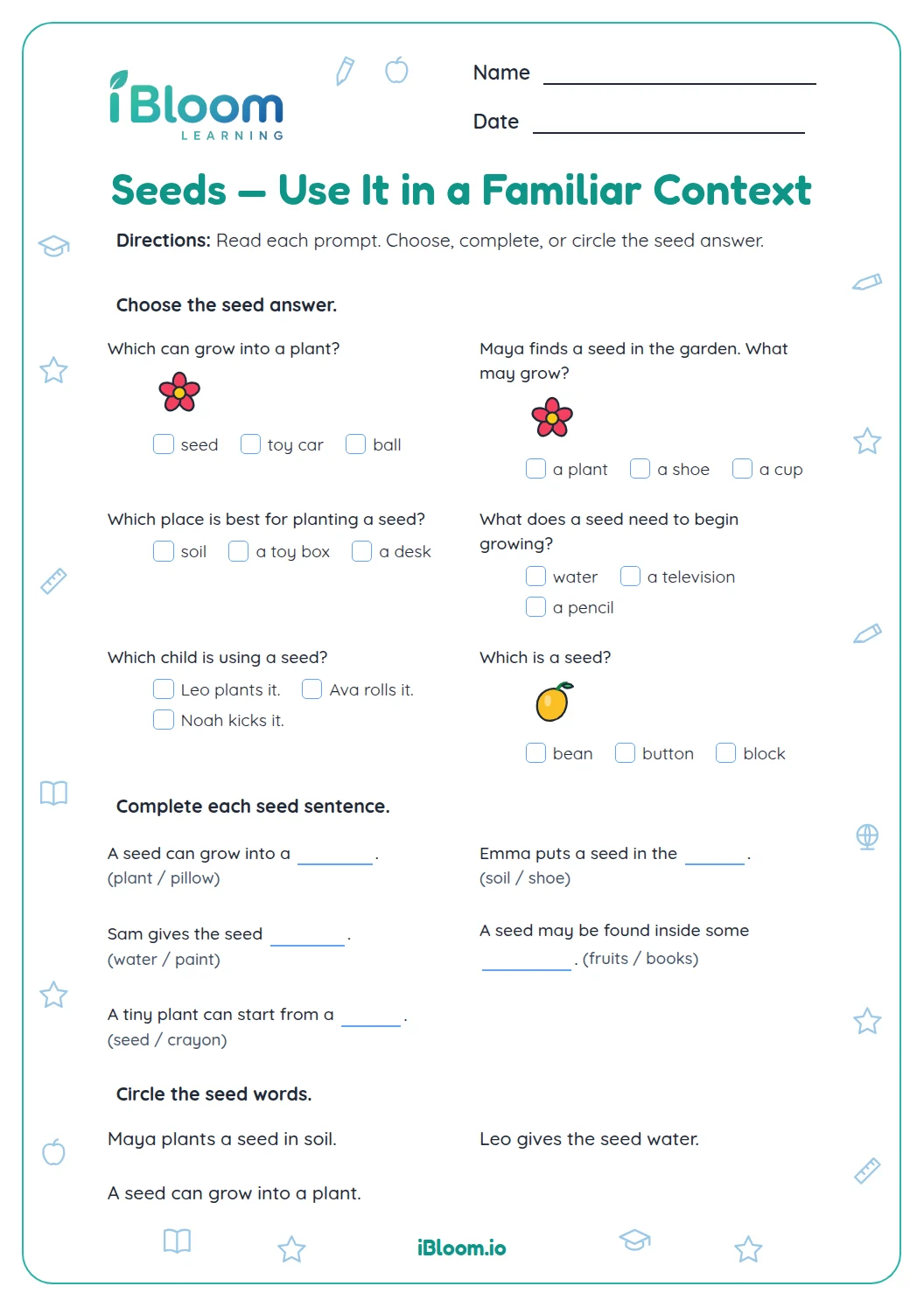
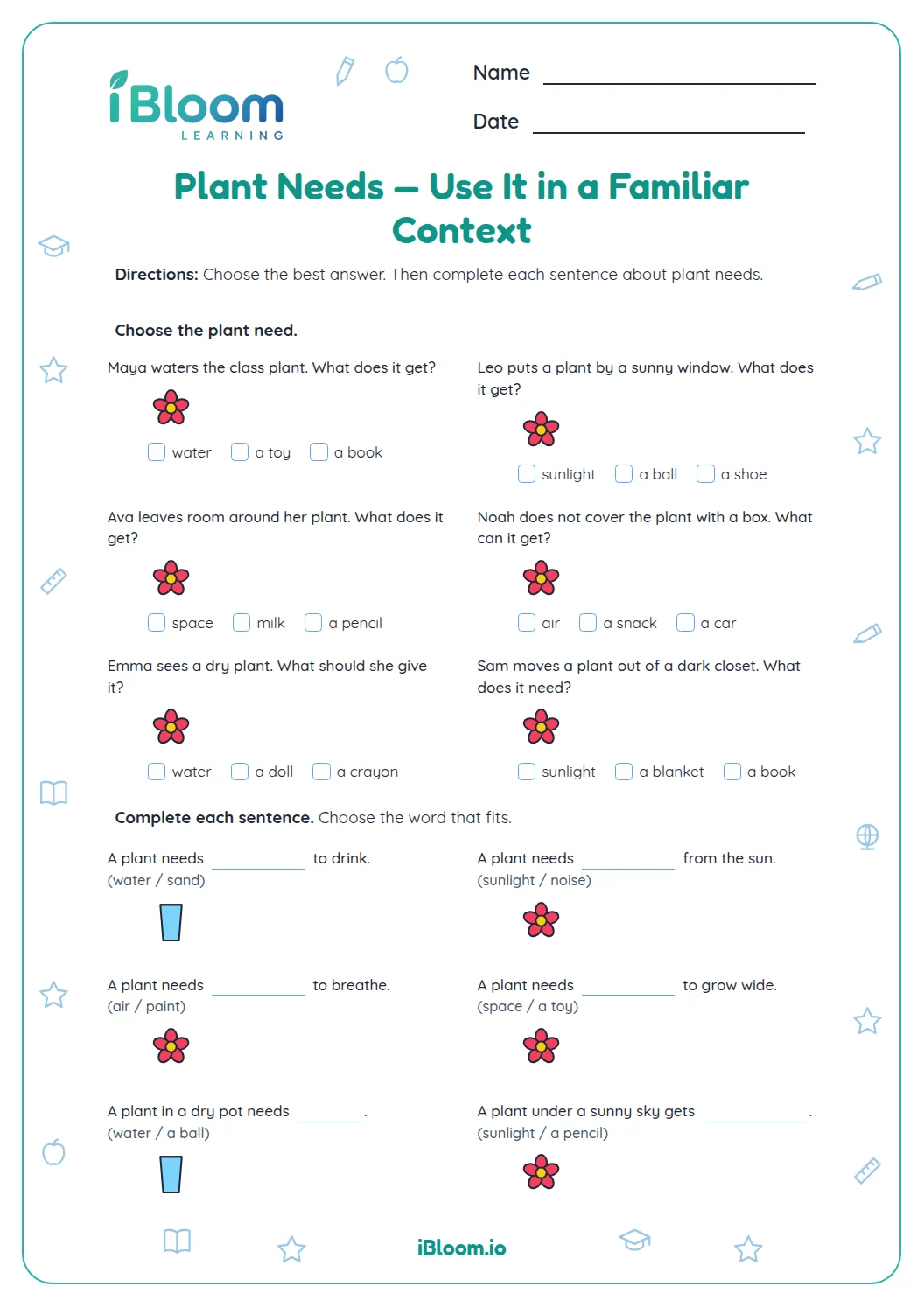
This free printable is for preschool and kindergarten learners exploring seeds and young plants. Children identify seeds and plants in picture choices, finish simple ideas about what helps plants grow, and identify a young plant. The sheet uses familiar pictures and short prompts so an adult can read aloud as needed. The answer key gives picture-choice answers and sample responses for picture activity.
What will children do on the sheet?
Part A uses four picture choices to identify a young plant, a fruit with seeds, what a seed can grow into, and what can help it begin growing. Part B has nine short completions about seeds and plant growth. Part C asks children to point to a young plant among two familiar pictures. An adult can read prompts aloud and help children mark or say an answer.
An adult can read each question aloud and let a child point before writing. The pictures keep early questions accessible while the later prompts invite a child to connect seeds with growing plants.
- Choose from four seed and plant picture questions
- Finish nine brief science ideas
- Point to a young plant in the final picture activity
What does a seed need to grow?
Children connect a seed with water and a young plant with light. The worksheet keeps the science language simple: a seed may begin growing with water, and plants need water and light as they live and grow.
- 1Read: “A seed needs ___ to begin growing.”
- 2Choose water as the missing word.
- 3Read the completed idea aloud: “A seed needs water to begin growing.”
What does the picture activity ask?
The final item asks children to point to the growing plant in a pair of pictures. The seedling is the young plant; the apple is a fruit that may contain seeds. Invite children to say what they noticed about the seedling.
How to use this worksheet
- 1Read the prompt aloud and let the child study the pictures.
- 2For picture choices, have the child point first and then mark the answer.
- 3Read the whole sentence after the missing word is written.
- 4Ask the child to explain one way a seed can become a plant.
- 5Use the key for fixed answers and discuss why a seedling is a growing plant.
Common mistakes and quick fixes
The mistake
Calling every pictured object a plant.
The fix
Ask whether it grows and has plant parts, or whether it is an object such as a ball.
The mistake
Saying a seed needs food like an animal.
The fix
Point to the water and light examples and explain that plants make their own food.
The mistake
Choosing a fruit instead of a young plant in the final picture pair.
The fix
Ask which picture shows a plant that is still growing: the seedling, not the apple.
What to practice next
Make more practice
Questions parents and teachers ask
What ages is this seed worksheet for?
It is designed for preschool and kindergarten learners. An adult can read the prompts aloud, and children can answer by pointing, speaking, or writing a word. The first four questions use familiar pictures, while the next nine invite short answers about seeds and growing plants.
What will children learn about seeds?
Children connect seeds with growing plants and identify water and light as plant needs. They use familiar pictures and short prompts to describe what a seed may become and what can help a plant grow. An adult can extend the conversation by asking what the child notices about a seedling.
Can an adult read the questions aloud?
Yes. Reading each question aloud is a good fit for early learners who are still building reading skills. Pause to name the pictured objects, let the child point to an answer, and then help them mark or write it. The answer key supports checking without requiring a child to read independently.
Are there picture activity?
Yes. The last item shows a seedling and an apple and asks children to point to the growing plant. The seedling is the correct choice. An adult can invite the child to describe one visible feature, such as its stem or leaves.
What does the answer key include?
The separate key lists the correct picture choice for each fixed-answer item, the missing words for all nine sentence completions, and a note identifying the seedling in the final activity. Use it to check the science idea while letting children explain their thinking in their own words.