







About this worksheet
This free printable preschool–kindergarten science worksheet uses familiar picture choices to explore living things and their needs. Part A asks children to spot living things in a yard, home, garden, and park. Part B connects everyday observations—drinking, eating, and growing—with needs such as water and food. Part C asks children to notice shared needs and return to familiar examples. The 16 picture questions can be read aloud, with an adult naming the choices when helpful.
Aligned to K-LS1-1
How do children recognize a living thing?
Living things grow and have needs. The tree, cat, sunflower, and bird in Part A are living things. The rock, chair, bucket, bicycle, and shoe are nonliving objects.
Ask children to think about what each choice needs to stay alive. A bicycle can move when someone rides it, but that movement alone does not make it living. A tree stays rooted yet grows and needs water and light.
How do the observations help children find an answer?
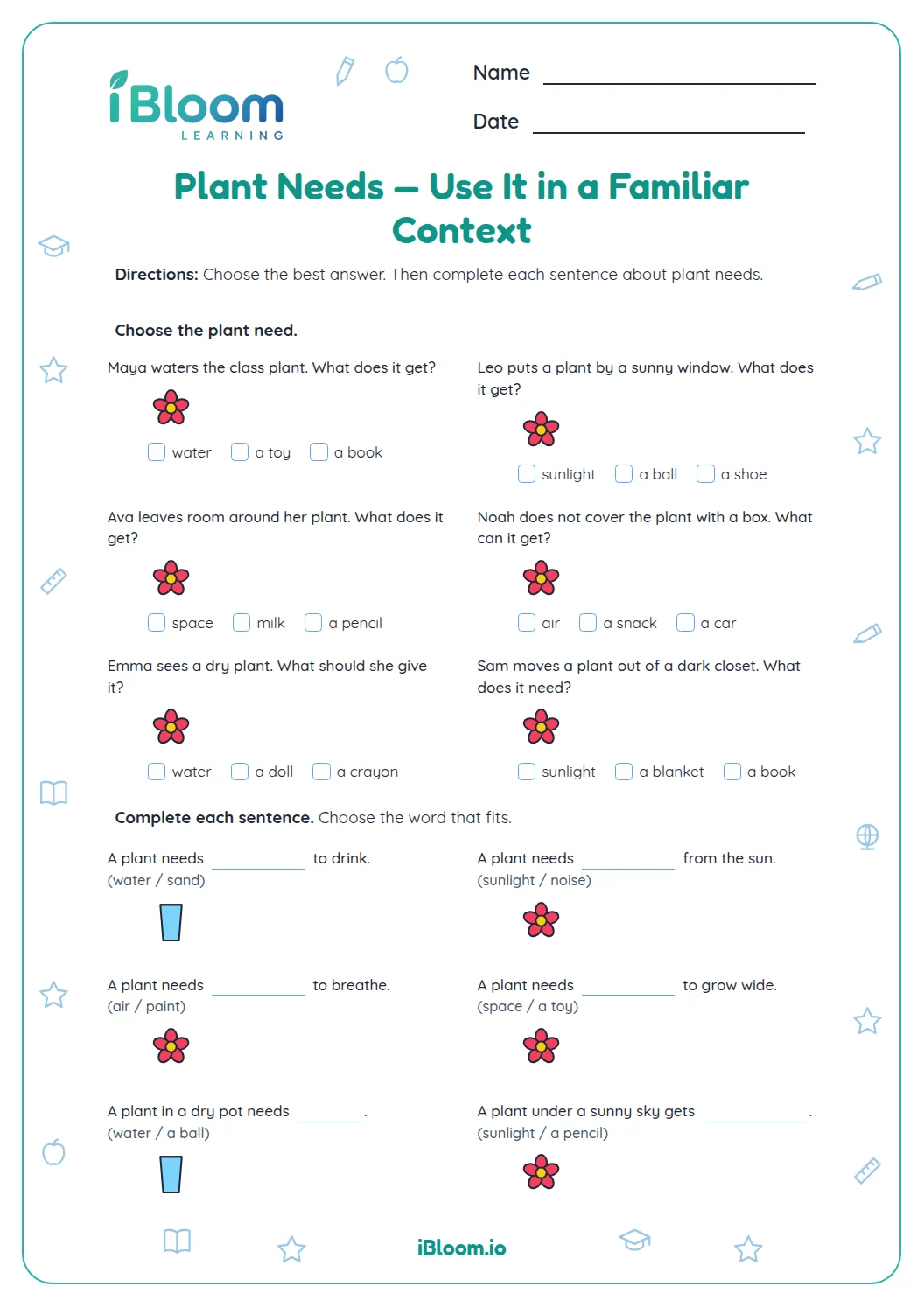
Part B uses short familiar events: a dog drinks, a rabbit eats, a child drinks, and a seedling grows after watering. Later questions extend these observations to a flower, a bird finding food, and a cat and child sharing a need.
The pictures make choosing possible for a child who is still learning to read. Read the whole prompt first, name the two picture choices if needed, and let the child decide.
- 1A dog drinks from its bowl.
- 2Drinking gives the dog water.
- 3Circle the water picture, then say “The dog needs water.”
What pattern connects the dog and the seedling?
Water is one shared need for plants, animals, and people. The page also asks children to connect sunlight with plant growth and food with animals. Ask for an example from home or outside after checking the picture answers.
After checking the key, invite a child to name another living thing that needs water. A pet, a person, or a plant is a useful example. Keep the conversation grounded in things the child has seen.
How to use this worksheet
- 1Read the Part A direction aloud and name the two pictures in question 1.
- 2Have the child choose a living thing in each familiar place.
- 3Read each Part B observation and ask what the living thing receives.
- 4Before question 9, revisit the dog drinking and the seedling being watered.
- 5Check the picture choices with the key and ask for one more living thing that needs water.
Mistakes to notice and fix
The mistake
Calling the bicycle living because it moves.
The fix
Compare growth and needs: someone moves the bicycle, but it does not grow or drink.
The mistake
Calling the tree nonliving because it stays in one place.
The fix
Talk about a tree growing new leaves and taking in water.
The mistake
Choosing a ball as a dog’s need in the drinking question.
The fix
Reread “drinks from its bowl” and connect drinking to water.
Curriculum alignment
Use the drinking and growing observations to identify shared needs for water and plant needs for light.
On this sheet: Parts B and C use observations about a dog, rabbit, child, and plants to identify needs and shared patterns.
Show the official wordingHide the official wording
Use observations to describe patterns of what plants and animals (including humans) need to survive.
What to practice next
Make more practice
Further reading
Questions parents and teachers ask
Can a preschooler use this worksheet without reading?
Yes. An adult can read each prompt aloud while the child chooses between picture answers. Name unfamiliar picture choices without giving away the answer. The familiar-place questions offer an easy start, and later examples connect drinking, eating, and growing with needs.
Are plants counted as living things here?
Yes. The tree, sunflower, and seedling are living things on this sheet. They grow and need water and light. A plant does not have to walk around to be alive. Use the garden questions to help children notice a living thing that stays in one place.
Why does a child appear in a question about animal needs?
People are animals and need water, just as the dog does. Question 7 describes a child drinking after playing, an experience young learners can connect with. Read it beside the dog question and ask what both are getting. The answer in both cases is water.
What is the answer to the shared-need question?
Water is the shared need in question 9: the dog drinks from a bowl, and the seedling receives water. Question 15 makes a second connection between a cat and child. Reread each short situation before checking the answer, then invite the child to point to the water picture.
How can we extend this activity at home?
Look for one living thing and one nonliving object near home. Ask how you know which is living, then talk about what it needs. A houseplant beside a chair works well for this conversation. Return to the worksheet’s plant examples to connect the observation with water and light.