


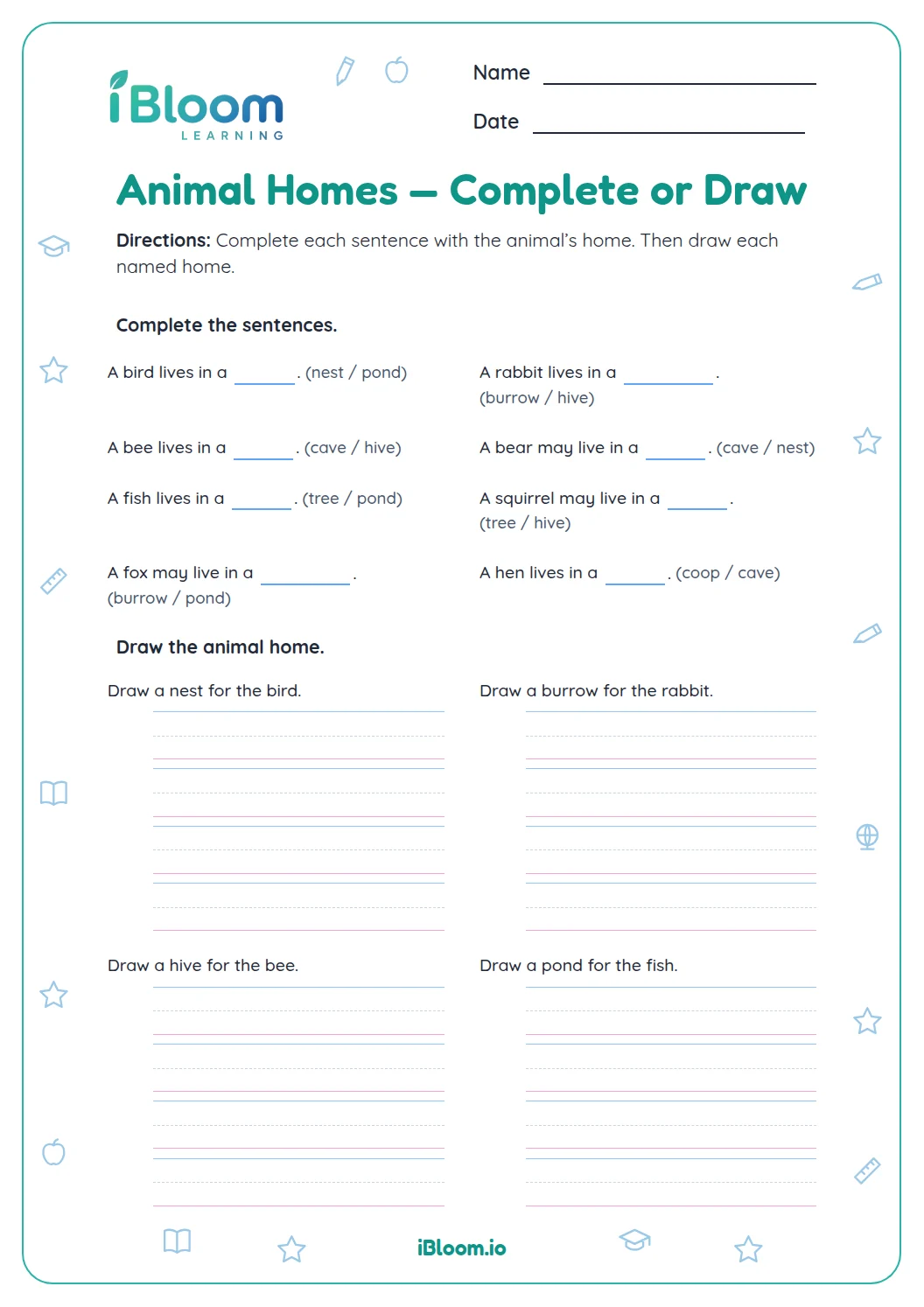


About this worksheet
This animal homes printable gives preschool and kindergarten learners practice matching familiar animals with places where they live. Picture clues show animals such as a bird, bee, rabbit, fox, fish, and spider. Children first choose a fitting home, then complete short sentences with home words. The key lists the intended matches and words. Adult support can help children name each picture and talk about how a home gives an animal a place to live.
How do picture clues support animal-home matching?
Part A shows an animal and two possible homes. Children name the animal, then choose the place that matches it.
How do children choose an animal’s home?
Part B asks children to match animals with homes, then choose a matching animal-home pair and name a home a bird makes.
Which home words appear?
The sentence completions use nest, hive, burrow, den, pond, and web. For example, “A spider makes a ___” is completed with “web.”
How to use this worksheet
- 1Name the animal shown in each clue.
- 2Say both home choices and pick the one that fits.
- 3Talk about how the animal uses its home as a place to live.
- 4Read each sentence and write the home word that completes it.
- 5For the last two questions, choose the animal-home pair or bird home that fits.
Helpful reminders
The mistake
Choosing a habitat that is familiar but does not match the animal.
The fix
Name the animal first, then recall the specific home word in the choices.
The mistake
Mixing a nest and a burrow.
The fix
A nest is built by birds; a burrow is a tunnel or hole used by animals such as rabbits.
The mistake
Writing the animal name in the blank instead of its home.
The fix
Read the sentence frame and ask what place completes it.
What to practice next
Make more practice
Questions parents and teachers ask
Which animal-home pairs are on the page?
The worksheet matches a bird with a nest, a bee with a hive, a rabbit with a burrow, a fox with a den, a fish with a pond, and a spider with a web. The last questions also ask children to recognize a fish-and-pond pair and a bird’s nest.
What ages is this animal homes page for?
It is intended for preschool and kindergarten learners. An adult can read the short questions aloud, help name the animal pictures, and invite the child to explain why a particular home fits. Children can point or answer orally before writing the home words.
Are there animal pictures on the worksheet?
Yes. Each matching question includes an animal picture clue. Children can use the image to identify the animal before choosing its home from two printed words, then apply the vocabulary again in sentence-completion questions later on the page.
What does the word “home” mean here?
Here, a home is a place an animal lives or makes a shelter. The examples include nests, hives, burrows, dens, ponds, and webs, with familiar animal matches for each. The worksheet practices matching animal names to these home words.
Can children answer orally instead of writing?
Yes. A young learner can point to or say the matching home while an adult records the answer. The later sentence-completion items also work as read-aloud practice before children are ready to write each word independently. This keeps the science vocabulary accessible.