






About this worksheet
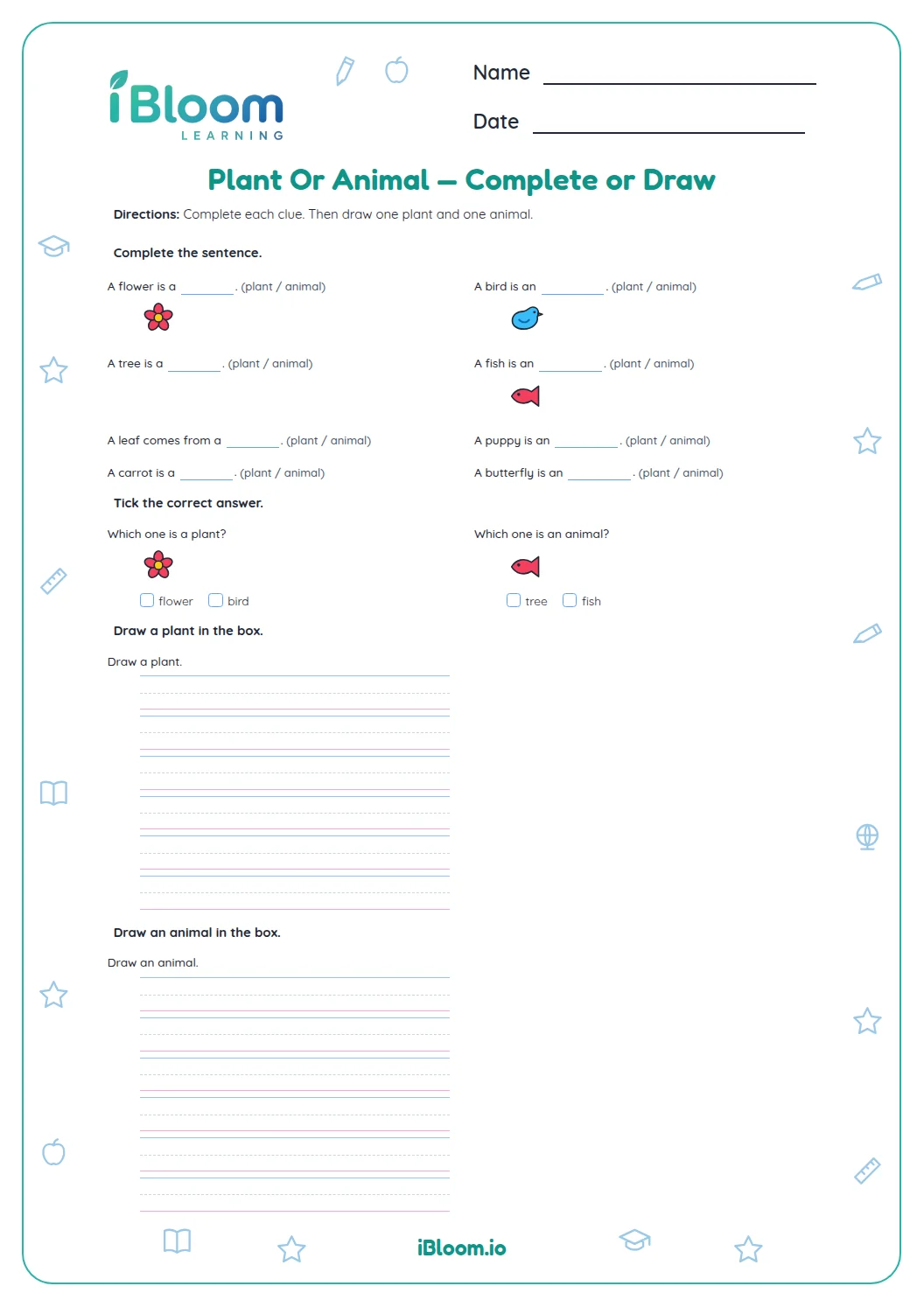
This free printable worksheet is for preschool–kindergarten learners practicing plant or animal classification. It includes 14 questions for picture choices and familiar plant-or-animal clues, followed by a separate answer key. Each section gives learners a clear way to apply the skill.
What does plant or animal classification practice?
Learners identify familiar plants and animals from pictures and short observations. The picture section builds recognition; the clue section asks children to use details such as growing from a seed or moving to find food.
How can a learner solve an item?
Read the whole prompt, identify the feature the question asks about, and check that the response fits the sentence or model.
- 1A tree is a plant.
- 2A cat is an animal.
- 3Use the living thing named in the prompt.
How is the printable organized?
The worksheet has 14 questions across 2 pages, followed by 2 answer-key pages. Its sections move from direct examples to applying the same skill in context.
How to use the worksheet
- 1Name each pictured living thing.
- 2Choose whether it is a plant or animal.
- 3Listen to each short observation.
- 4Use the clue to choose plant or animal.
- 5Review the answers with an adult.
Common mistakes and quick fixes
The mistake
Calling every outdoor living thing a plant.
The fix
Check whether the example is a plant or an animal.
The mistake
Choosing from the setting alone.
The fix
Use the living thing named in the sentence.
The mistake
Mixing up the two answer choices.
The fix
Say “plant” or “animal” aloud before marking it.
What to practice next
Make more practice
Questions parents and teachers ask
What does this plant or animal worksheet include?
This printable has 14 questions focused on pictured examples and familiar clues about living things. The prompts use the target skill in short, specific tasks, and the separate answer key lets an adult review responses after the learner finishes.
Can an adult read the directions aloud?
Yes. Read the directions and each prompt aloud if that helps the learner focus on the skill. Keep the printed words or pictures in view, and invite the learner to explain the clue or letter pattern that supports each answer.
When should we use the answer key?
Let the learner complete the questions first, then compare each response with the separate key. For a missed item, return to its sentence or model and identify the part that supports the answer. This gives you a specific point to review together.
Can we split the worksheet into shorter sessions?
Yes. There are 14 questions across 2 worksheet pages, so you can stop after a section and continue later. Keep the answer key nearby, but wait until the learner finishes a section before checking. This makes it easier to review one skill at a time.
How long should this practice take?
Plan for about 15 to 20 minutes, with extra time if the learner talks through choices, traces carefully, or writes slowly. The estimate is a flexible guide rather than a timer. Pause at a section break when the learner needs a rest, then return to the next set of questions.